Worked example
Read the two components
For , give and .
The Cartesian form is . The real part is the term without .
The imaginary part is the real coefficient of , so the two values are and .
Separate the two components, calculate in Cartesian form and use the conjugate to turn a complex denominator into a real one.
Try the quick check →Section 1 of 6 · Core · about 6 min
The definition extends the real numbers. Every complex number has a unique Cartesian form.
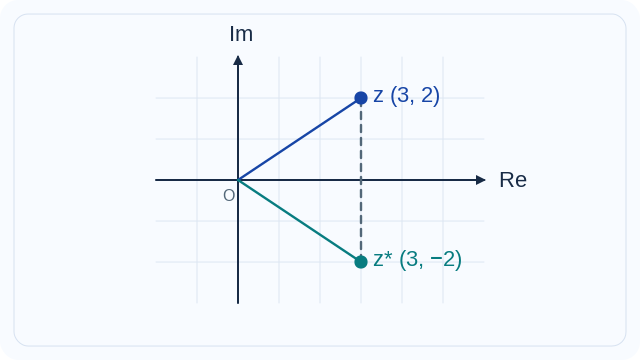
Conjugation keeps the horizontal position and changes the vertical sign.
Worked example
For , give and .
The Cartesian form is . The real part is the term without .
The imaginary part is the real coefficient of , so the two values are and .
Section 2 of 6 · Core · about 7 min
Adding a fixed complex number translates every point by the same two components. Subtracting translates by the opposite displacement.
Worked example
Calculate . Give the pair (real part, imaginary part).
Combine the real parts: .
Do the same for the imaginary parts: .
The result is .
Worked example
Calculate . Give the pair (real part, imaginary part).
Try it on paper first.
Combine the real parts: .
Do the same for the imaginary parts: .
The result is .
Section 3 of 6 · Core · about 7 min
Expand using the same distributive rule used for real algebra. The one new step is to simplify the product of the two imaginary terms.
Worked example
Multiply . Give the pair (real part, imaginary part).
Use all four terms. The product of the two imaginary terms is because .
The real part is .
The cross terms give imaginary part , so the product is .
Section 4 of 6 · Core · about 6 min
Reflect the point in the real axis. Its two imaginary components now cancel in a sum and its product has no imaginary cross term.
Worked example
For , give as (real part, imaginary part), then calculate .
Keep the real component and change the sign of the imaginary component. This gives .
The cross terms cancel in the product, leaving .
Here the product is .
Section 5 of 6 · Core · about 8 min
Divide by a real denominator after multiplying by a suitable form of one.
Worked example
Express as a (real part, imaginary part) pair.
Multiply numerator and denominator by . This keeps the ratio unchanged.
The denominator becomes and the numerator becomes .
Divide both components by to obtain .
Section 6 of 6 · Extension · about 6 min
Convert every term to Cartesian form, then compare the two real equations.
Worked example
Let , with real . If , find as a (real part, imaginary part) pair.
The left side is for weights .
Equate the real terms and imaginary coefficients: and .
Therefore .
Question 1 of 4
0 / 4 checked in this collection
Calculate . Give the pair (real part, imaginary part).
Progress stays in this browser. Create an account to save it or sign in.
Show your working on paper and compare it with the worked solution and marking guidance.
Your review plan starts after your first check.