Worked example
Find distance from the origin
Find the modulus of .
The two Cartesian components are and .
By Pythagoras the modulus is .
Find exact distances and directions, choose the correct quadrant and move between Cartesian and modulus–argument descriptions.
Try the quick check →Section 1 of 6 · Core · about 6 min
Plot the point on the Argand plane. Its two components are the signed horizontal and vertical displacements from the origin.
Worked example
Find the modulus of .
The two Cartesian components are and .
By Pythagoras the modulus is .
Section 2 of 6 · Core · about 8 min
A positive turn from the positive real axis is anticlockwise. Start by marking the signs of the coordinates, then find an acute reference angle if the point is off the axes.
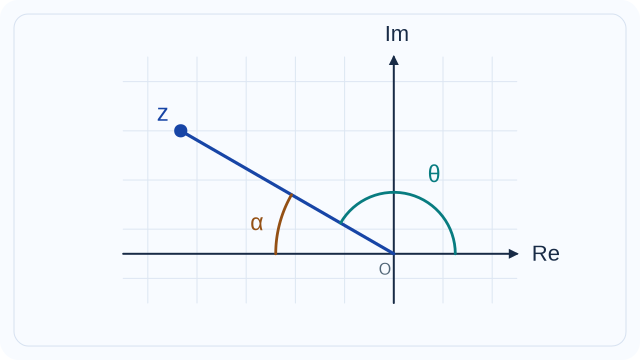
Locate the correct quadrant before choosing the argument.
Worked example
Find the exact argument of in radians with .
Use the point to fix the direction.
The signs put the point in quadrant II. The acute reference angle is . In the stated interval that gives .
Worked example
Find the exact argument of in radians with .
Try it on paper first.
Use the point to fix the direction.
The signs put the point in quadrant III. The acute reference angle is . In the stated interval that gives .
Section 3 of 6 · Core · about 6 min
Adding a whole turn of leaves the direction unchanged. At the origin the direction is undefined.
| Ray | Argument in the usual principal interval |
|---|---|
| Positive real | |
| Positive imaginary | |
| Negative real | |
| Negative imaginary |
Worked example
Find the exact argument of in radians with .
Use the point to fix the direction.
The point lies on an axis. From the positive real axis, the required direction in the stated interval is .
Section 4 of 6 · Core · about 7 min
Take the projection of the radius onto each axis. The trigonometric signs already account for the quadrant.
Worked example
A point has modulus and argument radians. Give the (real part, imaginary part) pair.
The horizontal component is ; the vertical component is .
The two components are and . Thus the number is .
Section 5 of 6 · Core · about 7 min
For points corresponding to and , start at and move by to reach .
Worked example
Points and represent and . Give as (real part, imaginary part) and the exact distance .
Subtract start from finish: .
The length is . Interchanging start and finish reverses the displacement and leaves its length unchanged.
Section 6 of 6 · Extension · about 5 min
Conjugation keeps the horizontal coordinate and reverses the vertical coordinate. The distance from the origin is unchanged.
Worked example
Find the exact argument of in radians with .
Use the point to fix the direction.
The signs put the point in quadrant III. The acute reference angle is . In the stated interval that gives .
Question 1 of 4
0 / 4 checked in this collection
Find the modulus of .
Progress stays in this browser. Create an account to save it or sign in.
Show your working on paper and compare it with the worked solution and marking guidance.
Your review plan starts after your first check.