Maths4UBETA

Argand loci and regions

Turn modulus and argument conditions into circles, bisectors and rays, and identify shared regions with the correct boundaries.

Try the quick check →
Lesson 5 of 5

Section 1 of 6 · Core · about 7 min

Why does a modulus condition give a circle?

The value of a difference modulus is a distance from a fixed centre. Equal distance gives a boundary circle and an inequality chooses a side.

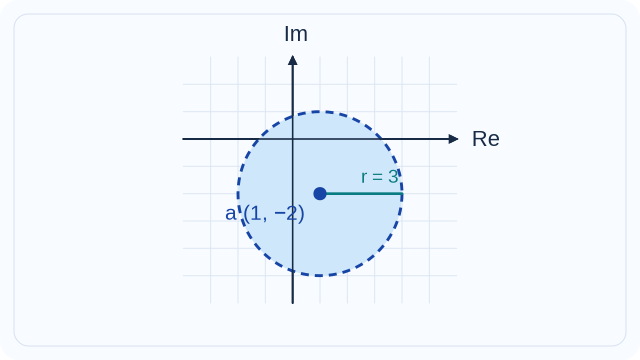
A circle centred at the point a representing 1−2i. Its open interior is shaded and the circle boundary is drawn dashed.

The disk contains points less than the radius away from a. A dashed boundary is excluded.

Worked example

Read a circle and its boundary

For ∣z−(1−2i)∣<3|z-\left(1 - 2 \mathrm{i}\right)|<3, give the Cartesian equation of the circle centred at the fixed point. Then select the intended region.

  1. The fixed point is 1−2i1 - 2 \mathrm{i}. Interpret the modulus as distance from (1,−2)\left(1,-2\right).

  2. Setting the distance equal to 33 gives the boundary (x−1)2+(y+2)2=9\left(x - 1\right)^{2} + \left(y + 2\right)^{2}=9.

  3. Inside the circle, with the boundary excluded.
Worked example

Read a circle and its boundary

For ∣z−(−2+i)∣≤4|z-\left(-2 + \mathrm{i}\right)|\le4, give the Cartesian equation of the circle centred at the fixed point. Then select the intended region.

Try it on paper first.

  1. The fixed point is −2+i-2 + \mathrm{i}. Interpret the modulus as distance from (−2,1)\left(-2,1\right).

  2. Setting the distance equal to 44 gives the boundary (x+2)2+(y−1)2=16\left(x + 2\right)^{2} + \left(y - 1\right)^{2}=16.

  3. Inside the circle and on its boundary.

Your turn

For ∣z−(3−4i)∣≤5|z-\left(3 - 4 \mathrm{i}\right)|\le5, give the Cartesian equation of the circle centred at the fixed point. Then select the intended region.

Enter both sides of the equation or give an expression equal to zero. Use ^ for powers and / for fractions.

Included region

Section 2 of 6 · Core · about 8 min

Which points are equally far from two positions?

Take two fixed points. Points on their perpendicular bisector are the same distance from each of them.

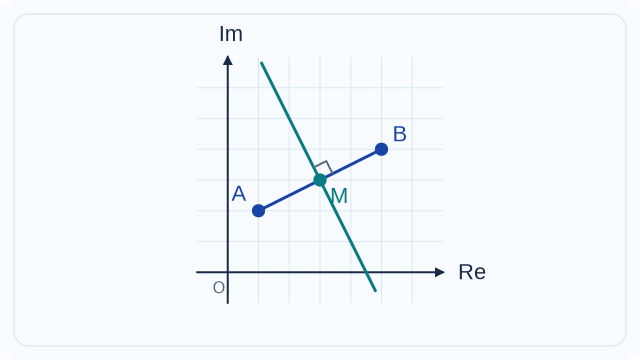
Points A and B are separated by an oblique segment. A line through its midpoint is perpendicular to the segment.

Equal distances from A and B select their perpendicular bisector.

Worked example

Find the perpendicular bisector

Let a=1+2ia=1 + 2 \mathrm{i} and b=5+4ib=5 + 4 \mathrm{i}. Give the midpoint as (real part, imaginary part), then enter the Cartesian equation of ∣z−a∣=∣z−b∣|z-a|=|z-b|.

  1. The two moduli are non-negative distances. Equal distances define the perpendicular bisector of the segment joining the two fixed points.

  2. The midpoint is 3+3i3 + 3 \mathrm{i}. After squaring the distances, the two squared variable terms cancel.

  3. The resulting line is 2x+y−9=02 x + y - 9=0.

Your turn

Let a=−2+4ia=-2 + 4 \mathrm{i} and b=4+2ib=4 + 2 \mathrm{i}. Give the midpoint as (real part, imaginary part), then enter the Cartesian equation of ∣z−a∣=∣z−b∣|z-a|=|z-b|.

Enter each pair in the order shown. Separate complete pairs with commas or semicolons.

Enter both sides of the equation or give an expression equal to zero. Use ^ for powers and / for fractions.

Section 3 of 6 · Core · about 6 min

Where does a shifted argument ray start?

The displacement is z−az-a. Put the endpoint at the point representing aa and measure the direction from a horizontal ray pointing right.

Worked example

Identify a ray and its endpoint

For arg⁡ ⁣(z−(2−i))=π4\arg\!\left(z-\left(2 - \mathrm{i}\right)\right)=\frac{\pi}{4}, give the endpoint coordinates and choose the point that belongs to the locus.

  1. The argument measures the direction of the displacement from 2−i2 - \mathrm{i}, so the endpoint is (2,−1)\left(2,-1\right).

  2. Moving from the endpoint by 1+i1 + \mathrm{i} follows the required ray and reaches 33.

  3. The endpoint is excluded because the zero displacement has no argument.

Your turn

For arg⁡ ⁣(z−(1+4i))=−π2\arg\!\left(z-\left(1 + 4 \mathrm{i}\right)\right)=- \frac{\pi}{2}, give the endpoint coordinates and choose the point that belongs to the locus.

Enter each pair in the order shown. Separate complete pairs with commas or semicolons.

Point on the ray

Section 4 of 6 · Core · about 8 min

How do I shade points that satisfy two conditions?

Sketch each boundary and mark which side meets its condition. A candidate point is in the shared region only if it meets both tests.

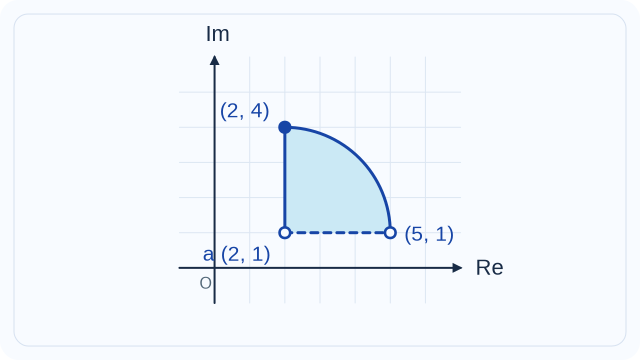
The shaded quarter-disc is above and to the right of its centre, excluding its lower ray and centre. The upper ray and quarter-circle arc are included where both restrictions hold.

Keep only the points that satisfy both tests.

Worked example

Decide which point satisfies both restrictions

Let a=2+ia=2 + \mathrm{i}. Apply both restrictions ∣z−a∣≤3|z-a|\le3 and 0<arg⁡(z−a)≤π20<\arg(z-a)\le\frac{\pi}{2}. Which listed point is included?

  1. Measure from 2+i2 + \mathrm{i}. The circle limits how far the point can lie from the centre.

  2. The angle limits select the quarter from just above the positive real direction up to and including the positive imaginary direction, measured from that centre.

  3. The displacement to 3+2i3 + 2 \mathrm{i} is 1+i1+\mathrm i. It satisfies both restrictions. The centre has no direction.

Your turn

Let a=−1+3ia=-1 + 3 \mathrm{i}. Apply both restrictions ∣z−a∣<4|z-a|<4 and 0<arg⁡(z−a)≤π20<\arg(z-a)\le\frac{\pi}{2}. Which listed point is included?

Point in the region

Section 5 of 6 · Core · about 7 min

How do I calculate where boundaries meet?

Use coordinates when a circle boundary meets a line. Re⁡z=h\operatorname{Re}z=h is the vertical line x=hx=h. Im⁡z=k\operatorname{Im}z=k is the horizontal line y=ky=k.

Worked example

Find both intersections with a boundary

The circle ∣z−(2−i)∣=5|z-(2 - \mathrm{i})|=5 meets the line x=6x=6. Enter both intersection coordinates as (x, y).

  1. Write the circle as (x−2)2+(y+1)2=25\left(x - 2\right)^{2} + \left(y + 1\right)^{2}=25.

  2. Substituting the fixed x-coordinate leaves a squared displacement of 99 in the other coordinate.

  3. Taking both signs yields (6,−4),(6,2)\left(6,-4\right),\quad \left(6,2\right).

Your turn

The circle ∣z−(−3+2i)∣=5|z-(-3 + 2 \mathrm{i})|=5 meets the line y=5y=5. Enter both intersection coordinates as (x, y).

Enter a point as (1, 2) or x = 1, y = 2. Separate complete pairs with commas or semicolons.

Section 6 of 6 · Extension · about 5 min

How can I check a boundary point at a glance?

A candidate point can satisfy the correct distance condition and still fail the directional condition. Test the two quantities separately.

Worked example

Decide which point satisfies both restrictions

Let a=3−2ia=3 - 2 \mathrm{i}. Apply both restrictions ∣z−a∣<5|z-a|<5 and 0<arg⁡(z−a)≤π20<\arg(z-a)\le\frac{\pi}{2}. Which listed point is included?

  1. Measure from 3−2i3 - 2 \mathrm{i}. The circle limits how far the point can lie from the centre.

  2. The angle limits select the quarter from just above the positive real direction up to and including the positive imaginary direction, measured from that centre.

  3. The displacement to 4−i4 - \mathrm{i} is 1+i1+\mathrm i. It satisfies both restrictions. The centre has no direction.

Your turn

Let a=5+2ia=5 + 2 \mathrm{i}. Apply both restrictions ∣z−a∣≤3|z-a|\le3 and 0<arg⁡(z−a)≤π20<\arg(z-a)\le\frac{\pi}{2}. Which listed point is included?

Point in the region

Worked examples

Practise the method

Core practice

Question 1 of 4

0 / 4 checked in this collection

Question list

Core practice

Fresh variants

Exam-style

Read a circle and its boundary

2 marks

For ∣z−(4−2i)∣<3|z-\left(4 - 2 \mathrm{i}\right)|<3, give the Cartesian equation of the circle centred at the fixed point. Then select the intended region.

Enter both sides of the equation or give an expression equal to zero. Use ^ for powers and / for fractions.

Included region

Choose one option. Explain your reasoning on paper.

Full answer-format guide

Exact numbers: 3/2, sqrt(5), 2-sqrt(3), pi/6, 3*pi/2. Sets: {1,4}. Intervals: (3,5]; a round bracket excludes the endpoint. Infinity: inf; union: U; no solutions: empty. Separate coordinate pairs or triples with semicolons. Expressions: 2x^2+3x-1; equations: x^2=3x+1 or the polynomial equal to zero. Factors: x-1 ; x+2. Parameter fraction: numerator ; denominator. List integer answers individually.

Review the method

Progress stays in this browser. Create an account to save it or sign in.

Extra practice from this lesson

Read a circle and its boundary

For ∣z−(−4−2i)∣=6|z-\left(-4 - 2 \mathrm{i}\right)|=6, give the Cartesian equation of the circle centred at the fixed point. Then select the intended region.

Enter both sides of the equation or give an expression equal to zero. Use ^ for powers and / for fractions.

Included region

Find the perpendicular bisector

Let a=−2−4ia=-2 - 4 \mathrm{i} and b=4+2ib=4 + 2 \mathrm{i}. Give the midpoint as (real part, imaginary part), then enter the Cartesian equation of ∣z−a∣=∣z−b∣|z-a|=|z-b|.

Enter each pair in the order shown. Separate complete pairs with commas or semicolons.

Enter both sides of the equation or give an expression equal to zero. Use ^ for powers and / for fractions.

Identify a ray and its endpoint

For arg⁡ ⁣(z−(−3+2i))=3π4\arg\!\left(z-\left(-3 + 2 \mathrm{i}\right)\right)=\frac{3 \pi}{4}, give the endpoint coordinates and choose the point that belongs to the locus.

Enter each pair in the order shown. Separate complete pairs with commas or semicolons.

Point on the ray

Decide which point satisfies both restrictions

Let a=2−4ia=2 - 4 \mathrm{i}. Apply both restrictions ∣z−a∣≤5|z-a|\le5 and 0<arg⁡(z−a)≤π20<\arg(z-a)\le\frac{\pi}{2}. Which listed point is included?

Point in the region

Find both intersections with a boundary

The circle ∣z−(4+2i)∣=10|z-(4 + 2 \mathrm{i})|=10 meets the line x=10x=10. Enter both intersection coordinates as (x, y).

Enter a point as (1, 2) or x = 1, y = 2. Separate complete pairs with commas or semicolons.

Read a circle and its boundary

For ∣z−(3+2i)∣>4|z-\left(3 + 2 \mathrm{i}\right)|>4, give the Cartesian equation of the circle centred at the fixed point. Then select the intended region.

Enter both sides of the equation or give an expression equal to zero. Use ^ for powers and / for fractions.

Included region

Apply it · original exam-style problems

Show your working on paper and compare it with the worked solution and marking guidance.

Come back to what needs practice

Quick revision sheet (A4)

Your review plan starts after your first check.