Maths4UBETA

Recovering a curve from its gradient

A gradient determines a family. Use a point, tangent or stationary level to select the complete curve.

Try the quick check →
Lesson 2 of 5

Section 1 of 5 · Core · about 6 min

Why does a gradient function describe a whole family of curves?

Differentiation removes a constant vertical shift. On one connected interval, curves with the same derivative differ only by a constant. Knowing their slopes therefore does not tell you their heights.

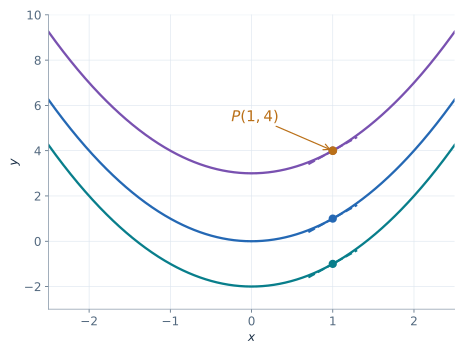
Several vertical shifts of the same parabola share one gradient function, while a marked point selects one curve.

Integrating f′(x)=2xf'(x)=2x gives the family f(x)=x2+Cf(x)=x^2+C. At x=1x=1 all three curves have gradient 22. The curve through (1,4)(1,4) satisfies 4=1+C  ⟹  C=34=1+C\implies C=3.

Every curve y=x2+Cy=x^2+C has derivative 2x2x. The point (1,4)(1,4) selects C=3C=3.

Worked example

A point selects one vertical shift

A curve satisfies f′(x)=2xf^{\prime}(x)=2x and passes through (1,4)(1,4). Find its equation.

  1. f(x)=∫2x dx=x2+C.f(x)=\int2x\,\mathrm{d}x=x^2+C.
  2. All values of CC give the same derivative. The point supplies the missing height:

    4=12+C⟹C=3.4=1^2+C\Longrightarrow C=3.
  3. f(x)=x2+3.f(x)=x^2+3.
  4. Its derivative is 2x2x, and f(1)=4f(1)=4. Both original conditions are satisfied.
Your turn

A curve has gradient function f′(x)=6x+1f^{\prime}(x)=6x+1, so f(x)=3x2+x+Cf(x)=3x^2+x+C. Which single condition below determines CC? Use that condition to find its value.

Condition that fixes the constant

Enter the value on its own or write C = … . Fractions and exact square roots are accepted.

Section 2 of 5 · Core · about 6 min

How do I use a point to recover the particular curve?

Integrate the complete gradient function and include +C+C. Then substitute both coordinates of an allowed point into the recovered function. Do not substitute the point’s height into the derivative.

Worked example

Integrate before using the point coordinates

Find the curve with gradient function f′(x)=4x3−6x+2f^{\prime}(x)=4x^3-6x+2 that passes through (−1,7)(-1,7).

  1. f(x)=x4−3x2+2x+C.f(x)=x^4-3x^2+2x+C.
  2. Substitute the given input and height into this function:

    7=(−1)4−3(−1)2+2(−1)+C=−4+C.7=(-1)^4-3(-1)^2+2(-1)+C=-4+C.
  3. C=11,f(x)=x4−3x2+2x+11.C=11,\qquad f(x)=x^4-3x^2+2x+11.
  4. Differentiating gives the original gradient function. Substituting x=−1x=-1 gives 1−3−2+11=71-3-2+11=7.

Your turn

A curve satisfies f′(x)=9x2−4x+1f^{\prime}(x)=9x^2-4x+1 and passes through (−1,5)(-1,5). Write f(x)=3x3−2x2+x+Cf(x)=3x^3-2x^2+x+C. Find CC, then f(2)f(2).

Enter the value on its own or write C = … . Fractions and exact square roots are accepted.

Enter an exact number, for example 3/2 or 2-sqrt(3).

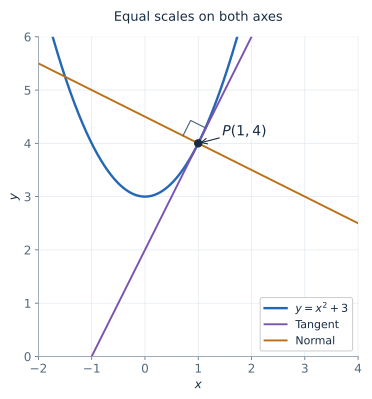
A point on a parabola is labelled separately from the tangent gradient there, preventing confusion between function and derivative values.

  1. The point (1,4)(1,4) fixes the position in the family f(x)=x2+Cf(x)=x^2+C. From 4=1+C4=1+C, obtain C=3C=3.
  2. Every curve in the family has f′(1)=2f'(1)=2. This is also the tangent gradient associated with a normal gradient of −12-\frac12.
  3. y−4=2(x−1)(tangent).y-4=2(x-1)\quad\text{(tangent)}.y−4=−12(x−1)(normal).y-4=-\frac12(x-1)\quad\text{(normal)}.

For f(x)=x2+3f(x)=x^2+3, the statements f(1)=4f(1)=4 and f′(1)=2f^{\prime}(1)=2 give different information: a height and a tangent gradient.

Section 3 of 5 · Core · about 10 min

How do tangent, normal and stationary conditions supply information?

Separate information about direction from information about height. A complete line equation can supply both, once its contact input is known.

Worked example

A full normal equation can supply the missing contact point

A curve has f′(x)=2x−4f^{\prime}(x)=2x-4. The line x+2y=7x+2y=7 is a normal at a point on the curve. Recover the curve equation.

  1. The normal has gradient −12-\frac{1}{2}, so the tangent gradient at the contact is 22.

    2a−4=2⟹a=3.2a-4=2\Longrightarrow a=3.
  2. The contact point lies on the normal line:

    3+2y=7⟹y=2.3+2y=7\Longrightarrow y=2.
  3. f(x)=x2−4x+C.f(x)=x^2-4x+C.
  4. f(3)=9−12+C=2⟹C=5.f(3)=9-12+C=2\Longrightarrow C=5.
  5. f(x)=x2−4x+5.f(x)=x^2-4x+5.

    At (3,2)(3,2) the tangent gradient is 22, so the normal is y−2=−12(x−3)y-2=-\frac{1}{2}(x-3), exactly the given line.

Your turn

A curve has f′(x)=4x+1f^{\prime}(x)=4x+1. The line x+9y=20x+9y=20 is a normal at an unknown contact point. Find that point and the constant CC in f(x)=2x2+x+Cf(x)=2x^2+x+C.

Enter a point as (1, 2) or x = 1, y = 2. Separate complete pairs with commas or semicolons.

Enter the value on its own or write C = … . Fractions and exact square roots are accepted.

A vertical normal x=ax=a means a horizontal tangent, so f′(a)=0f^{\prime}(a)=0. It supplies no height by itself. A horizontal normal requires a vertical tangent; it cannot be handled by dividing by a zero normal gradient or by assigning an ordinary finite derivative there.

Worked example

A stationary height can leave more than one curve

A curve has f′(x)=3x2−12f^{\prime}(x)=3x^2-12, and one stationary point has height 44. Find every possible curve. Which one has a local minimum at height 44?

  1. f(x)=x3−12x+C,3x2−12=0⟹x=±2.f(x)=x^3-12x+C,\qquad3x^2-12=0\Longrightarrow x=\pm2.
  2. f′′(x)=6x.f^{\prime\prime}(x)=6x.

    The point at x=−2x=-2 is a local maximum, while the point at x=2x=2 is a local minimum.

  3. If the stated stationary point is at x=−2x=-2,

    f(−2)=16+C=4⟹C=−12.f(-2)=16+C=4\Longrightarrow C=-12.
  4. If it is at x=2x=2,

    f(2)=−16+C=4⟹C=20.f(2)=-16+C=4\Longrightarrow C=20.
  5. Both f(x)=x3−12x−12f(x)=x^3-12x-12 and f(x)=x3−12x+20f(x)=x^3-12x+20 satisfy the stationary-height condition. The second has its local minimum at (2,4)(2,4).

Section 4 of 5 · Further applications · about 7 min

What if the derivative contains an unknown coefficient?

An unknown coefficient in the derivative and the integration constant play different roles. Keep the coefficient as a constant while integrating. Then turn every supplied height or direction into an equation and solve the equations together.

Worked example

Keep an unknown coefficient while integrating

A curve has f′(x)=kx+2f^{\prime}(x)=kx+2, where kk is constant, and passes through (0,1)(0,1) and (2,9)(2,9). Find its equation.

  1. Treat kk as constant when integrating with respect to xx:

    f(x)=k2x2+2x+C.f(x)=\frac{k}{2}x^2+2x+C.
  2. f(0)=1⟹C=1.f(0)=1\Longrightarrow C=1.
  3. f(2)=2k+4+1=9⟹k=2.f(2)=2k+4+1=9\Longrightarrow k=2.
  4. f(x)=x2+2x+1.f(x)=x^2+2x+1.
  5. Its derivative is 2x+22x+2, and its values at 00 and 22 are 11 and 99. The two point conditions determine both unknown constants.

Your turn

A curve has f′(x)=kx+3f^{\prime}(x)=kx+3, where kk is constant, and passes through (0,2)(0,2) and (2,14)(2,14). Find kk and the integration constant CC.

Enter the value on its own or write k = … . Fractions and exact square roots are accepted.

Enter the value on its own or write C = … . Fractions and exact square roots are accepted.

Section 5 of 5 · Core · about 8 min

Which domain and algebraic form should the final curve keep?

Retain the interval supplied with the derivative and check that every used point belongs to it. Roots, denominators and cancelled factors may exclude inputs. A finite antiderivative value at an excluded endpoint does not automatically enlarge the original domain.

Worked example

Recover the function on the stated interval before rewriting it

For x>0x>0, a curve has f′(x)=3x−3xf^{\prime}(x)=\frac{3x-3}{\sqrt{x}} and passes through (1,0)(1,0). Find f(x)f(x), then write it as a polynomial in u=xu=\sqrt{x}. Does the recovered formula add x=0x=0 to the given domain?

  1. First rewrite and integrate with respect to xx:

    f′(x)=3x12−3x−12,f(x)=2x32−6x+C.f^{\prime}(x)=3x^{\frac{1}{2}}-3x^{-\frac{1}{2}},\qquad f(x)=2x^{\frac{3}{2}}-6\sqrt{x}+C.
  2. f(1)=2−6+C=0⟹C=4.f(1)=2-6+C=0\Longrightarrow C=4.
  3. f(x)=2x32−6x+4,x>0.f(x)=2x^{\frac{3}{2}}-6\sqrt{x}+4,\qquad x>0.
  4. Now use u=x>0u=\sqrt{x}>0 to represent the completed answer:

    f(x)=2u3−6u+4.f(x)=2u^3-6u+4.
  5. The expression has a finite limiting value 44 as xx approaches zero from the right, but the specified domain is still x>0x>0. A continuous extension would be a further choice, not a consequence of integration.

If the domain has separate intervals, each can have its own integration constant. A point on the left of an excluded input fixes the left constant only, unless an additional condition links the two parts. Algebraic cancellation preserves that gap.

Your turn

A curve is defined on R∖{1}\mathbb{R}\setminus\{1\}, with f′(x)=x2−1x−1f^{\prime}(x)=\frac{x^2-1}{x-1} and f(0)=4f(0)=4. On x<1x<1, write f(x)=x22+x+CLf(x)=\frac{x^2}{2}+x+C_L. Find CLC_L, then decide whether f(2)f(2) is determined.

Enter an exact number, for example 3/2 or 2-sqrt(3).

Is f(2)f(2) determined?

Worked examples

Practise the method

Core practice

Question 1 of 4

0 / 4 checked in this collection

Question list

Core practice

Fresh variants

Exam-style

A gradient and a point give the whole curve

2 marks

A curve has f′(x)=6x−4f^{\prime}(x)=6 x - 4 and passes through (2, 5)\left( 2, \ 5\right). Give the integration constant C in f(x)=3x2−4x+Cf(x)=3 x^{2} - 4 x+C and the complete f.

Enter an exact number, for example 3/2 or 2-sqrt(3).

Enter an expression in x; use ^ for powers and / for fractions.

Full answer-format guide

Exact numbers: 3/2, sqrt(5), 2-sqrt(3), pi/6, 3*pi/2. Sets: {1,4}. Intervals: (3,5]; a round bracket excludes the endpoint. Infinity: inf; union: U; no solutions: empty. Separate coordinate pairs or triples with semicolons. Expressions: 2x^2+3x-1; equations: x^2=3x+1 or the polynomial equal to zero. Factors: x-1 ; x+2. Parameter fraction: numerator ; denominator. List integer answers individually.

Review the method

Progress stays in this browser. Create an account to save it or sign in.

Extra practice from this lesson

A point fixes the vertical position

A curve has gradient f′(x)=6x−4f^{\prime}(x)=6x-4 and passes through (2,7)(2,7). Write its equation as f(x)=Ax2+Bx+Cf(x)=Ax^2+Bx+C and find A,B,CA,B,C.

Enter the value on its own or write a = … . Fractions and exact square roots are accepted.

Enter the value on its own or write b = … . Fractions and exact square roots are accepted.

Enter the value on its own or write c = … . Fractions and exact square roots are accepted.

Recover a curve with roots and reciprocal powers

For x>0x>0, f′(x)=3x−8x3f^{\prime}(x)=\frac{3}{\sqrt{x}}-\frac{8}{x^3} and f(1)=5f(1)=5. Express the curve as f(x)=Ax+Bx2+Cf(x)=A\sqrt{x}+\frac{B}{x^2}+C. Find A,B,CA,B,C and f(4)f(4).

Enter the value on its own or write a = … . Fractions and exact square roots are accepted.

Enter the value on its own or write b = … . Fractions and exact square roots are accepted.

Enter the value on its own or write c = … . Fractions and exact square roots are accepted.

Enter an exact number, for example 3/2 or 2-sqrt(3).

Convert the normal direction before using the gradient

A curve satisfies f′(x)=ax−3f^{\prime}(x)=ax-3, passes through (2,1)(2,1), and has a normal of gradient −15-\frac{1}{5} at that point. Find aa and the integration constant CC in f(x)=a2x2−3x+Cf(x)=\frac{a}{2}x^2-3x+C. Also find f(3)f(3).

Enter the value on its own or write a = … . Fractions and exact square roots are accepted.

Enter the value on its own or write c = … . Fractions and exact square roots are accepted.

Enter an exact number, for example 3/2 or 2-sqrt(3).

A stationary point gives two conditions

A curve with f′(x)=2x+kf^{\prime}(x)=2x+k has a stationary point at (−2,6)(-2,6). Find k,Ck,C in f(x)=x2+kx+Cf(x)=x^2+kx+C, and classify the stationary point.

Enter the value on its own or write k = … . Fractions and exact square roots are accepted.

Enter the value on its own or write c = … . Fractions and exact square roots are accepted.

Nature

One point need not determine both disconnected parts

A differentiable function is defined on (−∞,2)∪(2,∞)( -\infty,2)\cup(2,\infty), and

f′(x)=x2−4x−2,f(0)=1.f^{\prime}(x)=\frac{x^2-4}{x-2},\qquad f(0)=1.

Find f(1)f(1). Decide whether the supplied information determines f(3)f(3) uniquely and whether it defines f(2)f(2).

Enter an exact number, for example 3/2 or 2-sqrt(3).

Is f(3)f(3) determined uniquely?
Is f(2)f(2) defined?

Apply it · original exam-style problems

Show your working on paper and compare it with the worked solution and marking guidance.

Start after this lesson

Two points determine a gradient parameter and a constant 7 marks

A curve has gradient f′(x)=kx2−6x+4f^{\prime}(x)=kx^2-6x+4 and passes through (1,0)(1,0) and (3,0)(3,0). Find kk and the constant CC in its recovered equation. Then find m,cm,c in the tangent equation y=mx+cy=mx+c at (1,0)(1,0).

Hint

Integrate with the parameter retained. Subtract the two point equations to eliminate the constant.

Worked solution
  1. f(x)=k3x3−3x2+4x+C.f(x)=\frac{k}{3}x^3-3x^2+4x+C.
  2. 0=k3+1+C,0=9k−15+C.0=\frac{k}{3}+1+C,\qquad0=9k-15+C.
  3. 26k3−16=0⟹k=2413,C=−1−813=−2113.\frac{26k}{3}-16=0\Longrightarrow k=\frac{24}{13},\qquad C=-1-\frac{8}{13}=-\frac{21}{13}.
  4. f(x)=813x3−3x2+4x−2113.f(x)=\frac{8}{13}x^3-3x^2+4x-\frac{21}{13}.
  5. m=f′(1)=2413−6+4=−213.m=f^{\prime}(1)=\frac{24}{13}-6+4=-\frac{2}{13}.
  6. y=−213(x−1)=−213x+213.y=-\frac{2}{13}(x-1)=-\frac{2}{13}x+\frac{2}{13}.
  7. Substitution gives zero at both supplied inputs, and differentiating the recovered curve returns the given parameterised gradient.

Marking guidance
  • 1 mark: integrate the full gradient with a constant.
  • 1 mark: form both point equations.
  • 1 mark: eliminate the constant and find the gradient parameter.
  • 1 mark: find the integration constant.
  • 1 mark: state the complete recovered curve.
  • 1 mark: obtain the tangent gradient at the specified point.
  • 1 mark: form the correct tangent equation.
A normal line supplies both position and direction 9 marks

For x>0x>0, a curve satisfies f′(x)=ax+2xf^{\prime}(x)=\frac{ax+2}{\sqrt{x}}. The normal at the point whose input is 11 has equation 2x+3y=172x+3y=17.

Find aa, recover the curve with its integration constant CC, and express the result using u=xu=\sqrt{x}. Find and classify the stationary point of the curve.

Hint

At the contact, substitute x=1x=1 into the normal line to obtain the height. Convert its gradient to the tangent gradient. Perform the calculus in xx, then use uu to rewrite the final expression.

Worked solution
  1. 2(1)+3y=17⟹y=5,mN=−23,mT=32.2(1)+3y=17\Longrightarrow y=5,\qquad m_N=-\frac{2}{3},\qquad m_T=\frac{3}{2}.
  2. f′(1)=a+2=32⟹a=−12.f^{\prime}(1)=a+2=\frac{3}{2}\Longrightarrow a=-\frac{1}{2}.
  3. f′(x)=−12x12+2x−12⟹f(x)=−13x32+4x+C.f^{\prime}(x)=-\frac{1}{2}x^{\frac{1}{2}}+2x^{-\frac{1}{2}}\Longrightarrow f(x)=-\frac{1}{3}x^{\frac{3}{2}}+4\sqrt{x}+C.
  4. 5=−13+4+C⟹C=43.5=-\frac{1}{3}+4+C\Longrightarrow C=\frac{4}{3}.
  5. u=x>0:f(x)=−u33+4u+43.u=\sqrt{x}>0:\qquad f(x)=-\frac{u^3}{3}+4u+\frac{4}{3}.
  6. f′(x)=4−x2x=0⟹x=4,f(4)=203.f^{\prime}(x)=\frac{4-x}{2\sqrt{x}}=0\Longrightarrow x=4,\qquad f(4)=\frac{20}{3}.
  7. The denominator is positive throughout x>0x>0. Thus the derivative is positive before 44 and negative after it: the stationary point is a maximum, in fact the global maximum on the stated domain.

  8. The recovered curve remains restricted to x>0x>0; the finite limit at zero does not add that input to the original curve.

Marking guidance
  • 1 mark: obtain the contact height from the normal line.
  • 1 mark: convert the normal gradient to the tangent gradient.
  • 1 mark: use the derivative condition to find the parameter.
  • 1 mark: integrate both gradient terms with a constant.
  • 1 mark: find the constant using the contact point.
  • 1 mark: state the complete expression in the requested representation with its domain.
  • 1 mark: find the allowed stationary input.
  • 1 mark: calculate the stationary height.
  • 1 mark: justify the classification.

Come back to what needs practice

Quick revision sheet (A4)

Your review plan starts after your first check.

Question bank and saved work