Maths4U · Learning together
Recovering a curve from its gradient
Notes
Objective
Recover a curve with its constant, use geometric information correctly and retain the original gradient domain.
Before you start
Recall curve points, tangent and normal gradients, stationary points and exact substitution.
Key ideas
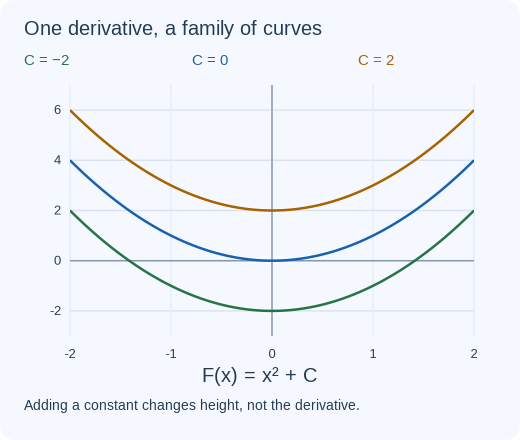
A derivative alone leaves a family
If , every has that derivative. A point fixes the vertical constant.
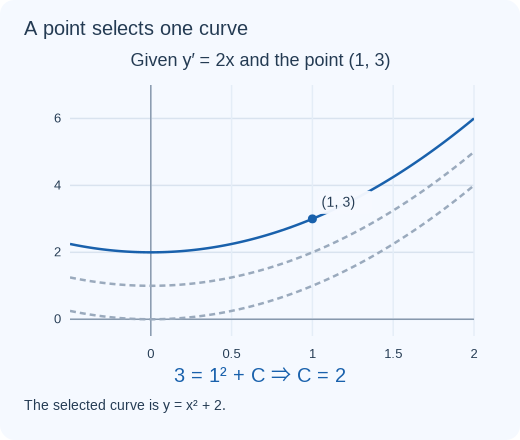
Use the given point after integration
First find an antiderivative with its constant, then substitute both coordinates of the point. Check the final equation against both the derivative and the point.
Position and direction give different equations
A curve point constrains ; a tangent direction constrains . A finite nonzero normal gradient gives the tangent gradient by a negative reciprocal. A stationary input gives , while a stationary level gives . Use the correct condition for each unknown.
The original domain remains part of the answer
A recovered expression may have a finite endpoint value even where the supplied gradient was undefined. Unless an extension is specified, keep the original interval. If you rewrite the final curve with , differentiate and integrate with respect to x first; u is only a convenient answer representation.
Method
- Integrate the complete gradient and include its constant.
- Use direction or stationary information to determine any gradient parameters.
- Substitute the actual curve point or level to find the constant.
- Restore every requested coordinate, line and domain; check both original conditions.
Common mistakes
- A slope is not a y-coordinate.
- Do not discard the constant when a complete curve is requested.
- A normal gradient is not the tangent gradient.
- A simplified antiderivative does not change the original domain.
Worked examples
A point selects the constant
A curve has and passes through . Find its equation.
Follow the solutionAt the point, , so .
This expression gives both the stated gradient and the given point.
A fractional-power gradient with an original restriction
A curve has for , and . Find f.
Follow the solutionAt , , so
The original gradient was supplied only for positive x. In terms of , the same final curve is .
A normal direction and a point fix different constants
A curve has . At its normal gradient is . Find k, the curve and the tangent.
Follow the solutionThe tangent gradient is 6, so and . Integration gives . The point gives , hence .
A stationary level determines the vertical position
A curve has and a local maximum of height 5. Find its equation and both stationary points.
Follow the solutionThe maximum occurs at ; its height is , so . The curve is
Its stationary points are , a maximum, and , a minimum.