Worked example
Build a tangent from a point and a gradient
Find the tangent to at .
Substituting into the line gives , and its gradient is the required .
Use the point on the curve and its derivative to form a complete line equation, including horizontal and vertical cases.
Try the quick check →Section 1 of 5 · Core · about 6 min
A tangent at passes through that contact point and has the curve’s local gradient , when this is finite. It need not stay on one side of the curve: a tangent can cross a curve.
Worked example
Find the tangent to at .
Substituting into the line gives , and its gradient is the required .
If the contact point is already given, check that it lies on the curve. If only its input is supplied, calculate the missing height before writing the line. A point–slope answer is already a valid line equation unless another form is requested.
Section 2 of 5 · Core · about 9 min
The normal passes through the same contact point and is perpendicular to the tangent. For finite nonzero tangent gradient, take its negative reciprocal.
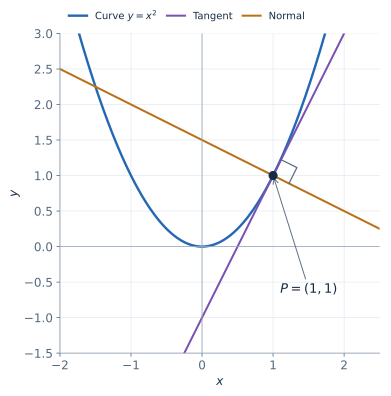
At on , the tangent is , while the normal is . Both share the contact point.
Worked example
Find the normal to at .
The normal passes through , and , so it is perpendicular to the tangent.
Worked example
Find the tangent and normal to at .
The tangent is horizontal through the contact height; the normal is vertical through the contact input.
Do not attempt to calculate .
Section 3 of 5 · Core · about 8 min
First translate the line information into the required tangent gradient. Then solve the derivative equation and recover every allowed contact height from the original curve.
Worked example
Find all tangents to that are parallel to .
Both lines have the prescribed gradient. The given line’s intercept is not transferred to the tangents.
Worked example
Find the normals to that are parallel to .
The given line has gradient . The normal must have that gradient, so the tangent gradient must be .
The contact points are and .
Keep all real solutions in the original domain. A reciprocal curve excludes zero; a root expression may restrict the input further. A quadratic gradient equation can give two contact points and therefore two distinct lines.
Section 4 of 5 · Further applications · about 10 min
A point through which the tangent passes is not necessarily the contact point. Introduce an unknown contact input , build the tangent there, then impose the given point .
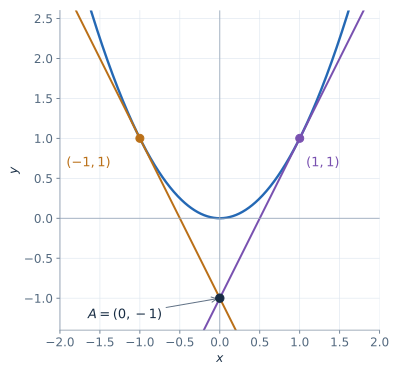
Two tangents from meet at different contact points, and . The shared external point is not a contact point.
Worked example
Find every tangent from to .
Let the contact point be . Its tangent gradient is .
Substitute the external point into this line:
The contacts are and . Both lines pass through , which is not on the curve.
For a normal through an external point, use the normal line at the unknown contact. Check horizontal-tangent contacts separately before taking a reciprocal gradient.
Worked example
Find all normals to passing through .
At contact input , the tangent is horizontal and the normal is . It passes through , so keep this solution before using a reciprocal gradient.
For , the normal at is
There are three normals: these two sloping lines and the vertical line . Their contact points are .
Section 5 of 5 · Further applications · about 6 min
A tangent line gives two kinds of information: its height at the contact input and its gradient. Substitute the point condition into the original curve and the gradient condition into its derivative, then solve the equations together.
Worked example
The line is tangent to at . Find .
The line gives the contact height . Therefore
With , the curve has height and gradient at , matching the given line.
Question 1 of 4
0 / 4 checked in this collection
Find the tangent and normal to y= at . Give complete equations in x and y.
Progress stays in this browser. Create an account to save it or sign in.
Show your working on paper and compare it with the worked solution and marking guidance.
Find every tangent to that passes through . Give all contact points and write each tangent as . Enter the complete set of ordered pairs .
Name the unknown contact input . The contact point is , and the tangent gradient is . Insert the given external point into that tangent equation.
Passing through requires
Thus or , giving contact points and .
Both lines pass through , pass through their respective contact points, and have the derivative gradient at those contacts.
Find every tangent to that passes through . Although lies on the curve, a required tangent may touch elsewhere. Give all contact points and the complete set of line parameters for .
The tangent at input has equation . Substitute , then factor the resulting cubic using the known contact .
The repeated algebraic root is one contact, not two different contacts. At , the tangent is horizontal: .
At , the ordinate is and the gradient is , giving
Substituting gives on each line. Both lines also meet the curve with its derivative gradient at their stated contacts.
For , the curve passes through . Its normal there has gradient . Find , then find the normal at the point with , writing it as .
First turn the given normal gradient into the tangent gradient. Combine the derivative condition with the point condition, then repeat the point-and-gradient method at the new input.
The tangent gradient at is , so . Solving the pair gives .
The original conditions are satisfied: , and the tangent gradient gives the stated normal gradient . Both requested inputs are positive.
Your review plan starts after your first check.