Maths4U · Learning together
Tangents, normals and prescribed gradients
Notes
Objective
Find tangent and normal equations, solve prescribed-gradient conditions and recover parameters from geometric information.
Before you start
Recall point-gradient equations, perpendicular lines and complete root sets.
Key ideas
Find both the point and the gradient
At , the point is (a,f(a)) and the finite tangent gradient is .
Do not use the derivative value as the ordinate. Equivalent complete line equations are acceptable.
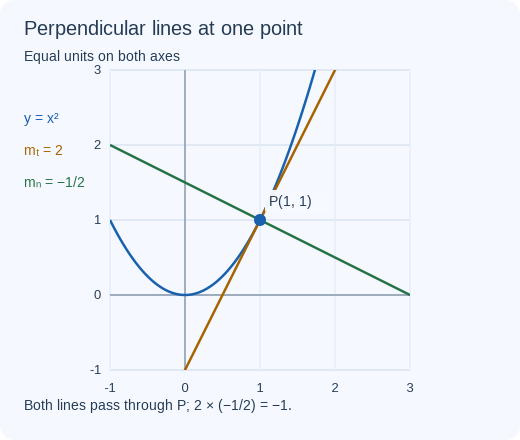
A normal is perpendicular to the tangent
If is finite, its normal has gradient . If , the tangent is horizontal and the normal is vertical . The expression is not a gradient.
A prescribed gradient can occur at several points
Solve for every input in the original curve domain, then recover each ordinate. Equal tangent gradients mean parallel tangents, not necessarily the same line.
Parameter conditions use two different facts
A point lying on the curve gives an equation in f. A tangent or normal direction gives an equation in f′. Use both when recovering missing constants, and verify both original conditions.
Method
- Find or verify the actual point on the original curve.
- Differentiate and evaluate the tangent gradient there.
- For a normal, handle before taking a negative reciprocal.
- Give the full line equation and retain every valid point or parameter case.
Common mistakes
- The derivative is a gradient, not a coordinate.
- The normal uses a negative reciprocal when that reciprocal is defined.
- A zero tangent gradient gives a vertical normal.
- A gradient equation may have two valid points.
Worked examples
Two different lines through one curve point
Find the tangent and normal to at .
Follow the solutionThe derivative is , giving tangent gradient 2.
Both lines pass through , and their finite gradients multiply to −1.
Recover the ordinate before writing a line
Find the tangent and normal to at .
Follow the solutionThe point is ; the tangent gradient is .
Using 11 as the ordinate would give a line through the wrong point.
A horizontal tangent has a vertical normal
Find the tangent and normal to at its stationary point.
Follow the solutionThe derivative vanishes at , where . Therefore
No reciprocal of zero is taken.
One gradient, two complete answers
Find the points on where the tangent gradient is 9, and give both tangent equations.
Follow the solutionThe points are and . Their tangents are
The slopes agree but the lines have different intercepts.