Maths4UBETA

Derivative signs, stationary points and ranges

Separate a stationary point from a turning point and distinguish local classification from the range on the full domain.

Try the quick check →
Lesson 3 of 5

Section 1 of 5 · Core · about 9 min

How do derivative signs tell me where a curve rises or falls?

Increasing means that outputs rise as the input moves to the right; decreasing means that they fall. For a differentiable function on an interval, a positive derivative throughout gives strict increase, and a negative derivative throughout gives strict decrease.

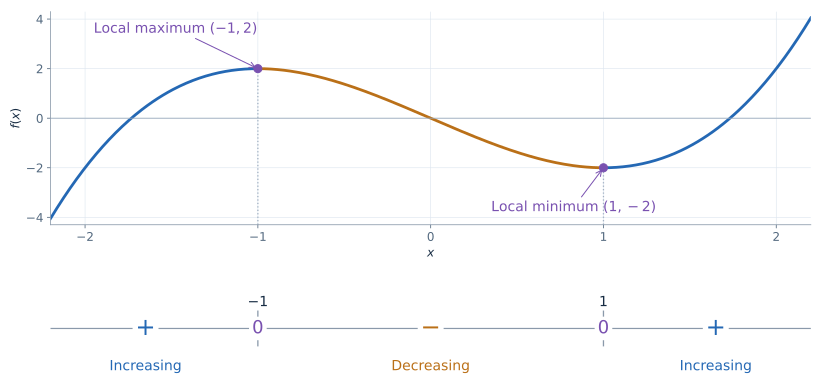
A cubic curve and its derivative sign chart show increasing intervals outside two stationary inputs and a decreasing interval between them.

For f(x)=x3−3xf(x)=x^3-3x, f′(x)=3(x−1)(x+1)f'(x)=3(x-1)(x+1). A sign change from positive to negative gives the local maximum at x=−1x=-1. The opposite sign change gives the local minimum at x=1x=1.

The signs of 3(x+1)(x−1)3(x+1)(x-1) explain the rising, falling and rising sections of y=x3−3xy=x^3-3x.

Worked example

Turn a derivative into a sign chart

Find where f(x)=x3−3xf(x)=x^3-3x has positive or negative gradient. State its increasing and decreasing intervals.

  1. f′(x)=3x2−3=3(x+1)(x−1).f^{\prime}(x)=3x^2-3=3(x+1)(x-1).
  2. The only zeros are −1-1 and 11. They split the real line into three intervals. The two factors have the same sign outside these roots and opposite signs between them.

  3. f′(x)>0 for x<−1 or x>1;f′(x)<0 for −1<x<1.f^{\prime}(x)>0\text{ for }x<-1\text{ or }x>1;\qquad f^{\prime}(x)<0\text{ for }-1<x<1.
  4. The function is strictly increasing on each of (−∞,−1]( -\infty,-1] and [1,∞)[1,\infty), and strictly decreasing on [−1,1][-1,1]. Including the zero-gradient endpoints does not spoil these monotonic intervals.
Your turn

For g(x)=x3−3x2−24xg(x)=x^3-3x^2-24x, find all inputs where g′(x)=0g^{\prime}(x)=0, then choose the interval where g′(x)<0g^{\prime}(x)<0.

Give the complete set: {1, 4} for separate values, (1, 5] for an interval, U for union or empty for no real solutions. Use sqrt(...) for exact roots.

Negative-gradient interval

Nonnegative derivative means the function never decreases; it does not by itself guarantee strict increase, since a constant function also has zero derivative. Conversely, strict increase can include isolated zero gradients, as x3x^3 shows later. If asked where f′(x)>0f^{\prime}(x)>0, exclude its zeros; a full increasing interval can still include them.

Worked example

A missing input separates two intervals

For f(x)=1x−1f(x)=\frac{1}{x-1}, determine where the function decreases and whether it has a stationary point.

  1. x≠1,f′(x)=−1(x−1)2<0.x\ne1,\qquad f^{\prime}(x)=-\frac{1}{(x-1)^2}<0.
  2. It is strictly decreasing on (−∞,1)( -\infty,1) and separately on (1,∞)(1,\infty). The derivative is never zero, so there is no stationary point.

  3. The excluded input 11 is not a point on the curve. Do not join the intervals across it.

  4. The function is not decreasing across its whole disconnected domain: 0<20<2, but f(0)=−1<f(2)=1f(0)=-1<f(2)=1.

Section 2 of 5 · Core · about 7 min

How do I find and classify every stationary point?

A stationary point has a horizontal tangent: its finite derivative is zero. Solve f′(x)=0f^{\prime}(x)=0 within the original domain, then use y=f(x)y=f(x) to find each height. A turning point is a local maximum or minimum, where the direction changes.

Worked example

Find the points, then identify the turns

Find and classify every stationary point of g(x)=x3−3x2−9x+2g(x)=x^3-3x^2-9x+2 using first-derivative signs.

  1. g′(x)=3x2−6x−9=3(x+1)(x−3).g^{\prime}(x)=3x^2-6x-9=3(x+1)(x-3).
  2. g′(x)=0⟹x=−1,3.g^{\prime}(x)=0\Longrightarrow x=-1,3.
  3. g(−1)=7,g(3)=−25.g(-1)=7,\qquad g(3)=-25.
  4. The derivative is positive before −1-1, negative between −1-1 and 33, and positive after 33.

  5. Thus (−1,7)(-1,7) is a local maximum: increasing changes to decreasing. The point (3,−25)(3,-25) is a local minimum: decreasing changes to increasing.

Your turn

Find the stationary points of h(x)=2x3−3x2−12x+5h(x)=2x^3-3x^2-12x+5. Which stationary input gives a local maximum?

Enter a point as (1, 2) or x = 1, y = 2. Separate complete pairs with commas or semicolons.

Enter an exact number, for example 3/2 or 2-sqrt(3).

Section 3 of 5 · Core · about 9 min

When does the second derivative decide the nature?

At a stationary input aa, the second derivative gives a quick classification when it is nonzero. First establish f′(a)=0f^{\prime}(a)=0; the second derivative is not a substitute for finding stationary inputs.

Worked example

Use the second derivative only at stationary inputs

Find and classify the stationary points of h(x)=x3+3x2−9x+4h(x)=x^3+3x^2-9x+4 using the second derivative.

  1. h′(x)=3(x+3)(x−1)=0⟹x=−3,1.h^{\prime}(x)=3(x+3)(x-1)=0\Longrightarrow x=-3,1.
  2. h(−3)=31,h(1)=−1.h(-3)=31,\qquad h(1)=-1.
  3. h′′(x)=6x+6.h^{\prime\prime}(x)=6x+6.
  4. At x=−3x=-3, h′′(−3)=−12<0h^{\prime\prime}(-3)=-12<0, so (−3,31)(-3,31) is a local maximum.

  5. At x=1x=1, h′′(1)=12>0h^{\prime\prime}(1)=12>0, so (1,−1)(1,-1) is a local minimum.

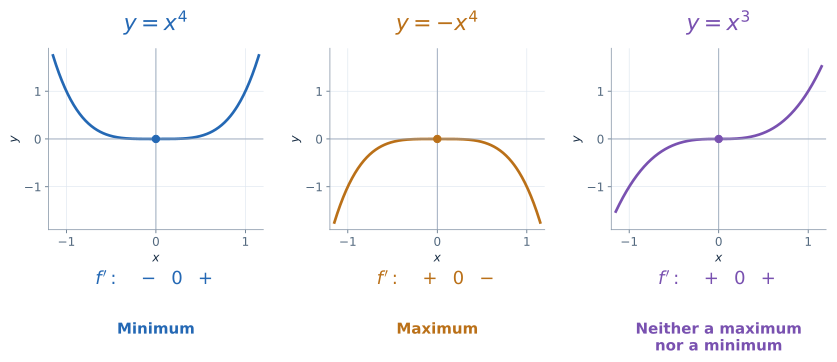
Three graphs at the origin show a minimum, a maximum and a stationary point with no turn, despite the same zero second derivative.

All three curves satisfy f′(0)=f′′(0)=0f'(0)=f''(0)=0. The sign changes in the first derivative distinguish a minimum for x4x^4, a maximum for −x4-x^4 and a stationary point that does not turn for x3x^3.

At the origin, x4x^4, −x4-x^4 and x3x^3 all have zero second derivative, but their stationary points have different natures.

Worked example

The same zero second derivative can lead to three outcomes

Classify the stationary point at the origin for y=x4y=x^4, y=−x4y=-x^4 and y=x3y=x^3.

  1. All three first derivatives are zero at the origin. Their second derivatives, 12x2,−12x2,6x12x^2,-12x^2,6x, are also zero there. This does not decide the nature.

  2. For y=x4y=x^4, the first derivative 4x34x^3 changes from negative to positive. The origin is a minimum.

  3. For y=−x4y=-x^4, the first derivative −4x3-4x^3 changes from positive to negative. The origin is a maximum.

  4. For y=x3y=x^3, the first derivative 3x23x^2 is positive on both sides. The origin is stationary but is neither a maximum nor a minimum.

  5. The function x3x^3 is strictly increasing throughout the real line. Its isolated zero gradient does not reverse or stop that overall increase.

Your turn

For f(x)=4−(x+2)4f(x)=4-(x+2)^4, find f′′(−2)f^{\prime\prime}(-2) and classify the stationary point at x=−2x=-2.

Enter an exact number, for example 3/2 or 2-sqrt(3).

Nature

Section 4 of 5 · Core · about 12 min

How do domain restrictions change the range?

The range contains every output attained on the stated domain. A global maximum or minimum compares all allowed inputs. For a continuous curve on a closed interval, compare the values at all interior stationary points and both endpoints. Check any interior points where the derivative does not exist as well.

Worked example

Compare stationary values and domain boundaries

Find the range of f(x)=6−(x−1)2f(x)=6-(x-1)^2 first on [−1,4][-1,4], then on (−1,4)(-1,4).

  1. f′(x)=−2(x−1)=0⟹x=1,f(1)=6.f^{\prime}(x)=-2(x-1)=0\Longrightarrow x=1,\qquad f(1)=6.
  2. The derivative is positive before 11 and negative after it. Compare the included endpoints as well:

    f(−1)=2,f(4)=−3.f(-1)=2,\qquad f(4)=-3.
  3. On the closed interval the minimum is −3-3 and the maximum is 66. The function is continuous, so it takes every value between them:

    Range on [−1,4]: [−3,6].\text{Range on }[-1,4]:\ [-3,6].
  4. On the open interval the maximum 66 is still attained at x=1x=1. The lower bound −3-3 is approached as xx approaches 44, but is never attained:

    Range on (−1,4): (−3,6].\text{Range on }(-1,4):\ (-3,6].
  5. Removing the input −1-1 does not remove its output 22 from the range: f(3)=2f(3)=2, and 33 remains in the domain.

Your turn

Find the range of f(x)=(x+1)2−2f(x)=(x+1)^2-2 on −1<x≤2-1<x\le2. Give the lower and upper bounds and select which are included.

Enter an exact number, for example 3/2 or 2-sqrt(3).

Enter an exact number, for example 3/2 or 2-sqrt(3).

Included bounds

Worked example

A local maximum need not be a global maximum

Find all stationary points and the full range of f(x)=x+16xf(x)=x+\frac{16}{x}, x≠0x\ne0.

  1. f′(x)=1−16x2=x2−16x2=0⟹x=±4.f^{\prime}(x)=1-\frac{16}{x^2}=\frac{x^2-16}{x^2}=0\Longrightarrow x=\pm4.
  2. The denominator is positive on the domain. The derivative is positive for x<−4x<-4 and x>4x>4, and negative for −4<x<0-4<x<0 and 0<x<40<x<4.

  3. f(−4)=−8(local maximum),f(4)=8(local minimum).f(-4)=-8\quad\text{(local maximum)},\qquad f(4)=8\quad\text{(local minimum)}.
  4. On the negative component, the function tends to negative infinity toward either end, giving range (−∞,−8]( -\infty,-8]. On the positive component, it tends to positive infinity toward either end, giving range [8,∞)[8,\infty).

  5. Full range: (−∞,−8]∪[8,∞).\text{Full range: }(-\infty,-8]\cup[8,\infty).
  6. There is no global maximum or minimum on the full domain, because values are unbounded above and below. Zero is not a stationary input: it is excluded.

Your turn

For f(x)=x+25xf(x)=x+\frac{25}{x}, x≠0x\ne0, find the stationary points and choose the full range.

Enter a point as (1, 2) or x = 1, y = 2. Separate complete pairs with commas or semicolons.

Range

Section 5 of 5 · Further applications · about 8 min

How do parameters change stationary behaviour?

A parameter can alter the number of real stationary inputs or move them outside the allowed domain. Solve the derivative equation before assuming how many points exist. Separate the boundary case where two roots meet from the cases on either side.

Worked example

A parameter can change the number and nature of stationary points

For fk(x)=x3−3kxf_k(x)=x^3-3kx, classify the stationary behaviour for every real kk. When is the function strictly increasing throughout the real line?

  1. fk′(x)=3(x2−k),fk′(x)=0⟹x2=k.f_k^{\prime}(x)=3(x^2-k),\qquad f_k^{\prime}(x)=0\Longrightarrow x^2=k.
  2. If k<0k<0, there are no real stationary inputs. The derivative is positive everywhere, so the function is strictly increasing.

  3. If k=0k=0, the only stationary point is (0,0)(0,0). It is neither a maximum nor a minimum, and the function x3x^3 is strictly increasing.

  4. If k>0k>0, there are two stationary inputs, x=±kx=\pm\sqrt{k}. Since fk′′(x)=6xf_k^{\prime\prime}(x)=6x, the negative input gives a maximum and the positive input gives a minimum:

    (−k, 2kk)maximum,(k, −2kk)minimum.(-\sqrt{k},\,2k\sqrt{k})\quad\text{maximum},\qquad(\sqrt{k},\,-2k\sqrt{k})\quad\text{minimum}.
  5. For k>0k>0, the derivative is negative between the stationary inputs, so the function is not increasing throughout the real line. Therefore the complete condition for strict increase is k≤0k\le0.

Your turn

Let h(x)=x3+3kx+1h(x)=x^3+3kx+1, where kk is real. Choose the condition for two distinct stationary points, then the condition for strict increase throughout the real line.

Two distinct stationary points
Strictly increasing for all real inputs

Worked examples

Practise the method

Core practice

Question 1 of 4

0 / 4 checked in this collection

Question list

Core practice

Fresh variants

Exam-style

Every stationary point and its nature

2 marks

Find all stationary points of f(x)=x3−3xx^{3} - 3 x and select their nature from left to right.

Enter a point as (1, 2) or x = 1, y = 2. Separate complete pairs with commas or semicolons.

Nature from left to right

Choose one option. Explain your reasoning on paper.

Full answer-format guide

Exact numbers: 3/2, sqrt(5), 2-sqrt(3), pi/6, 3*pi/2. Sets: {1,4}. Intervals: (3,5]; a round bracket excludes the endpoint. Infinity: inf; union: U; no solutions: empty. Separate coordinate pairs or triples with semicolons. Expressions: 2x^2+3x-1; equations: x^2=3x+1 or the polynomial equal to zero. Factors: x-1 ; x+2. Parameter fraction: numerator ; denominator. List integer answers individually.

Review the method

Progress stays in this browser. Create an account to save it or sign in.

Extra practice from this lesson

Recover both coordinates and classify each stationary point

Find all stationary points of f(x)=x3−6x2+9x+1f(x)=x^3-6x^2+9x+1. Classify them from left to right, and choose the set where f′(x)<0f^{\prime}(x)<0.

Enter a point as (1, 2) or x = 1, y = 2. Separate complete pairs with commas or semicolons.

Nature from left to right
Where f′(x)<0f^{\prime}(x)<0

A zero second derivative does not rule out a minimum

For f(x)=(x−2)4−3f(x)=(x-2)^4-3, give the stationary point, the value of f′′f^{\prime\prime} there, and its nature.

Enter a point as (1, 2) or x = 1, y = 2. Separate complete pairs with commas or semicolons.

Enter an exact number, for example 3/2 or 2-sqrt(3).

Nature

Distinguish a strict derivative inequality from strict increase

For f(x)=(x+1)3−2f(x)=(x+1)^3-2, identify the nature of its stationary point. Choose the set where f′(x)>0f^{\prime}(x)>0, and decide whether ff is strictly increasing on the whole real line.

Nature of the stationary point
Set where f′(x)>0f^{\prime}(x)>0
Strictly increasing on the whole real line?

Compare stationary values with both included endpoints

Find the minimum and maximum values of f(x)=−x2+6x+1f(x)=-x^2+6x+1 on 0≤x≤50\le x\le5. Give the input where each occurs.

Enter an exact number, for example 3/2 or 2-sqrt(3).

Enter an exact number, for example 3/2 or 2-sqrt(3).

Enter an exact number, for example 3/2 or 2-sqrt(3).

Enter an exact number, for example 3/2 or 2-sqrt(3).

An open input boundary can give an unattained output bound

Find the range of f(x)=(x−2)2+1f(x)=(x-2)^2+1 for 0<x<30<x<3. Enter the lower and upper bounds and choose which are attained.

Enter an exact number, for example 3/2 or 2-sqrt(3).

Enter an exact number, for example 3/2 or 2-sqrt(3).

Which bounds are attained?

Keep the two components of a reciprocal curve separate

For f(x)=x+9xf(x)=x+\frac{9}{x}, where x≠0x\ne0, give all stationary points and select the complete range.

Enter a point as (1, 2) or x = 1, y = 2. Separate complete pairs with commas or semicolons.

Complete range

Apply it · original exam-style problems

Show your working on paper and compare it with the worked solution and marking guidance.

Start after this lesson

Stationary inputs determine a curve, but endpoints determine its full range 8 marks

Let f(x)=ax3+bx2+12x−7f(x)=ax^3+bx^2+12x-7. It has stationary points at inputs x=1x=1 and x=2x=2. Find a,ba,b, give the local maximum and minimum points, and find the range of the recovered function on 0≤x≤30\le x\le3.

Hint

Use the two zero-gradient conditions to find the parameters. Then classify the stationary points and compare their heights with both endpoint heights.

Worked solution
  1. f′(x)=3ax2+2bx+12.f^{\prime}(x)=3ax^2+2bx+12.
  2. 3a+2b+12=0,12a+4b+12=0.3a+2b+12=0,\qquad12a+4b+12=0.
  3. Subtract twice the first equation from the second: 6a−12=06a-12=0. Thus a=2a=2, and the first equation gives b=−9b=-9.

  4. f(x)=2x3−9x2+12x−7,f′′(x)=12x−18.f(x)=2x^3-9x^2+12x-7,\qquad f^{\prime\prime}(x)=12x-18.
  5. At 11, the second derivative is −6-6, giving a local maximum (1,−2)(1,-2). At 22, it is 66, giving a local minimum (2,−3)(2,-3).

  6. f(0)=−7,f(1)=−2,f(2)=−3,f(3)=2.f(0)=-7,\quad f(1)=-2,\quad f(2)=-3,\quad f(3)=2.
  7. The global minimum and maximum on the restricted domain occur at the endpoints. Continuity gives the complete range [−7,2][-7,2]. Both bounds are attained.

Marking guidance
  • 1 mark: obtain the first derivative with unknown parameters.
  • 1 mark: form both stationary-input equations.
  • 1 mark: solve for a=2,b=−9a=2,b=-9.
  • 1 mark: obtain both complete stationary coordinates.
  • 1 mark: justify the local maximum at x=1x=1.
  • 1 mark: justify the local minimum at x=2x=2.
  • 1 mark: calculate and compare both endpoint values.
  • 1 mark: state the complete closed range [−7,2][-7,2].
Include valid endpoints without calling them stationary 6 marks

For f(x)=9−x2f(x)=\sqrt{9-x^2} on its full real domain, find all stationary points and their nature. Find every point where the global minimum is attained, then give the range bounds.

Hint

The square root gives a closed real domain. Its derivative is finite only inside that interval. Check the endpoint function values separately.

Worked solution
  1. 9−x2≥0⟹−3≤x≤3.9-x^2\ge0\Longrightarrow -3\le x\le3.
  2. f′(x)=−x9−x2(−3<x<3).f^{\prime}(x)=-\frac{x}{\sqrt{9-x^2}}\qquad(-3<x<3).
  3. The only finite zero derivative is at x=0x=0, giving (0,3)(0,3). The derivative changes from positive to negative there, so this is a local maximum and also the global maximum.

  4. f(−3)=f(3)=0.f(-3)=f(3)=0.
  5. These endpoints give the global minimum but are not stationary points: they do not have a finite zero derivative. By continuity, the full range is [0,3][0,3].

Marking guidance
  • 1 mark: establish the real domain [−3,3][-3,3].
  • 1 mark: obtain the derivative and its interior domain.
  • 1 mark: find the sole stationary point (0,3)(0,3).
  • 1 mark: classify it using the derivative signs.
  • 1 mark: identify both endpoint minima without calling them stationary.
  • 1 mark: state the full range [0,3][0,3].
Separate parameter cases before using a stationary value 7 marks

Let f(x)=x3−3kx+4f(x)=x^3-3kx+4, where kk is real. Choose the condition for two distinct stationary points, and the condition for strict increase on the entire real line. If the local maximum value is 2020, find kk and both stationary points.

Hint

The stationary equation is x2=kx^2=k. For positive kk, classify the negative and positive roots before substituting into the function.

Worked solution
  1. f′(x)=3(x2−k),f′′(x)=6x.f^{\prime}(x)=3(x^2-k),\qquad f^{\prime\prime}(x)=6x.
  2. If k>0k>0, the two stationary inputs are −k-\sqrt{k} and k\sqrt{k}. They are a local maximum and minimum respectively. If k=0k=0, there is one stationary point with no maximum or minimum. If k<0k<0, there are none.

  3. For k<0k<0, the derivative is positive everywhere. For k=0k=0, the translated cubic is still strictly increasing despite its isolated zero derivative. For k>0k>0, the derivative is negative between the two stationary inputs. Thus strict increase on the whole real line occurs exactly when k≤0k\le0.

  4. f(−k)=4+2kk=20⟹kk=8⟹k=4.f(-\sqrt{k})=4+2k\sqrt{k}=20\Longrightarrow k\sqrt{k}=8\Longrightarrow k=4.
  5. f(−2)=20,f(2)=−12.f(-2)=20,\qquad f(2)=-12.
  6. The required points are the local maximum (−2,20)(-2,20) and local minimum (2,−12)(2,-12).

Marking guidance
  • 1 mark: obtain the stationary equation x2=kx^2=k.
  • 1 mark: distinguish the positive, zero and negative parameter cases.
  • 1 mark: give the strict-increase condition including k=0k=0.
  • 1 mark: identify the maximum branch and form its value equation.
  • 1 mark: solve for k=4k=4.
  • 1 mark: obtain the complete local maximum point.
  • 1 mark: obtain the complete local minimum point.

Come back to what needs practice

Quick revision sheet (A4)

Your review plan starts after your first check.

Question bank and saved work