Maths4UBETA

Optimisation, transformations and linked conditions

Build a model on its feasible domain, compare global candidates and carry the chain rule into transformed curves.

Try the quick check →
Lesson 5 of 5

Section 1 of 5 · Core · about 8 min

How do I turn a practical problem into one function?

Optimisation means finding the greatest or least possible value under stated conditions. The objective is the quantity to improve, such as area, volume or cost. The constraint is the relationship that must remain true.

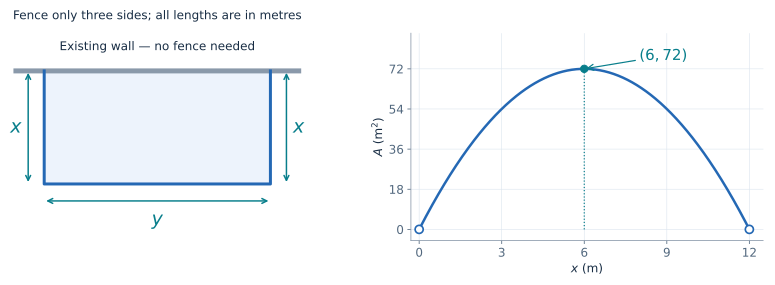
A rectangle against a wall has two equal perpendicular fenced sides and one remaining fenced side. Its area graph marks the feasible domain and maximum.

  1. The three fenced sides give 2x+y=242x+y=24. Thus y=24−2xy=24-2x and 0<x<120<x<12.
  2. A(x)=24x−2x2,A′(x)=24−4x.A(x)=24x-2x^2,\qquad A'(x)=24-4x.Setting the derivative to zero gives x=6x=6 and y=12y=12.
  3. Since A(x)=72−2(x−6)2A(x)=72-2(x-6)^2, the maximum is 72 m272\,\mathrm{m}^2. The excluded endpoints would give a zero side length.

The fence constraint is 2x+y=242x+y=24, so A=x(24−2x)A=x(24-2x) on 0<x<120<x<12. The greatest area is 72 m272\ \mathrm{m^2}.

Worked example

Choose one variable for a constrained area

A wall forms one side of a rectangular enclosure. There are 24 m24\ \mathrm{m} of fencing for the other three sides. Find the dimensions giving the greatest area.

  1. Let xx be each side perpendicular to the wall and yy the remaining fenced side.

    2x+y=24⟹y=24−2x.2x+y=24\Longrightarrow y=24-2x.
  2. Positive side lengths give 0<x<120<x<12. The area is

    A=xy=x(24−2x)=24x−2x2.A=xy=x(24-2x)=24x-2x^2.
  3. dAdx=24−4x=0⟹x=6.\frac{dA}{dx}=24-4x=0\Longrightarrow x=6.
  4. y=12 m,A=72 m2.y=12\ \mathrm{m},\qquad A=72\ \mathrm{m^2}.
  5. The identity A=72−2(x−6)2A=72-2(x-6)^2 shows that no allowed input gives a greater value. Equality is attained at the feasible dimensions 6 m6\ \mathrm{m} by 12 m12\ \mathrm{m}.

Your turn

A rectangular enclosure uses a wall for one side and 32 m32\ \mathrm{m} of fencing for the other three. Let xx be each side perpendicular to the wall and yy the remaining fenced side. Find the dimensions giving the greatest area and that area.

Enter the value on its own or write x = … . Fractions and exact square roots are accepted.

Enter the value on its own or write y = … . Fractions and exact square roots are accepted.

Enter the value on its own or write area = … . Fractions and exact square roots are accepted.

Section 2 of 5 · Core · about 7 min

How do I prove that a value is the global optimum?

A zero derivative identifies a possible interior optimum. It does not by itself prove that the point is allowed, that it has the right nature or that no better value occurs elsewhere.

Worked example

Reject an infeasible stationary input and check attainment

Find the greatest and least values of F(x)=12−(x−2)2F(x)=12-(x-2)^2 on [4,7][4,7]. What changes if the domain is [4,7)[4,7)?

  1. F′(x)=−2(x−2)=0⟹x=2.F^{\prime}(x)=-2(x-2)=0\Longrightarrow x=2.
  2. The stationary input is outside both stated domains. On either domain, F′(x)<0F^{\prime}(x)<0, so FF is strictly decreasing.

  3. F(4)=8,F(7)=−13.F(4)=8,\qquad F(7)=-13.
  4. On [4,7][4,7], the maximum is 88 at x=4x=4 and the minimum is −13-13 at x=7x=7.

  5. On [4,7)[4,7), the maximum 88 is still attained. There is no minimum: values approach −13-13 as xx approaches 77, but no allowed input produces −13-13.

Your turn

Find the maximum value of F(x)=x(18−x)F(x)=x(18-x) on 0≤x≤60\le x\le6, and the input where it occurs.

Enter an exact number, for example 3/2 or 2-sqrt(3).

Enter an exact number, for example 3/2 or 2-sqrt(3).

A nonzero second derivative classifies a stationary point locally. To claim a global optimum, connect that result to the whole domain, for example using a complete sign argument, endpoint comparison or a direct inequality such as a completed square.

Section 3 of 5 · Core · about 14 min

How do I optimise cylinders and folded boxes?

For a cylinder, V=πr2hV=\pi r^2h and the curved area is 2πrh2\pi rh. Add 2πr22\pi r^2 for two circular ends, or πr2\pi r^2 for one base. A fixed volume lets you express hh in terms of rr before differentiating. If materials have different costs per unit area, multiply each area by its own cost first.

Worked example

Minimise the surface area of a closed cylinder

A closed cylindrical can has volume 54π cm354\pi\ \mathrm{cm^3}. Find the positive radius and height that minimise its total surface area, and calculate that area. Ignore material thickness.

  1. V=πr2h=54π⟹h=54r2,r>0.V=\pi r^2h=54\pi\Longrightarrow h=\frac{54}{r^2},\qquad r>0.
  2. Count two circular ends and the curved surface:

    S=2πr2+2πrh=2πr2+108πr.S=2\pi r^2+2\pi rh=2\pi r^2+\frac{108\pi}{r}.
  3. S′(r)=4πr−108πr2=4π(r3−27)r2.S^{\prime}(r)=4\pi r-\frac{108\pi}{r^2}=\frac{4\pi(r^3-27)}{r^2}.
  4. S′(r)=0⟹r3=27⟹r=3 cm.S^{\prime}(r)=0\Longrightarrow r^3=27\Longrightarrow r=3\ \mathrm{cm}.
  5. For 0<r<30<r<3, the derivative is negative; for r>3r>3, it is positive. The surface area therefore decreases to this point and then increases throughout the remaining domain. This is a global minimum.

  6. h=549=6 cm,S=18π+36π=54π cm2.h=\frac{54}{9}=6\ \mathrm{cm},\qquad S=18\pi+36\pi=54\pi\ \mathrm{cm^2}.

Worked example

Removing the lid changes the optimum

An open cylindrical container has volume 27π cm327\pi\ \mathrm{cm^3}, one base and no lid. Find the dimensions that minimise the material area.

  1. h=27r2,S=πr2+2πrh=πr2+54πr,r>0.h=\frac{27}{r^2},\qquad S=\pi r^2+2\pi rh=\pi r^2+\frac{54\pi}{r},\qquad r>0.
  2. S′(r)=2πr−54πr2=2π(r3−27)r2.S^{\prime}(r)=2\pi r-\frac{54\pi}{r^2}=\frac{2\pi(r^3-27)}{r^2}.
  3. S′(r)=0⟹r=3 cm,h=3 cm.S^{\prime}(r)=0\Longrightarrow r=3\ \mathrm{cm},\qquad h=3\ \mathrm{cm}.
  4. The derivative is negative before 33 and positive after it, so this is the global minimum on the physical domain.

  5. S=9π+18π=27π cm2.S=9\pi+18\pi=27\pi\ \mathrm{cm^2}.
  6. Here the best height equals the radius. The closed can above has height twice its radius. These relationships come from the counted surfaces; rebuild the objective if faces or material costs change.

Your turn

An open cylindrical container has volume 8π cm38\pi\ \mathrm{cm^3}, one base and no lid. Find the radius, height and least surface area.

Enter the value on its own or write r = … . Fractions and exact square roots are accepted.

Enter an exact number, for example 3/2 or 2-sqrt(3).

Enter the value on its own or write area = … . Fractions and exact square roots are accepted.

For a box made by cutting squares from a sheet, each base dimension loses twice the cut size. Write all three dimensions before multiplying them. The smallest original sheet dimension determines the upper bound on the cut.

Worked example

Keep all dimensions positive in a folded-box model

A square sheet has side 12 cm12\ \mathrm{cm}. Equal squares of side xx are removed from its corners, and the sides are folded up to form an open box. Find the cut size giving the greatest volume.

  1. The height is xx; each base side is 12−2x12-2x. Positive dimensions require 0<x<60<x<6.

    V=x(12−2x)2=144x−48x2+4x3.V=x(12-2x)^2=144x-48x^2+4x^3.
  2. V′(x)=144−96x+12x2=12(x−2)(x−6).V^{\prime}(x)=144-96x+12x^2=12(x-2)(x-6).
  3. The derivative vanishes at 22 and 66. Reject 66, which would give a zero-width base and is outside the feasible domain.

  4. The derivative is positive on (0,2)(0,2) and negative on (2,6)(2,6). The volume tends to zero at both domain ends, so x=2x=2 gives the global maximum.

  5. Dimensions: 8 cm×8 cm×2 cm;V=128 cm3.\text{Dimensions: }8\ \mathrm{cm}\times8\ \mathrm{cm}\times2\ \mathrm{cm};\qquad V=128\ \mathrm{cm^3}.

Section 4 of 5 · Core · about 12 min

How do transformations move stationary points and gradients?

Suppose g(x)=Af(Bx)+Cg(x)=Af(Bx)+C, where A≠0A\ne0 and B≠0B\ne0. To reproduce an original input aa, solve Bx=aBx=a. Transform the height separately.

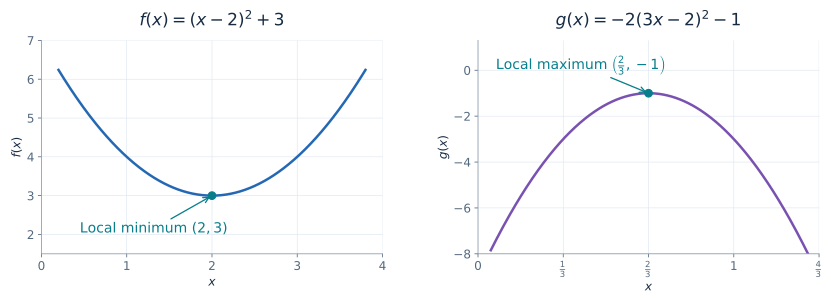
Separate original and transformed curves show a horizontal input scale and a negative vertical factor changing a minimum into a maximum.

  1. For f(x)=(x−2)2+3f(x)=(x-2)^2+3, the turning point is (2,3)(2,3). For g(x)=−2f(3x)+5g(x)=-2f(3x)+5, solve 3x=2  ⟹  x=233x=2\implies x=\frac23 and find the new output −2(3)+5=−1-2(3)+5=-1.
  2. In general, g(x)=Af(Bx)+Cg(x)=Af(Bx)+C maps (u,v)↦(uB,Av+C)(u,v)\mapsto\left(\frac{u}{B},Av+C\right) for non-zero AA and BB. A negative AA reverses maximum and minimum.

The minimum (2,3)(2,3) of ff maps to the maximum (23,−1)\left(\frac{2}{3},-1\right) of g(x)=−2f(3x)+5g(x)=-2f(3x)+5.

Worked example

Map a stationary point through a combined transformation

Let f(x)=(x−2)2+3f(x)=(x-2)^2+3 and g(x)=−2f(3x)+5g(x)=-2f(3x)+5. Find the stationary point of gg, classify it and check using differentiation.

  1. The minimum of ff is (2,3)(2,3). Set the transformed input equal to the original input:

    3x=2⟹x=23.3x=2\Longrightarrow x=\frac{2}{3}.
  2. g(23)=−2(3)+5=−1.g\left(\frac{2}{3}\right)=-2(3)+5=-1.
  3. The negative vertical factor turns the minimum into a maximum, so the image is (23,−1)\left(\frac{2}{3},-1\right).

  4. g(x)=−2(3x−2)2−1,g′(x)=−12(3x−2).g(x)=-2(3x-2)^2-1,\qquad g^{\prime}(x)=-12(3x-2).
  5. g′(23)=0,g′′(x)=−36<0.g^{\prime}\left(\frac{2}{3}\right)=0,\qquad g^{\prime\prime}(x)=-36<0.

    The derivative check confirms the maximum.

Worked example

A negative inner factor reverses positions, not peak types

The function f(x)=x3−3xf(x)=x^3-3x has a local maximum at (−1,2)(-1,2) and a local minimum at (1,−2)(1,-2). Find and classify the stationary points of g(x)=−2f(−3x)+5g(x)=-2f(-3x)+5.

  1. Divide original inputs by −3-3, and transform each height by multiplying by −2-2 then adding 55:

    (−1,2)↦(13,1),(1,−2)↦(−13,9).(-1,2)\mapsto\left(\frac{1}{3},1\right),\qquad(1,-2)\mapsto\left(-\frac{1}{3},9\right).
  2. The negative inner factor reverses left and right. The negative outer factor swaps maxima and minima. Thus (13,1)\left(\frac{1}{3},1\right) is a local minimum and (−13,9)\left(-\frac{1}{3},9\right) is a local maximum.

  3. g′(x)=(−2)(−3)f′(−3x)=6(27x2−3)=162x2−18.g^{\prime}(x)=(-2)(-3)f^{\prime}(-3x)=6(27x^2-3)=162x^2-18.
  4. g′′(x)=324x.g^{\prime\prime}(x)=324x.

    It is positive at 13\frac{1}{3} and negative at −13-\frac{1}{3}, confirming both classifications.

Your turn

The graph of a differentiable function ff has a local maximum at (−3,4)(-3,4), and f′(2)=−4f^{\prime}(2)=-4. Let g(x)=3f(−2x)−5g(x)=3f(-2x)-5. Find the image of that point, classify it and calculate g′(−1)g^{\prime}(-1).

Enter a point as (1, 2) or x = 1, y = 2. Separate complete pairs with commas or semicolons.

Nature

Enter an exact number, for example 3/2 or 2-sqrt(3).

The nonzero assumptions matter. If A=0A=0, the expression is constant only on its inherited domain: excluded inputs of f(Bx)f(Bx) stay excluded. If B=0B=0, the expression requires f(0)f(0) to exist; when it does, gg is constant. These cases do not give a one-to-one mapping of isolated stationary points.

Section 5 of 5 · Further applications · about 9 min

How do several point and gradient conditions determine parameters?

Translate each statement into its own equation. A point supplies a function value; a stationary input supplies a zero derivative. A prescribed gradient supplies a derivative value. Solve the resulting equations together, then verify the requested nature and domain.

Worked example

A prescribed minimum gives two linked equations

For x>0x>0, the curve f(x)=ax2+bxf(x)=ax^2+\frac{b}{x} has a minimum at (2,12)(2,12). Find a,ba,b and verify the minimum.

  1. The stated height gives

    f(2)=4a+b2=12.f(2)=4a+\frac{b}{2}=12.
  2. The stationary input gives a different condition:

    f′(x)=2ax−bx2,4a−b4=0⟹b=16a.f^{\prime}(x)=2ax-\frac{b}{x^2},\qquad4a-\frac{b}{4}=0\Longrightarrow b=16a.
  3. 4a+8a=12⟹a=1,b=16.4a+8a=12\Longrightarrow a=1,\qquad b=16.
  4. f′′(x)=2+32x3,f′′(2)=6>0.f^{\prime\prime}(x)=2+\frac{32}{x^3},\qquad f^{\prime\prime}(2)=6>0.
  5. Both original conditions hold. Also f′(x)=2(x3−8)x2f^{\prime}(x)=\frac{2(x^3-8)}{x^2} is negative before 22 and positive after it throughout x>0x>0, so the point is a global minimum on this domain.

Your turn

The curve y=x2+ax+by=x^2+ax+b has a minimum at (−2,3)(-2,3). Find a,ba,b.

Enter the value on its own or write a = … . Fractions and exact square roots are accepted.

Enter the value on its own or write b = … . Fractions and exact square roots are accepted.

Your turn

A differentiable function ff, defined for all real inputs, has a local minimum at (3,4)(3,4) and f′(0)=5f^{\prime}(0)=5. In g(x)=Af(Bx)+Cg(x)=Af(Bx)+C, where A,B≠0A,B\ne0, this point maps to (−1,−2)(-1,-2), and g′(0)=30g^{\prime}(0)=30. Find A,B,CA,B,C and classify the mapped stationary point.

Enter the value on its own or write A = … . Fractions and exact square roots are accepted.

Enter the value on its own or write B = … . Fractions and exact square roots are accepted.

Enter the value on its own or write C = … . Fractions and exact square roots are accepted.

Mapped point

Worked examples

Practise the method

Core practice

Question 1 of 4

0 / 4 checked in this collection

Question list

Core practice

Fresh variants

Exam-style

A feasible rectangle and a global maximum

3 marks

A non-degenerate rectangle has perimeter 24 cm. One side is x. Give its feasible x-interval, the x giving greatest area and that area.

Use inequalities in x or interval notation. Join intervals with ‘or’ or ∪. Enter an isolated value on its own.

Enter an exact number, for example 3/2 or 2-sqrt(3).

Enter the value on its own or write area = … . Fractions and exact square roots are accepted.

Full answer-format guide

Exact numbers: 3/2, sqrt(5), 2-sqrt(3), pi/6, 3*pi/2. Sets: {1,4}. Intervals: (3,5]; a round bracket excludes the endpoint. Infinity: inf; union: U; no solutions: empty. Separate coordinate pairs or triples with semicolons. Expressions: 2x^2+3x-1; equations: x^2=3x+1 or the polynomial equal to zero. Factors: x-1 ; x+2. Parameter fraction: numerator ; denominator. List integer answers individually.

Review the method

Progress stays in this browser. Create an account to save it or sign in.

Extra practice from this lesson

Turn a fixed perimeter into a one-variable area

A rectangle with positive side lengths has perimeter 36 m36\,\mathrm{m}. Find its dimensions when its area is greatest, and find that greatest area.

Enter an exact number, for example 3/2 or 2-sqrt(3).

Enter an exact number, for example 3/2 or 2-sqrt(3).

Enter the value on its own or write area = … . Fractions and exact square roots are accepted.

A feasible boundary can beat every interior candidate

A rectangular enclosure uses an existing wall for one side. The other three sides use 60 m60\,\mathrm{m} of fencing. Each perpendicular side has length xx, and a site restriction requires 0<x≤100<x\le10.

Find the width xx, the side parallel to the wall, and the greatest possible area.

Enter an exact number, for example 3/2 or 2-sqrt(3).

Enter an exact number, for example 3/2 or 2-sqrt(3).

Enter the value on its own or write area = … . Fractions and exact square roots are accepted.

An excluded limiting value is not an attained optimum

For F(x)=x2+1F(x)=x^2+1 with 1<x<31<x<3, find the lower and upper limiting bounds of the output. Decide whether either bound is attained.

Enter an exact number, for example 3/2 or 2-sqrt(3).

Enter an exact number, for example 3/2 or 2-sqrt(3).

Which bounds are attained?

Transform coordinates, the domain and the nature of stationary points

A differentiable function ff has domain [−2,4][-2,4]. Its only stationary points are a local maximum at (2,5)(2,5) and a local minimum at (−1,−3)(-1,-3). Define g(x)=−2f(3x)+7g(x)=-2f(3x)+7.

Give the local maximum and minimum points of gg, and the bounds of its domain.

Enter each pair in the order shown. Separate complete pairs with commas or semicolons.

Enter each pair in the order shown. Separate complete pairs with commas or semicolons.

Enter an exact number, for example 3/2 or 2-sqrt(3).

Enter an exact number, for example 3/2 or 2-sqrt(3).

The transformed gradient needs both scale factors

You are given f′(−2)=3f^{\prime}(-2)=3. If g(x)=4f(−2x)+1g(x)=4f(-2x)+1, find g′(1)g^{\prime}(1).

Enter an exact number, for example 3/2 or 2-sqrt(3).

Use a point condition and a stationary condition separately

The curve f(x)=ax3+bx+1f(x)=ax^3+bx+1 passes through (1,−2)(1,-2), which is a stationary point. Find a,ba,b, classify this point, and find the other stationary point.

Enter the value on its own or write a = … . Fractions and exact square roots are accepted.

Enter the value on its own or write b = … . Fractions and exact square roots are accepted.

Nature of the given point

Enter a point as (1, 2) or x = 1, y = 2. Separate complete pairs with commas or semicolons.

Apply it · original exam-style problems

Show your working on paper and compare it with the worked solution and marking guidance.

Start after this lesson

Minimise the material in a closed cylinder 7 marks

A closed cylindrical container has volume 128π cm3128\pi\,\mathrm{cm^3}. Its curved side and both circular ends use material of the same thickness. Find the radius and height that minimise its total surface area, and find the minimum surface area. Justify that the minimum is global for positive dimensions.

Hint

Use the volume constraint to eliminate height. A closed cylinder has two circular ends.

Worked solution
  1. πr2h=128π⟹h=128r2(r>0).\pi r^2h=128\pi\Longrightarrow h=\frac{128}{r^2}\qquad(r>0).
  2. S=2πr2+2πrh=2πr2+256πr.S=2\pi r^2+2\pi rh=2\pi r^2+\frac{256\pi}{r}.
  3. S′(r)=4πr−256πr2=4π(r3−64)r2.S^{\prime}(r)=4\pi r-\frac{256\pi}{r^2}=\frac{4\pi(r^3-64)}{r^2}.
  4. S′(r)=0⟹r=4 cm,h=12816=8 cm.S^{\prime}(r)=0\Longrightarrow r=4\,\mathrm{cm},\qquad h=\frac{128}{16}=8\,\mathrm{cm}.
  5. For every positive radius below 44, the derivative is negative; for every radius above 44, it is positive. The area therefore decreases to this point and increases afterward, proving a global minimum.

  6. Smin⁡=2π(4)2+2π(4)(8)=96π cm2.S_{\min}=2\pi(4)^2+2\pi(4)(8)=96\pi\,\mathrm{cm^2}.
Marking guidance
  • 1 mark: use the volume constraint to express height in terms of radius.
  • 1 mark: form the total surface area including both ends.
  • 1 mark: differentiate the one-variable area correctly.
  • 1 mark: obtain the positive stationary radius 4 cm4\,\mathrm{cm}.
  • 1 mark: restore the height 8 cm8\,\mathrm{cm}.
  • 1 mark: justify the global minimum on the positive domain.
  • 1 mark: obtain 96π cm296\pi\,\mathrm{cm^2}.
Reject an algebraic root outside the physical box model 8 marks

An open box is made from a 30 cm30\,\mathrm{cm} by 18 cm18\,\mathrm{cm} rectangular sheet. Equal squares of side xx are cut from all four corners, and the remaining sides are folded upward.

Find the height, longer base side, shorter base side and greatest volume of the box. Give exact values and justify the maximum on the physical domain.

Hint

The dimensions are xx, 30−2x30-2x and 18−2x18-2x. All must be positive, so use 0<x<90<x<9 before choosing a stationary root.

Worked solution
  1. V(x)=x(30−2x)(18−2x)=540x−96x2+4x3,0<x<9.V(x)=x(30-2x)(18-2x)=540x-96x^2+4x^3,\qquad0<x<9.
  2. V′(x)=12(x2−16x+45)=0⟹x=8±19.V^{\prime}(x)=12(x^2-16x+45)=0\Longrightarrow x=8\pm\sqrt{19}.
  3. The input 8+19>98+\sqrt{19}>9 is infeasible. Only x=8−19x=8-\sqrt{19} lies in the physical interval.

  4. The derivative is positive before this allowed input and negative after it throughout (0,9)(0,9). The volume approaches zero at both excluded degenerate ends, so the interior value is the global maximum.

  5. 30−2x=14+219,18−2x=2+219.30-2x=14+2\sqrt{19},\qquad18-2x=2+2\sqrt{19}.
  6. Vmax⁡=(8−19)(14+219)(2+219)=224+15219 cm3.V_{\max}=(8-\sqrt{19})(14+2\sqrt{19})(2+2\sqrt{19})=224+152\sqrt{19}\,\mathrm{cm^3}.
Marking guidance
  • 1 mark: form the volume in one variable.
  • 1 mark: state the strict physical domain 0<x<90<x<9.
  • 1 mark: obtain the derivative and its quadratic equation.
  • 1 mark: select 8−198-\sqrt{19} and reject the infeasible root.
  • 1 mark: justify the global maximum over the whole feasible interval.
  • 1 mark: obtain the longer base side.
  • 1 mark: obtain the shorter base side.
  • 1 mark: give the exact greatest volume with correct units.
Recover a transformation from linked point and gradient conditions 7 marks

A twice differentiable function ff has a stationary point at (2,3)(2,3), with f′(0)=2f^{\prime}(0)=2 and f′′(2)=−1f^{\prime\prime}(2)=-1. Define g(x)=Af(Bx)+Cg(x)=Af(Bx)+C, where A,B≠0A,B\ne0.

This stationary point is mapped to (−1,−5)(-1,-5) on gg, and g′(0)=12g^{\prime}(0)=12. Find A,B,CA,B,C, calculate g′′(−1)g^{\prime\prime}(-1), and classify the transformed stationary point.

Hint

Match the inner input at the mapped point first. Use g′(x)=ABf′(Bx)g^{\prime}(x)=ABf^{\prime}(Bx) for the gradient condition and g′′(x)=AB2f′′(Bx)g^{\prime\prime}(x)=AB^2f^{\prime\prime}(Bx) for the final classification.

Worked solution
  1. At the mapped contact, the inner input must equal 22:

    B(−1)=2⟹B=−2.B(-1)=2\Longrightarrow B=-2.
  2. g′(0)=ABf′(0)=2AB=12⟹AB=6⟹A=−3.g^{\prime}(0)=ABf^{\prime}(0)=2AB=12\Longrightarrow AB=6\Longrightarrow A=-3.
  3. g(−1)=Af(2)+C=−5⟹−9+C=−5⟹C=4.g(-1)=Af(2)+C=-5\Longrightarrow -9+C=-5\Longrightarrow C=4.
  4. g′′(x)=AB2f′′(Bx).g^{\prime\prime}(x)=AB^2f^{\prime\prime}(Bx).
  5. g′′(−1)=(−3)(−2)2(−1)=12.g^{\prime\prime}(-1)=(-3)(-2)^2(-1)=12.
  6. The mapped point is stationary because g′(−1)=ABf′(2)=0g^{\prime}(-1)=ABf^{\prime}(2)=0. Its positive second derivative makes it a local minimum. The negative outside factor reverses the original maximum; the squared inside factor does not reverse this classification.

Marking guidance
  • 1 mark: match the original and transformed contact inputs.
  • 1 mark: obtain B=−2B=-2.
  • 1 mark: form the gradient equation using both scale factors.
  • 1 mark: obtain A=−3A=-3.
  • 1 mark: use the mapped height to obtain C=4C=4.
  • 1 mark: calculate the second derivative with the factor B2B^2.
  • 1 mark: justify the local minimum at the stationary point.

Come back to what needs practice

Quick revision sheet (A4)

Your review plan starts after your first check.

Question bank and saved work