Maths4UBETA

Chords, triangles and circular segments

Separate a sector from its triangle and decide whether the requested region is minor or major.

Try the quick check →
Lesson 4 of 5

Section 1 of 6 · Core · about 7 min

Which triangle facts do I need?

Join both ends of a chord to the centre. The two radii form an isosceles triangle. Its perpendicular from the centre divides it into two right triangles. These triangles connect a curved boundary with measurable straight lengths.

For an acute angle α\alpha in a right triangle, label the hypotenuse first: it is opposite the right angle. Then label the opposite and adjacent sides relative to α\alpha.

AngleSineCosineTangent
π6\frac{\pi}{6}12\frac{1}{2}32\frac{\sqrt3}{2}13\frac{1}{\sqrt3}
π4\frac{\pi}{4}22\frac{\sqrt2}{2}22\frac{\sqrt2}{2}11
π3\frac{\pi}{3}32\frac{\sqrt3}{2}12\frac{1}{2}3\sqrt3

Worked example

Find the two shorter sides

A right triangle has hypotenuse 88 cm and acute angle π3\frac{\pi}{3}. Find its opposite and adjacent sides exactly.

  1. x8=sin⁡(π3)\frac{x}{8}=\sin(\frac{\pi}{3}), so x=8(32)=43x=8(\frac{\sqrt3}{2})=4\sqrt3 cm.

    Use sine for the opposite side.

  2. y8=cos⁡(π3)\frac{y}{8}=\cos(\frac{\pi}{3}), so y=8(12)=4y=8(\frac{1}{2})=4 cm.

    Use cosine for the adjacent side.

  3. (43)2+42=48+16=64=82(4\sqrt3)^2+4^2=48+16=64=8^2.

    Pythagoras checks both lengths.

Your turn

A right triangle has hypotenuse 1010 cm and an angle π6\frac{\pi}{6}. Find the side opposite this angle and the adjacent side exactly.

Enter an exact number, for example 3/2 or 2-sqrt(3).

Enter an exact number, for example 3/2 or 2-sqrt(3).

For a triangle with sides aa and bb and the angle CC between them, the height to side aa is bsin⁡Cb\sin C. Therefore its area is 12absin⁡C\tfrac12ab\sin C. This formula also works for an obtuse included angle: sin⁡(π−C)=sin⁡C\sin(\pi-C)=\sin C, so the perpendicular height is still positive. The triangle angle satisfies 0<C<π0<C<\pi.

Worked example

Find an area from two sides and their angle

Two sides of a triangle are 88 cm and 66 cm, with included angle π6\frac{\pi}{6}. Find its exact area.

  1. A=12(8)(6)sin⁡(π6)A=\tfrac12(8)(6)\sin(\frac{\pi}{6}).

    The angle belongs between the two lengths used in the formula.

  2. A=12(8)(6)(12)=12 cm2A=\tfrac12(8)(6)(\frac{1}{2})=12\text{ cm}^2.

    Use the exact sine value and square units.

Your turn

Two sides of a triangle are 77 cm and 1212 cm. The angle between them is π6\frac{\pi}{6}. Find its exact area.

Enter the value on its own or write area = … . Fractions and exact square roots are accepted.

Section 2 of 6 · Core · about 6 min

How does the central angle determine the chord?

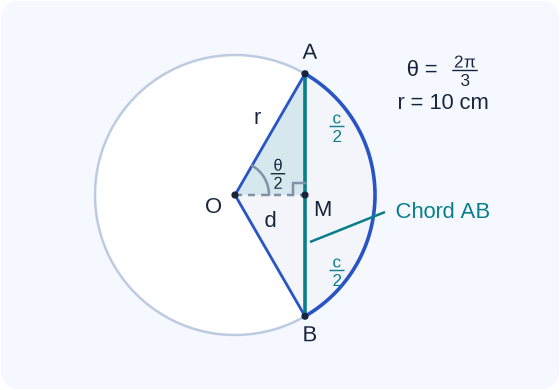
First take a chord ABAB that is not a diameter. Let the circle have centre OO, radius rr, and minor central angle θ\theta, where 0<θ<π0<\theta<\pi. Let MM be the midpoint of ABAB. Then OMOM is perpendicular to ABAB, AM=AB2AM=\frac{AB}{2}, and ∠AOM=θ2\angle AOM=\frac{\theta}{2}.

A radius-10 circle has central angle 2π/3. The perpendicular from O to chord AB meets it at midpoint M, with OM=5 and AM=BM=5√3.

One right triangle gives half the chord and the centre-to-chord distance.

Worked example

Use half of the central angle

A chord in a circle of radius 1010 cm subtends 2π3\frac{2\pi}{3} at the centre. Find the chord and its distance from the centre.

  1. θ2=π3\frac{\theta}{2}=\frac{\pi}{3}.

    The perpendicular bisects the central angle.

  2. c=2(10)sin⁡(π3)=103c=2(10)\sin(\frac{\pi}{3})=10\sqrt3 cm.

    Find the half-chord, then double it.

  3. d=10cos⁡(π3)=5d=10\cos(\frac{\pi}{3})=5 cm.

    The distance from the centre is the adjacent side.

  4. (c2)2+d2=(53)2+52=100(\frac{c}{2})^2+d^2=(5\sqrt3)^2+5^2=100.

    Check the right triangle has radius 10 as its hypotenuse.

Your turn

A chord in a circle of radius 66 cm subtends the minor central angle π2\frac{\pi}{2}. Find the chord length and the perpendicular distance from the centre to the chord. Give exact answers.

Enter an exact number, for example 3/2 or 2-sqrt(3).

Enter an exact number, for example 3/2 or 2-sqrt(3).

Section 3 of 6 · Core · about 8 min

How can I find the angle from a chord or cap height?

An inverse trigonometric function recovers an angle from a ratio. For example, if sin⁡α=35\sin\alpha=\frac{3}{5} and α\alpha is acute, then α=arcsin⁡(35)\alpha=\arcsin(\frac{3}{5}). A calculator may label this key sin⁡−1\sin^{-1}; here it means inverse sine, not 1sin⁡\frac{1}{\sin}.

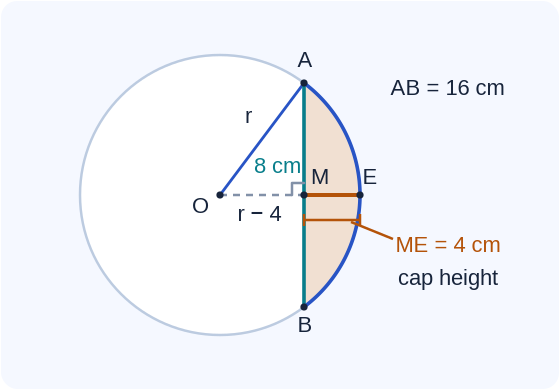
Chord AB is 16 cm. Its midpoint M is 4 cm from midpoint E of the minor arc. The unknown radius is r, OM=r−4 and AM=8. The accurate geometry has radius 10 and OM=6.

The cap height is h; the adjacent side of the half-angle triangle is r − h.

Worked example

Recover an angle from a measured chord

A circle has radius 1313 cm and chord length 1010 cm. Find the perpendicular distance to the chord and the minor central angle, giving the angle exactly and to 3 significant figures.

  1. AM=102=5AM=\frac{10}{2}=5 cm and d=132−52=12d=\sqrt{13^2-5^2}=12 cm.

    Use half the chord in Pythagoras.

  2. sin⁡(θ2)=513\sin(\frac{\theta}{2})=\frac{5}{13}, so θ=2arcsin⁡(513)\theta=2\arcsin(\frac{5}{13}).

    The inverse sine gives the half-angle.

  3. θ≈0.790\theta\approx0.790 rad.

    Evaluate in RAD mode. Keep the full value if another calculation follows.

Your turn

A circle has radius 1717 cm and a chord of length 1616 cm. Find the centre-to-chord distance and give the minor central angle as an exact inverse-trigonometric expression.

Enter an exact number, for example 3/2 or 2-sqrt(3).

Give the exact angle. You can type asin, acos or atan.

The height hh of a minor cap is measured from the chord to the midpoint of the smaller arc. It is called the sagitta. Along the symmetry line, d+h=rd+h=r, so d=r−hd=r-h. For a cap smaller than a semicircle, 0<h<r0<h<r. At a semicircle, h=rh=r and d=0d=0.

If the radius is unknown, the half-chord triangle gives r2=(r−h)2+(c2)2\displaystyle r^2=(r-h)^2+(\frac{c}{2})^2. Expand and solve; the r2r^2 terms cancel. This also gives r=c2+4h28h\displaystyle r=\frac{c^2+4h^2}{8h}, but setting up Pythagoras shows where the relation comes from.

Worked example

Recover a radius from a cap

A minor cap has chord length 1616 cm and height 44 cm. Find the radius and the minor central angle to 3 significant figures.

  1. r2=(r−4)2+82r^2=(r-4)^2+8^2.

    The right triangle has sides r−4r-4, 8 and hypotenuse rr.

  2. r2=r2−8r+16+64r^2=r^2-8r+16+64, so 8r=808r=80 and r=10r=10 cm.

    Expand before cancelling the equal square terms.

  3. d=10−4=6d=10-4=6 cm and θ=2arccos⁡(610)\theta=2\arccos(\frac{6}{10}).

    Use the distance from the centre, not the cap height, in the cosine ratio.

  4. θ≈1.85\theta\approx1.85 rad. Also 0<4<100<4<10, as required for a minor cap.

    Round the angle at the end and check the geometry.

Your turn

A minor circular segment has chord length 66 cm and perpendicular height 11 cm, measured from the chord to the midpoint of its arc. Find the radius and the exact minor central angle.

Enter the value on its own or write r = … . Fractions and exact square roots are accepted.

Give the exact angle. You can type asin, acos or atan.

Section 4 of 6 · Core · about 6 min

Why is a segment area the sector minus a triangle?

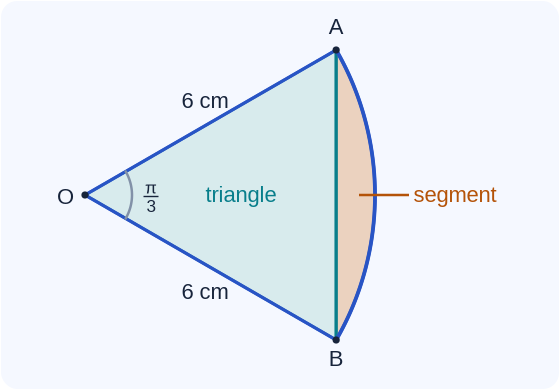
A sector is bounded by two radii and an arc. Drawing the chord divides the minor sector into a triangle and a curved segment. The small curved region is the part left after removing the triangle.

A radius-6 sector has central angle π/3. Triangle OAB is teal and the minor segment is orange. These two pieces partition the same sector.

Sector = triangle + minor segment.

On the diagram, point to the sector first. Then point to the triangle and to the remaining segment. Only the last region equals 12r2(θ−sin⁡θ)\frac{1}{2}r^2(\theta-\sin\theta).

Worked example

Keep the two areas separate

Find the exact area of the minor segment in a radius-66 cm circle with central angle π3\frac{\pi}{3}.

  1. Asector=12(62)(π3)=6π cm2A_{\rm sector}=\tfrac12(6^2)(\frac{\pi}{3})=6\pi\text{ cm}^2.

    Use the radian sector formula.

  2. A△=12(6)(6)sin⁡(π3)=93 cm2A_{\triangle}=\tfrac12(6)(6)\sin(\frac{\pi}{3})=9\sqrt3\text{ cm}^2.

    The two equal sides are both radii.

  3. Aminor=6π−93 cm2A_{\rm minor}=6\pi-9\sqrt3\text{ cm}^2.

    Subtract the triangle that lies inside the sector.

Your turn

A circle has radius 44 cm. Find the exact area of the minor segment cut off by a chord with central angle π2\frac{\pi}{2}.

Enter the value on its own or write area = … . Fractions and exact square roots are accepted.

Section 5 of 6 · Core · about 5 min

How do I find the area on the other side of the chord?

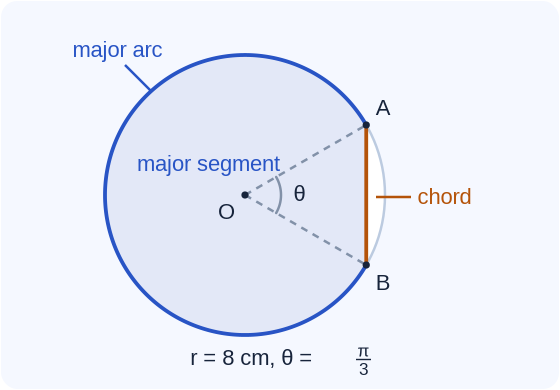
A chord divides the disk into two segments. Except for a diameter, one is smaller and one is larger. The major segment includes the centre. Their areas add to the area of the full disk.

A chord subtends minor angle π/3 in a radius-8 circle. The major region containing O is shaded blue. Its boundary is the long blue arc and orange chord. Dashed radii are construction lines.

The major segment contains the centre. Its boundary is the long arc and the same chord.

Worked example

Subtract from the complete disk

A chord in a circle of radius 88 cm subtends the minor central angle π3\frac{\pi}{3}. Find the exact area of the major segment.

  1. Aminor=12(64)(π3)−12(64)sin⁡(π3)=32π3−163A_{\rm minor}=\tfrac12(64)(\frac{\pi}{3})-\tfrac12(64)\sin(\frac{\pi}{3})=\tfrac{32\pi}{3}-16\sqrt3.

    First find the smaller region using the angle shown.

  2. Amajor=64π−(32π3−163)A_{\rm major}=64\pi-(\tfrac{32\pi}{3}-16\sqrt3).

    The two segment areas total the disk area.

  3. Amajor=160π3+163 cm2A_{\rm major}=\tfrac{160\pi}{3}+16\sqrt3\text{ cm}^2.

    Subtract the entire bracket; the triangle term becomes positive.

Your turn

A chord in a circle of radius 55 cm subtends the minor angle 2π3\frac{2\pi}{3}. Find the exact area of the major segment.

Enter the value on its own or write area = … . Fractions and exact square roots are accepted.

Section 6 of 6 · Core · about 7 min

Which lengths form a segment perimeter, and can I work backwards?

Trace the outside edge with your finger. A segment has one straight chord and one curved arc. For a chord that is not a diameter, the two radii are construction lines rather than exposed boundary edges. For a semicircle, the straight edge is the diameter: count that whole chord once.

Worked example

Find the radius before tracing the boundary

A minor segment has central angle π2\frac{\pi}{2} and area (9π−18) cm2(9\pi-18)\text{ cm}^2. Find its radius and exact perimeter.

  1. 12r2(π2−1)=9π−18\tfrac12r^2(\frac{\pi}{2}-1)=9\pi-18, so r2(π−2)4=9(π−2)\frac{r^2(\pi-2)}{4}=9(\pi-2).

    Use the segment area, not the sector area, to recover the radius.

  2. r2=36r^2=36, hence r=6r=6 cm.

    The positive root is the geometric radius.

  3. s=6(π2)=3πs=6(\frac{\pi}{2})=3\pi cm and c=2(6)sin⁡(π4)=62c=2(6)\sin(\frac{\pi}{4})=6\sqrt2 cm.

    Find the curved edge and straight edge separately.

  4. P=3π+62P=3\pi+6\sqrt2 cm.

    Add exactly those two exposed edges.

Your turn

A minor segment has central angle π3\frac{\pi}{3} and area (8π3−43) cm2(\frac{8\pi}{3}-4\sqrt3)\text{ cm}^2. Find its radius and exact perimeter.

Enter the value on its own or write r = … . Fractions and exact square roots are accepted.

Enter an exact number, for example 3/2 or 2-sqrt(3).

Worked examples

Practise the method

Core practice

Question 1 of 4

0 / 4 checked in this collection

Question list

Core practice

Fresh variants

Exam-style

A minor segment has an arc and a chord

2 marks

A circle has radius 4 cm and minor central angle π3\frac{\pi}{3}. Find the exact area and perimeter of the minor segment.

Enter the value on its own or write area = … . Fractions and exact square roots are accepted.

Enter an exact number, for example 3/2 or 2-sqrt(3).

Full answer-format guide

Exact numbers: 3/2, sqrt(5), 2-sqrt(3), pi/6, 3*pi/2. Sets: {1,4}. Intervals: (3,5]; a round bracket excludes the endpoint. Infinity: inf; union: U; no solutions: empty. Separate coordinate pairs or triples with semicolons. Expressions: 2x^2+3x-1; equations: x^2=3x+1 or the polynomial equal to zero. Factors: x-1 ; x+2. Parameter fraction: numerator ; denominator. List integer answers individually.

Review the method

Progress stays in this browser. Create an account to save it or sign in.

Extra practice from this lesson

A right-triangle warm-up

A right triangle has hypotenuse 77 cm and acute angle π6\frac{\pi}{6}. Find the opposite and adjacent sides exactly.

Enter an exact number, for example 3/2 or 2-sqrt(3).

Enter an exact number, for example 3/2 or 2-sqrt(3).

A chord and its distance

A chord subtends 2π3\frac{2\pi}{3} at the centre of a radius-99 cm circle. Find the exact chord length and its perpendicular distance from the centre.

Enter an exact number, for example 3/2 or 2-sqrt(3).

Enter an exact number, for example 3/2 or 2-sqrt(3).

An angle from a straight measurement

A circle has radius 2525 cm and chord length 1414 cm. Find the centre-to-chord distance exactly and the minor central angle to 3 significant figures.

Enter an exact number, for example 3/2 or 2-sqrt(3).

Round as requested in the label, or enter your calculator value. Decimal or fraction input is accepted.

A deep minor cap

A minor circular cap has radius 1313 cm and height 88 cm. Find its chord length exactly and its central angle to 3 significant figures.

Enter an exact number, for example 3/2 or 2-sqrt(3).

Round as requested in the label, or enter your calculator value. Decimal or fraction input is accepted.

A quarter-circle segment

Find the exact area of the minor segment in a circle of radius 77 cm with central angle π2\frac{\pi}{2}.

Enter the value on its own or write area = … . Fractions and exact square roots are accepted.

Trace the major boundary

A chord in a radius-99 cm circle subtends the minor central angle 2π3\frac{2\pi}{3}. Find the exact perimeter of the major segment.

Enter an exact number, for example 3/2 or 2-sqrt(3).

Keep the calculator in radians

A minor segment has radius 1212 cm and central angle 1.41.4 rad. Find its chord length and area, each to 3 significant figures.

Round as requested in the label, or enter your calculator value. Decimal or fraction input is accepted.

Round as requested in the label, or enter your calculator value. Decimal or fraction input is accepted.

Reconstruct from an area

A minor segment has central angle π2\frac{\pi}{2} and area (16π−32) cm2(16\pi-32)\text{ cm}^2. Find its radius and exact perimeter.

Enter the value on its own or write r = … . Fractions and exact square roots are accepted.

Enter an exact number, for example 3/2 or 2-sqrt(3).

Apply it · original exam-style problems

Show your working on paper and compare it with the worked solution and marking guidance.

Start after this lesson

One chord, two segments 8 marks

A chord ABAB lies in a circle of radius 1010 cm and subtends the minor central angle 2π3\frac{2\pi}{3}.

  1. Find ABAB.
  2. Find the areas of both segments.
  3. Find the perimeter of the major segment. Give exact answers and show how each area and boundary is assembled.
Hint

Use the half-angle for the chord, the full minor angle for the triangle, and 2π−θ2\pi-\theta for the major arc.

Worked solution
  1. AB=2(10)sin⁡(π3)=103AB=2(10)\sin(\frac{\pi}{3})=10\sqrt3 cm.

    The half-chord triangle has angle π3\frac{\pi}{3}.

  2. Asector=12(100)(2π3)=100π3A_{\rm sector}=\tfrac12(100)(\frac{2\pi}{3})=\frac{100\pi}{3}, and A△=12(100)sin⁡(2π3)=253A_{\triangle}=\tfrac12(100)\sin(\frac{2\pi}{3})=25\sqrt3.

    Find the two component areas.

  3. Aminor=100π3−253 cm2A_{\rm minor}=\frac{100\pi}{3}-25\sqrt3\text{ cm}^2.

    The minor segment is sector minus triangle.

  4. Amajor=100π−Aminor=200π3+253 cm2A_{\rm major}=100\pi-A_{\rm minor}=\frac{200\pi}{3}+25\sqrt3\text{ cm}^2.

    Use the rest of the disk.

  5. Pmajor=10(4π3)+103=40π3+103P_{\rm major}=10(\frac{4\pi}{3})+10\sqrt3=\frac{40\pi}{3}+10\sqrt3 cm.

    The major boundary is the long arc plus the shared chord.

Marking guidance
  • 2 marks: use the half-angle correctly and obtain the chord.

  • 2 marks: identify sector minus triangle and obtain the minor area.

  • 2 marks: subtract the minor area from the disk and obtain the major area.

  • 2 marks: use the major arc plus chord and obtain the perimeter.

A chord measured on a large circle 8 marks

A circle has radius 2020 cm and a chord of length 2424 cm.

  1. Find the perpendicular distance from the centre to the chord.
  2. Find the minor central angle.
  3. Find the area of the minor segment and the perimeter of the major segment. Give the distance exactly and all other numerical answers to 3 significant figures. Keep your angle unrounded during the calculation.
Hint

The half-chord is 1212 cm. The triangle area can be calculated directly as 12×24×d\tfrac12\times24\times d.

Worked solution
  1. d=202−122=16d=\sqrt{20^2-12^2}=16 cm.

    Use the half-chord triangle.

  2. θ=2arcsin⁡(1220)=1.287002…≈1.29\theta=2\arcsin(\frac{12}{20})=1.287002\ldots\approx1.29 rad.

    Save the full value of θ\theta.

  3. A△=12(24)(16)=192 cm2A_{\triangle}=\tfrac12(24)(16)=192\text{ cm}^2.

    The chord is a base and the perpendicular distance is its height.

  4. Aminor=200θ−192=65.4004…≈65.4 cm2A_{\rm minor}=200\theta-192=65.4004\ldots\approx65.4\text{ cm}^2.

    Subtract from the minor sector.

  5. Pmajor=20(2π−θ)+24=123.9236…≈124P_{\rm major}=20(2\pi-\theta)+24=123.9236\ldots\approx124 cm.

    Add the long arc and the chord.

Marking guidance
  • 2 marks: a correct half-chord Pythagoras method and distance.

  • 2 marks: a correct inverse-ratio method and radian central angle.

  • 2 marks: correct sector-minus-triangle assembly and minor area.

  • 2 marks: correct major-arc-plus-chord assembly and rounded perimeter.

Reconstruct a circular cap 9 marks

A minor circular cap has a straight chord 1212 cm long. Its greatest perpendicular height above the chord is 22 cm.

  1. Form an equation and find the circle's radius.
  2. Find the minor central angle.
  3. Find the cap's area and perimeter. Give the radius exactly and the other answers to 3 significant figures.
Hint

Use r2=(r−2)2+62r^2=(r-2)^2+6^2. After finding rr, find the distance to the chord and the half-angle.

Worked solution
  1. r2=(r−2)2+36=r2−4r+40r^2=(r-2)^2+36=r^2-4r+40.

    The centre-to-chord distance is r−2r-2.

  2. 4r=404r=40, so r=10r=10 cm and d=8d=8 cm.

    Solve and check the cap height is smaller than the radius.

  3. θ=2arccos⁡(810)=1.287002…≈1.29\theta=2\arccos(\frac{8}{10})=1.287002\ldots\approx1.29 rad.

    Use the half-angle cosine ratio.

  4. A=12(102)θ−12(12)(8)=100arccos⁡(45)−48≈16.4 cm2A=\tfrac12(10^2)\theta-\tfrac12(12)(8)=100\arccos(\frac{4}{5})-48\approx16.4\text{ cm}^2.

    Remove the triangle from the sector.

  5. P=10θ+12=20arccos⁡(45)+12≈24.9P=10\theta+12=20\arccos(\frac{4}{5})+12\approx24.9 cm.

    Only the chord and minor arc form the cap boundary.

Marking guidance
  • 3 marks: construct the right-triangle equation, solve it and obtain the valid radius.

  • 2 marks: obtain the minor central angle by an inverse ratio.

  • 2 marks: assemble and calculate the cap area.

  • 2 marks: assemble and calculate the cap perimeter.

Come back to what needs practice

Quick revision sheet (A4)

Your review plan starts after your first check.

Question bank and saved work