Maths4UBETA

Radians, degrees and complete rotations

Connect an angle to an arc-to-radius ratio and keep its units throughout the calculation.

Try the quick check →
Lesson 1 of 5

Section 1 of 5 · Core · about 5 min

What does one radian mean?

An angle tells you how far one ray has turned from another. Degrees measure a turn in 360 equal parts. Radians measure it by comparing an arc with the circle's radius.

Draw a circle with centre OO. Mark an arc ABAB whose length equals the radius. The angle AOBAOB, measured at the centre, is one radian.

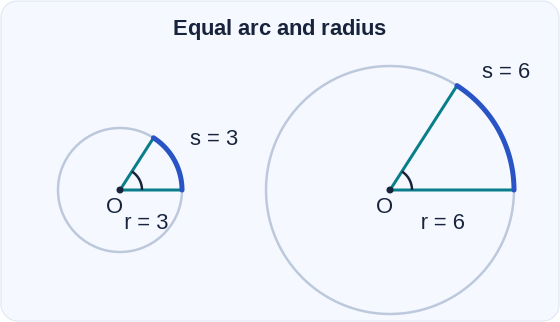
Circles with radii 3 and 6 have arcs of lengths 3 and 6. Both central angles are exactly one radian.

33=66=1radian.\frac33=\frac66=1\quad\text{radian}.Doubling the radius doubles this arc. The ratio sr\frac{s}{r}, and therefore the angle, stays the same.

Worked example

Start with the arc-to-radius ratio

An arc has length 13.5 cm13.5\text{ cm} on a circle of radius 9 cm9\text{ cm}. Find its central angle in radians.

  1. Here s=13.5 cms=13.5\text{ cm} and r=9 cmr=9\text{ cm}. Thus θ=sr=13.59\theta=\frac{s}{r}=\frac{13.5}{9}.

    The arc and radius are already in the same unit.

  2. θ=1.5 rad\theta=1.5\text{ rad}.

    The arc is one and a half radius-lengths long.

  3. 1.5<π21.5<\frac{\pi}{2}, so the angle is a little smaller than a right angle.

    Use a familiar angle to check the size.
The circle's size does not determine the angle. If both ss and rr are multiplied by the same number, their ratio is unchanged. Radians are a ratio of two lengths; we still write “rad” when it helps make the angle unit clear.

A full turn uses the whole circumference:

θ=2πrr=2π.\theta=\frac{2\pi r}{r}=2\pi.
So a half-turn is π\pi radians and a quarter-turn is π2\frac{\pi}{2} radians. One radian is about 57.3∘57.3^\circ, slightly less than 60∘60^\circ.

Compare the two circles. When radius and arc length both double, sr\frac{s}{r} stays the same. On one fixed circle, doubling the central angle doubles the arc length.

Your turn

An arc is 96 mm96\text{ mm} long and the radius is 8 cm8\text{ cm}. Find the central angle.

Enter an exact number, for example 3/2 or 2-sqrt(3).

Your turn

A second circle has three times the radius and an arc three times as long as the first. What happens to the central angle?

Central angle

Section 2 of 5 · Core · about 5 min

How do I convert between degrees and radians?

Use the unit you want to decide the conversion. A number of degrees is multiplied by π180\frac{\pi}{180}. A number of radians is multiplied by 180π\frac{180}{\pi}. Keep π\pi in an exact answer; press the calculator's π\pi key when an approximation is requested.

DegreesRadiansPart of a turn
30∘30^\circπ6\frac{\pi}{6}112\frac{1}{12}
45∘45^\circπ4\frac{\pi}{4}18\frac{1}{8}
60∘60^\circπ3\frac{\pi}{3}16\frac{1}{6}
90∘90^\circπ2\frac{\pi}{2}14\frac{1}{4}
180∘180^\circπ\pi12\frac{1}{2}
360∘360^\circ2π2\pi11

Worked example

Keep exact conversions exact

Convert 135∘135^\circ to radians and 11π6\frac{11\pi}{6} radians to degrees.

  1. 135∘×π180=135π180=3π4 rad135^\circ\times\frac{\pi}{180}=\frac{135\pi}{180}=\frac{3\pi}{4}\text{ rad}.

    Multiply degrees by π180\frac{\pi}{180} and simplify the fraction.

  2. (11π6)×(180π)=11×30=330∘(\frac{11\pi}{6})\times(\frac{180}{\pi})=11\times30=330^\circ.

    The π factors cancel in an exact conversion.

  3. 135∘135^\circ lies between a right angle and a straight angle; 3π4\frac{3\pi}{4} lies between π2\frac{\pi}{2} and π\pi.

    The answer should describe the same-sized angle.

Worked example

Convert a decimal radian measure

Convert 1.35 rad1.35\text{ rad} to degrees, correct to one decimal place.

  1. 1.35×180π=77.3493…∘1.35\times\frac{180}{\pi}=77.3493\ldots^\circ.

    The given angle is a decimal number of radians, so the same conversion still applies.

  2. 77.3∘77.3^\circ, to one decimal place.

    Round only the final result to the requested accuracy.

Your turn

Convert 210∘210^\circ to radians and 5π8\frac{5\pi}{8} radians to degrees. Give exact answers.

Enter an exact number, for example 3/2 or 2-sqrt(3).

Enter an exact number, for example 3/2 or 2-sqrt(3).

Section 3 of 5 · Core · about 5 min

Which angle belongs to the arc?

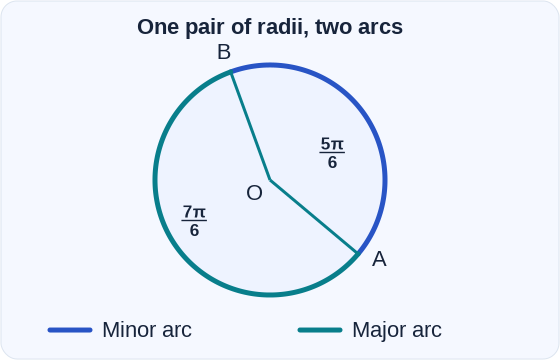
Two radii usually define two arcs. The shorter arc has a central angle between 00 and π\pi; the longer arc has a reflex angle between π\pi and 2π2\pi. A diameter is the special case: both arcs are semicircles with angle π\pi.

The minor angle is five pi over six radians and the reflex angle is seven pi over six radians. Their sum is two pi.

The two central angles make one complete turn.

Worked example

Find the angle on the longer route

The minor central angle between two radii is 7π12\frac{7\pi}{12}. Find the angle belonging to the major arc.

  1. θ=2π−7π12\theta=2\pi-\frac{7\pi}{12}.

    The two central angles make a full turn.

  2. θ=24π12−7π12=17π12 rad\theta=\frac{24\pi}{12}-\frac{7\pi}{12}=\frac{17\pi}{12}\text{ rad}.

    Use a common denominator.

  3. π<17π12<2π\pi<\frac{17\pi}{12}<2\pi.

    The answer is reflex, as required for the major arc.

Worked example

Use the correct angle sum

The three angles in a triangle are xx, 2x2x and π6\frac{\pi}{6}, all in radians. Find xx.

  1. x+2x+π6=πx+2x+\frac{\pi}{6}=\pi.

    The angle sum of a triangle is π radians.

  2. 3x=5π63x=\frac{5\pi}{6}, so x=5π18x=\frac{5\pi}{18}.

    Subtract the known angle, then divide by 3.

  3. The angles are 5π18\frac{5\pi}{18}, 5π9\frac{5\pi}{9} and π6\frac{\pi}{6}; they are positive and add to π\pi.

    Check that the values can form a triangle.

Your turn

The smaller central angle is 3π5\frac{3\pi}{5}. Give the reflex angle between the same radii.

Enter an exact number, for example 3/2 or 2-sqrt(3).

Your turn

Two angles make a complete turn around a point and are in the ratio 3:73:7. Find the smaller angle in radians.

Enter an exact number, for example 3/2 or 2-sqrt(3).

Section 4 of 5 · Core · about 6 min

How do I keep full turns separate from final direction?

A rotating pointer can sweep through more than one turn. Its total angular travel records every part of the movement. Its final direction records where it finishes.

To describe a direction with an angle from 00 up to, but not including, 2π2\pi, add or subtract whole turns. Do this only when finding the final direction. Keep all turns when the question asks how far something travelled.

Worked example

A pointer turns and then reverses

A pointer starts along a fixed reference ray. It turns 13π3\frac{13\pi}{3} radians anticlockwise, then π2\frac{\pi}{2} radians clockwise. Find its total angular travel, net signed rotation and final anticlockwise direction in [0,2π)[0,2\pi).

  1. Total angular travel =13π3+π2=29π6 rad=\frac{13\pi}{3}+\frac{\pi}{2}=\frac{29\pi}{6}\text{ rad}.

    Both parts count as movement, even though their directions differ.

  2. Net signed rotation =13π3−π2=23π6 rad=\frac{13\pi}{3}-\frac{\pi}{2}=\frac{23\pi}{6}\text{ rad}.

    Subtract the clockwise part when anticlockwise is positive.

  3. Final direction =23π6−2π=11π6 rad=\frac{23\pi}{6}-2\pi=\frac{11\pi}{6}\text{ rad}.

    Remove one complete turn to give a direction between 0 and 2π.

  4. 11π6=330∘\frac{11\pi}{6}=330^\circ.

    The pointer finishes 30° clockwise from its starting ray.

A negative rotation can be converted to the same final direction by adding 2π2\pi. For example, a clockwise quarter-turn is −π2-\frac{\pi}{2}, which finishes in the same direction as 3π2\frac{3\pi}{2} anticlockwise. If a pointer makes exactly three complete turns, its total travel is 6π6\pi and its final direction is 00.

Your turn

A pointer turns 17π4\frac{17\pi}{4} radians anticlockwise without reversing. Find its total angular travel and final direction in [0,2π)[0,2\pi).

Enter an exact number, for example 3/2 or 2-sqrt(3).

Enter an exact number, for example 3/2 or 2-sqrt(3).

Section 5 of 5 · Core · about 5 min

When does calculator angle mode matter?

The calculator needs an angle unit when it evaluates sin⁡\sin, cos⁡\cos, tan⁡\tan, or their inverse functions. Choose RAD when the angles are in radians. An inverse trigonometric calculation then returns an answer in radians.

Ordinary arithmetic such as 1.35×180π1.35\times\frac{180}{\pi} does not depend on RAD or DEG mode. The mode matters when a trigonometric function interprets or returns an angle.

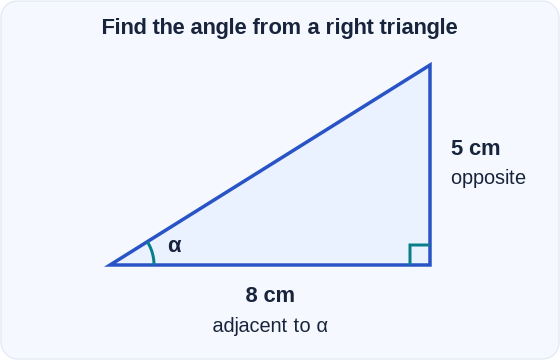
A right triangle has an adjacent side of 8 centimetres and opposite side of 5 centimetres relative to alpha. The side ratio in the drawing is exactly five to eight.

The labels opposite and adjacent refer to the chosen angle α.

Worked example

Find an angle in radians

For an acute angle α\alpha in a right-angled triangle, the opposite side is 5 cm5\text{ cm} and the adjacent side is 8 cm8\text{ cm}. Find α\alpha in radians to 3 significant figures.

  1. tan⁡α=58\tan\alpha=\frac{5}{8}.

    Use opposite divided by adjacent for the marked angle.

  2. In RAD mode, α=tan⁡−1(58)=0.558599…\alpha=\tan^{-1}(\frac{5}{8})=0.558599\ldots.

    Inverse tangent finds the acute angle matching the ratio.

  3. α=0.559 rad\alpha=0.559\text{ rad}, to 3 significant figures.

    Retain the full calculator value if a later part needs the angle.

  4. 0<α<π20<\alpha<\frac{\pi}{2}.

    The result must be acute because of the stated triangle.

Your turn

An acute angle β\beta in a right-angled triangle has opposite side 2 cm2\text{ cm} and adjacent side 5 cm5\text{ cm}. Find β\beta in radians to 3 significant figures.

Round as requested in the label, or enter your calculator value. Decimal or fraction input is accepted.

Worked examples

Practise the method

Core practice

Question 1 of 4

0 / 4 checked in this collection

Question list

Core practice

Fresh variants

Exam-style

Exact conversion in both directions

2 marks

Convert 150° to radians and 7π4\frac{7 \pi}{4} radians to degrees. Give exact answers.

Enter an exact number, for example 3/2 or 2-sqrt(3).

Enter an exact number, for example 3/2 or 2-sqrt(3).

Full answer-format guide

Exact numbers: 3/2, sqrt(5), 2-sqrt(3), pi/6, 3*pi/2. Sets: {1,4}. Intervals: (3,5]; a round bracket excludes the endpoint. Infinity: inf; union: U; no solutions: empty. Separate coordinate pairs or triples with semicolons. Expressions: 2x^2+3x-1; equations: x^2=3x+1 or the polynomial equal to zero. Factors: x-1 ; x+2. Parameter fraction: numerator ; denominator. List integer answers individually.

Review the method

Progress stays in this browser. Create an account to save it or sign in.

Extra practice from this lesson

Two exact conversions

Convert 96∘96^\circ and 330∘330^\circ to radians. Give exact answers.

Enter an exact number, for example 3/2 or 2-sqrt(3).

Enter an exact number, for example 3/2 or 2-sqrt(3).

Exact and decimal radians

Convert 13π12\frac{13\pi}{12} radians to degrees exactly. Convert 0.90.9 radians to degrees to 1 decimal place.

Enter an exact number, for example 3/2 or 2-sqrt(3).

Round as requested in the label, or enter your calculator value. Decimal or fraction input is accepted.

One length unit

An arc is 84 mm84\text{ mm} long on a circle of radius 7 cm7\text{ cm}. Find its central angle in radians.

Enter an exact number, for example 3/2 or 2-sqrt(3).

The major angle

The minor central angle between two radii is 9π14\frac{9\pi}{14}. Find the reflex angle belonging to the major arc.

Enter an exact number, for example 3/2 or 2-sqrt(3).

Angles in a triangle

A triangle has angles xx, 2x2x and π4\frac{\pi}{4}, all in radians. Find xx and the largest angle.

Enter the value on its own or write x = … . Fractions and exact square roots are accepted.

Enter an exact number, for example 3/2 or 2-sqrt(3).

Complete turns and a remainder

A pointer turns 15π2\frac{15\pi}{2} radians anticlockwise without reversing. How many complete turns does it make, and what is its final anticlockwise direction in [0,2π)[0,2\pi)?

Enter an exact number, for example 3/2 or 2-sqrt(3).

Enter an exact number, for example 3/2 or 2-sqrt(3).

A clockwise rotation

A pointer turns 5π3\frac{5\pi}{3} radians clockwise from a reference ray. Give its final direction as an anticlockwise angle in [0,2π)[0,2\pi).

Enter an exact number, for example 3/2 or 2-sqrt(3).

Find the acute angle

In a right-angled triangle, an acute angle has opposite side 7 cm7\text{ cm} and adjacent side 4 cm4\text{ cm}. Find the angle in radians to 3 significant figures.

Round as requested in the label, or enter your calculator value. Decimal or fraction input is accepted.

Apply it · original exam-style problems

Show your working on paper and compare it with the worked solution and marking guidance.

Start after this lesson

A triangle and two central angles 5 marks

A triangle has angles α\alpha, 2α2\alpha and π5\frac{\pi}{5}, all in radians.

  1. Find α\alpha exactly.
  2. Express the largest angle of the triangle in degrees.
  3. A circle has a minor central angle equal to that largest angle. Find the reflex angle between the same radii, in radians.
Hint

First use the triangle angle sum. For the circle, the two central angles add to 2π2\pi.

Worked solution
  1. 3α+π5=π3\alpha+\frac{\pi}{5}=\pi, so α=4π15\alpha=\frac{4\pi}{15}.

    The triangle's angles add to π.

  2. The largest angle is 2α=8π152\alpha=\frac{8\pi}{15}; in degrees it is (8π15)(180π)=96∘(\frac{8\pi}{15})(\frac{180}{\pi})=96^\circ.

    Check all three angle sizes before choosing the largest.

  3. The reflex angle is 2π−8π15=22π15 rad2\pi-\frac{8\pi}{15}=\frac{22\pi}{15}\text{ rad}.

    The circular angles use a full-turn sum.

Marking guidance
  • 1 method mark for the triangle angle equation.

  • 1 accuracy mark for α=4π15\frac{4\pi}{15}.

  • 1 method mark for converting the largest angle with 180π\frac{180}{\pi}.

  • 1 accuracy mark for 96°.

  • 1 accuracy mark for the reflex angle 22π15\frac{22\pi}{15}.

A pointer reverses 5 marks

A pointer starts along a reference ray. It turns 9π2\frac{9\pi}{2} radians clockwise, then 5π3\frac{5\pi}{3} radians anticlockwise. Take anticlockwise as positive.

Find (a) its total angular travel, (b) its net signed rotation and (c) its final anticlockwise direction in [0,2π)[0,2\pi). Give exact answers.

Hint

Add magnitudes for travel. Use signs for net rotation, then add enough complete turns to put the final direction in the stated interval.

Worked solution
  1. Total travel =9π2+5π3=37π6 rad=\frac{9\pi}{2}+\frac{5\pi}{3}=\frac{37\pi}{6}\text{ rad}.

    Both movements contribute to the travel.

  2. Net rotation =−9π2+5π3=−17π6 rad=-\frac{9\pi}{2}+\frac{5\pi}{3}=-\frac{17\pi}{6}\text{ rad}.

    The first turn is clockwise and negative.

  3. −17π6+4π=7π6 rad-\frac{17\pi}{6}+4\pi=\frac{7\pi}{6}\text{ rad}.

    Adding one turn still gives a negative value; adding two produces the required final direction.

Marking guidance
  • 1 method mark for adding both magnitudes.

  • 1 accuracy mark for 37π6\frac{37\pi}{6} total travel.

  • 1 method mark for a correctly signed sum.

  • 1 accuracy mark for −17π6\frac{17\pi}{6} net rotation.

  • 1 accuracy mark for 7π6\frac{7\pi}{6} as the final direction.

Three angles around a point 4 marks

Three adjacent angles make a complete turn around a point. Their sizes are (3x+0.2)(3x+0.2), (2x+0.6)(2x+0.6) and (x+0.4)(x+0.4) radians.

Find xx exactly in terms of π\pi, then find the smallest angle to 3 significant figures.

Hint

The three angles add to 2π2\pi. Find each angle before deciding which is smallest.

Worked solution
  1. 6x+1.2=2π6x+1.2=2\pi, so x=π3−0.2=π3−15x=\frac{\pi}{3}-0.2=\frac{\pi}{3}-\frac{1}{5}.

    Collect the x-terms and constants.

  2. The three angles are π−0.4\pi-0.4, 2π3+0.2\frac{2\pi}{3}+0.2, and π3+0.2\frac{\pi}{3}+0.2.

    Substitute the exact value of x.

  3. The smallest is π3+0.2=1.24719…=1.25 rad\frac{\pi}{3}+0.2=1.24719\ldots=1.25\text{ rad}.

    Compare before rounding; all three angles are positive.

Marking guidance
  • 1 method mark for the full-turn equation.

  • 1 accuracy mark for x=π3\frac{\pi}{3}−15\frac{1}{5}.

  • 1 method mark for comparing the substituted angles.

  • 1 accuracy mark for 1.25 rad.

Come back to what needs practice

Quick revision sheet (A4)

Your review plan starts after your first check.

Question bank and saved work