Maths4UBETA

Sector area and reconstruction

Use the sector fraction of a circle, combine area and arc data, and check geometric restrictions.

Try the quick check →
Lesson 3 of 5

Section 1 of 6 · Core · about 5 min

How do I find the area of a sector?

A sector is the region between two radii and their joining arc. Its area is the same fraction of the circle as its central angle is of a full turn.

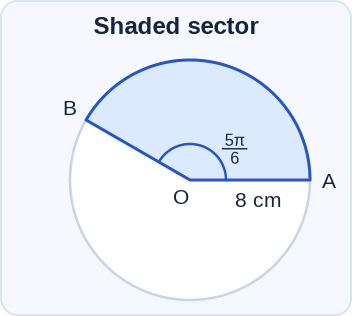
A circle of radius 8 cm contains a shaded 150-degree sector. The angle is 5π/6 radians and the shaded region is five twelfths of the disk, with area 80π/3 square centimetres.

The circle has radius 8 cm8\,\mathrm{cm}. The shaded angle is 150∘=5π6150^\circ=\frac{5\pi}{6} radians.

A=512π(8)2=80π3 cm2.A=\frac5{12}\pi(8)^2=\frac{80\pi}{3}\,\mathrm{cm}^2.A 150° sector occupies 512\frac{5}{12} of its circle. Convert the angle or use the same fraction of the full area.

For a proper sector, r>0r\gt 0 and 0<θ<2π0\lt \theta\lt 2\pi. Both minor and reflex sectors are allowed. At θ=2π\theta=2\pi, the area is the whole disk, πr2\pi r^2.

Check the angle first, square the radius, then multiply by the angle and by one half. If a radius is given in metres, the resulting area is in square metres.

Worked example

A sector given in degrees

A sector has radius 88 cm and central angle 150∘150^\circ. Find its exact area.

  1. Here r=8r=8 cm and θ=150∘\theta=150^\circ. Convert the angle:

    150∘=150×π180=5π6 rad.150^\circ=150\times\frac{\pi}{180}=\frac{5\pi}{6}\text{ rad}.

    The formula uses radians.

  2. A=12×82×5π6=80π3 cm2.A=\frac12\times8^2\times\frac{5\pi}{6}=\frac{80\pi}{3}\text{ cm}^2.

    Square the whole radius before multiplying.

  3. Check: the angle is 512\frac{5}{12} of a full turn, and (512)×64π=80π3(\frac{5}{12})\times64\pi=\frac{80\pi}{3}.

    The fraction-of-a-circle method gives the same area.
Your turn

A sector has radius 55 cm and angle 1.21.2 radians. Find its area.

Enter the value on its own or write area = … . Fractions and exact square roots are accepted.

Repeated turns: after a radius has swept through a full turn, later sweeps cover some points again. A value of 12r2θ\frac12r^2\theta with θ>2π\theta\gt 2\pi counts swept area with repetitions. The distinct region covered by a full rotating radius is just the disk.

Section 2 of 6 · Core · about 5 min

How do I find a missing radius or angle?

Use compatible units before rearranging. For example, convert square metres to square centimetres if the radius is required in centimetres: 1 m2=10 000 cm21\text{ m}^2=10\,000\text{ cm}^2. Once you know rr and θ\theta, you can also find the arc length s=rθs=r\theta.

Worked example

Recover a radius and then an arc

A sector has area 72 cm272\text{ cm}^2 and angle 44 radians. Find its radius and arc length.

  1. 72=12r2(4)=2r2.72=\frac12r^2(4)=2r^2.

    Write the formula with the given values before rearranging.

  2. r2=36,r=6 cm.r^2=36,\qquad r=6\text{ cm}.

    The negative square root cannot be a radius.

  3. s=rθ=6(4)=24 cm.s=r\theta=6(4)=24\text{ cm}.

    Use the recovered radius in the arc formula.

  4. The angle satisfies π<4<2π\pi\lt 4\lt 2\pi: this is a valid reflex sector. Its area 72 cm272\text{ cm}^2 is less than the full-circle area 36π cm236\pi\text{ cm}^2.

    An angle greater than π is not automatically impossible.

Your turn

A sector has area 75 cm275\text{ cm}^2 and angle 1.51.5 radians. Find its radius and arc length.

Enter the value on its own or write r = … . Fractions and exact square roots are accepted.

Enter an exact number, for example 3/2 or 2-sqrt(3).

Section 4 of 6 · Core · about 6 min

How does the area change when the dimensions change?

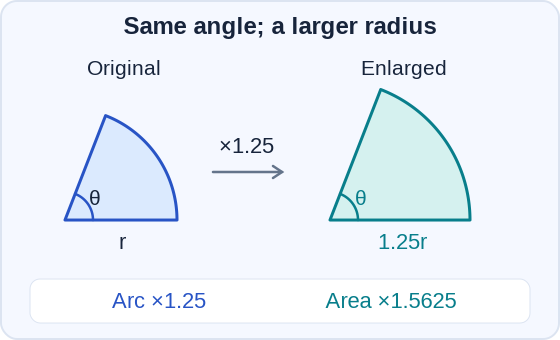
Two sectors have the same 1.2-radian angle and are drawn at the same scale. Their radii are 8 and 10, a ratio of 1.25. The second arc is 1.25 times as long and the second area is 1.5625 times as large.

The same angle with a radius 1.25 times as large: arc ×1.25, area ×1.5625.

Worked example

A percentage change in radius

The radius of a sector increases by 25%25\%, while the angle stays fixed. Find the percentage increase in its area.

  1. The new radius is 1.25r1.25r.

    An increase of 25% means multiplying by 1.25.

  2. AnewAold=12(1.25r)2θ12r2θ=1.252=1.5625.\frac{A_{\mathrm{new}}}{A_{\mathrm{old}}}=\frac{\tfrac12(1.25r)^2\theta}{\tfrac12r^2\theta}=1.25^2=1.5625.

    The common angle and other factors cancel.

  3. (1.5625−1)×100%=56.25%.(1.5625-1)\times100\%=56.25\%.

    Subtract the original 100% before reporting the increase.

Your turn

A sector radius increases by 10%10\%, with its angle unchanged. Find the percentage increase in area. Enter the number before the percent sign.

Enter an exact number, for example 3/2 or 2-sqrt(3).

What if the area must stay fixed?

If the new angle is kθk\theta, equate the two areas:

12rnew2(kθ)=12r2θ⟹rnew=rk.\frac12r_{\mathrm{new}}^2(k\theta)=\frac12r^2\theta\quad\Longrightarrow\quad r_{\mathrm{new}}=\frac{r}{\sqrt{k}}.

The new arc is (rk)(kθ)=k s(\frac{r}{\sqrt{k}})(k\theta)=\sqrt{k}\,s. Check that the new angle still fits the intended sector.

Your turn

The angle of a sector is multiplied by 33, while its area is kept fixed. Both angles lie between 00 and 2π2\pi. Give the multipliers for its radius and its arc length.

Enter an exact number, for example 3/2 or 2-sqrt(3).

Enter an exact number, for example 3/2 or 2-sqrt(3).

Section 5 of 6 · Further applications · about 8 min

How do area and perimeter determine a sector?

Two measurements can determine two unknowns. Write one equation for each measurement. Choose the equation that makes eliminating an unknown easiest.

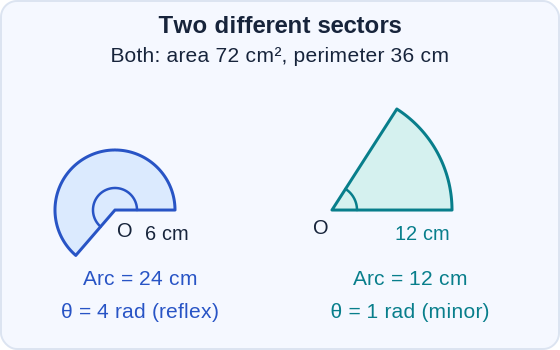
Two sectors are drawn using the same length scale. The first radius is 6 cm and angle is 4 radians, so its arc is 24 cm. The second radius is 12 cm and angle is 1 radian, so its arc is 12 cm. Both have area 72 square centimetres and perimeter 36 cm.

The same area and perimeter can describe two different sectors. Both must be checked.

Worked example

Two radii, two valid geometries

A proper sector has perimeter 3636 cm and area 72 cm272\text{ cm}^2. Find every possible pair (r,θ)(r,\theta), with rr in cm and θ\theta in radians.

  1. 72=12r(36−2r)=18r−r2.72=\frac12r(36-2r)=18r-r^2.

    Use the arc length 36−2r in the area–arc formula.

  2. r2−18r+72=0,(r−6)(r−12)=0.r^2-18r+72=0,\qquad (r-6)(r-12)=0.

    Rearrange before factorising.

  3. r=6:θ=36−126=4.r=6:\quad\theta=\frac{36-12}{6}=4.

    Recover the angle belonging to the first radius.

  4. r=12:θ=36−2412=1.r=12:\quad\theta=\frac{36-24}{12}=1.

    Recover the angle belonging to the second radius.

  5. Both satisfy r>0r\gt 0 and 0<θ<2π0\lt \theta\lt 2\pi. Thus (r,θ)=(6,4)(r,\theta)=(6,4) or (12,1)(12,1). The first is reflex; the second is minor.

    The question did not restrict the sector to a minor angle.

  6. Check: 12(6)2(4)=72\frac12(6)^2(4)=72, 6(4)+2(6)=366(4)+2(6)=36; also 12(12)2(1)=72\frac12(12)^2(1)=72, 12(1)+2(12)=3612(1)+2(12)=36.

    Each pair satisfies both original conditions.

Your turn

A proper sector has perimeter 4242 cm and area 90 cm290\text{ cm}^2. Find all pairs (r,θ)(r,\theta), in that order, using cm and radians.

Enter each pair in the order shown. Separate complete pairs with commas or semicolons.

Section 6 of 6 · Further applications · about 9 min

How can I maximise area with a fixed perimeter?

A fixed boundary length does not fix a unique sector. Increasing the radius leaves less boundary length for the arc. Use the relationship from the previous section to express the area in one variable.

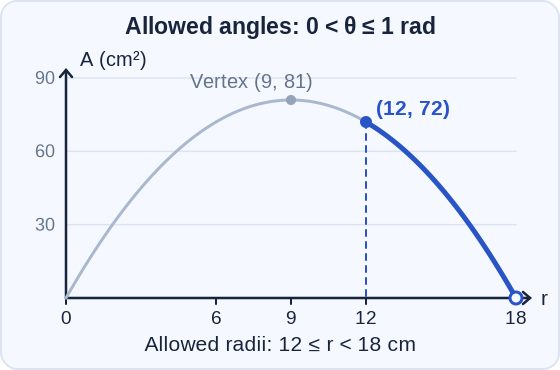
The graph A=18r−r squared has vertex (9,81). The condition 0<theta≤1 restricts the radius to 12≤r<18. Only this part of the curve is highlighted. A filled endpoint at (12,72) gives the allowed maximum. The point (18,0) is open.

For perimeter 36 cm and angle at most 1 radian, only r≥12r\ge12 is allowed. The allowed maximum is at the boundary r=12r=12.

For a proper sector, θ=Pr−2\theta=\frac{P}{r}-2. The restrictions 0<θ<2π0\lt \theta\lt 2\pi give

P2(π+1)<r<P2.\frac{P}{2(\pi+1)}\lt r\lt \frac P2.

The candidate r=P4r=\frac{P}{4} gives θ=2\theta=2 radians, so it is allowed for an unrestricted proper sector.

Worked example

Greatest area without differentiation

A proper sector has fixed perimeter 4040 cm. Find its greatest area, radius and angle without using differentiation.

  1. s=40−2r,A=12r(40−2r)=20r−r2.s=40-2r,\qquad A=\frac12r(40-2r)=20r-r^2.

    Eliminate the arc length using the boundary condition.

  2. A=100−(r−10)2.A=100-(r-10)^2.

    Complete the square to expose the greatest value.

  3. The square is smallest at r=10r=10, where it equals zero. Thus Amax⁡=100 cm2A_{\max}=100\text{ cm}^2.

    Subtracting a non-negative quantity cannot increase 100.

  4. θ=40−2010=2 rad.\theta=\frac{40-20}{10}=2\text{ rad}.

    Check the corresponding angle: 0<2<2π.

  5. The maximum is attained by a sector of radius 1010 cm and angle 22 radians.

    An allowed sector actually reaches the bound.

Your turn

A proper sector has fixed perimeter 4848 cm. Find its greatest area and the corresponding radius and angle.

Enter the value on its own or write area = … . Fractions and exact square roots are accepted.

Enter the value on its own or write r = … . Fractions and exact square roots are accepted.

Enter an exact number, for example 3/2 or 2-sqrt(3).

What if there is an extra angle restriction?

The vertex of the quadratic may fall outside the allowed radii. First translate the angle restriction into a restriction on rr. Then find the allowed value closest to the vertex, because it makes the subtracted square smallest.

Worked example

The unrestricted vertex is not allowed

A proper sector has perimeter 3636 cm and must satisfy 0<θ≤10\lt \theta\le1. Find its greatest area.

  1. θ=36r−2,36r−2≤1⇒r≥12.\theta=\frac{36}{r}-2,\qquad \frac{36}{r}-2\le1\Rightarrow r\ge12.

    The radius is positive, so multiplying by r preserves the inequality.

  2. Also θ>0\theta\gt 0 gives r<18r\lt 18. The allowed interval is 12≤r<1812\le r\lt 18.

    Both sides of the angle restriction matter.

  3. A=18r−r2=81−(r−9)2.A=18r-r^2=81-(r-9)^2.

    The unrestricted vertex is at r=9r=9, outside the interval.

  4. For r≥12r\ge12, the distance from rr to 99 is smallest at r=12r=12. Hence

    Amax⁡=81−(12−9)2=72 cm2.A_{\max}=81-(12-9)^2=72\text{ cm}^2.

    Choose the allowed radius closest to the vertex.

  5. θ=3612−2=1 rad.\theta=\frac{36}{12}-2=1\text{ rad}.

    The equality θ=1\theta=1 is allowed, so the bound is attained.

Your turn

A proper sector has fixed perimeter 3636 cm and satisfies the strict angle restriction 0<θ<10\lt\theta\lt1. Which statement about its greatest possible area is correct?

Choose the correct conclusion

Worked examples

Practise the method

Core practice

Question 1 of 4

0 / 4 checked in this collection

Question list

Core practice

Fresh variants

Exam-style

Sector area and arc length

2 marks

A sector has radius 6 cm and angle π3\frac{\pi}{3}. Find its area and arc length exactly.

Enter the value on its own or write area = … . Fractions and exact square roots are accepted.

Enter an exact number, for example 3/2 or 2-sqrt(3).

Full answer-format guide

Exact numbers: 3/2, sqrt(5), 2-sqrt(3), pi/6, 3*pi/2. Sets: {1,4}. Intervals: (3,5]; a round bracket excludes the endpoint. Infinity: inf; union: U; no solutions: empty. Separate coordinate pairs or triples with semicolons. Expressions: 2x^2+3x-1; equations: x^2=3x+1 or the polynomial equal to zero. Factors: x-1 ; x+2. Parameter fraction: numerator ; denominator. List integer answers individually.

Review the method

Progress stays in this browser. Create an account to save it or sign in.

Extra practice from this lesson

Convert before calculating

A sector has radius 99 cm and central angle 80∘80^\circ. Find its exact area.

Enter the value on its own or write area = … . Fractions and exact square roots are accepted.

An unrounded radius

A sector has area 35 cm235\text{ cm}^2 and angle 1.11.1 radians. Find its radius and arc length, each to 3 significant figures.

Round as requested in the label, or enter your calculator value. Decimal or fraction input is accepted.

Round as requested in the label, or enter your calculator value. Decimal or fraction input is accepted.

Three measurements from two

A proper sector has area 80 cm280\text{ cm}^2 and arc length 2020 cm. Find its radius, angle and perimeter.

Enter the value on its own or write r = … . Fractions and exact square roots are accepted.

Enter an exact number, for example 3/2 or 2-sqrt(3).

Enter an exact number, for example 3/2 or 2-sqrt(3).

A smaller radius

A sector radius decreases by 10%10\%, and its angle stays fixed. Find the percentage decrease in area. Enter a positive percentage.

Enter an exact number, for example 3/2 or 2-sqrt(3).

Double the angle, keep the area

The angle of a sector doubles while its area stays fixed. Both angles are between 00 and 2π2\pi. Find the multipliers for the radius and arc length.

Enter an exact number, for example 3/2 or 2-sqrt(3).

Enter an exact number, for example 3/2 or 2-sqrt(3).

Two sectors with one boundary length

A proper sector has perimeter 3434 cm and area 60 cm260\text{ cm}^2. Find every pair (r,θ)(r,\theta), with radius in cm and angle in radians.

Enter each pair in the order shown. Separate complete pairs with commas or semicolons.

A quadratic root that cannot be used

A proper sector has perimeter 2626 cm and area 22 cm222\text{ cm}^2. Find all geometrically valid pairs (r,θ)(r,\theta), using cm and radians.

Enter each pair in the order shown. Separate complete pairs with commas or semicolons.

Maximise with a fixed perimeter

A proper sector has fixed perimeter 4444 cm. Find its greatest area and the corresponding radius and angle. Use completing the square in your working.

Enter the value on its own or write area = … . Fractions and exact square roots are accepted.

Enter the value on its own or write r = … . Fractions and exact square roots are accepted.

Enter an exact number, for example 3/2 or 2-sqrt(3).

Apply it · original exam-style problems

Show your working on paper and compare it with the worked solution and marking guidance.

Start after this lesson

Reconstruct and redesign 7 marks

A proper sector has area 96 cm296\text{ cm}^2 and arc length 1616 cm.

  1. Find its radius, angle and perimeter.
  2. The radius is kept fixed while the angle is increased by 50%50\%. Find the new area and new perimeter.

Give exact answers and show the formulas you use.

Hint

Use A=12rsA=\frac12rs. With fixed radius, increasing the angle by 50% multiplies the area and arc by 1.5, but leaves the two radii unchanged.

Worked solution
  1. r=2(96)16=12 cm.r=\frac{2(96)}{16}=12\text{ cm}.

  2. θ=1612=43 rad,P=16+24=40 cm.\theta=\frac{16}{12}=\frac43\text{ rad},\qquad P=16+24=40\text{ cm}.

  3. θnew=32×43=2 rad.\theta_{\mathrm{new}}=\frac32\times\frac43=2\text{ rad}.

  4. Anew=12(12)2(2)=144 cm2.A_{\mathrm{new}}=\frac12(12)^2(2)=144\text{ cm}^2.

  5. Pnew=12(2)+2(12)=48 cm.P_{\mathrm{new}}=12(2)+2(12)=48\text{ cm}.

  6. Both angles are between 0 and 2π2\pi, so both sectors are valid.

Marking guidance
  • Use A=rs/2 to obtain r=12 (2 marks).

  • Find θ=43\frac{4}{3} and P=40 (2 marks).

  • Obtain the new angle 2 or correctly use the angle multiplier (1 mark).

  • Find new area 144 and perimeter 48 (2 marks).

A minor-sector condition 7 marks

A proper sector has perimeter 3838 cm and area 84 cm284\text{ cm}^2.

  1. Find every pair (r,θ)(r,\theta), with radius in cm and angle in radians.
  2. A design specification adds that the sector must be minor. State the radius of the sector that now remains.
Hint

First solve 84=12r(38−2r)84=\frac12r(38-2r). For part 2, compare each angle with π\pi.

Worked solution
  1. r2−19r+84=0⇒(r−7)(r−12)=0.r^2-19r+84=0\Rightarrow(r-7)(r-12)=0.

  2. r=7⇒θ=38−147=247,r=12⇒θ=38−2412=76.r=7\Rightarrow\theta=\frac{38-14}{7}=\frac{24}{7},\qquad r=12\Rightarrow\theta=\frac{38-24}{12}=\frac76.

  3. Both angles are less than 2π2\pi, so both pairs satisfy the original description.

  4. Since 247>π\frac{24}{7}\gt \pi, that sector is reflex. Since 76<π\frac{7}{6}\lt \pi, the minor sector has radius 1212 cm.

Marking guidance
  • Form the area-perimeter equation and obtain r²−19r+84=0 (2 marks).

  • Solve for both radii 7 and 12 (1 mark).

  • Recover the two corresponding angles 247\frac{24}{7} and 76\frac{7}{6} (2 marks).

  • Check the proper-sector restrictions and correctly apply θ<π to select r=12 (2 marks).

An allowed maximum and an excluded limit 9 marks

A proper sector has fixed perimeter 4848 cm and satisfies 0<θ≤430\lt \theta\le\frac{4}{3}.

  1. Express its area in terms of its radius rr, and determine the allowed interval of rr.
  2. Without differentiation, find its greatest area and the radius and angle at which it occurs.
  3. If the restriction becomes 0<θ<430\lt \theta\lt \frac{4}{3}, decide whether the greatest area from part 2 is still attained.

Enter exact final values below; show the model, interval and completed square on paper.

Hint

Use θ=48r−2\theta=\frac{48}{r}-2 and A=24r−r2A=24r-r^2. The unrestricted vertex is at r=12r=12; check whether it belongs to the allowed interval.

Worked solution
  1. A=12r(48−2r)=24r−r2.A=\frac12r(48-2r)=24r-r^2.

  2. 48r−2≤43⇒48r≤103⇒r≥725.\frac{48}{r}-2\le\frac43\Rightarrow\frac{48}{r}\le\frac{10}{3}\Rightarrow r\ge\frac{72}{5}.

  3. Also θ>0\theta\gt 0 requires r<24r\lt 24. Thus 725≤r<24\frac{72}{5}\le r\lt 24.

  4. A=144−(r−12)2.A=144-(r-12)^2.

  5. All allowed radii are greater than 12, so the square is smallest at the included endpoint r=725r=\frac{72}{5}.

  6. Amax⁡=144−(725−12)2=144−14425=345625 cm2.A_{\max}=144-\left(\frac{72}{5}-12\right)^2=144-\frac{144}{25}=\frac{3456}{25}\text{ cm}^2.

  7. θ=48725−2=43 rad.\theta=\frac{48}{\frac{72}{5}}-2=\frac43\text{ rad}.

  8. Under the strict restriction, r>725r\gt \frac{72}{5}. The area is always less than 345625\frac{3456}{25}, although it can approach that value. The bound is no longer attained.

Marking guidance
  • Build A=24r−r² (1 mark).

  • Translate both angle bounds to 725\frac{72}{5}≤r<24 (2 marks).

  • Complete the square and recognise that its vertex is excluded (2 marks).

  • Obtain the allowed endpoint radius, corresponding angle and greatest area (3 marks).

  • Explain non-attainment after the strict-bound change (1 mark).

Come back to what needs practice

Quick revision sheet (A4)

Your review plan starts after your first check.

Question bank and saved work