Maths4U · Learning together
Chords, triangles and circular segments
Notes
Objective
Find chord lengths and minor or major segment areas and perimeters using the correct radian angle.
Before you start
Recall sine, cosine, isosceles triangles, sector formulas and exact special-angle values.
Key ideas
A chord comes from two right triangles
Bisect the isosceles central triangle. For a minor central angle θ,
where c is the chord length and d the perpendicular distance from the centre to the chord.
A minor segment is sector minus triangle
For 0<θ<π,
Use radians both in θ and in the trigonometric calculation. At θ=π the segment is a semicircle.
Its perimeter is arc plus chord
The two radii inside the construction are not on the segment boundary.
A major segment is the complementary region
Using the complement avoids subtracting an unsigned triangle from a reflex sector incorrectly.
Method
- Mark the chord and the relevant central angle.
- Find the central triangle area or chord length using radians.
- For a minor segment, subtract the triangle from its sector.
- For a major segment, use the circle complement and the major arc; include the chord once.
Common mistakes
- A segment is bounded by an arc and a chord, not two radii.
- The half-angle belongs in the chord formula.
- Use the complementary area for a major segment.
- Keep full calculator precision until the final rounding.
Worked examples
See the triangle being removed
Find the minor segment area for radius 4 cm and angle π/2.
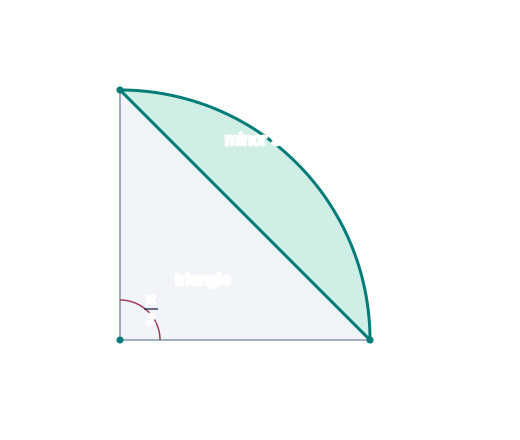
The unshaded central triangle is not part of the segment.
A chord equal to the radius
A circle has radius 6 cm and chord length 6 cm. Find the minor angle and the minor segment area and perimeter.
Follow the solutionThe central triangle is equilateral, so θ=π/3.
The perimeter uses the chord 6 and arc 2π, without adding either radius.
Choose the major region
A circle has radius 3 cm and chord length cm. Find the major segment area and perimeter.
Follow the solutionSince , the minor angle is 2π/3. Hence
The two segment areas sum to 9π.
Round the area, not the intermediate sine
Find the minor segment area for radius 8 cm and angle 0.9 radians, to 3 significant figures.
Follow the solutionTherefore A=3.73 cm². Using degree mode or rounding sin(0.9) too early gives a different result.