Maths4UBETA

Use a known derivative to evaluate an integral

Recognise a supplied antiderivative and apply it to an exact definite integral.

Try the quick check →
Lesson 9 of 11

Section 1 of 3 · Lesson · about 5 min

What evidence proves a proposed antiderivative?

Look for an inner expression and a matching derivative factor. Differentiate your proposed antiderivative before trusting the pattern.

Practise the method

Apply the outer derivative and inner factor, then check that the result matches every term.

Mark the inner function g(x)g(x), then look for its derivative beside the outer function. If there is a constant mismatch, keep it as a factor. Differentiate the result to confirm every factor.

Worked example

Recognise the inner derivative

Find ∫6x(1+x2)2 dx\int 6x(1+x^2)^2\,\mathrm dx.

  1. The inner expression is u=1+x2u=1+x^2, whose derivative is 2x2x. The integrand is 3u23u^2 times this derivative.

  2. An antiderivative has the form u3+Cu^3+C. On differentiating, 3u23u^2 is multiplied by 2x2x, which restores 6x(1+x2)26x(1+x^2)^2.

  3. Therefore the result is (1+x2)3+C(1+x^2)^3+C. Expansion is unnecessary.

Your turn

The integrand is (180x+75)(6x2+5x+1)2\left(180 x + 75\right) \left(6 x^{2} + 5 x + 1\right)^{2} on x≥0x\ge0.

Find the full indefinite integral of the given integrand.

Choose the complete result

Worked example

Find a missing scale factor in an inner derivative

Find ∫(12x(x2+1)3) dx\int\left(12 x \left(x^{2} + 1\right)^{3}\right)\,\mathrm dx.

Try it on paper first.

  1. The inner function is 1+x21+x^2, with derivative 2x2x. The integrand has 12x=6(2x)12x=6(2x).

  2. The outer cube integrates to a fourth power divided by four. The remaining factor is 64=32\frac64=\frac32.

  3. The full family is 3(x2+1)42+C\frac{3 \left(x^{2} + 1\right)^{4}}{2}+C. Differentiate this expression to recover 12x(x2+1)312 x \left(x^{2} + 1\right)^{3}. Every value of CC gives the same derivative.

Your turn

Find the exact value of ∫01(8x(x2+1)) dx\int_{0}^{1}\left(8 x \left(x^{2} + 1\right)\right)\,\mathrm dx.

Enter one number. Fractions and decimals are accepted.

Section 2 of 3 · Lesson · about 5 min

How can a root derivative give a related integral?

The derivative of a square root has a square root in its denominator. Match the numerator to the derivative of the radicand as well.

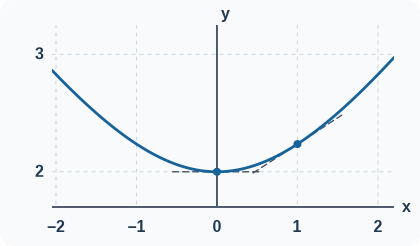
A square-root graph with a horizontal tangent at x equals zero and a rising tangent at x equals one.

For F(x)=x2+4F(x)=\sqrt{x^2+4}, the tangent at x=0x=0 is horizontal. At x=1x=1, the slope is 15\frac1{\sqrt5}. These slopes come from differentiating both the root and its radicand.

Practise the method

Spot the full structure, including the numerator, or verify it by differentiating the proposed expression.

For g(x)=x2+4g(x)=x^2+4, the numerator becomes 2x2x, which cancels the factor of two below. If the given numerator is 6x6x, multiply the proposed root by six.

Worked example

Recognise the derivative of a square root

Find ∫6xx2+4 dx\int\frac{6x}{\sqrt{x^2+4}}\,\mathrm dx.

  1. The derivative of x2+4\sqrt{x^2+4} is 2x2x2+4=xx2+4\frac{2x}{2\sqrt{x^2+4}}=\frac{x}{\sqrt{x^2+4}}.

  2. The required numerator is six times as large, so multiply the proposed antiderivative by 66.

  3. The result is 6x2+4+C6\sqrt{x^2+4}+C. The radicand is positive for every real xx.

Your turn

The integrand is 72x+7224x2+8x+1\frac{72 x + 72}{2 \sqrt{4 x^{2} + 8 x + 1}} on x≥0x\ge0.

Find the full indefinite integral of the given integrand.

Choose the complete result

Worked example

Use the derivative of a square root in a definite integral

Evaluate ∫04(2xx2+9) dx\int_{0}^{4}\left(\frac{2 x}{\sqrt{x^{2} + 9}}\right)\,\mathrm dx exactly.

Try it on paper first.

  1. The derivative of x2+9\sqrt{x^2+9} is 2x2x2+9=xx2+9\frac{2x}{2\sqrt{x^2+9}}=\frac{x}{\sqrt{x^2+9}}.

  2. The integrand is twice this derivative. The radicand takes the values 99 and 2525 at the endpoints.

  3. An antiderivative is F(x)=2x2+9F(x)=2 \sqrt{x^{2} + 9}. The written upper limit gives F(4)=10F(4)=10. The written lower limit gives F(0)=6F(0)=6.

  4. Subtract the whole lower evaluation. F(4)−F(0)=10−(6)=4F(4)-F(0)=10-\left(6\right)=4.

Your turn

Find the exact value of ∫03(5xx2+16) dx\int_{0}^{3}\left(\frac{5 x}{\sqrt{x^{2} + 16}}\right)\,\mathrm dx.

Enter one number. Fractions and decimals are accepted.

Section 3 of 3 · Lesson · about 5 min

How do you use the recognised function at the endpoints?

Once the reverse chain rule gives an antiderivative, use the original x-limits to evaluate it. Show both substitutions.

Practise the method

Find the indefinite integral up to a constant, then evaluate the particular definite integral with exact values.

Verify the primitive before evaluating. After substitution, a small value inside a power or root can simplify the arithmetic. Evaluate the entire expression at both limits.

Worked example

Evaluate a reverse-chain integral with small bounds

Evaluate ∫014x(1+x2) dx\int_0^1 4x(1+x^2)\,\mathrm dx exactly.

  1. Differentiate the proposed antiderivative (1+x2)2(1+x^2)^2. The result is 2(1+x2)⋅2x2(1+x^2)\cdot2x, which matches the integrand.

  2. The primitive gives F(1)=(1+1)2=4F(1)=(1+1)^2=4 and F(0)=(1+0)2=1F(0)=(1+0)^2=1.

  3. Subtract F(1)−F(0)=3F(1)-F(0)=3. These are the original xx-bounds because the primitive is written in xx.

Your turn

Evaluate ∫126x(x2+1)2 dx\int_1^2 6x(x^2+1)^2\,\mathrm dx exactly.

Enter one number. Fractions and decimals are accepted.

Your turn

The integrand is 108(6x+1)2108 \left(6 x + 1\right)^{2} on x≥0x\ge0.

Find the full indefinite integral of the given integrand.

Choose the complete result

Worked example

Recognise the derivative of a reciprocal

Evaluate ∫01(4x(x2+1)2) dx\int_{0}^{1}\left(\frac{4 x}{\left(x^{2} + 1\right)^{2}}\right)\,\mathrm dx exactly.

Try it on paper first.

  1. Use the derivative 2x2x of the inner function 1+x21+x^2. The outer exponent rises to −1-1, so the coefficient changes sign.

  2. With the numerator 4x=2(2x)4x=2(2x), the primitive is −2(1+x2)−1-2(1+x^2)^{-1}.

  3. An antiderivative is F(x)=−2x2+1F(x)=- \frac{2}{x^{2} + 1}. The written upper limit gives F(1)=−1F(1)=-1. The written lower limit gives F(0)=−2F(0)=-2.

  4. Subtract the whole lower evaluation. F(1)−F(0)=−1−(−2)=1F(1)-F(0)=-1-\left(-2\right)=1.

Your turn

Find the exact value of ∫01(6x(x2+1)2) dx\int_{0}^{1}\left(\frac{6 x}{\left(x^{2} + 1\right)^{2}}\right)\,\mathrm dx.

Enter one number. Fractions and decimals are accepted.

Worked examples

Practise the method

Core practice

Question 1 of 5

0 / 5 checked in this collection

Question list

Core practice

Fresh variants

Exam-style

Recognise a stated derivative in reverse

1 mark

The integrand is 8(x−3)(x2−6x+11)8 \left(x - 3\right) \left(x^{2} - 6 x + 11\right).

Find ∫(8(x−3)(x2−6x+11)) dx\int\left(8 \left(x - 3\right) \left(x^{2} - 6 x + 11\right)\right)\,\mathrm dx.

Choose the complete result

Choose one option. Explain your reasoning on paper.

Review the method

Progress stays in this browser. Create an account to save it or sign in.

Extra practice from this lesson

Use a derivative to recognise an antiderivative

The integrand is (288x+96)(6x2+4x+1)2\left(288 x + 96\right) \left(6 x^{2} + 4 x + 1\right)^{2} on x≥0x\ge0.

Find the full indefinite integral of the given integrand.

Choose the complete result

Use the cube without expanding its integrand

Find the exact value of ∫01(6x(x2+1)2) dx\int_{0}^{1}\left(6 x \left(x^{2} + 1\right)^{2}\right)\,\mathrm dx.

Enter one number. Fractions and decimals are accepted.

Use a derivative to recognise an antiderivative

The integrand is 12x+223x2+x+1\frac{12 x + 2}{2 \sqrt{3 x^{2} + x + 1}} on x≥0x\ge0.

Find the full indefinite integral of the given integrand.

Choose the complete result

Use two simple radicals after reversing the chain rule

Find the exact value of ∫012(3xx2+25) dx\int_{0}^{12}\left(\frac{3 x}{\sqrt{x^{2} + 25}}\right)\,\mathrm dx.

Enter one number. Fractions and decimals are accepted.

Use a derivative to recognise an antiderivative

The integrand is 63(7x+2)263 \left(7 x + 2\right)^{2} on x≥0x\ge0.

Find the full indefinite integral of the given integrand.

Choose the complete result

Use a descending bracket inside a power

Find the exact value of ∫01(8x(3−x2)) dx\int_{0}^{1}\left(8 x \left(3 - x^{2}\right)\right)\,\mathrm dx.

Enter one number. Fractions and decimals are accepted.

Previous checkpoints

Use a derivative to recognise an antiderivative

The integrand is (108x+36)(3x2+2x+1)2\left(108 x + 36\right) \left(3 x^{2} + 2 x + 1\right)^{2} on x≥0x\ge0.

Evaluate ∫02(108x+36)(3x2+2x+1)2 dx\int_{0}^{2}\left(108 x + 36\right) \left(3 x^{2} + 2 x + 1\right)^{2}\,\mathrm dx exactly.

Enter one number. Fractions and decimals are accepted.

Use a derivative to recognise an antiderivative

The integrand is 98x+4227x2+6x+1\frac{98 x + 42}{2 \sqrt{7 x^{2} + 6 x + 1}} on x≥0x\ge0.

Evaluate ∫0298x+4227x2+6x+1 dx\int_{0}^{2}\frac{98 x + 42}{2 \sqrt{7 x^{2} + 6 x + 1}}\,\mathrm dx exactly.

Enter one number. Fractions and decimals are accepted.

Use a derivative to recognise an antiderivative

The integrand is 42(7x+3)242 \left(7 x + 3\right)^{2} on x≥0x\ge0.

Evaluate ∫0242(7x+3)2 dx\int_{0}^{2}42 \left(7 x + 3\right)^{2}\,\mathrm dx exactly.

Enter one number. Fractions and decimals are accepted.

Use a derivative to recognise an antiderivative

The integrand is (60x+60)(2x2+4x+1)2\left(60 x + 60\right) \left(2 x^{2} + 4 x + 1\right)^{2} on x≥0x\ge0.

Evaluate ∫03(60x+60)(2x2+4x+1)2 dx\int_{0}^{3}\left(60 x + 60\right) \left(2 x^{2} + 4 x + 1\right)^{2}\,\mathrm dx exactly.

Enter one number. Fractions and decimals are accepted.

Use a derivative to recognise an antiderivative

The integrand is 81(3x+6)281 \left(3 x + 6\right)^{2} on x≥0x\ge0.

Evaluate ∫0281(3x+6)2 dx\int_{0}^{2}81 \left(3 x + 6\right)^{2}\,\mathrm dx exactly.

Enter one number. Fractions and decimals are accepted.

Use a derivative to recognise an antiderivative

The integrand is 96x+628x2+x+1\frac{96 x + 6}{2 \sqrt{8 x^{2} + x + 1}} on x≥0x\ge0.

Evaluate ∫0496x+628x2+x+1 dx\int_{0}^{4}\frac{96 x + 6}{2 \sqrt{8 x^{2} + x + 1}}\,\mathrm dx exactly.

Enter one number. Fractions and decimals are accepted.

Use a derivative to recognise an antiderivative

The integrand is (180x+75)(6x2+5x+1)2\left(180 x + 75\right) \left(6 x^{2} + 5 x + 1\right)^{2} on x≥0x\ge0.

Find the full indefinite integral of the given integrand.

Choose the complete result

Use a derivative to recognise an antiderivative

The integrand is 72x+7224x2+8x+1\frac{72 x + 72}{2 \sqrt{4 x^{2} + 8 x + 1}} on x≥0x\ge0.

Find the full indefinite integral of the given integrand.

Choose the complete result

Use a derivative to recognise an antiderivative

The integrand is 108(6x+1)2108 \left(6 x + 1\right)^{2} on x≥0x\ge0.

Find the full indefinite integral of the given integrand.

Choose the complete result

Use a derivative to recognise an antiderivative

The integrand is 12x+223x2+x+1\frac{12 x + 2}{2 \sqrt{3 x^{2} + x + 1}} on x≥0x\ge0.

Find the full indefinite integral of the given integrand.

Choose the complete result

Use a derivative to recognise an antiderivative

The integrand is 63(7x+2)263 \left(7 x + 2\right)^{2} on x≥0x\ge0.

Find the full indefinite integral of the given integrand.

Choose the complete result

Apply it · original exam-style problems

Show your working on paper and compare it with the worked solution and marking guidance.

Come back to what needs practice

Quick revision sheet (A4)

Your review plan starts after your first check.