Maths4UBETA

Further indefinite integration

Select antiderivative rules across mixed sums and verify the complete expression.

Try the quick check →
Lesson 7 of 11

Section 1 of 3 · Lesson · about 5 min

How do you organise a sum of different function types?

Read an expression one term at a time. Decide which rule belongs to each term before finding an antiderivative.

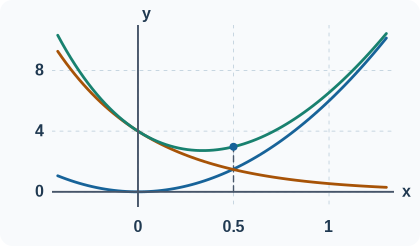
The blue polynomial and amber exponential add vertically to make the green sum curve.

The blue graph is 6x26x^2, the amber graph is 4e−2x4e^{-2x}, and the green graph is their sum. At each input, the green height is the sum of the two component heights. Integrate each component using its own rule.

Practise the method

Identify an exponential, power or trigonometric rule for each term before simplifying.

Mark a different rule against each term. Integrate a power by changing its exponent, but keep the exponent of an exponential unchanged. Then add the terms and check the derivative.

Worked example

Choose a rule separately for each term

Find ∫(3x2−4e−2x) dx\int(3x^2-4e^{-2x})\,\mathrm dx.

  1. The power term 3x23x^2 contributes x3x^3 because its new exponent is 33.

  2. The exponential term keeps exponent −2x-2x. Dividing its coefficient −4-4 by −2-2 gives 22.

  3. The complete result is x3+2e−2x+Cx^3+2e^{-2x}+C. Its exponential derivative is negative as required.

Your turn

Integrate the expression x2+4e7x+3x^{2} + 4 e^{7 x + 3}. Any angles are in radians.

Find the indefinite integral. Give the full family of antiderivatives.

Choose the complete result

Worked example

Use the power rule and the exponential rule together

Find ∫(6x2+4e−2x) dx\int\left(6 x^{2} + 4 e^{- 2 x}\right)\,\mathrm dx.

Try it on paper first.

  1. The polynomial term 6x26x^2 integrates to 63x3=2x3\frac63 x^3=2x^3.

  2. The exponential term keeps its exponent. Divide 44 by the inner derivative −2-2, giving −2e−2x-2e^{-2x}.

  3. The full family is 2x3−2e−2x+C2 x^{3} - 2 e^{- 2 x}+C. Differentiate this expression to recover 6x2+4e−2x6 x^{2} + 4 e^{- 2 x}. Every value of CC gives the same derivative.

Your turn

∫(8x+10sin⁡(5x)) dx=4x2+kcos⁡(5x)+C\int(8x+10\sin(5x))\,\mathrm dx=4x^2+k\cos(5x)+C. Angles are in radians. Find kk.

Enter one number. Fractions and decimals are accepted.

Section 2 of 3 · Lesson · about 5 min

How many arbitrary constants are needed?

Include every term and then add one constant for the whole expression. Differentiating at the end quickly catches a missing term.

Practise the method

Write all variable terms first, then add one C and check by differentiating.

Use the given point on the combined equation. A point fixes the one total constant. Differentiation checks the method, and substitution of the point checks the constant.

Worked example

Use one constant for the whole expression

A curve has gradient 2x+3cos⁡(3x)2x+3\cos(3x) and passes through (0,4)(0,4). Find its equation.

  1. The two variable terms integrate to x2x^2 and sin⁡(3x)\sin(3x). Their arbitrary constants combine into one CC.

  2. At x=0x=0 both variable terms vanish, so y(0)=C=4y(0)=C=4.

  3. Thus y=x2+sin⁡(3x)+4y=x^2+\sin(3x)+4. Its derivative is 2x+3cos⁡(3x)2x+3\cos(3x).

Your turn

Integrate the expression 4x+9sin⁡(4x)4 x + 9 \sin{\left(4 x \right)}. Any angles are in radians.

Find the indefinite integral. Give the full family of antiderivatives.

Choose the complete result

Worked example

Use a single constant after combining two rules

A curve satisfies dydx=6x+4cos⁡(2x)\frac{\mathrm dy}{\mathrm dx}=6x+4\cos(2x) and passes through (0,3)(0,3). Find its equation.

Try it on paper first.

  1. Integrate the two terms separately. The results are 3x23x^2 and 42sin⁡(2x)=2sin⁡(2x)\frac42\sin(2x)=2\sin(2x).

  2. Combine the terms and write one arbitrary constant: y=3x2+2sin⁡(2x)+Cy=3x^2+2\sin(2x)+C.

  3. At x=0x=0 both variable terms are zero, so C=3C=3, giving y=3x2+2sin⁡(2x)+3y=3x^2+2\sin(2x)+3.

Your turn

Integrate the expression 5x+8sin⁡(2x)5 x + 8 \sin{\left(2 x \right)}. Any angles are in radians.

Evaluate ∫0π65x+8sin⁡(2x) dx\int_{0}^{\frac{\pi}{6}}5 x + 8 \sin{\left(2 x \right)}\,\mathrm dx exactly.

Enter one number. Fractions and decimals are accepted.

Section 3 of 3 · Lesson · about 5 min

When do bracketed terms need an extra factor?

For an exponential, trigonometric or power term with a linear argument, check that you cancelled its inner derivative.

Practise the method

Keep the bracket intact unless expanding makes the integral simpler.

Read each inner derivative from its own bracket or angle. For a power with bracket 2x+12x+1 and a cosine with angle 3x3x, the inner factors are different.

Worked example

Track two different chain factors

Find ∫(4(2x+1)3+3cos⁡(3x)) dx\int\bigl(4(2x+1)^3+3\cos(3x)\bigr)\,\mathrm dx.

  1. For the bracket power, the new exponent is 44 and the inner derivative is 22. The coefficient is 44⋅2=12\frac{4}{4\cdot2}=\frac12.

  2. For the cosine, use sine with the same angle. Its coefficient is 33=1\frac{3}{3}=1.

  3. The result is 12(2x+1)4+sin⁡(3x)+C\frac12(2x+1)^4+\sin(3x)+C. Differentiate the two terms separately to check.

Your turn

Integrate the expression 5x+8(6x+8)45 x + 8 \left(6 x + 8\right)^{4}. Any angles are in radians.

Find the indefinite integral. Give the full family of antiderivatives.

Choose the complete result

Worked example

Combine a linear bracket with a constant term

Evaluate ∫012(12(2x+1)2−5) dx\int_{0}^{\frac{1}{2}}\left(12 \left(2 x + 1\right)^{2} - 5\right)\,\mathrm dx exactly.

Try it on paper first.

  1. For the bracket, raise the outer exponent and divide by 3⋅2=63\cdot2=6. Its contribution is 2(2x+1)32(2x+1)^3.

  2. The constant term contributes −5x-5x, so the lower evaluation still contains the bracket's value at zero.

  3. An antiderivative is F(x)=−5x+2(2x+1)3F(x)=- 5 x + 2 \left(2 x + 1\right)^{3}. The written upper limit gives F(12)=272F(\frac{1}{2})=\frac{27}{2}. The written lower limit gives F(0)=2F(0)=2.

  4. Subtract the whole lower evaluation. F(12)−F(0)=272−(2)=232F(\frac{1}{2})-F(0)=\frac{27}{2}-\left(2\right)=\frac{23}{2}.

Your turn

Find the exact value of ∫01(8x+7) dx\int_{0}^{1}\left(8 x + 7\right)\,\mathrm dx.

Enter one number. Fractions and decimals are accepted.

Worked examples

Practise the method

Core practice

Question 1 of 5

0 / 5 checked in this collection

Question list

Core practice

Fresh variants

Exam-style

Combine two reverse derivative rules

1 mark

Use −3x+3e3x- 3 x + 3 e^{3 x} as the integrand.

Find ∫(−3x+3e3x) dx\int\left(- 3 x + 3 e^{3 x}\right)\,\mathrm dx.

Choose the complete result

Choose one option. Explain your reasoning on paper.

Review the method

Progress stays in this browser. Create an account to save it or sign in.

Extra practice from this lesson

Select the correct antiderivative for each term

Integrate the expression x3+9e8x−5x^{3} + 9 e^{8 x - 5}. Any angles are in radians.

Find the indefinite integral. Give the full family of antiderivatives.

Choose the complete result

Select the correct antiderivative for each term

Integrate the expression x4+6e7x−1x^{4} + 6 e^{7 x - 1}. Any angles are in radians.

Find the indefinite integral. Give the full family of antiderivatives.

Choose the complete result

Select the correct antiderivative for each term

Integrate the expression −5x+8sin⁡(6x)- 5 x + 8 \sin{\left(6 x \right)}. Any angles are in radians.

Find the indefinite integral. Give the full family of antiderivatives.

Choose the complete result

Select the correct antiderivative for each term

Integrate the expression 4x+sin⁡(5x)4 x + \sin{\left(5 x \right)}. Any angles are in radians.

Evaluate ∫0π154x+sin⁡(5x) dx\int_{0}^{\frac{\pi}{15}}4 x + \sin{\left(5 x \right)}\,\mathrm dx exactly.

Enter one number. Fractions and decimals are accepted.

Select the correct antiderivative for each term

Integrate the expression 3x+9(3x+9)23 x + 9 \left(3 x + 9\right)^{2}. Any angles are in radians.

Find the indefinite integral. Give the full family of antiderivatives.

Choose the complete result

Combine a reciprocal square and a power

Find the exact value of ∫01(2x+6(x+1)2) dx\int_{0}^{1}\left(2 x + \frac{6}{\left(x + 1\right)^{2}}\right)\,\mathrm dx.

Enter one number. Fractions and decimals are accepted.

Previous checkpoints

Select the correct antiderivative for each term

Integrate the expression x4+7e2x−5x^{4} + 7 e^{2 x - 5}. Any angles are in radians.

Find the indefinite integral. Give the full family of antiderivatives.

Choose the complete result

Select the correct antiderivative for each term

Integrate the expression −3x+2(8x+2)4- 3 x + 2 \left(8 x + 2\right)^{4}. Any angles are in radians.

Evaluate ∫03−3x+2(8x+2)4 dx\int_{0}^{3}- 3 x + 2 \left(8 x + 2\right)^{4}\,\mathrm dx exactly.

Enter one number. Fractions and decimals are accepted.

Select the correct antiderivative for each term

Integrate the expression 7(6x+7)27 \left(6 x + 7\right)^{2}. Any angles are in radians.

Evaluate ∫037(6x+7)2 dx\int_{0}^{3}7 \left(6 x + 7\right)^{2}\,\mathrm dx exactly.

Enter one number. Fractions and decimals are accepted.

Select the correct antiderivative for each term

Integrate the expression x2+4e7x+3x^{2} + 4 e^{7 x + 3}. Any angles are in radians.

Find the indefinite integral. Give the full family of antiderivatives.

Choose the complete result

Select the correct antiderivative for each term

Integrate the expression 4x+9sin⁡(4x)4 x + 9 \sin{\left(4 x \right)}. Any angles are in radians.

Find the indefinite integral. Give the full family of antiderivatives.

Choose the complete result

Select the correct antiderivative for each term

Integrate the expression 5x+8(6x+8)45 x + 8 \left(6 x + 8\right)^{4}. Any angles are in radians.

Find the indefinite integral. Give the full family of antiderivatives.

Choose the complete result

Select the correct antiderivative for each term

Integrate the expression −5x+8sin⁡(6x)- 5 x + 8 \sin{\left(6 x \right)}. Any angles are in radians.

Find the indefinite integral. Give the full family of antiderivatives.

Choose the complete result

Select the correct antiderivative for each term

Integrate the expression 3x+9(3x+9)23 x + 9 \left(3 x + 9\right)^{2}. Any angles are in radians.

Find the indefinite integral. Give the full family of antiderivatives.

Choose the complete result

Apply it · original exam-style problems

Show your working on paper and compare it with the worked solution and marking guidance.

Come back to what needs practice

Quick revision sheet (A4)

Your review plan starts after your first check.