Maths4UBETA

Reciprocal integrals and natural logarithms

Recognise the power-rule exception and choose a logarithmic form on a valid interval.

Try the quick check →
Lesson 6 of 11

Section 1 of 3 · Lesson · about 5 min

Why does one over x need a different rule?

An exponent of minus one would give zero in the denominator of the power rule. The derivative of a natural logarithm gives the required reciprocal instead.

Practise the method

Use a natural logarithm instead of the integration power rule at exponent −1.

A natural logarithm needs a positive argument. The absolute value makes it work on the negative branch as well. Choose the expression suitable for the domain given.

Worked example

Use a natural logarithm for the reciprocal

Evaluate ∫142x dx\int_1^4 \frac{2}{x}\,\mathrm dx exactly.

  1. The power rule would divide by zero at exponent −1-1. On x>0x>0, the derivative of ln⁡x\ln x is 1x\frac1x.

  2. Use F(x)=2ln⁡xF(x)=2\ln x and subtract F(4)−F(1)=2ln⁡4−2ln⁡1F(4)-F(1)=2\ln4-2\ln1.

  3. Since ln⁡1=0\ln1=0, the exact value is 2ln⁡42\ln4. Keeping the coefficient outside gives a compact exact answer.
Your turn

The integrand is 11x\frac{11}{x}. Work on x>0x>0.

Find the indefinite integral. Give the full family of antiderivatives.

Choose the complete result

Worked example

Simplify a log difference using a ratio

Evaluate ∫26(3x) dx\int_{2}^{6}\left(\frac{3}{x}\right)\,\mathrm dx exactly.

Try it on paper first.

  1. The power rule would give a zero denominator. On x>0x>0, use ddxln⁡x=1x\frac{\mathrm d}{\mathrm dx}\ln x=\frac1x.

  2. After substituting, the difference of logarithms can be written as 3ln⁡(62)=3ln⁡33\ln\left(\frac62\right)=3\ln 3.

  3. An antiderivative is F(x)=3log⁡(x)F(x)=3 \log{\left(x \right)}. The written upper limit gives F(6)=log⁡(216)F(6)=\log{\left(216 \right)}. The written lower limit gives F(2)=log⁡(8)F(2)=\log{\left(8 \right)}.

  4. Subtract the whole lower evaluation. F(6)−F(2)=log⁡(216)−(log⁡(8))=log⁡(27)F(6)-F(2)=\log{\left(216 \right)}-\left(\log{\left(8 \right)}\right)=\log{\left(27 \right)}.

Your turn

∫2104x dx=4ln⁡r\int_2^{10}\frac4x\,\mathrm dx=4\ln r. Find rr.

Enter one number. Fractions and decimals are accepted.

Section 2 of 3 · Lesson · about 5 min

What factor goes before the logarithm?

Write the reciprocal as a constant times one over a linear expression. The inner derivative supplies the additional factor you must divide by.

Practise the method

For a linear denominator, divide by its x-coefficient and place its absolute value inside the logarithm.

Compare the numerator with the derivative of the denominator. For 5−2x5-2x that derivative is −2-2, so a numerator of 44 needs a multiplier 4−2=−2\frac4{-2}=-2.

Worked example

Divide by the gradient of the denominator

Find ∫63x+2 dx\int\frac{6}{3x+2}\,\mathrm dx on x>−23x>-\frac23.

  1. The bracket 3x+23x+2 is positive on the stated interval. Differentiate ln⁡(3x+2)\ln(3x+2) to get 33x+2\frac{3}{3x+2}.

  2. Multiply by 63=2\frac{6}{3}=2, so the result is 2ln⁡(3x+2)+C2\ln(3x+2)+C.

  3. Check: 2⋅33x+2=63x+22\cdot\frac{3}{3x+2}=\frac{6}{3x+2}.

Your turn

The integrand is 26x+2\frac{2}{6 x + 2}. Work on 6x+2>06 x + 2>0.

Find the indefinite integral. Give the full family of antiderivatives.

Choose the complete result

Worked example

Match the derivative of a descending denominator

Find ∫(45−2x) dx\int\left(\frac{4}{5 - 2 x}\right)\,\mathrm dx. Use x<52x<\frac52.

Try it on paper first.

  1. The denominator stays positive on the given branch. The derivative of ln⁡(5−2x)\ln(5-2x) is −25−2x\frac{-2}{5-2x}.

  2. Multiplying that logarithm by 4−2=−2\frac4{-2}=-2 gives the required numerator.

  3. The full family is −2log⁡(5−2x)+C- 2 \log{\left(5 - 2 x \right)}+C. Differentiate this expression to recover 45−2x\frac{4}{5 - 2 x}. Every value of CC gives the same derivative.

Your turn

For x<4x<4, write ∫38−2x dx=kln⁡(8−2x)+C\int\frac{3}{8-2x}\,\mathrm dx=k\ln(8-2x)+C. Find kk.

Enter an exact value or round to 3 significant figures.

Section 3 of 3 · Lesson · about 5 min

Why must both limits stay on the same side of a pole?

An antiderivative involving a logarithm can be used on either side of a pole, separately. The endpoint rule requires a continuous integrand between the limits.

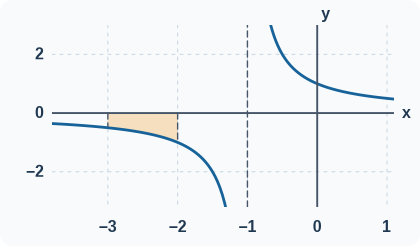
A reciprocal graph with dashed vertical asymptote x equals negative one. The shaded interval is to the left of the asymptote.

For y=1x+1y=\frac1{x+1}, the shaded interval [−3,−2][-3,-2] stays on the negative branch. The dashed line is the pole at x=−1x=-1.

Practise the method

Check that the full interval lies in one continuous branch. Use the log form on that branch.

Check the denominator on the whole interval. If it vanishes between the limits, finite endpoint values on different branches do not justify a single subtraction.

Worked example

Keep the logarithm real on a negative branch

Evaluate ∫−3−21x+1 dx\int_{-3}^{-2}\frac{1}{x+1}\,\mathrm dx exactly.

  1. Both bounds lie to the left of the pole x=−1x=-1. Use F(x)=ln⁡∣x+1∣F(x)=\ln|x+1| so that the input to the logarithm stays positive.

  2. At x=−3x=-3 the log input is 22. At x=−2x=-2 it is 11.

  3. The signed integral is ln⁡1−ln⁡2=−ln⁡2\ln1-\ln2=-\ln2. The sign agrees with the negative integrand.

Your turn

The integrand is 3+57x+83 + \frac{5}{7 x + 8}. Work on 7x+8<07 x + 8<0.

Find the indefinite integral. Give the full family of antiderivatives.

Choose the complete result

Worked example

Spot a pole between two finite endpoint values

Can the usual endpoint rule be used on ∫−201x+1 dx\int_{-2}^{0}\frac{1}{x+1}\,\mathrm dx?

Try it on paper first.

  1. The denominator vanishes at x=−1x=-1, which lies between −2-2 and 00. The integrand is undefined there.

  2. The antiderivative ln⁡∣x+1∣\ln|x+1| is valid on each branch separately. Each branch ends at the pole.

  3. The usual endpoint rule requires a continuous integrand from the lower input to the upper input. It does not apply across this pole.

Your turn

The integrand is 4+46x+74 + \frac{4}{6 x + 7}. Work on 6x+7<06 x + 7<0.

Evaluate ∫−236−324+46x+7 dx\int_{- \frac{23}{6}}^{- \frac{3}{2}}4 + \frac{4}{6 x + 7}\,\mathrm dx exactly.

Choose the complete result

Worked examples

Practise the method

Core practice

Question 1 of 5

0 / 5 checked in this collection

Question list

Core practice

Fresh variants

Exam-style

Integrate a reciprocal on a continuous branch

1 mark

Integrate 3x\frac{3}{x} on the branch x>0x > 0.

Find ∫(3x) dx\int\left(\frac{3}{x}\right)\,\mathrm dx.

Choose the complete result

Choose one option. Explain your reasoning on paper.

Review the method

Progress stays in this browser. Create an account to save it or sign in.

Extra practice from this lesson

Integrate a reciprocal and stay on one side of its pole

The integrand is 1x\frac{1}{x}. Work on x>0x>0.

Find the indefinite integral. Give the full family of antiderivatives.

Choose the complete result

Keep a logarithmic result in a compact form

The exact value of ∫265x dx\int_2^6\frac5x\,\mathrm dx is 5ln⁡r5\ln r. Find rr.

Enter one number. Fractions and decimals are accepted.

Integrate a reciprocal and stay on one side of its pole

The integrand is 22x−1\frac{2}{2 x - 1}. Work on 2x−1>02 x - 1>0.

Find the indefinite integral. Give the full family of antiderivatives.

Choose the complete result

Check the inner slope before applying the logarithm

The exact value of ∫15222x+1 dx\int_1^{\frac52}\frac2{2x+1}\,\mathrm dx is ln⁡r\ln r. Find rr.

Enter one number. Fractions and decimals are accepted.

Integrate a reciprocal and stay on one side of its pole

The integrand is −5+73x−6-5 + \frac{7}{3 x - 6}. Work on 3x−6<03 x - 6<0.

Find the indefinite integral. Give the full family of antiderivatives.

Choose the complete result

Use positive magnitudes inside a logarithm

∫−5−21x+1 dx=ln⁡r\int_{-5}^{-2}\frac{1}{x+1}\,\mathrm dx=\ln r. Find the exact value of rr.

Enter one number. Fractions and decimals are accepted.

Previous checkpoints

Integrate a reciprocal and stay on one side of its pole

The integrand is 6x\frac{6}{x}. Work on x>0x>0.

Evaluate ∫2166x dx\int_{2}^{16}\frac{6}{x}\,\mathrm dx exactly.

Choose the complete result

Integrate a reciprocal and stay on one side of its pole

The integrand is 42x+7\frac{4}{2 x + 7}. Work on 2x+7>02 x + 7>0.

Evaluate ∫−12342x+7 dx\int_{- \frac{1}{2}}^{3}\frac{4}{2 x + 7}\,\mathrm dx exactly.

Choose the complete result

Integrate a reciprocal and stay on one side of its pole

The integrand is −6+28x+1-6 + \frac{2}{8 x + 1}. Work on 8x+1<08 x + 1<0.

Evaluate ∫−2−34−6+28x+1 dx\int_{-2}^{- \frac{3}{4}}-6 + \frac{2}{8 x + 1}\,\mathrm dx exactly.

Choose the complete result

Integrate a reciprocal and stay on one side of its pole

The integrand is 9x\frac{9}{x}. Work on x>0x>0.

Evaluate ∫9119x dx\int_{9}^{11}\frac{9}{x}\,\mathrm dx exactly.

Choose the complete result

Integrate a reciprocal and stay on one side of its pole

The integrand is 107x−8\frac{10}{7 x - 8}. Work on 7x−8>07 x - 8>0.

Evaluate ∫1573107x−8 dx\int_{\frac{15}{7}}^{3}\frac{10}{7 x - 8}\,\mathrm dx exactly.

Choose the complete result

Integrate a reciprocal and stay on one side of its pole

The integrand is 11x\frac{11}{x}. Work on x>0x>0.

Find the indefinite integral. Give the full family of antiderivatives.

Choose the complete result

Integrate a reciprocal and stay on one side of its pole

The integrand is 26x+2\frac{2}{6 x + 2}. Work on 6x+2>06 x + 2>0.

Find the indefinite integral. Give the full family of antiderivatives.

Choose the complete result

Integrate a reciprocal and stay on one side of its pole

The integrand is 3+57x+83 + \frac{5}{7 x + 8}. Work on 7x+8<07 x + 8<0.

Find the indefinite integral. Give the full family of antiderivatives.

Choose the complete result

Integrate a reciprocal and stay on one side of its pole

The integrand is 4+46x+74 + \frac{4}{6 x + 7}. Work on 6x+7<06 x + 7<0.

Evaluate ∫−236−324+46x+7 dx\int_{- \frac{23}{6}}^{- \frac{3}{2}}4 + \frac{4}{6 x + 7}\,\mathrm dx exactly.

Choose the complete result

Integrate a reciprocal and stay on one side of its pole

The integrand is 1x\frac{1}{x}. Work on x>0x>0.

Find the indefinite integral. Give the full family of antiderivatives.

Choose the complete result

Integrate a reciprocal and stay on one side of its pole

The integrand is 22x−1\frac{2}{2 x - 1}. Work on 2x−1>02 x - 1>0.

Find the indefinite integral. Give the full family of antiderivatives.

Choose the complete result

Integrate a reciprocal and stay on one side of its pole

The integrand is −5+73x−6-5 + \frac{7}{3 x - 6}. Work on 3x−6<03 x - 6<0.

Find the indefinite integral. Give the full family of antiderivatives.

Choose the complete result

Apply it · original exam-style problems

Show your working on paper and compare it with the worked solution and marking guidance.

Come back to what needs practice

Quick revision sheet (A4)

Your review plan starts after your first check.