Maths4UBETA

Powers of a linear expression

Integrate positive, negative and fractional powers of a linear bracket using the reverse chain factor.

Try the quick check →
Lesson 3 of 11

Section 1 of 3 · Lesson · about 5 min

Why divide by the inner slope?

Keep the inner expression in brackets. The reverse chain rule divides by its constant derivative, as well as the new power.

Practise the method

Use the ordinary integration power rule on the bracket and divide by the inner slope.

The outer derivative would multiply by n+1n+1. The inner derivative would multiply by aa. Divide by both factors when finding the antiderivative. Include a negative sign if one of the factors is negative.

Worked example

Keep the linear bracket

Find ∫6(2x+1)2 dx\int 6(2x+1)^2\,\mathrm dx.

  1. Raise the bracket exponent from 22 to 33. Differentiating (2x+1)3(2x+1)^3 would give 3(2x+1)23(2x+1)^2 times the inner derivative 22.

  2. The coefficient needed in front is 63×2=1\frac{6}{3\times2}=1. The result is (2x+1)3+C(2x+1)^3+C.

  3. Check: its derivative is 3(2x+1)2⋅2=6(2x+1)23(2x+1)^2\cdot2=6(2x+1)^2.

Your turn

The integrand is 2(2x+9)42 \left(2 x + 9\right)^{4} on the interval where 2x+9>02 x + 9>0.

Find the indefinite integral. Give the full family of antiderivatives.

Choose the complete result

Worked example

Keep a descending linear bracket

Find ∫(6(5−2x)2) dx\int\left(6 \left(5 - 2 x\right)^{2}\right)\,\mathrm dx.

Try it on paper first.

  1. Keep 5−2x5-2x together and increase the outer power to three.

  2. Divide by the new outer exponent 33 and the inner derivative −2-2. The coefficient is 63(−2)=−1\frac6{3(-2)}=-1.

  3. The full family is −(5−2x)3+C- \left(5 - 2 x\right)^{3}+C. Differentiate this expression to recover 6(5−2x)26 \left(5 - 2 x\right)^{2}. Every value of CC gives the same derivative.

Your turn

∫12(7−2x)3 dx=k(7−2x)4+C\int12(7-2x)^3\,\mathrm dx=k(7-2x)^4+C. Find kk.

Enter an exact value or round to 3 significant figures.

Section 2 of 3 · Lesson · about 5 min

How do you handle a fractional bracket power?

Rewrite a square root of a linear expression as a half power. After integration the exponent is three halves, so divide by both three halves and the bracket's gradient.
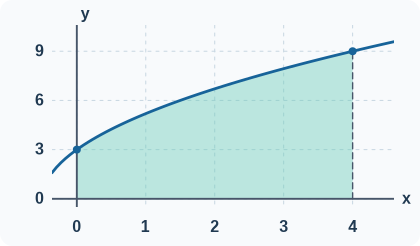
The positive square-root curve rises from height 3 at x = 0 to height 9 at x = 4.

This is y=32x+1y=3\sqrt{2x+1} from the first worked example. The enclosed region has x-limits 00 and 44. The expression 2x+12x+1 takes the values 11 and 99.

Practise the method

Leave the bracket intact. Use exact values for convenient bracket inputs.

For definite integrals, calculate the two values of the bracket before taking the powers. A value such as 93/29^{3/2} is easy to read as (9)3=27(\sqrt9)^3=27.

Worked example

Choose bounds that simplify a square root

Evaluate ∫0432x+1 dx\int_0^4 3\sqrt{2x+1}\,\mathrm dx exactly.

  1. The bracket has derivative 22. Increasing the exponent to 32\frac32 gives coefficient 32×32=1\frac{3}{2\times\frac32}=1.

  2. Use F(x)=(2x+1)3/2F(x)=(2x+1)^{3/2}. At x=0x=0 the bracket is 11, and at x=4x=4 it is 99.

  3. Subtract F(4)−F(0)=93/2−1=27−1=26F(4)-F(0)=9^{3/2}-1=27-1=26.

Your turn

Evaluate ∫0234x+1 dx\int_0^2 3\sqrt{4x+1}\,\mathrm dx exactly.

Enter one number. Fractions and decimals are accepted.

Your turn

The integrand is 23x−92 \sqrt{3 x - 9} on the interval where 3x−9>03 x - 9>0.

Find the indefinite integral. Give the full family of antiderivatives.

Choose the complete result

Worked example

Use both limits with a square-root bracket

Evaluate ∫01(63x+1) dx\int_{0}^{1}\left(6 \sqrt{3 x + 1}\right)\,\mathrm dx exactly.

Try it on paper first.

  1. Rewrite the root as a half power. The new exponent is 32\frac32, and the bracket's gradient is 33. The coefficient becomes 6(3/2)⋅3=43\frac6{(3/2)\cdot3}=\frac43.

  2. At the two x-values the bracket equals 11 and 44, so its powers are 13/2=11^{3/2}=1 and 43/2=84^{3/2}=8.

  3. An antiderivative is F(x)=4(3x+1)323F(x)=\frac{4 \left(3 x + 1\right)^{\frac{3}{2}}}{3}. The written upper limit gives F(1)=323F(1)=\frac{32}{3}. The written lower limit gives F(0)=43F(0)=\frac{4}{3}.

  4. Subtract the whole lower evaluation. F(1)−F(0)=323−(43)=283F(1)-F(0)=\frac{32}{3}-\left(\frac{4}{3}\right)=\frac{28}{3}.

Your turn

Find the exact value of ∫052(32x+4) dx\int_{0}^{\frac{5}{2}}\left(3 \sqrt{2 x + 4}\right)\,\mathrm dx.

Enter one number. Fractions and decimals are accepted.

Section 3 of 3 · Lesson · about 5 min

How does a negative bracket power integrate?

A negative power can stay negative after integration. Check the excluded value of the bracket and handle exponent minus one with a logarithm.

Practise the method

Choose an antiderivative on the stated domain and check by differentiating.

Keep the bracket as a unit when working with negative exponents. An exponent of −3-3 increases by one to −2-2. Check whether the denominator vanishes anywhere between the limits.

Worked example

Read the sign of a negative bracket power

Find ∫12(3x+1)3 dx\int \frac{12}{(3x+1)^3}\,\mathrm dx on x>−13x>-\frac13.

  1. The power is −3-3. Raise it to −2-2 and divide the coefficient by both −2-2 and the inner derivative 33.

  2. The result is −2(3x+1)−2+C-2(3x+1)^{-2}+C. The coefficient is negative because the new power is negative.

  3. Check: (−2)(−2)(3)(3x+1)−3=12(3x+1)−3(-2)(-2)(3)(3x+1)^{-3}=12(3x+1)^{-3}.

Your turn

The integrand is 10(6x−2)3\frac{10}{\left(6 x - 2\right)^{3}} on the interval where 6x−2>06 x - 2>0.

Find the indefinite integral. Give the full family of antiderivatives.

Choose the complete result

Worked example

Evaluate a reciprocal-square integral with small bounds

Evaluate ∫012(8(2x+1)2) dx\int_{0}^{\frac{1}{2}}\left(\frac{8}{\left(2 x + 1\right)^{2}}\right)\,\mathrm dx exactly.

Try it on paper first.

  1. The bracket is positive over this interval. Write the power as −2-2 and add one to get −1-1.

  2. Divide 88 by −1-1 and by the inner gradient 22. The coefficient is −4-4.

  3. An antiderivative is F(x)=−42x+1F(x)=- \frac{4}{2 x + 1}. The written upper limit gives F(12)=−2F(\frac{1}{2})=-2. The written lower limit gives F(0)=−4F(0)=-4.

  4. Subtract the whole lower evaluation. F(12)−F(0)=−2−(−4)=2F(\frac{1}{2})-F(0)=-2-\left(-4\right)=2.

Your turn

Find the exact value of ∫02(6(x+1)2) dx\int_{0}^{2}\left(\frac{6}{\left(x + 1\right)^{2}}\right)\,\mathrm dx.

Enter one number. Fractions and decimals are accepted.

Worked examples

Practise the method

Core practice

Question 1 of 5

0 / 5 checked in this collection

Question list

Core practice

Fresh variants

Exam-style

Reverse the chain factor in a bracket power

1 mark

Use 4x+3>04 x + 3>0 for 2(4x+3)32 \left(4 x + 3\right)^{3}.

Find ∫(2(4x+3)3) dx\int\left(2 \left(4 x + 3\right)^{3}\right)\,\mathrm dx.

Choose the complete result

Choose one option. Explain your reasoning on paper.

Review the method

Progress stays in this browser. Create an account to save it or sign in.

Extra practice from this lesson

Integrate a power of a linear expression

The integrand is 9(2x−3)49 \left(2 x - 3\right)^{4} on the interval where 2x−3>02 x - 3>0.

Find the indefinite integral. Give the full family of antiderivatives.

Choose the complete result

Use a fractional lower bound in a cube

Find the exact value of ∫1232(4(2x−1)3) dx\int_{\frac{1}{2}}^{\frac{3}{2}}\left(4 \left(2 x - 1\right)^{3}\right)\,\mathrm dx.

Enter one number. Fractions and decimals are accepted.

Integrate a power of a linear expression

The integrand is 10(7x−3)3210 \left(7 x - 3\right)^{\frac{3}{2}} on the interval where 7x−3>07 x - 3>0.

Find the indefinite integral. Give the full family of antiderivatives.

Choose the complete result

Integrate a power of a linear expression

The integrand is 83x−6\frac{8}{\sqrt{3 x - 6}} on the interval where 3x−6>03 x - 6>0.

Evaluate ∫51483x−6 dx\int_{5}^{14}\frac{8}{\sqrt{3 x - 6}}\,\mathrm dx exactly.

Enter one number. Fractions and decimals are accepted.

Integrate a power of a linear expression

The integrand is 10(5x−8)4\frac{10}{\left(5 x - 8\right)^{4}} on the interval where 5x−8>05 x - 8>0.

Find the indefinite integral. Give the full family of antiderivatives.

Choose the complete result

Check the two denominators before subtracting

Find the exact value of ∫13(4(5−x)3) dx\int_{1}^{3}\left(\frac{4}{\left(5 - x\right)^{3}}\right)\,\mathrm dx.

Enter one number. Fractions and decimals are accepted.

Previous checkpoints

Integrate a power of a linear expression

The integrand is (5x+5)2\left(5 x + 5\right)^{2} on the interval where 5x+5>05 x + 5>0.

Evaluate ∫−2545(5x+5)2 dx\int_{- \frac{2}{5}}^{\frac{4}{5}}\left(5 x + 5\right)^{2}\,\mathrm dx exactly.

Enter one number. Fractions and decimals are accepted.

Integrate a power of a linear expression

The integrand is 777x3277 \sqrt{7} x^{\frac{3}{2}} on the interval where 7x>07 x>0.

Evaluate ∫97167777x32 dx\int_{\frac{9}{7}}^{\frac{16}{7}}77 \sqrt{7} x^{\frac{3}{2}}\,\mathrm dx exactly.

Enter one number. Fractions and decimals are accepted.

Integrate a power of a linear expression

The integrand is 7(5x+2)4\frac{7}{\left(5 x + 2\right)^{4}} on the interval where 5x+2>05 x + 2>0.

Evaluate ∫25657(5x+2)4 dx\int_{\frac{2}{5}}^{\frac{6}{5}}\frac{7}{\left(5 x + 2\right)^{4}}\,\mathrm dx exactly.

Enter one number. Fractions and decimals are accepted.

Integrate a power of a linear expression

The integrand is 4(8x−8)34 \left(8 x - 8\right)^{3} on the interval where 8x−8>08 x - 8>0.

Evaluate ∫321584(8x−8)3 dx\int_{\frac{3}{2}}^{\frac{15}{8}}4 \left(8 x - 8\right)^{3}\,\mathrm dx exactly.

Enter one number. Fractions and decimals are accepted.

Integrate a power of a linear expression

The integrand is 2343x3\frac{2}{343 x^{3}} on the interval where 7x>07 x>0.

Evaluate ∫471172343x3 dx\int_{\frac{4}{7}}^{\frac{11}{7}}\frac{2}{343 x^{3}}\,\mathrm dx exactly.

Enter one number. Fractions and decimals are accepted.

Integrate a power of a linear expression

The integrand is 2(2x+9)42 \left(2 x + 9\right)^{4} on the interval where 2x+9>02 x + 9>0.

Find the indefinite integral. Give the full family of antiderivatives.

Choose the complete result

Integrate a power of a linear expression

The integrand is 23x−92 \sqrt{3 x - 9} on the interval where 3x−9>03 x - 9>0.

Find the indefinite integral. Give the full family of antiderivatives.

Choose the complete result

Integrate a power of a linear expression

The integrand is 10(6x−2)3\frac{10}{\left(6 x - 2\right)^{3}} on the interval where 6x−2>06 x - 2>0.

Find the indefinite integral. Give the full family of antiderivatives.

Choose the complete result

Integrate a power of a linear expression

The integrand is 10(7x−3)3210 \left(7 x - 3\right)^{\frac{3}{2}} on the interval where 7x−3>07 x - 3>0.

Find the indefinite integral. Give the full family of antiderivatives.

Choose the complete result

Integrate a power of a linear expression

The integrand is 10(5x−8)4\frac{10}{\left(5 x - 8\right)^{4}} on the interval where 5x−8>05 x - 8>0.

Find the indefinite integral. Give the full family of antiderivatives.

Choose the complete result

Apply it · original exam-style problems

Show your working on paper and compare it with the worked solution and marking guidance.

Come back to what needs practice

Quick revision sheet (A4)

Your review plan starts after your first check.