Worked example
Subtract the area of a rectangular cut-out
A 14 cm by 7 cm rectangular card has a 4 cm by 2 cm rectangular corner cut off. Find the area that remains.
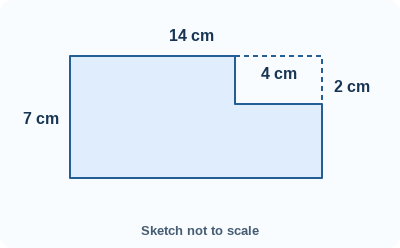
Calculate the whole rectangle, then subtract the area removed.
.
The result is cm².
Split shapes into familiar areas or subtract the part removed, then trace the actual perimeter.
Try the quick check →Section 1 of 3 · Core · about 8 min
Sketch the complete shape before a piece was removed. Mark the missing piece in a different colour.
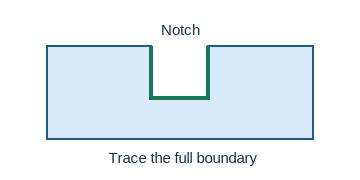
The back of the notch replaces the missing outside edge. Both new side lengths add to the perimeter.
Worked example
A 14 cm by 7 cm rectangular card has a 4 cm by 2 cm rectangular corner cut off. Find the area that remains.
Calculate the whole rectangle, then subtract the area removed.
.
The result is cm².
Worked example
A 19 cm by 12 cm rectangular card has a 4 cm by 2 cm rectangular corner cut off. Find the area that remains.
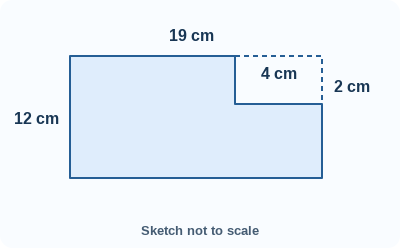
Try it on paper first.
Calculate the whole rectangle, then subtract the area removed.
.
The result is cm².
Section 2 of 3 · Core · about 8 min
Start at one corner and trace each exposed edge until you return. Trace inward and outwards around the notch.
Worked example
A rectangle is 15 cm by 8 cm. A 2 cm wide rectangular notch extends 5 cm into the middle of one long edge. Find the new perimeter.
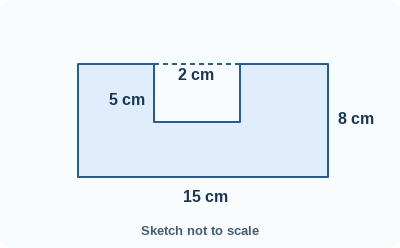
The back of the notch replaces the missing 2 cm of edge. Its two sides each add the depth of the notch.
.
The result is cm.
Worked example
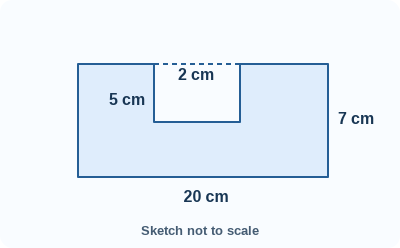
A rectangle is 20 cm by 7 cm. A 2 cm wide rectangular notch extends 5 cm into the middle of one long edge. Find the new perimeter.
Try it on paper first.
The back of the notch replaces the missing 2 cm of edge. Its two sides each add the depth of the notch.
.
The result is cm.
Section 3 of 3 · Core · about 8 min
Start with the area of the flat disc. Remove the smaller circle from the middle.
Worked example
A circular disc of radius 16 cm has a circular hole of radius 6 cm cut from its centre. Find the area that remains. Give your answer in terms of .
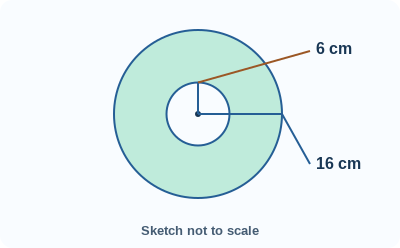
Subtract the area of the small circle from the area of the large circle.
.
The result is cm².
Worked example
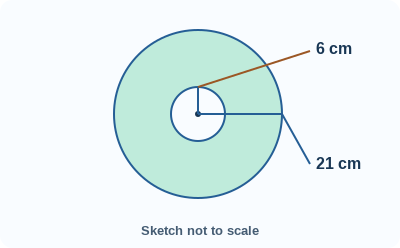
A circular disc of radius 21 cm has a circular hole of radius 6 cm cut from its centre. Find the area that remains. Give your answer in terms of .
Try it on paper first.
Subtract the area of the small circle from the area of the large circle.
.
The result is cm².
Question 1 of 5
0 / 5 checked in this collection
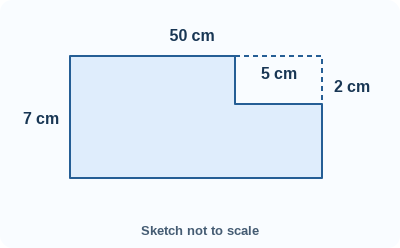
A 50 cm by 7 cm rectangular card has a 5 cm by 2 cm rectangular corner cut off. Find the area that remains.
Progress stays in this browser. Create an account to save it or sign in.
Show your working on paper and compare it with the worked solution and marking guidance.
Your review plan starts after your first check.