Maths4UBETA

Frustums by similarity and subtraction (Extended)

Use the radius scale factor, then subtract the missing cone and handle both circular ends.

Try the quick check →
Lesson 13 of 13

Section 1 of 3 · Core · about 8 min

Why can I compare the two cones?

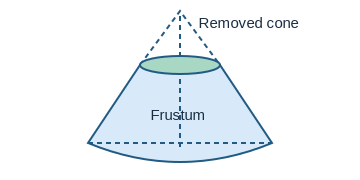
The cut is parallel to the original base. A side-view sketch shows two similar triangles with a common apex.

A smaller cone is removed above a cut parallel to the base.

The cut is parallel to the base, so the removed cone and the full cone are similar.

Worked example

Find the height of the cone that was removed

A cone of base radius 24 cm and vertical height 32 cm is cut parallel to its base. The removed cone has base radius 8 cm. Find the perpendicular height of the removed cone.
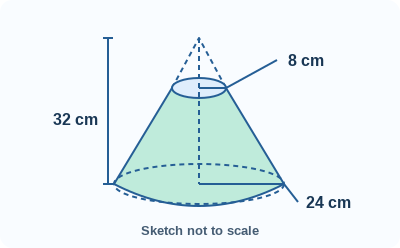
Original cone radius 24 cm, height 32 cm. The dashed removed cone has radius 8 cm.

  1. The two cones are similar. Their radii and their perpendicular heights have the same scale factor.

  2. 32×824=32332\times\frac{8}{24}=\frac{32}{3}.

  3. The result is 323\frac{32}{3} cm.

Your turn

A cone of base radius 63 cm and vertical height 84 cm is cut parallel to its base. The removed cone has base radius 21 cm. Find the perpendicular height of the removed cone.

Original cone radius 63 cm, height 84 cm. The dashed removed cone has radius 21 cm.

Enter one number. Fractions and decimals are accepted.

Worked example

Find the height of the cone that was removed

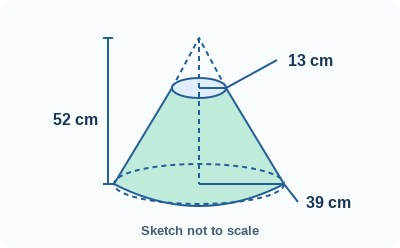
A cone of base radius 39 cm and vertical height 52 cm is cut parallel to its base. The removed cone has base radius 13 cm. Find the perpendicular height of the removed cone.

Original cone radius 39 cm, height 52 cm. The dashed removed cone has radius 13 cm.

Try it on paper first.

  1. The two cones are similar. Their radii and their perpendicular heights have the same scale factor.

  2. 52×1339=52352\times\frac{13}{39}=\frac{52}{3}.

  3. The result is 523\frac{52}{3} cm.

Your turn

A cone of base radius 78 cm and vertical height 104 cm is cut parallel to its base. The removed cone has base radius 26 cm. Find the perpendicular height of the removed cone.

Original cone radius 78 cm, height 104 cm. The dashed removed cone has radius 26 cm.

Enter an exact value or round to 3 significant figures.

Section 2 of 3 · Core · about 8 min

How can I calculate the remaining volume?

Use the similarity result for the small cone's perpendicular height. Then calculate two volumes using their own radii and heights.

Worked example

Find frustum volume by subtraction

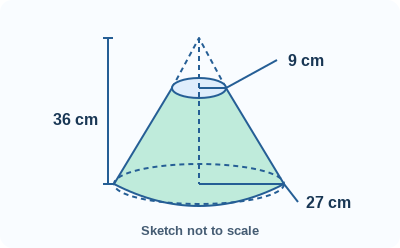
A cone of base radius 27 cm and vertical height 36 cm is cut parallel to its base. The removed cone has base radius 9 cm. Find the volume of the remaining solid. Give your answer in terms of π\pi.

Original cone radius 27 cm, height 36 cm. The dashed removed cone has radius 9 cm.

  1. Use similarity to find the small cone's height. Subtract its volume from the whole cone's volume.

  2. 13π(272×36−92×12)=8424π\frac13\pi\left(27^2\times 36-9^2\times 12\right)=8424\pi.

  3. The result is 8424π8424\pi cm³.

Your turn

A cone of base radius 66 cm and vertical height 88 cm is cut parallel to its base. The removed cone has base radius 22 cm. Find the volume of the remaining solid. Give your answer in terms of π\pi.

Original cone radius 66 cm, height 88 cm. The dashed removed cone has radius 22 cm.

Enter one number. Fractions and decimals are accepted.

Worked example

Find frustum volume by subtraction

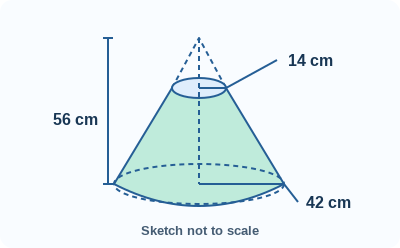
A cone of base radius 42 cm and vertical height 56 cm is cut parallel to its base. The removed cone has base radius 14 cm. Find the volume of the remaining solid. Give your answer in terms of π\pi.

Original cone radius 42 cm, height 56 cm. The dashed removed cone has radius 14 cm.

Try it on paper first.

  1. Use similarity to find the small cone's height. Subtract its volume from the whole cone's volume.

  2. 13π(422×56−142×563)=2853769π\frac13\pi\left(42^2\times 56-14^2\times \frac{56}{3}\right)=\frac{285376}{9}\pi.

  3. The result is 2853769π\frac{285376}{9}\pi cm³.

Your turn

A cone of base radius 81 cm and vertical height 108 cm is cut parallel to its base. The removed cone has base radius 27 cm. Find the volume of the remaining solid. Give your answer in terms of π\pi.

Original cone radius 81 cm, height 108 cm. The dashed removed cone has radius 27 cm.

Enter one number. Fractions and decimals are accepted.

Section 3 of 3 · Core · about 8 min

Which areas form the frustum's skin?

The original curved surface loses the small curved tip. The cut exposes a new small disc. The original base remains.

Worked example

Find the surface area of a frustum

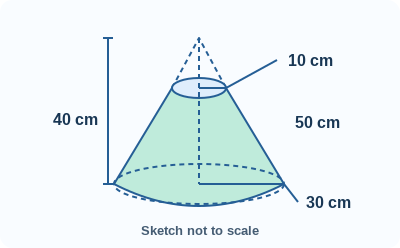
A cone of base radius 30 cm and vertical height 40 cm is cut parallel to its base. The removed cone has base radius 10 cm. The whole cone's slant height is 50 cm. Find the total surface area of the remaining frustum. Give your answer in terms of π\pi.

Original cone radius 30 cm, height 40 cm. The dashed removed cone has radius 10 cm. Original slant height 50 cm.

  1. Scale the slant height for the removed cone. Subtract its curved surface from the large cone's curved surface. Add both end discs.

  2. π(30×50−10×503+302+102)=70003π\pi\left(30\times 50-10\times \frac{50}{3}+30^2+10^2\right)=\frac{7000}{3}\pi.

  3. The result is 70003π\frac{7000}{3}\pi cm².

Your turn

A cone of base radius 69 cm and vertical height 92 cm is cut parallel to its base. The removed cone has base radius 23 cm. The whole cone's slant height is 115 cm. Find the total surface area of the remaining frustum. Give your answer in terms of π\pi.

Original cone radius 69 cm, height 92 cm. The dashed removed cone has radius 23 cm. Original slant height 115 cm.

Enter one number. Fractions and decimals are accepted.

Worked example

Find the surface area of a frustum

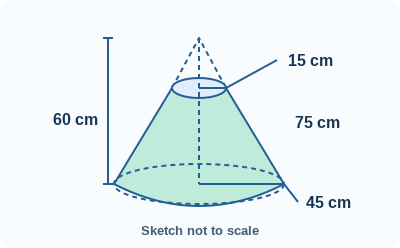
A cone of base radius 45 cm and vertical height 60 cm is cut parallel to its base. The removed cone has base radius 15 cm. The whole cone's slant height is 75 cm. Find the total surface area of the remaining frustum. Give your answer in terms of π\pi.

Original cone radius 45 cm, height 60 cm. The dashed removed cone has radius 15 cm. Original slant height 75 cm.

Try it on paper first.

  1. Scale the slant height for the removed cone. Subtract its curved surface from the large cone's curved surface. Add both end discs.

  2. π(45×75−15×25+452+152)=5250π\pi\left(45\times 75-15\times 25+45^2+15^2\right)=5250\pi.

  3. The result is 5250π5250\pi cm².

Your turn

A cone of base radius 84 cm and vertical height 112 cm is cut parallel to its base. The removed cone has base radius 28 cm. The whole cone's slant height is 140 cm. Find the total surface area of the remaining frustum. Give your answer in terms of π\pi.

Original cone radius 84 cm, height 112 cm. The dashed removed cone has radius 28 cm. Original slant height 140 cm.

Enter one number. Fractions and decimals are accepted.

Worked examples

Practise the method

Core practice

Question 1 of 5

0 / 5 checked in this collection

Question list

Core practice

Fresh variants

Exam-style

Find the height of the cone that was removed

1 mark

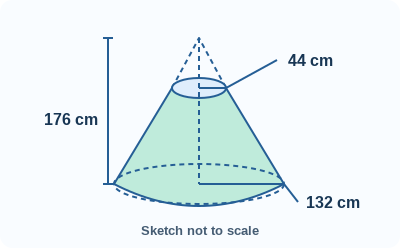
A cone of base radius 132 cm and vertical height 176 cm is cut parallel to its base. The removed cone has base radius 44 cm. Find the perpendicular height of the removed cone.

Original cone radius 132 cm, height 176 cm. The dashed removed cone has radius 44 cm.

Enter an exact value or round to 3 significant figures.

Full answer-format guide

Exact numbers: 3/2, sqrt(5), 2-sqrt(3), pi/6, 3*pi/2. Sets: {1,4}. Intervals: (3,5]; a round bracket excludes the endpoint. Infinity: inf; union: U; no solutions: empty. Separate coordinate pairs or triples with semicolons. Expressions: 2x^2+3x-1; equations: x^2=3x+1 or the polynomial equal to zero. Factors: x-1 ; x+2. Parameter fraction: numerator ; denominator. List integer answers individually.

Review the method

Progress stays in this browser. Create an account to save it or sign in.

Extra practice from this lesson

A cone of base radius 99 cm and vertical height 132 cm is cut parallel to its base. The removed cone has base radius 33 cm. Find the perpendicular height of the removed cone.

Original cone radius 99 cm, height 132 cm. The dashed removed cone has radius 33 cm.

Enter one number. Fractions and decimals are accepted.

A cone of base radius 102 cm and vertical height 136 cm is cut parallel to its base. The removed cone has base radius 34 cm. Find the perpendicular height of the removed cone.

Original cone radius 102 cm, height 136 cm. The dashed removed cone has radius 34 cm.

Enter an exact value or round to 3 significant figures.

A cone of base radius 108 cm and vertical height 144 cm is cut parallel to its base. The removed cone has base radius 36 cm. Find the volume of the remaining solid. Give your answer in terms of π\pi.

Original cone radius 108 cm, height 144 cm. The dashed removed cone has radius 36 cm.

Enter one number. Fractions and decimals are accepted.

A cone of base radius 111 cm and vertical height 148 cm is cut parallel to its base. The removed cone has base radius 37 cm. Find the volume of the remaining solid. Give your answer in terms of π\pi.

Original cone radius 111 cm, height 148 cm. The dashed removed cone has radius 37 cm.

Enter one number. Fractions and decimals are accepted.

A cone of base radius 117 cm and vertical height 156 cm is cut parallel to its base. The removed cone has base radius 39 cm. The whole cone's slant height is 195 cm. Find the total surface area of the remaining frustum. Give your answer in terms of π\pi.

Original cone radius 117 cm, height 156 cm. The dashed removed cone has radius 39 cm. Original slant height 195 cm.

Enter one number. Fractions and decimals are accepted.

A cone of base radius 120 cm and vertical height 160 cm is cut parallel to its base. The removed cone has base radius 40 cm. The whole cone's slant height is 200 cm. Find the total surface area of the remaining frustum. Give your answer in terms of π\pi.

Original cone radius 120 cm, height 160 cm. The dashed removed cone has radius 40 cm. Original slant height 200 cm.

Enter one number. Fractions and decimals are accepted.

Apply it · original exam-style problems

Show your working on paper and compare it with the worked solution and marking guidance.

Come back to what needs practice

Quick revision sheet (A4)

Your review plan starts after your first check.