Worked example
Convert to a smaller metric unit
The width of a workbench is m. Give it in cm.
There are 100 cm in one m. Multiply by 100.
.
The result is cm.
Convert between metric units and check whether the number should get bigger or smaller.
Try the quick check →Section 1 of 3 · Core · about 8 min
The measurement stays the same. Smaller units fit more times along it, so the number increases.
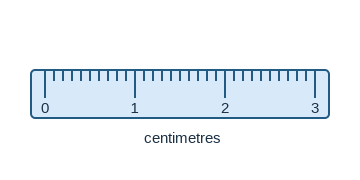
Count ten millimetre gaps from each numbered centimetre mark to the next.
Worked example
The width of a workbench is m. Give it in cm.
There are 100 cm in one m. Multiply by 100.
.
The result is cm.
Worked example
The width of a workbench is m. Give it in cm.
Try it on paper first.
There are 100 cm in one m. Multiply by 100.
.
The result is cm.
Section 2 of 3 · Core · about 8 min
A bigger unit bundles several smaller units together. Divide by the number in one bundle.
Worked example
The mass of a parcel is 240 g. Give it in kg.
Group the g into sets of 1000 to make one kg.
.
The result is kg.
Worked example
The mass of a parcel is 290 g. Give it in kg.
Try it on paper first.
Group the g into sets of 1000 to make one kg.
.
The result is kg.
Section 3 of 3 · Core · about 8 min
Choose the unit the question asks for. Convert each measurement to that unit before using it.
Worked example
The length of a label is 25 cm. Another 50 mm is added. Give the total in mm.
Convert to a common unit before adding.
.
The result is mm.
Worked example
The length of a label is 30 cm. Another 60 mm is added. Give the total in mm.
Try it on paper first.
Convert to a common unit before adding.
.
The result is mm.
Question 1 of 5
0 / 5 checked in this collection
The length of a trail is km. Give it in m.
Progress stays in this browser. Create an account to save it or sign in.
Show your working on paper and compare it with the worked solution and marking guidance.
Your review plan starts after your first check.