Maths4UBETA

Perimeters of triangles and quadrilaterals

Trace and add the correct side lengths when a shape also shows an internal height.

Try the quick check →
Lesson 4 of 13

Section 1 of 3 · Core · about 8 min

How do I trace a triangle's boundary?

Start at one corner and trace the outside. Write down each edge length as you go.

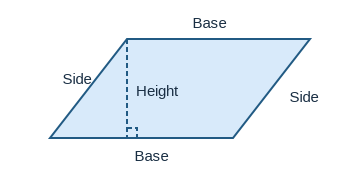
Parallelogram with marked boundary edges and a dashed inside height.

Trace the four outer edges for the perimeter. The dotted height shows the perpendicular distance between the bases.

Worked example

Trace the three sides of a triangle

A triangle has sides of length 12 cm, 10 cm and 9 cm. Find its perimeter.
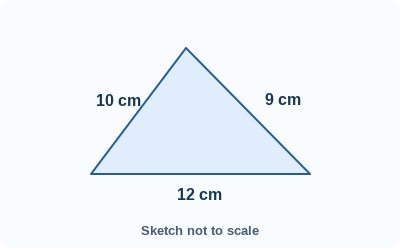
Triangle sides 12 cm, 10 cm and 9 cm.

  1. Add the three sides once each to get the distance round the triangle.

  2. 12+10+9=3112+10+9=31.

  3. The result is 3131 cm.

Your turn

A triangle has sides of length 25 cm, 23 cm and 22 cm. Find its perimeter.

Triangle sides 25 cm, 23 cm and 22 cm.

Enter one number. Fractions and decimals are accepted.

Worked example

Trace the three sides of a triangle

A triangle has sides of length 17 cm, 15 cm and 14 cm. Find its perimeter.
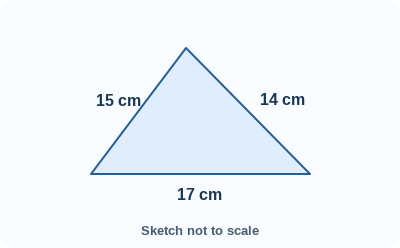
Triangle sides 17 cm, 15 cm and 14 cm.

Try it on paper first.

  1. Add the three sides once each to get the distance round the triangle.

  2. 17+15+14=4617+15+14=46.

  3. The result is 4646 cm.

Your turn

A triangle has sides of length 30 cm, 28 cm and 27 cm. Find its perimeter.

Triangle sides 30 cm, 28 cm and 27 cm.

Enter one number. Fractions and decimals are accepted.

Section 2 of 3 · Core · about 8 min

Which lengths repeat in a parallelogram?

Mark matching opposite sides. Count the base and the sloping side, two of each.

Worked example

Distinguish sloping side from perpendicular height

A parallelogram has base 13 cm, sloping side 8 cm and perpendicular height 6 cm. Find its perimeter.
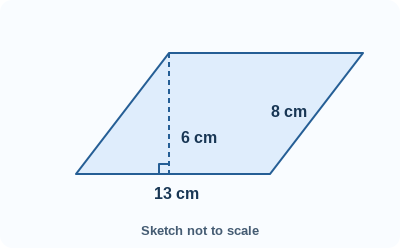
Parallelogram base 13 cm and dashed perpendicular height 6 cm. The sloping side is 8 cm.

  1. Opposite sides match. Add both bases and both sloping sides.

  2. 2(13+8)=422(13+8)=42.

  3. The result is 4242 cm.

Your turn

A parallelogram has base 26 cm, sloping side 5 cm and perpendicular height 3 cm. Find its perimeter.

Parallelogram base 26 cm and dashed perpendicular height 3 cm. The sloping side is 5 cm.

Enter one number. Fractions and decimals are accepted.

Worked example

Distinguish sloping side from perpendicular height

A parallelogram has base 18 cm, sloping side 5 cm and perpendicular height 3 cm. Find its perimeter.
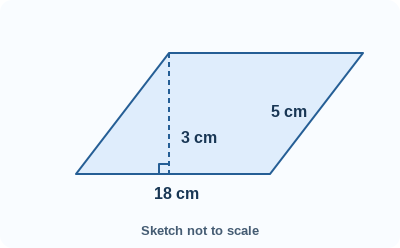
Parallelogram base 18 cm and dashed perpendicular height 3 cm. The sloping side is 5 cm.

Try it on paper first.

  1. Opposite sides match. Add both bases and both sloping sides.

  2. 2(18+5)=462(18+5)=46.

  3. The result is 4646 cm.

Your turn

A parallelogram has base 31 cm, sloping side 6 cm and perpendicular height 4 cm. Find its perimeter.

Parallelogram base 31 cm and dashed perpendicular height 4 cm. The sloping side is 6 cm.

Enter one number. Fractions and decimals are accepted.

Section 3 of 3 · Core · about 8 min

How do I trace around an isosceles trapezium?

The sloping sides have equal length. Its parallel sides may have different lengths.

Worked example

Trace both parallel and both sloping sides

A trapezium has parallel sides of length 20 cm and 80 cm, and equal sloping sides of length 50 cm. Its perpendicular height is 40 cm. Find its perimeter.
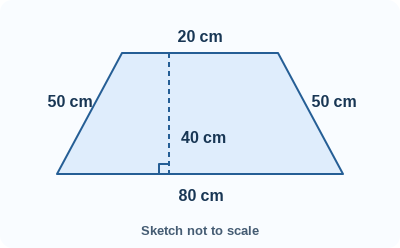
Trapezium parallel sides 20 cm and 80 cm. Perpendicular height 40 cm. Both sloping sides are 50 cm.

  1. Add both parallel sides, then add both matching sloping edges.

  2. 20+80+2×50=20020+80+2\times 50=200.

  3. The result is 200200 cm.

Your turn

A trapezium has parallel sides of length 46 cm and 184 cm, and equal sloping sides of length 115 cm. Its perpendicular height is 92 cm. Find its perimeter.

Trapezium parallel sides 46 cm and 184 cm. Perpendicular height 92 cm. Both sloping sides are 115 cm.

Enter one number. Fractions and decimals are accepted.

Worked example

Trace both parallel and both sloping sides

A trapezium has parallel sides of length 30 cm and 120 cm, and equal sloping sides of length 75 cm. Its perpendicular height is 60 cm. Find its perimeter.
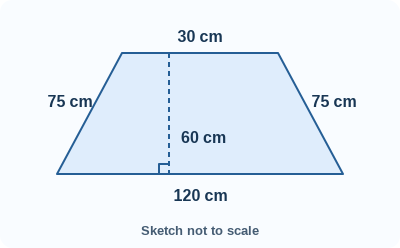
Trapezium parallel sides 30 cm and 120 cm. Perpendicular height 60 cm. Both sloping sides are 75 cm.

Try it on paper first.

  1. Add both parallel sides, then add both matching sloping edges.

  2. 30+120+2×75=30030+120+2\times 75=300.

  3. The result is 300300 cm.

Your turn

A trapezium has parallel sides of length 56 cm and 224 cm, and equal sloping sides of length 140 cm. Its perpendicular height is 112 cm. Find its perimeter.

Trapezium parallel sides 56 cm and 224 cm. Perpendicular height 112 cm. Both sloping sides are 140 cm.

Enter one number. Fractions and decimals are accepted.

Worked examples

Practise the method

Core practice

Question 1 of 5

0 / 5 checked in this collection

Question list

Core practice

Fresh variants

Exam-style

Trace the three sides of a triangle

1 mark

A triangle has sides of length 48 cm, 46 cm and 45 cm. Find its perimeter.
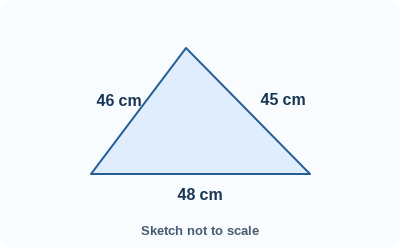
Triangle sides 48 cm, 46 cm and 45 cm.

Enter one number. Fractions and decimals are accepted.

Full answer-format guide

Exact numbers: 3/2, sqrt(5), 2-sqrt(3), pi/6, 3*pi/2. Sets: {1,4}. Intervals: (3,5]; a round bracket excludes the endpoint. Infinity: inf; union: U; no solutions: empty. Separate coordinate pairs or triples with semicolons. Expressions: 2x^2+3x-1; equations: x^2=3x+1 or the polynomial equal to zero. Factors: x-1 ; x+2. Parameter fraction: numerator ; denominator. List integer answers individually.

Review the method

Progress stays in this browser. Create an account to save it or sign in.

Extra practice from this lesson

A triangle has sides of length 37 cm, 35 cm and 34 cm. Find its perimeter.

Triangle sides 37 cm, 35 cm and 34 cm.

Enter one number. Fractions and decimals are accepted.

A triangle has sides of length 38 cm, 36 cm and 35 cm. Find its perimeter.

Triangle sides 38 cm, 36 cm and 35 cm.

Enter one number. Fractions and decimals are accepted.

A parallelogram has base 40 cm, sloping side 7 cm and perpendicular height 5 cm. Find its perimeter.

Parallelogram base 40 cm and dashed perpendicular height 5 cm. The sloping side is 7 cm.

Enter one number. Fractions and decimals are accepted.

A parallelogram has base 41 cm, sloping side 8 cm and perpendicular height 6 cm. Find its perimeter.

Parallelogram base 41 cm and dashed perpendicular height 6 cm. The sloping side is 8 cm.

Enter one number. Fractions and decimals are accepted.

A trapezium has parallel sides of length 78 cm and 312 cm, and equal sloping sides of length 195 cm. Its perpendicular height is 156 cm. Find its perimeter.

Trapezium parallel sides 78 cm and 312 cm. Perpendicular height 156 cm. Both sloping sides are 195 cm.

Enter one number. Fractions and decimals are accepted.

A trapezium has parallel sides of length 80 cm and 320 cm, and equal sloping sides of length 200 cm. Its perpendicular height is 160 cm. Find its perimeter.

Trapezium parallel sides 80 cm and 320 cm. Perpendicular height 160 cm. Both sloping sides are 200 cm.

Enter one number. Fractions and decimals are accepted.

Apply it · original exam-style problems

Show your working on paper and compare it with the worked solution and marking guidance.

Come back to what needs practice

Quick revision sheet (A4)

Your review plan starts after your first check.