Maths4UBETA

Reciprocal trigonometric functions

Read reciprocal graphs, locate their undefined angles and solve equations using sine, cosine or tangent.

Try the quick check →
Lesson 1 of 5

Section 1 of 5 · Core · about 5 min

What am I taking the reciprocal of?

For an angle xx, take the reciprocal of cosine for secant and of sine for cosecant. For cotangent, use cosine divided by sine. Write the original denominator before substituting a value.

Worked example

Evaluate reciprocal ratios in different quadrants

Find sec⁡5π3\sec\frac{5\pi}{3}, cosec⁡7π6\cosec\frac{7\pi}{6} and cot⁡3π2\cot\frac{3\pi}{2}.

  1. At 5π3\frac{5\pi}{3}, cosine is 12\frac12. Its reciprocal is sec⁡5π3=2\sec\frac{5\pi}{3}=2.

  2. At 7π6\frac{7\pi}{6}, sine is −12-\frac12. Its reciprocal is cosec⁡7π6=−2\cosec\frac{7\pi}{6}=-2.

  3. At 3π2\frac{3\pi}{2}, cosine is zero and sine is −1-1. Therefore cot⁡3π2=0\cot\frac{3\pi}{2}=0.

Worked example

Use the reciprocal of sin

Find the exact value of cosec⁡240∘\operatorname{cosec}240^\circ.

Try it on paper first.

  1. First find the signed value of sin⁡240∘\sin240^\circ, which is −32- \frac{\sqrt{3}}{2}.

  2. Take its reciprocal to obtain −233- \frac{2 \sqrt{3}}{3}. The sign stays the same.

Your turn

Find cosec⁡11π6\cosec\frac{11\pi}{6} and sec⁡2π3\sec\frac{2\pi}{3} exactly.

Enter an exact number, for example 3/2 or 2-sqrt(3).

Enter an exact number, for example 3/2 or 2-sqrt(3).

Section 2 of 5 · Core · about 8 min

Where do the reciprocal graphs break or cross?

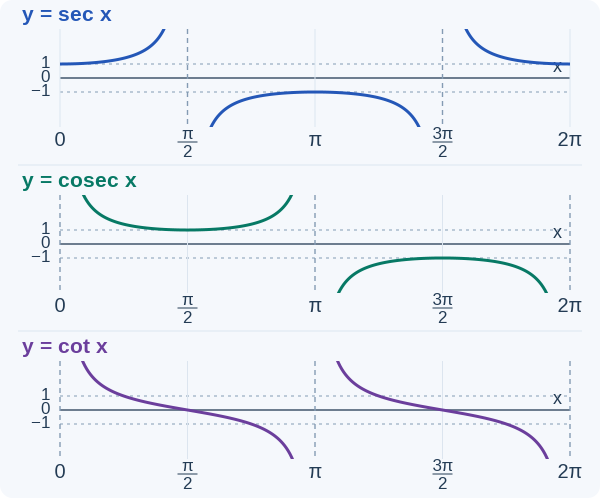
Mark every zero of the denominator before drawing a curve. Each of these inputs gives a vertical asymptote. Where sine or cosine is 11 or −1-1, its reciprocal has the same value.

Three graphs on the same angular scale. Secant has asymptotes at pi over two and three pi over two. Cosecant and cotangent have asymptotes at zero, pi and two pi. Secant and cosecant have gaps between heights minus one and one. Cotangent crosses zero at pi over two and three pi over two.
Dashed vertical lines mark excluded inputs. The dashed horizontal guides are y=1y=1 and y=−1y=-1. The plots use radians.

For integer kk, the secant poles are x=π2+kπx=\frac\pi2+k\pi. Both cosecant and cotangent have poles at x=kπx=k\pi. Cotangent vanishes at x=π2+kπx=\frac\pi2+k\pi.

Worked example

Read one branch of cotangent

Describe y=cot⁡xy=\cot x on 0≤x≤π0\le x\le\pi.

  1. Sine vanishes at both ends, so x=0x=0 and x=πx=\pi are vertical asymptotes.

  2. At x=π2x=\frac\pi2, cosine is zero and sine is one. The branch crosses the axis here.

  3. Between the asymptotes sine is positive. The ratio decreases from large positive values to large negative values through the crossing.

Worked example

Find both exclusions for a shifted reciprocal

For 0∘≤x<360∘0^\circ\le x<360^\circ, find all inputs where sec⁡((x−30)∘)\sec\left((x - 30)^\circ\right) is undefined. Enter angles in degrees.

Try it on paper first.

  1. The denominator is cos⁡((x−30)∘)\cos\left((x - 30)^\circ\right). List its zeros in the shifted interval.

  2. Adding back the shift gives 120∘120^\circ, 300∘300^\circ.

Your turn

Give all values of xx in −π≤x≤π-\pi\le x\le\pi where y=sec⁡xy=\sec x has a vertical asymptote.

Give the complete set: {1, 4} for separate values, (1, 5] for an interval, U for union or empty for no real solutions. Use sqrt(...) for exact roots.

Section 3 of 5 · Core · about 6 min

How can I connect squares of the ratios?

Start with sin⁡2x+cos⁡2x=1\sin^2x+\cos^2x=1. Dividing every term by cos⁡2x\cos^2x gives the secant identity. Dividing every term by sin⁡2x\sin^2x gives the cosecant identity.

Worked example

Find tangent from a signed secant

Angle xx is in quadrant III and sec⁡x=−53\sec x=-\frac53. Find tan⁡x\tan x exactly.

  1. The identity gives tan⁡2x=259−1=169\tan^2x=\frac{25}{9}-1=\frac{16}{9}.

  2. Sine and cosine are both negative in quadrant III, so tangent is positive.

  3. Choose tan⁡x=43\tan x=\frac43.

Your turn

Angle xx is in quadrant II and cosec⁡x=135\cosec x=\frac{13}{5}. Find cot⁡x\cot x exactly.

Enter an exact number, for example 3/2 or 2-sqrt(3).

Section 4 of 5 · Core · about 6 min

How do I turn a reciprocal equation into a familiar one?

For sec⁡x=k\sec x=k or cosec⁡x=k\cosec x=k, check ∣k∣≥1|k|\ge1 before taking reciprocals. For non-zero kk, cot⁡x=k\cot x=k gives tan⁡x=1k\tan x=\frac1k. If k=0k=0, use cos⁡x=0\cos x=0 with sin⁡x≠0\sin x\ne0.

Worked example

Solve a secant equation in radians

Solve sec⁡x=−2\sec x=-\sqrt2 for 0≤x<2π0\le x<2\pi.

  1. The equation gives cos⁡x=−12=−22\cos x=-\frac1{\sqrt2}=-\frac{\sqrt2}{2}.

  2. The reference angle is π4\frac\pi4. Negative cosine occurs in quadrants II and III.

  3. The solutions are 3π4\frac{3\pi}{4} and 5π4\frac{5\pi}{4}. At both angles cosine is non-zero.

Your turn

Solve cot⁡x=−3\cot x=-\sqrt3 for −π≤x≤π-\pi\le x\le\pi. Give all answers exactly.

Give the complete set: {1, 4} for separate values, (1, 5] for an interval, U for union or empty for no real solutions. Use sqrt(...) for exact roots.

Section 5 of 5 · Core · about 5 min

How does a horizontal shift move the exclusions?

Solve for the zeros of the denominator using the full shifted argument.

Worked example

Find both exclusions for a shifted reciprocal

For 0∘≤x<360∘0^\circ\le x<360^\circ, find all inputs where cosec⁡((x−15)∘)\operatorname{cosec}\left((x - 15)^\circ\right) is undefined. Enter angles in degrees.

  1. The denominator is sin⁡((x−15)∘)\sin\left((x - 15)^\circ\right). List its zeros in the shifted interval.

  2. Adding back the shift gives 15∘15^\circ, 195∘195^\circ.

Your turn

For 0∘≤x<360∘0^\circ\le x<360^\circ, find all inputs where cot⁡((x−30)∘)\cot\left((x - 30)^\circ\right) is undefined. Enter angles in degrees.

Give the complete set: {1, 4} for separate values, (1, 5] for an interval, U for union or empty for no real solutions. Use sqrt(...) for exact roots.

Worked examples

Practise the method

Core practice

Question 1 of 4

0 / 4 checked in this collection

Question list

Core practice

Fresh variants

Exam-style

Evaluate two reciprocals

2 marks

Find the exact values of sec⁡(2π3)\sec\left(\frac{2 \pi}{3}\right) and cosec⁡(7π6)\operatorname{cosec}\left(\frac{7 \pi}{6}\right).

Enter an exact number, for example 3/2 or 2-sqrt(3).

Enter an exact number, for example 3/2 or 2-sqrt(3).

Full answer-format guide

Exact numbers: 3/2, sqrt(5), 2-sqrt(3), pi/6, 3*pi/2. Sets: {1,4}. Intervals: (3,5]; a round bracket excludes the endpoint. Infinity: inf; union: U; no solutions: empty. Separate coordinate pairs or triples with semicolons. Expressions: 2x^2+3x-1; equations: x^2=3x+1 or the polynomial equal to zero. Factors: x-1 ; x+2. Parameter fraction: numerator ; denominator. List integer answers individually.

Review the method

Progress stays in this browser. Create an account to save it or sign in.

Extra practice from this lesson

Use the reciprocal of cos

Find the exact value of sec⁡120∘\sec120^\circ.

Enter an exact number, for example 3/2 or 2-sqrt(3).

Use the reciprocal of tan

Find the exact value of cot⁡225∘\cot225^\circ.

Enter an exact number, for example 3/2 or 2-sqrt(3).

Find both exclusions for a shifted reciprocal

For 0∘≤x<360∘0^\circ\le x<360^\circ, find all inputs where sec⁡((x+20)∘)\sec\left((x + 20)^\circ\right) is undefined. Enter angles in degrees.

Give the complete set: {1, 4} for separate values, (1, 5] for an interval, U for union or empty for no real solutions. Use sqrt(...) for exact roots.

Use the reciprocal of sin

Find the exact value of cosec⁡330∘\operatorname{cosec}330^\circ.

Enter an exact number, for example 3/2 or 2-sqrt(3).

Find both exclusions for a shifted reciprocal

For 0∘≤x<360∘0^\circ\le x<360^\circ, find all inputs where cosec⁡((x−45)∘)\operatorname{cosec}\left((x - 45)^\circ\right) is undefined. Enter angles in degrees.

Give the complete set: {1, 4} for separate values, (1, 5] for an interval, U for union or empty for no real solutions. Use sqrt(...) for exact roots.

Find both exclusions for a shifted reciprocal

For 0∘≤x<360∘0^\circ\le x<360^\circ, find all inputs where cot⁡((x+15)∘)\cot\left((x + 15)^\circ\right) is undefined. Enter angles in degrees.

Give the complete set: {1, 4} for separate values, (1, 5] for an interval, U for union or empty for no real solutions. Use sqrt(...) for exact roots.

Apply it · original exam-style problems

Show your working on paper and compare it with the worked solution and marking guidance.

Come back to what needs practice

Quick revision sheet (A4)

Your review plan starts after your first check.