Maths4UBETA

The R form

Combine sine and cosine into one shifted function and use its amplitude, phase and range.

Try the quick check →
Lesson 4 of 5

Section 1 of 5 · Core · about 7 min

How can I combine two ratios into one sine?

Expand the requested bracket first. For Rsin⁡(x+α)R\sin(x+\alpha), the sine coefficient is Rcos⁡αR\cos\alpha and the cosine coefficient is Rsin⁡αR\sin\alpha. Match the two coefficients and square and add to find RR.

Worked example

Match and check a sine sum

Write 8sin⁡x+15cos⁡x8\sin x+15\cos x as Rsin⁡(x+α)R\sin(x+\alpha), where R>0R>0 and α\alpha is acute.

  1. Comparing coefficients gives Rcos⁡α=8R\cos\alpha=8 and Rsin⁡α=15R\sin\alpha=15.

  2. Square and add to get R2=82+152=289R^2=8^2+15^2=289, so R=17R=17.

  3. Divide the equations to get α=tan⁡−1 ⁣(158)\alpha=\tan^{-1}\!\left(\frac{15}{8}\right). Both ratios are positive, as needed for the acute phase.

Worked example

Read the phase and amplitude from two coefficients

Let f(θ)=15sin⁡(θ)+8cos⁡(θ)f(\theta)=15 \sin{\left(\theta \right)} + 8 \cos{\left(\theta \right)}. Write the variable part as Rcos⁡(θ−α)R\cos(\theta-\alpha) with 0≤α<2π0\le\alpha<2\pi. Give R,cos⁡α,sin⁡αR,\cos\alpha,\sin\alpha exactly.

Try it on paper first.

  1. Expanding Rcos⁡(θ−α)R\cos(\theta-\alpha) against cosine and sine gives Rcos⁡α=8,Rsin⁡α=15R\cos\alpha=8,\quad R\sin\alpha=15.

  2. Squaring and adding gives R=17R=17. The phase ratios are cos⁡α=817,sin⁡α=1517\cos\alpha=\frac{8}{17},\quad\sin\alpha=\frac{15}{17}.

  3. With the vertical shift included, the full range is [−17,17][-17,17].

Your turn

Write 5sin⁡x−12cos⁡x5\sin x-12\cos x as Rsin⁡(x−α)R\sin(x-\alpha), with R>0R>0 and 0<α<π20<\alpha<\frac\pi2. Give RR and α\alpha exactly.

Enter the value on its own or write r = … . Fractions and exact square roots are accepted.

Give the exact angle. You can type asin, acos or atan.

Section 2 of 5 · Core · about 7 min

Why does the phase sign change in the cosine form?

Expand Rcos⁡(x−α)R\cos(x-\alpha) to get Rcos⁡αcos⁡x+Rsin⁡αsin⁡xR\cos\alpha\cos x+R\sin\alpha\sin x. A plus sign in the cosine bracket instead gives a negative sine term for acute α\alpha.

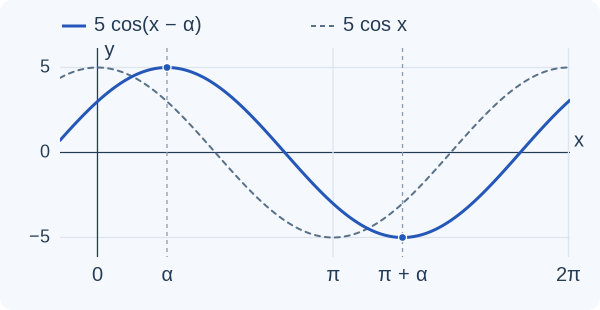
Two cosine waves of amplitude five. The dashed reference curve peaks at zero. The solid wave peaks later, at alpha, and reaches its trough at alpha plus pi.
Both curves have amplitude 55. The peak of 5cos⁡(x−α)5\cos(x-\alpha) is shifted right by α\alpha.

Worked example

Choose a cosine sum with a negative sine coefficient

Write 12cos⁡x−5sin⁡x12\cos x-5\sin x as Rcos⁡(x+α)R\cos(x+\alpha), where R>0R>0 and α\alpha is acute.

  1. The cosine sum expands to Rcos⁡αcos⁡x−Rsin⁡αsin⁡xR\cos\alpha\cos x-R\sin\alpha\sin x. Compare it with the given coefficients.

  2. Rcos⁡α=12R\cos\alpha=12, Rsin⁡α=5R\sin\alpha=5. Hence R=13R=13 and α=tan⁡−1 ⁣(512)\alpha=\tan^{-1}\!\left(\frac5{12}\right).

  3. The plus inside the bracket produces the required minus in front of sin⁡x\sin x.

Your turn

Write 20cos⁡x+21sin⁡x20\cos x+21\sin x as Rcos⁡(x−α)R\cos(x-\alpha), with R>0R>0 and 0<α<π20<\alpha<\frac\pi2. Give RR and α\alpha exactly.

Enter the value on its own or write r = … . Fractions and exact square roots are accepted.

Give the exact angle. You can type asin, acos or atan.

Section 3 of 5 · Core · about 6 min

What can the amplitude tell me about maxima and minima?

With R>0R>0, Rsin⁡(x+α)R\sin(x+\alpha) and Rcos⁡(x−α)R\cos(x-\alpha) take values from −R-R to RR over a full cycle. A vertical shift cc moves both endpoints by cc.

Worked example

Find both extrema without differentiation

Give the minimum and maximum of 4+6sin⁡x−8cos⁡x4+6\sin x-8\cos x over all real xx.

  1. The sine and cosine terms combine into a wave of amplitude 62+(−8)2=10\sqrt{6^2+(-8)^2}=10.

  2. The range of that wave is [−10,10][-10,10]. Add four to both endpoints.

  3. The minimum is −6-6 and the maximum is 1414.

Worked example

Read the phase and amplitude from two coefficients

Let f(θ)=−5sin⁡(θ)+12cos⁡(θ)+4f(\theta)=- 5 \sin{\left(\theta \right)} + 12 \cos{\left(\theta \right)} + 4. Find the minimum and maximum value.

Try it on paper first.

  1. Expanding Rcos⁡(θ−α)R\cos(\theta-\alpha) against cosine and sine gives Rcos⁡α=12,Rsin⁡α=−5R\cos\alpha=12,\quad R\sin\alpha=-5.

  2. Squaring and adding gives R=13R=13. The phase ratios are cos⁡α=1213,sin⁡α=−513\cos\alpha=\frac{12}{13},\quad\sin\alpha=- \frac{5}{13}.

  3. With the vertical shift included, the full range is [−9,17][-9,17].

Your turn

Find the range of g(x)=5+8cos⁡x+15sin⁡xg(x)=5+8\cos x+15\sin x for all real xx.

Give the output range as an inequality or an interval. For example, y ≤ 4 is (−∞, 4]. You can type <= for ≤.

Section 4 of 5 · Core · about 8 min

How do I solve an equation after finding the R form?

Divide by RR and check that the target lies between −1-1 and 11. Then use the interval for the whole shifted angle. Undo the shift on every solution and check the original endpoints.

Worked example

Solve using the shifted cosine interval

Solve 3cos⁡x+33sin⁡x=−33\cos x+3\sqrt3\sin x=-3 for 0≤x<2π0\le x<2\pi.

  1. The left side is 6cos⁡(x−π3)6\cos(x-\frac\pi3). Put u=x−π3u=x-\frac\pi3 so −π3≤u<5π3-\frac\pi3\le u<\frac{5\pi}{3}.

  2. cos⁡u=−12\cos u=-\frac12 gives u=2π3,4π3u=\frac{2\pi}{3},\frac{4\pi}{3} in this interval.

  3. Add π3\frac\pi3 to get x=πx=\pi or x=5π3x=\frac{5\pi}{3}.

Your turn

Solve 3sin⁡x+cos⁡x=1\sqrt3\sin x+\cos x=1 for 0≤x<2π0\le x<2\pi. Give all answers exactly.

Give the complete set: {1, 4} for separate values, (1, 5] for an interval, U for union or empty for no real solutions. Use sqrt(...) for exact roots.

Section 5 of 5 · Core · about 5 min

How do the original signs locate the phase?

A tangent alone can correspond to angles separated by a half-turn.

Worked example

Read the phase and amplitude from two coefficients

Let f(θ)=24sin⁡(θ)−7cos⁡(θ)f(\theta)=24 \sin{\left(\theta \right)} - 7 \cos{\left(\theta \right)}. Write the variable part as Rcos⁡(θ−α)R\cos(\theta-\alpha) with 0≤α<2π0\le\alpha<2\pi. Give R,cos⁡α,sin⁡αR,\cos\alpha,\sin\alpha exactly.

  1. Expanding Rcos⁡(θ−α)R\cos(\theta-\alpha) against cosine and sine gives Rcos⁡α=−7,Rsin⁡α=24R\cos\alpha=-7,\quad R\sin\alpha=24.

  2. Squaring and adding gives R=25R=25. The phase ratios are cos⁡α=−725,sin⁡α=2425\cos\alpha=- \frac{7}{25},\quad\sin\alpha=\frac{24}{25}.

  3. With the vertical shift included, the full range is [−25,25][-25,25].

Your turn

Let f(θ)=−21sin⁡(θ)−20cos⁡(θ)f(\theta)=- 21 \sin{\left(\theta \right)} - 20 \cos{\left(\theta \right)}. Write the variable part as Rcos⁡(θ−α)R\cos(\theta-\alpha) with 0≤α<2π0\le\alpha<2\pi. Give R,cos⁡α,sin⁡αR,\cos\alpha,\sin\alpha exactly.

Enter the value on its own or write r = … . Fractions and exact square roots are accepted.

Enter an exact number, for example 3/2 or 2-sqrt(3).

Enter an exact number, for example 3/2 or 2-sqrt(3).

Worked examples

Practise the method

Core practice

Question 1 of 4

0 / 4 checked in this collection

Question list

Core practice

Fresh variants

Exam-style

Match a cosine R form

2 marks

Write 4cos⁡x+43sin⁡x4\cos x+4 \sqrt{3}\sin x as Rcos⁡(x−α)R\cos\left(x-\alpha\right) with R>0R>0 and 0<α<π20<\alpha<\frac{\pi}{2}. Give the exact values of RR and α\alpha in radians.

Enter the value on its own or write R = … . Fractions and exact square roots are accepted.

Enter an exact number, for example 3/2 or 2-sqrt(3).

Full answer-format guide

Exact numbers: 3/2, sqrt(5), 2-sqrt(3), pi/6, 3*pi/2. Sets: {1,4}. Intervals: (3,5]; a round bracket excludes the endpoint. Infinity: inf; union: U; no solutions: empty. Separate coordinate pairs or triples with semicolons. Expressions: 2x^2+3x-1; equations: x^2=3x+1 or the polynomial equal to zero. Factors: x-1 ; x+2. Parameter fraction: numerator ; denominator. List integer answers individually.

Review the method

Progress stays in this browser. Create an account to save it or sign in.

Extra practice from this lesson

Read the phase and amplitude from two coefficients

Let f(θ)=12sin⁡(θ)+5cos⁡(θ)f(\theta)=12 \sin{\left(\theta \right)} + 5 \cos{\left(\theta \right)}. Write the variable part as Rcos⁡(θ−α)R\cos(\theta-\alpha) with 0≤α<2π0\le\alpha<2\pi. Give R,cos⁡α,sin⁡αR,\cos\alpha,\sin\alpha exactly.

Enter the value on its own or write r = … . Fractions and exact square roots are accepted.

Enter an exact number, for example 3/2 or 2-sqrt(3).

Enter an exact number, for example 3/2 or 2-sqrt(3).

Read the phase and amplitude from two coefficients

Let f(θ)=−15sin⁡(θ)−8cos⁡(θ)−3f(\theta)=- 15 \sin{\left(\theta \right)} - 8 \cos{\left(\theta \right)} - 3. Find the minimum and maximum value.

Enter an exact number, for example 3/2 or 2-sqrt(3).

Enter an exact number, for example 3/2 or 2-sqrt(3).

Read the phase and amplitude from two coefficients

Let f(θ)=35sin⁡(θ)+12cos⁡(θ)f(\theta)=35 \sin{\left(\theta \right)} + 12 \cos{\left(\theta \right)}. Write the variable part as Rcos⁡(θ−α)R\cos(\theta-\alpha) with 0≤α<2π0\le\alpha<2\pi. Give R,cos⁡α,sin⁡αR,\cos\alpha,\sin\alpha exactly.

Enter the value on its own or write r = … . Fractions and exact square roots are accepted.

Enter an exact number, for example 3/2 or 2-sqrt(3).

Enter an exact number, for example 3/2 or 2-sqrt(3).

Read the phase and amplitude from two coefficients

Let f(θ)=7sin⁡(θ)−24cos⁡(θ)+5f(\theta)=7 \sin{\left(\theta \right)} - 24 \cos{\left(\theta \right)} + 5. Find the minimum and maximum value.

Enter an exact number, for example 3/2 or 2-sqrt(3).

Enter an exact number, for example 3/2 or 2-sqrt(3).

Read the phase and amplitude from two coefficients

Let f(θ)=−12sin⁡(θ)−9cos⁡(θ)f(\theta)=- 12 \sin{\left(\theta \right)} - 9 \cos{\left(\theta \right)}. Write the variable part as Rcos⁡(θ−α)R\cos(\theta-\alpha) with 0≤α<2π0\le\alpha<2\pi. Give R,cos⁡α,sin⁡αR,\cos\alpha,\sin\alpha exactly.

Enter the value on its own or write r = … . Fractions and exact square roots are accepted.

Enter an exact number, for example 3/2 or 2-sqrt(3).

Enter an exact number, for example 3/2 or 2-sqrt(3).

Read the phase and amplitude from two coefficients

Let f(θ)=−12sin⁡(θ)+5cos⁡(θ)+7f(\theta)=- 12 \sin{\left(\theta \right)} + 5 \cos{\left(\theta \right)} + 7. Find the minimum and maximum value.

Enter an exact number, for example 3/2 or 2-sqrt(3).

Enter an exact number, for example 3/2 or 2-sqrt(3).

Apply it · original exam-style problems

Show your working on paper and compare it with the worked solution and marking guidance.

Come back to what needs practice

Quick revision sheet (A4)

Your review plan starts after your first check.