Maths4UBETA

Further trigonometric equations and identities

Choose a useful identity, preserve the domain and find every solution on the original interval.

Try the quick check →
Lesson 5 of 5

Section 1 of 6 · Core · about 7 min

How do I decide which side to rewrite?

Start with the side that offers a clear simplification. Look for a double angle, a square or a reciprocal. Aim to produce the other side through reversible steps on the common domain.

Worked example

Choose the form of cosine that exposes a factor

Show that 1−cos⁡2xsin⁡2x=tan⁡x\frac{1-\cos2x}{\sin2x}=\tan x wherever the left side is defined.

  1. Use cos⁡2x=1−2sin⁡2x\cos2x=1-2\sin^2x, which makes the numerator 2sin⁡2x2\sin^2x.

  2. The denominator is 2sin⁡xcos⁡x2\sin x\cos x, so both sine and cosine are non-zero on the original domain.

  3. Cancel the common factor to give sin⁡xcos⁡x=tan⁡x\frac{\sin x}{\cos x}=\tan x, with the original restrictions still in force.
Your turn

For inputs where sin⁡2x≠0\sin 2x\ne0, which ratio equals 1+cos⁡2xsin⁡2x\frac{1+\cos2x}{\sin2x}?

Choose the equivalent ratio

Section 2 of 6 · Core · about 7 min

How do I keep a branch that division would lose?

When an equation contains a repeated trigonometric factor, bring all terms to one side. Set each factor equal to zero, solve each equation, then combine the solutions.

Worked example

Keep the zeros of cosine

Solve sin⁡2x=cos⁡x\sin2x=\cos x for 0≤x<2π0\le x<2\pi.

  1. Use sin⁡2x=2sin⁡xcos⁡x\sin2x=2\sin x\cos x and bring the right side across.

  2. cos⁡x(2sin⁡x−1)=0\cos x(2\sin x-1)=0. The first factor gives x=π2,3π2x=\frac\pi2,\frac{3\pi}{2}.

  3. The second factor gives sin⁡x=12\sin x=\frac12, hence x=π6,5π6x=\frac\pi6,\frac{5\pi}{6}. Include all four.

Worked example

Separate and solve both trigonometric factors

Solve sin⁡(2(x−20)∘)=−sin⁡((x−20)∘)\sin(2(x-20)^\circ)=-\sin((x-20)^\circ) for 0≤x<3600\le x<360. Enter your solutions in degrees.

Try it on paper first.

  1. Use sin⁡(2u)=2sin⁡ucos⁡u\sin(2u)=2\sin u\cos u with u=(x−20)u=(x-20). Bring all terms to one side.

  2. The factors are sin⁡(u∘)\sin(u^\circ) and 2cos⁡(u∘)−(−1)2\cos(u^\circ)-(-1). Solve both equations in the proper intervals.

  3. Return to the original input. The solutions are 20∘20^\circ, 140∘140^\circ, 200∘200^\circ, 260∘260^\circ.

Your turn

Solve sin⁡2x=2sin⁡x\sin2x=\sqrt2\sin x for −π≤x<π-\pi\le x<\pi. Give all solutions exactly.

Give the complete set: {1, 4} for separate values, (1, 5] for an interval, U for union or empty for no real solutions. Use sqrt(...) for exact roots.

Section 3 of 6 · Core · about 7 min

Which candidates survive the original restrictions?

Write down where each original denominator vanishes. Keep these exclusions if you cancel a factor. If you square an equation, check the candidates in the unsquared equation as well.

Worked example

Reject an input excluded by a cancelled expression

Solve 2sin⁡2x1−cos⁡x=4\frac{2\sin^2x}{1-\cos x}=4 for 0≤x≤2π0\le x\le2\pi.

  1. Require cos⁡x≠1\cos x\ne1. Factor sin⁡2x=1−cos⁡2x=(1−cos⁡x)(1+cos⁡x)\sin^2x=1-\cos^2x=(1-\cos x)(1+\cos x).

  2. On the allowed domain the equation becomes 2(1+cos⁡x)=42(1+\cos x)=4, giving cos⁡x=1\cos x=1.

  3. The only candidates are 00 and 2π2\pi, both excluded by the original denominator. There are no solutions.

Your turn

Solve cos⁡2x−1sin⁡x=−2\frac{\cos 2x-1}{\sin x}=-\sqrt2 for 0≤x≤2π0\le x\le 2\pi. Give all solutions exactly.

Give the complete set: {1, 4} for separate values, (1, 5] for an interval, U for union or empty for no real solutions. Use sqrt(...) for exact roots.

Section 4 of 6 · Core · about 7 min

How do I solve a quadratic in one ratio?

If an equation includes cos⁡2x\cos2x and sin⁡x\sin x, use cos⁡2x=1−2sin⁡2x\cos2x=1-2\sin^2x. Let s=sin⁡xs=\sin x and solve the quadratic. Retain only values in −1≤s≤1-1\le s\le1 before finding angles.

Worked example

Use one ratio before factorising

Solve cos⁡2x+3sin⁡x=2\cos2x+3\sin x=2 for 0≤x<2π0\le x<2\pi.

  1. Set s=sin⁡xs=\sin x. Since cos⁡2x=1−2s2\cos2x=1-2s^2, rearrange to 2s2−3s+1=02s^2-3s+1=0.

  2. Factorise to (2s−1)(s−1)=0(2s-1)(s-1)=0, so s=12s=\frac12 or s=1s=1. Both lie in the range of sine.

  3. s=12s=\frac12 gives x=π6,5π6x=\frac\pi6,\frac{5\pi}{6}. The maximum value s=1s=1 occurs once, at x=π2x=\frac\pi2.

Your turn

Solve cos⁡2x+5sin⁡x=3\cos2x+5\sin x=3 for 0≤x<2π0\le x<2\pi. Give all solutions exactly.

Give the complete set: {1, 4} for separate values, (1, 5] for an interval, U for union or empty for no real solutions. Use sqrt(...) for exact roots.

Section 5 of 6 · Core · about 9 min

How can I track a shifted interval across more than one cycle?

Name the entire argument u=ax+bu=ax+b. Map both bounds before finding roots. If aa is negative, the smaller and larger endpoints swap and inequality signs reverse. Use a periodic sketch or a reference angle and repeat by the correct period.

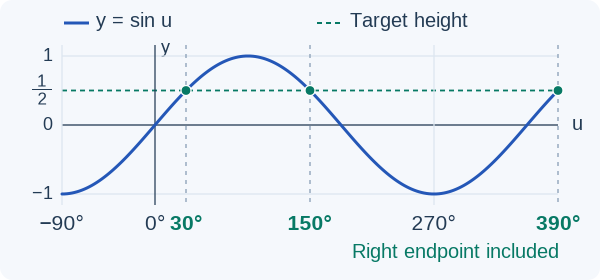
Sine from minus 90 degrees to 390 degrees. It meets the horizontal line of height one half at 30, 150 and the included right endpoint 390 degrees.
For u=2x+30∘u=2x+30^\circ and −60∘≤x≤180∘-60^\circ\le x\le180^\circ, the horizontal line y=12y=\frac12 meets the plotted curve at all three allowed angles.

Worked example

Use both interval endpoints before converting back

Solve sin⁡(2x+30∘)=12\sin(2x+30^\circ)=\frac12 for −60∘≤x≤180∘-60^\circ\le x\le180^\circ.

  1. Let u=2x+30∘u=2x+30^\circ. The new interval is −90∘≤u≤390∘-90^\circ\le u\le390^\circ.

  2. Use u=30∘+360∘ku=30^\circ+360^\circ k or u=150∘+360∘ku=150^\circ+360^\circ k for integer kk. The values in range are 30∘,150∘,390∘30^\circ,150^\circ,390^\circ.

  3. Use x=u−30∘2x=\frac{u-30^\circ}{2} to obtain 0∘,60∘,180∘0^\circ,60^\circ,180^\circ, including the right endpoint.

Your turn

Solve cos⁡(2x−60∘)=12\cos(2x-60^\circ)=\frac12 for −120∘≤x<180∘-120^\circ\le x<180^\circ. Give all solutions in degrees.

Give the complete set: {1, 4} for separate values, (1, 5] for an interval, U for union or empty for no real solutions. Use sqrt(...) for exact roots.

Section 6 of 6 · Core · about 5 min

How do I reject impossible values of a trigonometric ratio?

An algebraic equation can have values outside the range of a sine or cosine.

Worked example

Discard an algebraic root outside the sine range

Solve sin⁡2(x∘)−4sin⁡(x∘)+3=0\sin^2(x^\circ) - 4 \sin(x^\circ) + 3=0 for 0≤x<3600\le x<360. Enter angles in degrees.

  1. Let u=sin⁡(x∘)u=\sin(x^\circ). The quadratic gives u=1 or u=3u=1\text{ or }u=3.

  2. As −1≤u≤1-1\le u\le1, keep 11. The complete answer is 90∘90^\circ.

Your turn

Solve sin⁡2(x∘)−3sin⁡(x∘)2−1=0\sin^2(x^\circ) - \frac{3 \sin(x^\circ)}{2} - 1=0 for 0≤x<3600\le x<360. Enter angles in degrees.

Give the complete set: {1, 4} for separate values, (1, 5] for an interval, U for union or empty for no real solutions. Use sqrt(...) for exact roots.

Worked examples

Practise the method

Core practice

Question 1 of 4

0 / 4 checked in this collection

Question list

Core practice

Fresh variants

Exam-style

Map both endpoints before solving

1 mark

Solve sin⁡(3x−π6)=12\sin\left(3x-\frac{\pi}{6}\right)=\frac{1}{2} for 0≤x<π0\le x<\pi. Give every exact root.

Give the complete set: {1, 4} for separate values, (1, 5] for an interval, U for union or empty for no real solutions. Use sqrt(...) for exact roots.

Full answer-format guide

Exact numbers: 3/2, sqrt(5), 2-sqrt(3), pi/6, 3*pi/2. Sets: {1,4}. Intervals: (3,5]; a round bracket excludes the endpoint. Infinity: inf; union: U; no solutions: empty. Separate coordinate pairs or triples with semicolons. Expressions: 2x^2+3x-1; equations: x^2=3x+1 or the polynomial equal to zero. Factors: x-1 ; x+2. Parameter fraction: numerator ; denominator. List integer answers individually.

Review the method

Progress stays in this browser. Create an account to save it or sign in.

Extra practice from this lesson

Separate and solve both trigonometric factors

Solve sin⁡(2(x−15)∘)=sin⁡((x−15)∘)\sin(2(x-15)^\circ)=\sin((x-15)^\circ) for 0≤x<3600\le x<360. Enter your solutions in degrees.

Give the complete set: {1, 4} for separate values, (1, 5] for an interval, U for union or empty for no real solutions. Use sqrt(...) for exact roots.

Discard an algebraic root outside the sine range

Solve sin⁡2(x∘)+5sin⁡(x∘)2−32=0\sin^2(x^\circ) + \frac{5 \sin(x^\circ)}{2} - \frac{3}{2}=0 for 0≤x<3600\le x<360. Enter angles in degrees.

Give the complete set: {1, 4} for separate values, (1, 5] for an interval, U for union or empty for no real solutions. Use sqrt(...) for exact roots.

Find every root after stretching the interval

Solve sin⁡(3x∘)=−12\sin(3x^\circ)=- \frac{1}{2} for 0≤x<1200\le x<120. Enter all angles in degrees.

Give the complete set: {1, 4} for separate values, (1, 5] for an interval, U for union or empty for no real solutions. Use sqrt(...) for exact roots.

Separate and solve both trigonometric factors

Solve sin⁡(2(x−35)∘)=−sin⁡((x−35)∘)\sin(2(x-35)^\circ)=-\sin((x-35)^\circ) for 0≤x<3600\le x<360. Enter your solutions in degrees.

Give the complete set: {1, 4} for separate values, (1, 5] for an interval, U for union or empty for no real solutions. Use sqrt(...) for exact roots.

Discard an algebraic root outside the sine range

Solve sin⁡2(x∘)+3sin⁡(x∘)+2=0\sin^2(x^\circ) + 3 \sin(x^\circ) + 2=0 for 0≤x<3600\le x<360. Enter angles in degrees.

Give the complete set: {1, 4} for separate values, (1, 5] for an interval, U for union or empty for no real solutions. Use sqrt(...) for exact roots.

Find every root after stretching the interval

Solve sin⁡(3x∘)=22\sin(3x^\circ)=\frac{\sqrt{2}}{2} for 0≤x<2400\le x<240. Enter all angles in degrees.

Give the complete set: {1, 4} for separate values, (1, 5] for an interval, U for union or empty for no real solutions. Use sqrt(...) for exact roots.

Apply it · original exam-style problems

Show your working on paper and compare it with the worked solution and marking guidance.

Come back to what needs practice

Quick revision sheet (A4)

Your review plan starts after your first check.