Maths4UBETA

Parametric differentiation

Find exact gradients and tangent equations from parametric curves, including vertical tangents and repeated points.

Try the quick check →
Lesson 4 of 5

Section 1 of 5 · Core · about 6 min

Why do I divide the two rates?

A parametric curve gives xx and yy in terms of an input tt. The tangent gradient compares change in yy with change in xx, so differentiate both coordinates with respect to tt.

Worked example

Find a gradient without eliminating t

For x=t2+1x=t^2+1, y=t3−2ty=t^3-2t, find the exact gradient at t=2t=2.

  1. Differentiate the coordinates: dxdt=2t\frac{\mathrm dx}{\mathrm dt}=2t and dydt=3t2−2\frac{\mathrm dy}{\mathrm dt}=3t^2-2.

  2. The x-rate is 44 and the y-rate is 1010 at t=2t=2. Since the x-rate is non-zero, divide to get 52\frac52.

  3. The gradient belongs to the point (5,4)(5,4), found from the original coordinate functions.
Worked example

Find a tangent directly from two parameter rates

For x=2t+3,y=t2−4t+1x=2 t + 3,\quad y=t^{2} - 4 t + 1, find the tangent at t=1t=1 in the form y=mx+cy=mx+c. Give mm and cc.

Try it on paper first.

  1. The point is (5,−2)(5,-2). The two rates at this parameter are dxdt=2, dydt=−2\frac{\mathrm dx}{\mathrm dt}=2,\ \frac{\mathrm dy}{\mathrm dt}=-2.

  2. Divide the second rate by the first to get tangent gradient −1-1.

  3. Use the point to get the line y=3−xy=3 - x.

Your turn

For x=2t2−3x=2t^2-3, y=t3+ty=t^3+t, give the coordinates and exact gradient at t=1t=1.

Enter the value on its own or write x = … . Fractions and exact square roots are accepted.

Enter the value on its own or write y = … . Fractions and exact square roots are accepted.

Enter an exact number, for example 3/2 or 2-sqrt(3).

Section 2 of 5 · Core · about 7 min

How do I find the equation of the tangent?

Keep the parameter value until the end of the calculation. Substitute it into the coordinate functions and the two derivative functions. This works even when eliminating the parameter is difficult.

Worked example

Find a tangent to an exponential–trigonometric curve

Find the tangent equation for x=e2tx=e^{2t}, y=sin⁡(3t)y=\sin(3t) at t=0t=0.

  1. The contact point is (1,0)(1,0). Differentiate to get x′=2e2tx'=2e^{2t} and y′=3cos⁡(3t)y'=3\cos(3t), where primes denote derivatives with respect to tt.

  2. At t=0t=0 the values are 22 and 33, so the tangent gradient is 32\frac32.

  3. Use the point and slope to obtain y=32(x−1)y=\frac32(x-1).

Your turn

For x=1+e−2tx=1+e^{-2t}, y=cos⁡(2t)+3ty=\cos(2t)+3t, give the constants m,cm,c of the tangent y=mx+cy=mx+c at t=0t=0.

Enter the value on its own or write m = … . Fractions and exact square roots are accepted.

Enter the value on its own or write c = … . Fractions and exact square roots are accepted.

Section 3 of 5 · Core · about 7 min

What if one of the rates is zero?

Check both derivatives before taking a quotient. A zero in one coordinate rate tells you which axis the tangent follows, provided the other coordinate rate is non-zero.

Worked example

Find a horizontal and a vertical tangent

For x=t2x=t^2, y=t2+ty=t^2+t, find the horizontal and vertical tangent lines.

  1. The derivatives are 2t2t and 2t+12t+1. For a horizontal tangent, t=−12t=-\frac12 makes the y-rate zero with x-rate −1-1.

  2. The y-coordinate there is 14−12=−14\frac14-\frac12=-\frac14, so the horizontal tangent is y=−14y=-\frac14.

  3. For a vertical tangent, t=0t=0 makes the x-rate zero while the y-rate is 11. The x-coordinate is zero, so the vertical tangent is x=0x=0.

Worked example

Compare zero values of the two parametric rates

For x=t2+3, y=t3−12tx=t^{2} + 3,\ y=t^{3} - 12 t, use t≥0t\ge0. Give the parameter for the horizontal tangent and the xx-value of the vertical tangent.

Try it on paper first.

  1. The rates are dxdt=2t,dydt=3t2−12\frac{\mathrm dx}{\mathrm dt}=2t,\quad\frac{\mathrm dy}{\mathrm dt}=3t^2-12.

  2. At t=2t=2 only the second rate is zero. This gives a horizontal tangent.

  3. At t=0t=0 only the first rate is zero. The vertical tangent is x=3x=3.

Your turn

For x=t2+2tx=t^2+2t, y=t2−2ty=t^2-2t, give the value of tt at the horizontal tangent and at the vertical tangent.

Enter an exact number, for example 3/2 or 2-sqrt(3).

Enter an exact number, for example 3/2 or 2-sqrt(3).

Section 4 of 5 · Core · about 7 min

Can one point have more than one tangent?

Different values of tt can give the same point. Solve for every candidate parameter from one coordinate and test the other coordinate and the given interval. Then compute the gradient for every valid parameter.

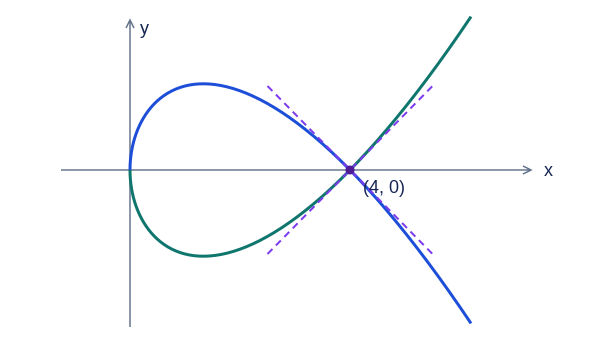
Blue and green branches of a loop meet at (4, 0). Two dashed tangent lines cross at that point.
For x=t2, y=t3−4tx=t^2,\ y=t^3-4t, both t=−2t=-2 and t=2t=2 give the contact point (4,0)(4,0). The gradient must be calculated for each value of tt.

Worked example

Separate two tangent directions at one point

For x=t2x=t^2, y=t3−4ty=t^3-4t with real tt, find both tangent gradients at (4,0)(4,0).

  1. The x-coordinate gives t=±2t=\pm2. Both give y=t(t2−4)=0y=t(t^2-4)=0.

  2. The gradients are values of 3t2−42t\frac{3t^2-4}{2t}. At t=−2t=-2 the ratio is 8−4=−2\frac8{-4}=-2.

  3. At t=2t=2 the ratio is 84=2\frac84=2. The two gradients are −2-2 and 22.

Your turn

For x=t2+1x=t^2+1, y=t3−ty=t^3-t and real tt, give all exact tangent gradients at (2,0)(2,0).

Give the complete set: {1, 4} for separate values, (1, 5] for an interval, U for union or empty for no real solutions. Use sqrt(...) for exact roots.

Section 5 of 5 · Core · about 5 min

How do the parameter rates give a normal line?

Differentiate both coordinate functions. Evaluate them at the same parameter value before forming a gradient.

Worked example

Find a normal directly from two parameter rates

For x=et+1,y=3t+2x=\mathrm e^{t} + 1,\quad y=3 t + 2, find the normal at t=0t=0 in the form y=mx+cy=mx+c. Give mm and cc.

  1. The point is (2,2)(2,2). The two rates at this parameter are dxdt=1, dydt=3\frac{\mathrm dx}{\mathrm dt}=1,\ \frac{\mathrm dy}{\mathrm dt}=3.

  2. Divide the second rate by the first to get tangent gradient 33. Take the negative reciprocal.

  3. Use the point to get the line y=83−x3y=\frac{8}{3} - \frac{x}{3}.

Your turn

For x=3t+4,y=t2+2tx=3 t + 4,\quad y=t^{2} + 2 t, find the normal at t=1t=1 in the form y=mx+cy=mx+c. Give mm and cc.

Enter the value on its own or write m = … . Fractions and exact square roots are accepted.

Enter the value on its own or write c = … . Fractions and exact square roots are accepted.

Worked examples

Practise the method

Core practice

Question 1 of 4

0 / 4 checked in this collection

Question list

Core practice

Fresh variants

Exam-style

Gradient of a parametric curve

1 mark

For x=3t2+2x=3t^2+2, y=t3+4ty=t^3+4t give the exact tangent gradient at t=1t=1.

Enter an exact number, for example 3/2 or 2-sqrt(3).

Full answer-format guide

Exact numbers: 3/2, sqrt(5), 2-sqrt(3), pi/6, 3*pi/2. Sets: {1,4}. Intervals: (3,5]; a round bracket excludes the endpoint. Infinity: inf; union: U; no solutions: empty. Separate coordinate pairs or triples with semicolons. Expressions: 2x^2+3x-1; equations: x^2=3x+1 or the polynomial equal to zero. Factors: x-1 ; x+2. Parameter fraction: numerator ; denominator. List integer answers individually.

Review the method

Progress stays in this browser. Create an account to save it or sign in.

Extra practice from this lesson

Find a tangent directly from two parameter rates

For x=t2+2,y=t3+2tx=t^{2} + 2,\quad y=t^{3} + 2 t, find the tangent at t=1t=1 in the form y=mx+cy=mx+c. Give mm and cc.

Enter the value on its own or write m = … . Fractions and exact square roots are accepted.

Enter the value on its own or write c = … . Fractions and exact square roots are accepted.

Find a normal directly from two parameter rates

For x=sin⁡(t),y=3t+2x=\sin{\left(t \right)},\quad y=3 t + 2, find the normal at t=0t=0 in the form y=mx+cy=mx+c. Give mm and cc.

Enter the value on its own or write m = … . Fractions and exact square roots are accepted.

Enter the value on its own or write c = … . Fractions and exact square roots are accepted.

Compare zero values of the two parametric rates

For x=t2+8, y=t3−27tx=t^{2} + 8,\ y=t^{3} - 27 t, use t≥0t\ge0. Give the parameter for the horizontal tangent and the xx-value of the vertical tangent.

Enter an exact number, for example 3/2 or 2-sqrt(3).

Enter an exact number, for example 3/2 or 2-sqrt(3).

Find a tangent directly from two parameter rates

For x=2t+1,y=5t2+1x=2 t + 1,\quad y=5 t^{2} + 1, find the tangent at t=2t=2 in the form y=mx+cy=mx+c. Give mm and cc.

Enter the value on its own or write m = … . Fractions and exact square roots are accepted.

Enter the value on its own or write c = … . Fractions and exact square roots are accepted.

Compare zero values of the two parametric rates

For x=t2+6, y=t3−3tx=t^{2} + 6,\ y=t^{3} - 3 t, use t≥0t\ge0. Give the parameter for the horizontal tangent and the xx-value of the vertical tangent.

Enter an exact number, for example 3/2 or 2-sqrt(3).

Enter an exact number, for example 3/2 or 2-sqrt(3).

Find a normal directly from two parameter rates

For x=e2t,y=sin⁡(3t)+4x=\mathrm e^{2 t},\quad y=\sin{\left(3 t \right)} + 4, find the normal at t=0t=0 in the form y=mx+cy=mx+c. Give mm and cc.

Enter the value on its own or write m = … . Fractions and exact square roots are accepted.

Enter the value on its own or write c = … . Fractions and exact square roots are accepted.

Apply it · original exam-style problems

Show your working on paper and compare it with the worked solution and marking guidance.

Come back to what needs practice

Quick revision sheet (A4)

Your review plan starts after your first check.