Maths4UBETA

Tangents, normals and curve problems

Use derivatives to write tangents and normals, recover constants, classify stationary points and find all points with a given gradient.

Try the quick check →
Lesson 5 of 5

Section 1 of 5 · Core · about 7 min

How do I turn a derivative into a line?

The derivative gives a direction, and the point of contact supplies the position. A normal is perpendicular to the tangent.

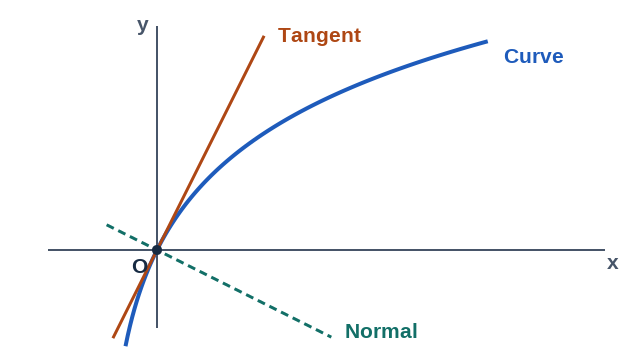
Logarithmic curve through the origin. Its tangent rises through the origin, and its normal falls through the origin.

For y=ln⁡(1+2x)y=\ln(1+2x), mT=2m_{\mathrm T}=2 at the origin and mN=−12m_{\mathrm N}=-\frac12. Both lines pass through the point of contact.

Worked example

Draw both lines at the origin

Find the equations of the tangent and normal to y=ln⁡(1+2x)y=\ln(1+2x) at x=0x=0.

  1. ln⁡1=0\ln 1=0, so P=(0,0)P=(0,0). The log argument is positive in a neighbourhood of 00.

  2. The chain rule gives y′=21+2xy'=\frac{2}{1+2x}, so mT=2m_{\mathrm T}=2. The tangent is y=2xy=2x.

  3. The normal gradient is −12-\frac12. Through PP, its equation is y=−12xy=-\frac12x.

Your turn

For y=2ln⁡(x+1)y=2\ln(x+1) at x=1x=1, give the tangent and normal gradients.

Enter an exact number, for example 3/2 or 2-sqrt(3).

Enter an exact number, for example 3/2 or 2-sqrt(3).

Section 2 of 5 · Core · about 8 min

How can a given tangent determine two constants?

The tangent line and the curve share their value and slope at the point of contact.

Worked example

Recover the two constants

The tangent to y=(ax+b)e1−xy=(ax+b)e^{1-x} at x=1x=1 is y=−3x+8y=-3x+8. Find aa and bb.

  1. The line has value 55 at x=1x=1. The exponential factor is 11, so a+b=5a+b=5.

  2. Use the product rule. Then y′=e1−x(a−ax−b)y'=e^{1-x}(a-ax-b). At x=1x=1, its value is a−(a+b)=a−5a-(a+b)=a-5.

  3. Match the slope: a−5=−3a-5=-3 gives a=2a=2. Now b=5−2=3b=5-2=3.

Worked example

Read both constraints at a tangent contact

The curve y=Ax2+Bx+(1)y=Ax^2+Bx+(1) has tangent y=5x−7y=5 x - 7 at x=2x=2. Find AA and BB.

Try it on paper first.

  1. At the contact input the line gives y=3y=3 and has gradient 55.

  2. Match the curve’s value and derivative there. The two equations give A=2, B=−3A=2,\ B=-3.

Your turn

The tangent to y=(px+q)e2−xy=(px+q)e^{2-x} at x=2x=2 is y=3x−2y=3x-2. Find both constants.

Enter the value on its own or write p = … . Fractions and exact square roots are accepted.

Enter the value on its own or write q = … . Fractions and exact square roots are accepted.

Section 3 of 5 · Core · about 8 min

How do derivative signs classify a stationary point?

A zero derivative gives a candidate. Compare the signs on the two sides of each candidate to see whether the curve turns.

Worked example

Use a sign table

Find and classify the stationary points of f(x)=(x−2)2exf(x)=(x-2)^2e^x.

  1. With the product rule, f′(x)=ex[(x−2)2+2(x−2)]=exx(x−2)f'(x)=e^x[(x-2)^2+2(x-2)]=e^x x(x-2).

  2. The exponential is positive. The zeros 00 and 22 split the domain into three intervals.

    Intervalx<0x<00<x<20<x<2x>2x>2
    f′(x)f'(x)+−+
    BehaviourIncreasingDecreasingIncreasing
  3. The signs change from ++ to −- at x=0x=0 and from −- to ++ at x=2x=2. The local maximum is (0,4)(0,4); the local minimum is (2,0)(2,0).

Worked example

Distinguish a stationary point from a turning point

For y=2(x−3)3+7y=2 \left(x - 3\right)^{3} + 7 give the stationary input and choose the nature of the point.

Try it on paper first.

  1. Differentiate to get dydx=6(x−3)2\frac{\mathrm dy}{\mathrm dx}=6 \left(x - 3\right)^{2}. This is zero at x=3x=3.

  2. The gradient has the same sign on either side. The point therefore has a horizontal tangent and is a stationary point of inflexion.

Your turn

For f(x)=(x−3)2exf(x)=(x-3)^2e^x, give the xx-coordinate of the local maximum and that of the local minimum, in that order.

Enter an exact number, for example 3/2 or 2-sqrt(3).

Enter an exact number, for example 3/2 or 2-sqrt(3).

Section 4 of 5 · Core · about 5 min

Which slope solutions survive a restricted domain?

A cubic can have the same gradient at two inputs. Equal slope alone does not determine a unique input.

Worked example

Find each allowed point with the required tangent gradient

The curve is restricted to x≥0x\ge0. Find every xx-coordinate where the tangent to y=x3−3x+7y=x^{3} - 3 x + 7 is parallel to y=24x+1y=24 x + 1.

  1. Differentiate the curve. Its gradient is 3x2−33 x^{2} - 3.

  2. Set this equal to 2424. The two candidates are −3, 3-3,\ 3.

  3. Only x=3x=3 lies in the given domain.

Your turn

The curve is restricted to x≥0x\ge0. Find every xx-coordinate where the tangent to y=2x3+x−4y=2 x^{3} + x - 4 is parallel to y=25x+1y=25 x + 1.

Enter the value on its own or write x = … . Fractions and exact square roots are accepted.

Section 5 of 5 · Further applications · about 9 min

How do I find every point with a given tangent direction?

Determine the requested gradient first. Solve the derivative condition together with the original curve, so that you keep every point of contact.

Worked example

Find the two tangents parallel to a line

Find both points on x2+2y2=18x^2+2y^2=18 where the tangent is parallel to x+2y=0x+2y=0.

  1. The reference line has slope −12-\frac12. Differentiate implicitly to get 2x+4yy′=02x+4yy'=0, so y′=−x2yy'=-\frac{x}{2y} for y≠0y\ne0.

  2. Set the slopes equal. Then x=yx=y. Substitute into the curve to get 3y2=183y^2=18 and y=±6y=\pm\sqrt6.

  3. The points are (6,6)(\sqrt6,\sqrt6) and (−6,−6)(-\sqrt6,-\sqrt6). Neither has y=0y=0, so both give finite tangents of the requested slope.

Your turn

On x2+4y2=20x^2+4y^2=20, find all points where the tangent has gradient −1-1.

Enter a point as (1, 2) or x = 1, y = 2. Separate complete pairs with commas or semicolons.

Worked examples

Practise the method

Core practice

Question 1 of 4

0 / 4 checked in this collection

Question list

Core practice

Fresh variants

Exam-style

Write the tangent and the normal

2 marks

At the origin, find the tangent and normal to y=2ln⁡(1+2x)y=2\ln(1+2x). Give both equations.

Enter both sides of the equation or give an expression equal to zero. Use ^ for powers and / for fractions.

Enter both sides of the equation or give an expression equal to zero. Use ^ for powers and / for fractions.

Full answer-format guide

Exact numbers: 3/2, sqrt(5), 2-sqrt(3), pi/6, 3*pi/2. Sets: {1,4}. Intervals: (3,5]; a round bracket excludes the endpoint. Infinity: inf; union: U; no solutions: empty. Separate coordinate pairs or triples with semicolons. Expressions: 2x^2+3x-1; equations: x^2=3x+1 or the polynomial equal to zero. Factors: x-1 ; x+2. Parameter fraction: numerator ; denominator. List integer answers individually.

Review the method

Progress stays in this browser. Create an account to save it or sign in.

Extra practice from this lesson

Read both constraints at a tangent contact

The curve y=Ax2+Bx+(5)y=Ax^2+Bx+(5) has tangent y=8x+2y=8 x + 2 at x=1x=1. Find AA and BB.

Enter the value on its own or write a = … . Fractions and exact square roots are accepted.

Enter the value on its own or write b = … . Fractions and exact square roots are accepted.

Distinguish a stationary point from a turning point

For y=3−2(x+4)3y=3 - 2 \left(x + 4\right)^{3} give the stationary input and choose the nature of the point.

Enter the value on its own or write x = … . Fractions and exact square roots are accepted.

Stationary point

Find each allowed point with the required tangent gradient

Find every xx-coordinate where the tangent to y=2x3−x+6y=2 x^{3} - x + 6 is parallel to y=95x+1y=95 x + 1.

Give the complete set: {1, 4} for separate values, (1, 5] for an interval, U for union or empty for no real solutions. Use sqrt(...) for exact roots.

Read both constraints at a tangent contact

The curve y=Ax2+Bx+(−3)y=Ax^2+Bx+(-3) has tangent y=15−7xy=15 - 7 x at x=3x=3. Find AA and BB.

Enter the value on its own or write a = … . Fractions and exact square roots are accepted.

Enter the value on its own or write b = … . Fractions and exact square roots are accepted.

Distinguish a stationary point from a turning point

For y=3(x−2)3−1y=3 \left(x - 2\right)^{3} - 1 give the stationary input and choose the nature of the point.

Enter the value on its own or write x = … . Fractions and exact square roots are accepted.

Stationary point

Find each allowed point with the required tangent gradient

Find every xx-coordinate where the tangent to y=3x3−2x+5y=3 x^{3} - 2 x + 5 is parallel to y=34x+1y=34 x + 1.

Give the complete set: {1, 4} for separate values, (1, 5] for an interval, U for union or empty for no real solutions. Use sqrt(...) for exact roots.

Apply it · original exam-style problems

Show your working on paper and compare it with the worked solution and marking guidance.

Come back to what needs practice

Quick revision sheet (A4)

Your review plan starts after your first check.