Maths4UBETA

Implicit differentiation

Differentiate equations connecting x and y. Find exact gradients, vertical tangents and normal lines.

Try the quick check →
Lesson 3 of 5

Section 1 of 5 · Core · about 5 min

Which terms pick up a derivative of y?

An equation can describe a curve without giving yy as a single formula in xx. On a smooth branch, regard yy as a function of xx and differentiate the relation with respect to xx.

Worked example

Differentiate an ellipse branch

Find the exact gradient of x2+2y2=17x^2+2y^2=17 at (3,2)(3,2).

  1. Differentiate with respect to xx: 2x+4y y′=02x+4y\,y'=0. The factor y′y' comes from the inner derivative of yy.

  2. At (3,2)(3,2), 6+8y′=06+8y'=0.

  3. Divide after moving the constant term to obtain y′=−34y'=-\frac34.

Worked example

Collect every derivative in an implicit curve

The curve 2x2+3y2=142 x^{2} + 3 y^{2}=14 contains (1,2)(1,2). Give the exact tangent gradient there.

Try it on paper first.

  1. Differentiate each term with respect to xx. Multiply terms differentiated through yy by dydx\frac{\mathrm dy}{\mathrm dx}.

  2. After collecting slope terms, the differentiated equation is 4x+(6y)dydx=04 x+(6 y)\frac{\mathrm dy}{\mathrm dx}=0.

  3. Substitute the point to find tangent gradient −13- \frac{1}{3}.

Your turn

Find the exact gradient of x2+3y2=28x^2+3y^2=28 at (4,2)(4,2).

Enter an exact number, for example 3/2 or 2-sqrt(3).

Section 2 of 5 · Core · about 7 min

How do I differentiate a mixed product?

In xyxy, both factors vary with xx. Apply the product rule before gathering the terms in y′y'.

Worked example

Keep both derivatives from a product

Find the exact gradient of x2+2xy+3y2=11x^2+2xy+3y^2=11 at (2,1)(2,1).

  1. The product term gives 2y+2xy′2y+2xy'. The square in yy contributes 6y y′6y\,y'.

  2. Gather terms as 2x+2y+(2x+6y)y′=02x+2y+(2x+6y)y'=0.

  3. At the given point this is 6+10y′=06+10y'=0, giving y′=−35y'=-\frac35.

Worked example

Collect every derivative in an implicit curve

The curve 3x2+2xy+y2=173 x^{2} + 2 x y + y^{2}=17 contains (2,1)(2,1). Give the exact tangent gradient there.

Try it on paper first.

  1. Differentiate each term with respect to xx. Multiply terms differentiated through yy by dydx\frac{\mathrm dy}{\mathrm dx}.

  2. After collecting slope terms, the differentiated equation is 6x+2y+(2x+2y)dydx=06 x + 2 y+(2 x + 2 y)\frac{\mathrm dy}{\mathrm dx}=0.

  3. Substitute the point to find tangent gradient −73- \frac{7}{3}.

Your turn

Differentiate x2+3xy+2y2=15x^2+3xy+2y^2=15, keeping every term on the left and without dividing the equation by a common factor. At (1,2)(1,2) give the coefficient of y′y' and the exact gradient.

Enter an exact number, for example 3/2 or 2-sqrt(3).

Enter an exact number, for example 3/2 or 2-sqrt(3).

Section 3 of 5 · Core · about 7 min

How do I distinguish horizontal and vertical tangents?

The equation A+By′=0A+B y'=0 helps classify the tangent at a regular point. Use the coefficients before dividing.
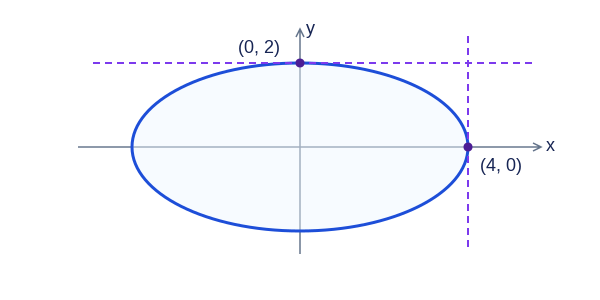
An ellipse touches a horizontal line at (0, 2) and a vertical line at (4, 0).
On x2+4y2=16x^2+4y^2=16, the zero xx-coordinate gives a horizontal tangent at (0,2)(0,2). The zero yy-coordinate gives a vertical tangent at (4,0)(4,0).

Worked example

Compare tangents on an ellipse

Find the tangents to x2+4y2=16x^2+4y^2=16 at (0,2)(0,2) and (4,0)(4,0).

  1. The relation 2x+8y y′=02x+8y\,y'=0 gives zero slope at (0,2)(0,2), hence the tangent is y=2y=2.

  2. At (4,0)(4,0) the coefficient of y′y' vanishes with 2x=82x=8 non-zero. Near this point we can instead treat xx as a function of yy.

  3. The derivative dxdy=−4yx\frac{\mathrm dx}{\mathrm dy}=-\frac{4y}{x} is zero there. The tangent is the vertical line x=4x=4.

Your turn

For 4x2+y2=364x^2+y^2=36, give the constant in the horizontal tangent y=by=b at (0,−6)(0,-6) and in the vertical tangent x=ax=a at (3,0)(3,0).

Enter the value on its own or write b = … . Fractions and exact square roots are accepted.

Enter the value on its own or write a = … . Fractions and exact square roots are accepted.

Section 4 of 5 · Core · about 7 min

How do I combine an implicit derivative with a normal?

Differentiate the inside of an exponential or logarithm term in full. The inside can depend on both xx and yy. Check that any logarithm argument is positive at the point.

Worked example

Find a normal to an exponential relation

Find the equation of the normal to ey−x+2x+y=4e^{y-x}+2x+y=4 at (1,1)(1,1).

  1. The exponential term differentiates to ey−x(y′−1)e^{y-x}(y'-1). The whole derivative equation is ey−x(y′−1)+2+y′=0e^{y-x}(y'-1)+2+y'=0.

  2. The exponential factor is one at (1,1)(1,1). Solve 2y′+1=02y'+1=0 to get tangent gradient −12-\frac12.

  3. Use gradient 22 through (1,1)(1,1). The normal is y−1=2(x−1)y-1=2(x-1).

Your turn

The curve ln⁡(x+y)+x−2y=4\ln(x+y)+x-2y=4 passes through (2,−1)(2,-1). Give the exact tangent and normal gradients there.

Enter an exact number, for example 3/2 or 2-sqrt(3).

Enter an exact number, for example 3/2 or 2-sqrt(3).

Section 5 of 5 · Core · about 5 min

How can I check the direction of a normal?

A normal passes through the same point as the tangent and is perpendicular to its direction.

Worked example

Collect every derivative in an implicit curve

The curve x2+xy+4y2=10x^{2} + x y + 4 y^{2}=10 contains (2,1)(2,1). Give the exact normal gradient there.

  1. Differentiate each term with respect to xx. Multiply terms differentiated through yy by dydx\frac{\mathrm dy}{\mathrm dx}.

  2. After collecting slope terms, the differentiated equation is 2x+y+(x+8y)dydx=02 x + y+(x + 8 y)\frac{\mathrm dy}{\mathrm dx}=0.

  3. Substitute the point to find tangent gradient −12- \frac{1}{2}. Take the negative reciprocal to get 22.

Your turn

The curve 2x2−2xy+y2=132 x^{2} - 2 x y + y^{2}=13 contains (3,1)(3,1). Give the exact normal gradient there.

Enter an exact number, for example 3/2 or 2-sqrt(3).

Worked examples

Practise the method

Core practice

Question 1 of 4

0 / 4 checked in this collection

Question list

Core practice

Fresh variants

Exam-style

Gradient of an ellipse

1 mark

Find the exact gradient of x2+5y2=29x^2+5y^2=29 at (3,2)(3,2).

Enter an exact number, for example 3/2 or 2-sqrt(3).

Full answer-format guide

Exact numbers: 3/2, sqrt(5), 2-sqrt(3), pi/6, 3*pi/2. Sets: {1,4}. Intervals: (3,5]; a round bracket excludes the endpoint. Infinity: inf; union: U; no solutions: empty. Separate coordinate pairs or triples with semicolons. Expressions: 2x^2+3x-1; equations: x^2=3x+1 or the polynomial equal to zero. Factors: x-1 ; x+2. Parameter fraction: numerator ; denominator. List integer answers individually.

Review the method

Progress stays in this browser. Create an account to save it or sign in.

Extra practice from this lesson

Collect every derivative in an implicit curve

The curve 5x2+xy+4y2=105 x^{2} + x y + 4 y^{2}=10 contains (1,1)(1,1). Give the exact tangent gradient there.

Enter an exact number, for example 3/2 or 2-sqrt(3).

Collect every derivative in an implicit curve

The curve 3x2−xy+2y2=163 x^{2} - x y + 2 y^{2}=16 contains (2,−1)(2,-1). Give the exact tangent gradient there.

Enter an exact number, for example 3/2 or 2-sqrt(3).

Match the vertical and horizontal tangents

On x249+y216=1\frac{x^{2}}{49} + \frac{y^{2}}{16}=1, give the xx-value of the vertical tangent at the right endpoint and the yy-value of the horizontal tangent at the upper endpoint.

Enter an exact number, for example 3/2 or 2-sqrt(3).

Enter an exact number, for example 3/2 or 2-sqrt(3).

Collect every derivative in an implicit curve

The curve 4x2+2xy+3y2=234 x^{2} + 2 x y + 3 y^{2}=23 contains (2,1)(2,1). Give the exact normal gradient there.

Enter an exact number, for example 3/2 or 2-sqrt(3).

Collect every derivative in an implicit curve

The curve 2x2−xy+4x+3y2=162 x^{2} - x y + 4 x + 3 y^{2}=16 contains (1,2)(1,2). Give the exact normal gradient there.

Enter an exact number, for example 3/2 or 2-sqrt(3).

Match the vertical and horizontal tangents

On x236+y225=1\frac{x^{2}}{36} + \frac{y^{2}}{25}=1, give the xx-value of the vertical tangent at the right endpoint and the yy-value of the horizontal tangent at the upper endpoint.

Enter an exact number, for example 3/2 or 2-sqrt(3).

Enter an exact number, for example 3/2 or 2-sqrt(3).

Apply it · original exam-style problems

Show your working on paper and compare it with the worked solution and marking guidance.

Come back to what needs practice

Quick revision sheet (A4)

Your review plan starts after your first check.