Maths4UBETA

Geometric conditions, signs and valid domains

Use the middle-square condition carefully, reconstruct the ratio and apply angle and convergence restrictions.

Try the quick check →
Lesson 4 of 5

Section 1 of 6 · Core · about 6 min

When does the squared-middle test actually give a GP?

For ordered consecutive values A,B,CA,B,C, a GP must have one finite real multiplier rr satisfying both steps:

If A≠0A\ne0, set r=BAr=\frac{B}{A} and verify C=rBC=rB. This also handles B=0B=0: it gives r=0r=0 and requires C=0C=0.

If A=0A=0, the recurrence forces B=0B=0 and then C=0C=0. The all-zero triple works for every finite real multiplier, so the ratio is not unique. Every partial sum of the zero sequence is zero.

All three triples satisfy B2=AC=0B^2=AC=0. When a zero term occurs, test whether one finite multiplier actually takes each term to the next.

TripleMultiplier testResult
0,0,50,0,5The second step is impossible because r⋅0≠5r\cdot0\ne5.No geometric progression
6,0,06,0,0Both steps use r=0r=0.S∞=6S_\infty=6
0,0,00,0,0Every finite real multiplier works.S∞=0S_\infty=0

All three triples satisfy B2=ACB^2=AC, but (0,0,5)(0,0,5) fails the actual multiplication rule. A zero ratio is valid for (6,0,0)(6,0,0); the all-zero triple has no unique multiplier.

Worked example

A zero middle term does not always invalidate a GP

Decide whether (9,0,0)(9,0,0), (0,0,9)(0,0,9) and (0,0,0)(0,0,0) can be consecutive GP terms with a finite real multiplier.

  1. For (9,0,0)(9,0,0), the first step forces r=0r=0, and the second step then also works.

  2. For (0,0,9)(0,0,9), no finite rr can satisfy 9=r⋅09=r\cdot0. It is not a GP, although 02=0⋅90^2=0\cdot9.

  3. For (0,0,0)(0,0,0), both recurrence steps work for every finite real rr. The multiplier is not uniquely determined.
Your turn

Consider the ordered triples A: (0,0,4)(0,0,4), B: (5,0,0)(5,0,0), and C: (0,0,0)(0,0,0).

Which can be generated by a finite real common multiplier? Give the ratio for B, describe the multiplier for C, and give the infinite sum of the zero sequence.

Valid GP triples

Enter an exact number, for example 3/2 or 2-sqrt(3).

Multiplier for C

Enter an exact number, for example 3/2 or 2-sqrt(3).

Section 2 of 6 · Core · about 5 min

How do I retain the correct parameter and sign cases?

Use B2=ACB^2=AC to generate algebraic candidates. Keep every real root, reconstruct the original values, and calculate the ratio for that same case. A positive parameter does not necessarily give a positive ratio.

Worked example

A positive parameter can produce alternating terms

The ordered expressions 4,−2x,2−x4,-2x,2-x form a GP. Find every real xx and its ratio. Which case remains if x>0x>0?

  1. (−2x)2=4(2−x)⟹x2+x−2=0.(-2x)^2=4(2-x)\quad\Longrightarrow\quad x^2+x-2=0.
  2. (x−1)(x+2)=0⟹x=1 or x=−2.(x-1)(x+2)=0\quad\Longrightarrow\quad x=1\ \text{or}\ x=-2.
  3. At x=1x=1, the terms are 4,−2,14,-2,1, with r=−12r=-\frac{1}{2}. At x=−2x=-2, they are 4,4,44,4,4, with r=1r=1.

  4. The condition x>0x>0 selects x=1x=1, even though its common ratio is negative.

Your turn

The ordered terms 9,k,19,k,1 form a GP. Find all real values of kk, then give the ratio when kk is positive and when it is negative.

Give the complete set: {1, 4} for separate values, (1, 5] for an interval, U for union or empty for no real solutions. Use sqrt(...) for exact roots.

Enter an exact number, for example 3/2 or 2-sqrt(3).

Enter an exact number, for example 3/2 or 2-sqrt(3).

For nonzero terms at different indices, ujui=rj−i\frac{u_j}{u_i}=r^{j-i}. An odd index gap has one real ratio root; an even gap may give two signs. Match each ratio with its own first term and any stated sign restriction.

Section 3 of 6 · Core · about 9 min

Which restrictions survive algebraic or trigonometric cancellation?

Write every denominator restriction before simplifying. Cancelling a factor preserves equality only where the original expressions were defined. Solve the simplified equation, then return to the original terms.

Worked example

Simplifying an expression does not fill its hole

The ordered expressions x2−1x−1, 2, x+1\frac{x^2-1}{x-1},\ 2,\ x+1 form a GP. Find every permitted xx and its ratio.

  1. x≠1,x2−1x−1=x+1(x≠1).x\ne1,\qquad\frac{x^2-1}{x-1}=x+1\quad(x\ne1).

    Record the original denominator restriction before cancelling.

  2. 4=(x+1)2⟹x=1 or x=−3.4=(x+1)^2\quad\Longrightarrow\quad x=1\ \text{or}\ x=-3.
  3. Reject x=1x=1, where the original first term does not exist.

  4. At x=−3x=-3, the terms are −2,2,−2-2,2,-2, and both steps use r=−1r=-1.

Your turn

The ordered expressions x2−4x−2, 4, x+2\frac{x^2-4}{x-2},\ 4,\ x+2 form a GP. Find the roots of the simplified squared-middle equation, then the values allowed by the original expressions. Give the ratio of the permitted GP.

Give the complete set: {1, 4} for separate values, (1, 5] for an interval, U for union or empty for no real solutions. Use sqrt(...) for exact roots.

Give the complete set: {1, 4} for separate values, (1, 5] for an interval, U for union or empty for no real solutions. Use sqrt(...) for exact roots.

Enter the value on its own or write r = … . Fractions and exact square roots are accepted.

If a square gives sin⁡2θ=c\sin^2\theta=c or cos⁡2θ=c\cos^2\theta=c, consider both signs of the square root when 0≤c≤10\le c\le1. A zero factor is a separate branch. Check open and closed endpoints, all original denominators and the actual GP recurrence for every angle.

Worked example

Cancel a trigonometric factor only on its original domain

The ordered values tan⁡θ, 12, 12cos⁡θ\tan\theta,\ \frac{1}{2},\ \frac{1}{2}\cos\theta form a GP for 0<θ<π0<\theta<\pi. Find all angles and their corresponding ratios.

  1. The original tangent requires cos⁡θ≠0\cos\theta\ne0, so exclude θ=π2\theta=\frac{\pi}{2}.

  2. 14=tan⁡θ(12cos⁡θ)=12sin⁡θ.\frac{1}{4}=\tan\theta\left(\frac{1}{2}\cos\theta\right)=\frac{1}{2}\sin\theta.

    The cancellation is valid at every remaining point of the original domain.

  3. sin⁡θ=12⟹θ=π6 or θ=5π6.\sin\theta=\frac{1}{2}\quad\Longrightarrow\quad\theta=\frac{\pi}{6}\ \text{or}\ \theta=\frac{5\pi}{6}.
  4. r=12tan⁡θ=32or−32,r=\frac{\frac{1}{2}}{\tan\theta}=\frac{\sqrt{3}}{2}\quad\text{or}\quad-\frac{\sqrt{3}}{2},
  5. The positive ratio belongs to π6\frac{\pi}{6}, and the negative ratio to 5π6\frac{5\pi}{6}. Both original triples are defined and both recurrence steps work.

Your turn

The ordered expressions tan⁡θ, 22, cos⁡θ\tan\theta,\ \frac{\sqrt{2}}{2},\ \cos\theta form a GP, where 0<θ<π0<\theta<\pi. Find all allowed angles. Give the ratio for the acute angle and for the obtuse angle.

Give the complete set: {1, 4} for separate values, (1, 5] for an interval, U for union or empty for no real solutions. Use sqrt(...) for exact roots.

Enter an exact number, for example 3/2 or 2-sqrt(3).

Enter an exact number, for example 3/2 or 2-sqrt(3).

Section 4 of 6 · Core · about 9 min

How do I find the complete convergence domain?

Worked example

A valid endpoint case is still excluded by an open interval

The ordered values 1, 1−sin⁡θ, cos⁡2θ1,\ 1-\sin\theta,\ \cos^2\theta form a GP, with −π2<θ<π2-\frac{\pi}{2}<\theta<\frac{\pi}{2}. Find every angle and decide whether the resulting nonzero GP has an ordinary sum to infinity.

  1. (1−sin⁡θ)2=1−sin⁡2θ⟹2sin⁡θ(sin⁡θ−1)=0.(1-\sin\theta)^2=1-\sin^2\theta\quad\Longrightarrow\quad2\sin\theta(\sin\theta-1)=0.
  2. The branch sin⁡θ=0\sin\theta=0 gives θ=0\theta=0. The branch sin⁡θ=1\sin\theta=1 would require θ=π2\theta=\frac{\pi}{2}, which is outside the open interval.

  3. At θ=0\theta=0, the triple is 1,1,11,1,1, with r=1r=1.

  4. It is a valid finite GP, but its nonzero constant terms do not have an ordinary finite sum to infinity.

If the ratio depends on a parameter, solve the full inequality and intersect it with the original domain. For r=p(x)q(x)r=\frac{p(x)}{q(x)}, with q(x)≠0q(x)\ne0, the convergence inequality is equivalent to p(x)2<q(x)2p(x)^2<q(x)^2. This avoids multiplying an inequality by a denominator whose sign is unknown.

Worked example

Solve the full convergence domain

A GP has first term 33 and ratio r=x−1x+2r=\frac{x-1}{x+2}. Find all real xx for which its ordinary sum to infinity exists, and express that sum in terms of xx.

  1. The original ratio requires x≠−2x\ne-2. Since the first term is nonzero, convergence requires ∣r∣<1|r|<1.

  2. ∣x−1x+2∣<1⟺(x−1)2<(x+2)2.\left|\frac{x-1}{x+2}\right|<1\quad\Longleftrightarrow\quad(x-1)^2<(x+2)^2.

    The denominator is nonzero, so its square is positive.

  3. −2x+1<4x+4⟹x>−12.-2x+1<4x+4\quad\Longrightarrow\quad x>-\frac{1}{2}.
  4. This region lies within the original domain. The boundary x=−12x=-\frac{1}{2} gives r=−1r=-1 and is excluded.

  5. S∞=31−x−1x+2=x+2(x>−12).S_\infty=\frac{3}{1-\frac{x-1}{x+2}}=x+2\qquad\left(x>-\frac{1}{2}\right).

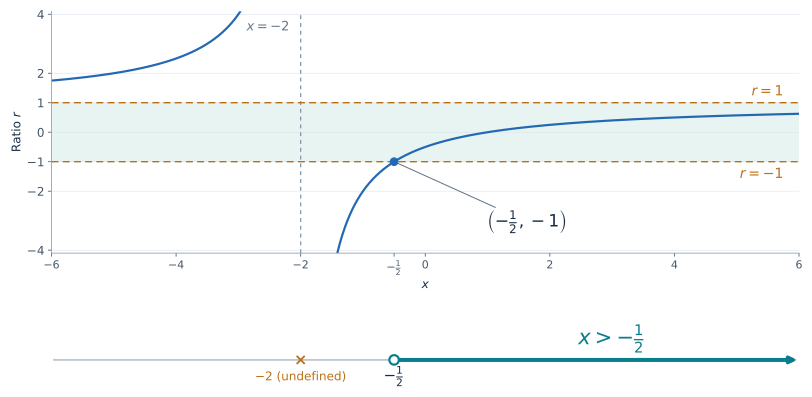
A rational-ratio graph is compared with the horizontal convergence bounds minus one and one. The open convergence region starts after minus one half; the graph is split at its excluded pole minus two.

With a non-zero first term and common ratio r=x−1x+2r=\frac{x-1}{x+2}, the series converges exactly when −1<r<1-1<r<1. This gives x>−12x>-\frac12. The boundary gives r=−1r=-1, and the ratio is undefined at x=−2x=-2.

For an angular ratio, solve −1<r(θ)<1-1<r(\theta)<1 within the stated degree or radian interval. On 0<θ<π0<\theta<\pi, cosine decreases from 11 towards −1-1. Locate any angles where the ratio equals −1-1 or 11, then test the intervals between them; exclude the strict convergence boundaries. For an integer parameter, retain only allowed integer values after solving the inequality. Neither rounding nor including a strict boundary is permitted.

Your turn

GP X has first term 55 and ratio x+1x−2\frac{x+1}{x-2}. GP Y has first term 11 and ratio 2cos⁡θ2\cos\theta, with 0<θ<π0<\theta<\pi.

Choose the complete convergence domain for each GP. Also find the infinite sum of X when x=−1x=-1.

Convergence domain for X
Convergence domain for Y

Enter an exact number, for example 3/2 or 2-sqrt(3).

Section 5 of 6 · Core · about 9 min

What changes when I select or square the terms?

A condition involving r4r^4 and r2r^2 is a quadratic in y=r2y=r^2. Solve for yy, reject negative values, then recover every real rr. A positive value of yy gives both signs; zero gives one ratio, r=0r=0. Apply convergence only after restoring the ratio candidates.

Worked example

A quadratic in the ratio squared has two sign stages

A GP has first term 66 and satisfies 4u5−5u3+u1=04u_5-5u_3+u_1=0. Find all real ratios, then the ratios giving an ordinary sum to infinity. Find that sum for each convergent case.

  1. 24r4−30r2+6=0⟹4r4−5r2+1=0.24r^4-30r^2+6=0\quad\Longrightarrow\quad4r^4-5r^2+1=0.

    The nonzero first term allows this simplification.

  2. y=r2≥0,(4y−1)(y−1)=0⟹y=14 or y=1.y=r^2\ge0,\qquad(4y-1)(y-1)=0\quad\Longrightarrow\quad y=\frac{1}{4}\ \text{or}\ y=1.
  3. r=±12,±1.r=\pm\frac{1}{2},\quad\pm1.

    Recover both real signs from each positive squared value.

  4. The boundary ratios ±1\pm1 are valid finite cases but fail convergence. Keep r=12r=\frac{1}{2} and r=−12r=-\frac{1}{2}.

  5. r=12: S∞=12;r=−12: S∞=4.r=\frac{1}{2}:\ S_\infty=12;\qquad r=-\frac{1}{2}:\ S_\infty=4.

For nonzero derived sequences, the corresponding infinite sums are uj1−rm\frac{u_j}{1-r^m} and a21−r2\frac{a^2}{1-r^2}, with ∣rm∣<1|r^m|<1 and ∣r2∣<1|r^2|<1, respectively. A selected all-zero sequence has total zero directly.

The original progression has a=12a=12 and r=−12r=-\frac12. Its first six terms are 12,−6,3,−32,34,−3812,-6,3,-\frac32,\frac34,-\frac38. Both constructions change the ratio to r2=14r^2=\frac14.

ConstructionNew termsInfinite sum
Even-indexed terms−6,−32,−38,…-6,-\frac32,-\frac38,\ldots−61−14=−8\frac{-6}{1-\frac14}=-8
Square each term144,36,9,94,…144,36,9,\frac94,\ldots1441−14=192\frac{144}{1-\frac14}=192

For a=12a=12, r=−12r=-\frac{1}{2}, selecting even indices starts at −6-6, while squaring values starts at 144144. Both new ratios equal 14\frac{1}{4}, but their infinite sums are −8-8 and 192192.

Worked example

Selecting terms and squaring terms are different operations

A GP has a=12a=12, r=−12r=-\frac{1}{2}. Find the sum u2+u4+u6+⋯u_2+u_4+u_6+\cdots. Separately, find u12+u22+u32+⋯u_1^2+u_2^2+u_3^2+\cdots.

  1. u2=−6,selected ratio=r2=14.u_2=-6,\qquad\text{selected ratio}=r^2=\frac{1}{4}.

    An index jump of two multiplies the original terms twice.

  2. u2+u4+⋯=−61−14=−8.u_2+u_4+\cdots=\frac{-6}{1-\frac{1}{4}}=-8.
  3. squared first term=122=144,squared-term ratio=r2=14.\text{squared first term}=12^2=144,\qquad\text{squared-term ratio}=r^2=\frac{1}{4}.
  4. u12+u22+⋯=1441−14=192.u_1^2+u_2^2+\cdots=\frac{144}{1-\frac{1}{4}}=192.
  5. The original infinite sum is 88, whose square is 6464. Squaring the total therefore does not give the sum of squared terms.

Your turn

A GP has a=8a=8, r=−12r=-\frac{1}{2}. Select u3,u6,u9,…u_3,u_6,u_9,\ldots.

Find the selected sequence’s first term, ratio and infinite sum. Separately, find u12+u22+u32+⋯u_1^2+u_2^2+u_3^2+\cdots.

Enter an exact number, for example 3/2 or 2-sqrt(3).

Enter an exact number, for example 3/2 or 2-sqrt(3).

Enter an exact number, for example 3/2 or 2-sqrt(3).

Enter an exact number, for example 3/2 or 2-sqrt(3).

Section 6 of 6 · Further applications · about 10 min

How do linked progressions supply the remaining equations?

An infinite total LL gives a=L(1−r)a=L(1-r) for a nonzero convergent GP. A shared term then supplies another equation. Solve every real candidate, restore its matching first term, and test both original relations and convergence.

Worked example

Linked GPs keep their own first terms and ratios

GP U has sum to infinity 1818. GP V has sum to infinity 1616 and ratio 12\frac{1}{2}. Their second terms are equal. Find V’s first term and every possible pair (a,r)(a,r) for U.

  1. b=16(1−12)=8,v2=4.b=16\left(1-\frac{1}{2}\right)=8,\qquad v_2=4.

    Use the known ratio of V only in V’s equations.

  2. a=18(1−r),ar=4⟹9r2−9r+2=0.a=18(1-r),\qquad ar=4\quad\Longrightarrow\quad9r^2-9r+2=0.
  3. (3r−1)(3r−2)=0⟹r=13 or r=23.(3r-1)(3r-2)=0\quad\Longrightarrow\quad r=\frac{1}{3}\ \text{or}\ r=\frac{2}{3}.
  4. (a,r)=(12,13)or(6,23).(a,r)=\left(12,\frac{1}{3}\right)\quad\text{or}\quad\left(6,\frac{2}{3}\right).
  5. Both ratios satisfy ∣r∣<1|r|<1, and both second terms equal V’s second term, 44.

Your turn

GP U has sum to infinity 1212. GP V has sum to infinity 88 and ratio 12\frac{1}{2}. Their second terms are equal.

Find both possible pairs (a,r)(a,r) for U, entering the smaller ratio first.

Enter an exact number, for example 3/2 or 2-sqrt(3).

Enter an exact number, for example 3/2 or 2-sqrt(3).

Enter an exact number, for example 3/2 or 2-sqrt(3).

Enter an exact number, for example 3/2 or 2-sqrt(3).

If selected terms of an AP form a GP, first write each selected value as a+(k−1)da+(k-1)d using its actual index. Apply the GP squared condition, factor, and check both recurrence steps. Keep d=0d=0 unless the AP is stated to be non-constant.

Worked example

Unequal AP index gaps can produce a non-constant GP

An AP has u3=12u_3=12. The values u1,u3,u7u_1,u_3,u_7, in that order, form a GP. Find every possible AP first term and difference, and the ratio of each selected GP.

  1. a+2d=12,(a+2d)2=a(a+6d).a+2d=12,\qquad(a+2d)^2=a(a+6d).

    Insert the actual AP indices before applying the GP condition.

  2. 2d(2d−a)=0.2d(2d-a)=0.

    Factoring keeps the possible constant-AP case.

  3. If d=0d=0, then a=12a=12, and the selected GP is 12,12,1212,12,12, with ratio 11.

  4. If a=2da=2d, then 4d=124d=12, so d=3d=3, a=6a=6. The selected GP is 6,12,246,12,24, with ratio 22.

  5. Both are valid. The selected indices have gaps 22 and 44, so the selected triple need not itself be an AP.

Your turn

An AP has u2=10u_2=10. Its terms u1,u2,u4u_1,u_2,u_4, in that order, form a GP. Find all possible AP differences. Give the first term in the constant and non-constant cases, and the GP ratio in the non-constant case.

Give the complete set: {1, 4} for separate values, (1, 5] for an interval, U for union or empty for no real solutions. Use sqrt(...) for exact roots.

Enter an exact number, for example 3/2 or 2-sqrt(3).

Enter an exact number, for example 3/2 or 2-sqrt(3).

Enter an exact number, for example 3/2 or 2-sqrt(3).

Worked examples

Practise the method

Core practice

Question 1 of 4

0 / 4 checked in this collection

Question list

Core practice

Fresh variants

Exam-style

Every middle-term and ratio pair

1 mark

The numbers 2, k, 18 are consecutive GP terms. Give all (k,r) pairs.

Enter each pair in the order shown. Separate complete pairs with commas or semicolons.

Full answer-format guide

Exact numbers: 3/2, sqrt(5), 2-sqrt(3), pi/6, 3*pi/2. Sets: {1,4}. Intervals: (3,5]; a round bracket excludes the endpoint. Infinity: inf; union: U; no solutions: empty. Separate coordinate pairs or triples with semicolons. Expressions: 2x^2+3x-1; equations: x^2=3x+1 or the polynomial equal to zero. Factors: x-1 ; x+2. Parameter fraction: numerator ; denominator. List integer answers individually.

Review the method

Progress stays in this browser. Create an account to save it or sign in.

Extra practice from this lesson

A candidate can fail the definition

Find every real xx for which (x,0,4)(x,0,4), in that order, are consecutive GP terms with a finite real multiplier. Enter “no solutions” if needed.

Give the complete set: {1, 4} for separate values, (1, 5] for an interval, U for union or empty for no real solutions. Use sqrt(...) for exact roots.

A positive parameter with a negative ratio

The ordered terms 9,−3x,2−x9,-3x,2-x form a GP, and x>0x>0. Find xx, the ratio and the sum to infinity.

Enter the value on its own or write x = … . Fractions and exact square roots are accepted.

Enter the value on its own or write r = … . Fractions and exact square roots are accepted.

Enter an exact number, for example 3/2 or 2-sqrt(3).

Two finite cases at the convergence boundaries

The ordered expressions x2−9x−3, 2, x+3\frac{x^2-9}{x-3},\ 2,\ x+3 form a GP. Find all permitted xx, and decide which corresponding GPs have ordinary finite sums to infinity.

Give the complete set: {1, 4} for separate values, (1, 5] for an interval, U for union or empty for no real solutions. Use sqrt(...) for exact roots.

Which converge?

An odd index gap fixes the angular ratio

A GP has ratio r=sin⁡θr=\sin\theta, where 0<θ<π20<\theta<\frac{\pi}{2}. Its terms satisfy u2=3u_2=3 and u5=38u_5=\frac{3}{8}. Find θ\theta, the first term and the infinite sum.

Enter an exact number, for example 3/2 or 2-sqrt(3).

Enter the value on its own or write a = … . Fractions and exact square roots are accepted.

Enter an exact number, for example 3/2 or 2-sqrt(3).

Keep a surd ratio exact

A GP has first term 44 and ratio 3−2\sqrt{3}-2. Choose the correct ratio bound and find the exact sum to infinity.

Where does the ratio lie?

Enter an exact number, for example 3/2 or 2-sqrt(3).

A discrete parameter cannot sit on a strict boundary

A GP has first term 22 and ratio r=n−23r=\frac{n-2}{3}, where nn is a positive integer. Find every nn for which its ordinary infinite sum exists. Find that sum when n=2n=2.

Give the complete set: {1, 4} for separate values, (1, 5] for an interval, U for union or empty for no real solutions. Use sqrt(...) for exact roots.

Enter an exact number, for example 3/2 or 2-sqrt(3).

An infinite sum determines an acute angle

A GP has first term 66, ratio cos⁡θ\cos\theta, and sum to infinity 1212, where 0<θ<π20<\theta<\frac{\pi}{2}. Find θ\theta, then the sum u1+u3+u5+⋯u_1+u_3+u_5+\cdots.

Enter an exact number, for example 3/2 or 2-sqrt(3).

Enter an exact number, for example 3/2 or 2-sqrt(3).

A GP at unequal AP indices

An AP has first term 44. Its terms u2,u4,u7u_2,u_4,u_7, in that order, form a GP. Find all possible AP differences and the GP ratio in the non-constant AP case.

Give the complete set: {1, 4} for separate values, (1, 5] for an interval, U for union or empty for no real solutions. Use sqrt(...) for exact roots.

Enter an exact number, for example 3/2 or 2-sqrt(3).

Apply it · original exam-style problems

Show your working on paper and compare it with the worked solution and marking guidance.

Start after this lesson

Keep both angular cases before applying a sign condition 7 marks

The ordered expressions tan⁡θ, 1, 23cos⁡θ\tan\theta,\ 1,\ \frac{2}{\sqrt{3}}\cos\theta form a GP, for 0<θ<π0<\theta<\pi.

Find all permitted angles and the ratio for each. Then find the sum to infinity of the case whose first term is positive.

Hint

The tangent excludes θ=π2\theta=\frac{\pi}{2}. Find every branch before using the sign of the first term.

Worked solution
  1. 1=23tan⁡θcos⁡θ=23sin⁡θ.1=\frac{2}{\sqrt{3}}\tan\theta\cos\theta=\frac{2}{\sqrt{3}}\sin\theta.
  2. sin⁡θ=32⟹θ=π3,2π3.\sin\theta=\frac{\sqrt{3}}{2}\quad\Longrightarrow\quad\theta=\frac{\pi}{3},\frac{2\pi}{3}.
  3. r=1tan⁡θ=33or−33.r=\frac{1}{\tan\theta}=\frac{\sqrt{3}}{3}\quad\text{or}\quad-\frac{\sqrt{3}}{3}.
  4. Both original triples are valid and both ratios have magnitude less than one. The positive first term occurs at θ=π3\theta=\frac{\pi}{3}, where a=3a=\sqrt{3}.

  5. S∞=31−33=3(3+1)2.S_\infty=\frac{\sqrt{3}}{1-\frac{\sqrt{3}}{3}}=\frac{3(\sqrt{3}+1)}{2}.
Marking guidance
  • 1 mark: retain the original restriction cos⁡θ≠0\cos\theta\ne0.
  • 1 mark: derive sin⁡θ=32\sin\theta=\frac{\sqrt{3}}{2} from the GP condition.
  • 1 mark: include both permitted angle branches.
  • 1 mark: pair each angle with its actual ratio.
  • 1 mark: verify convergence using the ratio magnitudes.
  • 1 mark: apply the positive-first-term condition to select a=3a=\sqrt{3}.
  • 1 mark: calculate the exact infinite sum 3(3+1)2\frac{3(\sqrt{3}+1)}{2}.
A ratio-squared equation and a selected series 8 marks

A GP has first term 88 and satisfies 16u5−17u3+u1=016u_5-17u_3+u_1=0.

Find every real algebraic ratio. The GP is then required to converge and to have a negative second term. Find the permitted ratio, the sum u2+u5+u8+⋯u_2+u_5+u_8+\cdots, and the sum of all squared terms.

Hint

Use y=r2y=r^2. The selected indices advance by three, starting at the second term.

Worked solution
  1. 16r4−17r2+1=0⟹(16y−1)(y−1)=0.16r^4-17r^2+1=0\quad\Longrightarrow\quad(16y-1)(y-1)=0.
  2. r=±14,±1.r=\pm\frac{1}{4},\quad\pm1.
  3. Convergence removes ±1\pm1. Since a=8>0a=8>0, a negative second term selects r=−14r=-\frac{1}{4}.

  4. u2=−2,r3=−164,selected sum=−21+164=−12865.u_2=-2,\qquad r^3=-\frac{1}{64},\qquad\text{selected sum}=\frac{-2}{1+\frac{1}{64}}=-\frac{128}{65}.
  5. squared-term sum=641−116=102415.\text{squared-term sum}=\frac{64}{1-\frac{1}{16}}=\frac{1024}{15}.
Marking guidance
  • 1 mark: obtain the quadratic in y=r2y=r^2.
  • 1 mark: solve for y=116y=\frac{1}{16} and y=1y=1.
  • 1 mark: restore all four real ratio candidates.
  • 1 mark: apply both convergence and the negative-second-term condition.
  • 1 mark: use first selected term −2-2.
  • 1 mark: use selected ratio −164-\frac{1}{64}.
  • 1 mark: obtain the selected infinite sum −12865-\frac{128}{65}.
  • 1 mark: obtain the squared-term sum 102415\frac{1024}{15}.
Two infinite sums and one shared later term 6 marks

GP U has sum to infinity 2424. GP V has sum to infinity 1212 and ratio 12\frac{1}{2}. Their second terms are equal.

Find V’s first term and all possible pairs (a,r)(a,r) for U. Enter the smaller U ratio first.

Hint

V’s second term is 33. Use U’s own ratio in a=24(1−r)a=24(1-r), then set ar=3ar=3.

Worked solution
  1. b=12(1−12)=6,v2=3.b=12\left(1-\frac{1}{2}\right)=6,\qquad v_2=3.
  2. 24r(1−r)=3⟹8r2−8r+1=0.24r(1-r)=3\quad\Longrightarrow\quad8r^2-8r+1=0.
  3. r=2±24,a=6(2∓2).r=\frac{2\pm\sqrt{2}}{4},\qquad a=6(2\mp\sqrt{2}).
  4. Both ratios lie strictly between zero and one. Each matched pair has product ar=3ar=3 and infinite sum 2424, so both remain.

Marking guidance
  • 1 mark: obtain V’s first term 66 and second term 33.
  • 1 mark: use U’s condition a=24(1−r)a=24(1-r).
  • 1 mark: form the correct quadratic from the shared second term.
  • 1 mark: obtain both exact ratio roots.
  • 1 mark: pair each root with the correct first term.
  • 1 mark: verify both original relations and convergence, retaining both pairs.
A geometric selection from an arithmetic progression 7 marks

An AP has S3=24S_3=24. Its terms u1,u4,u10u_1,u_4,u_{10}, in that order, form a GP.

Find every possible AP difference, and the first term in each case. For the non-constant AP case, find the selected GP ratio and the original AP sum S10S_{10}.

Hint

Use the actual selected values a,a+3d,a+9da,a+3d,a+9d. Keep the zero-difference branch.

Worked solution
  1. a+d=8,(a+3d)2=a(a+9d).a+d=8,\qquad(a+3d)^2=a(a+9d).
  2. 3d(3d−a)=0.3d(3d-a)=0.
  3. If d=0d=0, then a=8a=8, giving a constant selected GP. If a=3da=3d, then 4d=84d=8, so d=2d=2, a=6a=6.

  4. The non-constant AP gives selected values 6,12,246,12,24, with ratio 22.

  5. S10=102(12+9⋅2)=150.S_{10}=\frac{10}{2}(12+9\cdot2)=150.
Marking guidance
  • 1 mark: insert the AP indices into the GP condition.
  • 1 mark: factor as 3d(3d−a)=03d(3d-a)=0, retaining d=0d=0.
  • 1 mark: use a+d=8a+d=8 from the AP sum.
  • 1 mark: obtain the constant case (a,d)=(8,0)(a,d)=(8,0).
  • 1 mark: obtain the non-constant case (a,d)=(6,2)(a,d)=(6,2).
  • 1 mark: verify the selected multiplier 22.
  • 1 mark: calculate the original AP sum S10=150S_{10}=150.

Come back to what needs practice

Quick revision sheet (A4)

Your review plan starts after your first check.

Question bank and saved work