Maths4U · Learning together
Geometric conditions, signs and valid domains
Notes
Objective
Solve GP parameter and trigonometric conditions without losing signs or accepting a spurious zero-term triple.
Before you start
Recall GP ratios, quadratic factorisation, exact trigonometric values and denominator restrictions.
Key ideas
The squared-middle condition is only a starting point
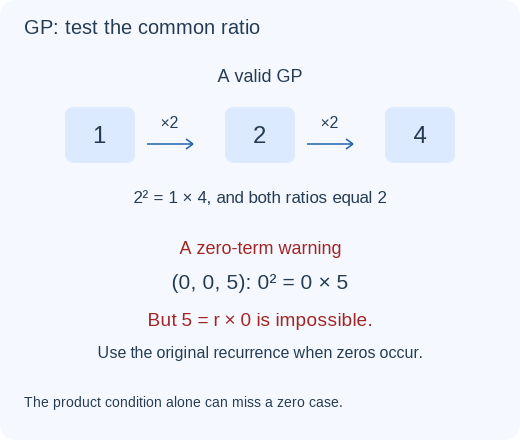
Consecutive GP terms A,B,C satisfy
If A and B are nonzero, reconstruct r=B/A and verify C=rB. With zero terms, the squared equation alone can accept a triple with no common finite ratio.
Restore paired signs
If B² is known, consider B=±√(AC) when real. The two signs may give different first terms and ratios. Preserve their pairing; do not independently mix the a of one case with the r of another.
Trigonometric conditions keep the original domain
Use tangent as sine divided by cosine only where cosine is nonzero. Record every denominator restriction before cancellation. A squared equation can add candidates, so check the original terms and their ratio.
Convergence is an additional question
After finding a valid GP, use its actual ratio in |r|<1. This inequality is strict. A boundary ratio of 1 or −1 does not give an ordinary infinite sum for nonzero terms.
Method
- Record domain restrictions and the actual order of the terms.
- Use B²=AC to obtain algebraic candidates.
- Reconstruct a finite common ratio and verify both recurrence steps.
- Apply positivity, angle and convergence conditions separately.
Common mistakes
- B²=AC can be insufficient when terms are zero.
- An even power can conceal two signs.
- A valid finite GP need not have a sum to infinity.
- A cancelled trigonometric denominator remains excluded.
Worked examples
An unknown middle term has two possible signs
The numbers 2, k and 18 are consecutive terms of a GP. Find every (k,r) pair.
Follow the solutionFor k=6, r=3. For k=−6, r=−3. Both recurrence steps hold in each case, giving pairs (6,3) and (−6,−3). Neither nonzero progression converges.
Cancel only on the stated acute domain
The terms form a GP, with . Find θ and r.
Follow the solutionCos θ is nonzero on the domain, so cancellation is valid. Thus θ=π/6. The terms are 1/√3, 1, √3, and the common ratio is √3. This finite GP has no ordinary sum to infinity.
An endpoint candidate must not be restored
The terms form a GP for . Find θ and decide whether the GP converges.
Follow the solutionThe algebra gives cos θ=0 or 1. The value θ=0 is outside the domain. At θ=π/2 the terms are 1,1,1: ratio 1, so the ordinary infinite sum does not exist.
A zero triple can pass one test and fail the definition
Can 0,0,7 be three consecutive terms of a GP with a finite common ratio?
Follow the solutionThe middle-square equation is 0²=0×7, so it is satisfied. But a common ratio would also require the third term to be r×0=0, not 7. Therefore no finite common ratio exists; the squared-middle test was necessary but insufficient.