Maths4UBETA

Series models: timing, accumulation and linked progressions

Choose an additive or multiplicative model, set the timeline and count the terms actually included.

Try the quick check →
Lesson 5 of 5

Section 1 of 6 · Core · about 6 min

How do I choose a model from the words?

A model is a mathematical rule for the situation. First identify what changes from one step to the next. A fixed addition or subtraction gives an AP; repeated multiplication by a fixed factor gives a GP.

Keep the first value and the index convention visible. A year-one amount bb becomes bqn−1bq^{n-1} in year nn. A lump sum LL present at time zero becomes LqnLq^n after nn complete growth periods.

Two observations may fit both an AP model and a GP model. Use the stated change rule, or an additional observation, to distinguish the proposed models. Agreement at the beginning does not make their later predictions equal.

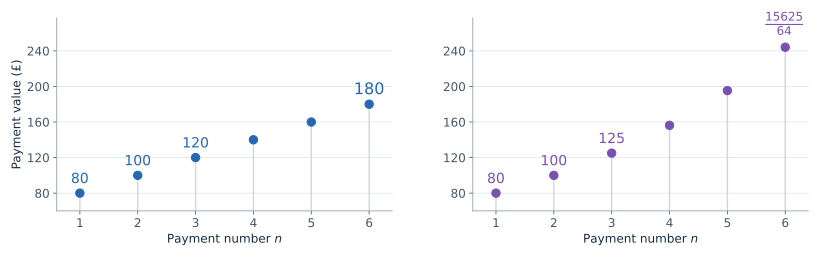
Discrete predictions from an arithmetic and a geometric model share the first two points and separate afterwards.

Both sequences begin with payments of £80\pounds80 and £100\pounds100. Their later predictions differ.

ModelRuleThird paymentSixth payment
Arithmeticd=20d=20£120\pounds120£180\pounds180
Geometricr=54r=\frac54£125\pounds1251562564 pounds\frac{15625}{64}\text{ pounds}

The values 80,10080,100 fit both a fixed increase of 2020 and a multiplier of 54\frac{5}{4}. The third values are 120120 and 125125; by the sixth value the forecasts are 180180 and 15 62564\frac{15\,625}{64}.

For a total, use the number of included terms, rather than the number of changes:

Worked example

The same first two values do not determine the rule

The first two payments are £ 80\text{£}\,80 and £ 100\text{£}\,100. Model A increases each payment by a fixed amount. Model G increases it by a fixed percentage.

Find the third payment and the total of the first four payments under each model.

  1. Model A: d=100−80=20.\text{Model A: }d=100-80=20.
  2. A3=80+2(20)=120,SA,4=42(80+140)=440.A_3=80+2(20)=120,\qquad S_{A,4}=\frac{4}{2}(80+140)=440.
  3. Model G: q=10080=54.\text{Model G: }q=\frac{100}{80}=\frac{5}{4}.
  4. G3=80(54)2=125,SG,4=80+100+125+156.25=461.25.G_3=80\left(\frac{5}{4}\right)^2=125,\qquad S_{G,4}=80+100+125+156.25=461.25.
  5. The third payments are £ 120\text{£}\,120 and £ 125\text{£}\,125; the totals are £ 440\text{£}\,440 and £ 461.25\text{£}\,461.25. Both models fit the first two observations, but their later predictions differ.
Your turn

The first two payments are £ 60\text{£}\,60 and £ 75\text{£}\,75. Model A adds a fixed amount each time. Model G multiplies by a fixed positive factor.

Find the third payment under each model, to the nearest penny. Do the first two observations distinguish these two models?

Round as requested in the label, or enter your calculator value. Decimal or fraction input is accepted.

Round as requested in the label, or enter your calculator value. Decimal or fraction input is accepted.

What do the two observations establish?

Section 2 of 6 · Core · about 7 min

How do I total salaries, bonuses or birthday payments?

A salary stated for year one is the first term. To reach year nn, apply n−1n-1 increases. To total the first nn salaries, include nn receipts.

Worked example

The fifth salary follows four increases

A salary starts at £ 27 000\text{£}\,27\,000 in year one and rises by £ 1 200\text{£}\,1\,200 each year. Find the year-five salary and the total received during the first five years.

  1. a=27 000,d=1 200,u5=a+4d=31 800.a=27\,000,\qquad d=1\,200,\qquad u_5=a+4d=31\,800.
  2. S5=52(27 000+31 800)=147 000.S_5=\frac{5}{2}(27\,000+31\,800)=147\,000.
  3. The year-five salary is £ 31 800\text{£}\,31\,800, and the total of the five annual receipts is £ 147 000\text{£}\,147\,000.

    The number of increases is one less than the number of included annual salaries.

Your turn

A salary is £ 28 600\text{£}\,28\,600 in year one and rises by £ 850\text{£}\,850 each year. Find the salary in year six and the total salary received over the first six years. Give money answers to the nearest penny.

Round as requested in the label, or enter your calculator value. Decimal or fraction input is accepted.

Round as requested in the label, or enter your calculator value. Decimal or fraction input is accepted.

For a run from year pp through year tt, both endpoints count: there are t−p+1t-p+1 receipts. Find the first included value, then sum that shorter progression. For a GP it starts at bqp−1bq^{p-1}, with the same ratio qq.

The same counting works for birthdays. Payments from the twelfth through the sixteenth birthday give five payments. If a payment is made at birth, call that time zero; its age after kk years is kk, even if it is the first payment in a list.

If two parts obey different rules, write two models. Add their year-specific values for a single-year payment, or add their separate sums for a multi-year total.

Worked example

A salary multiplier and a bonus increment

In year one, a salary is £ 25 000\text{£}\,25\,000 and a bonus is £ 1 000\text{£}\,1\,000. The salary rises by 4%4\% each year, while the bonus rises by £ 200\text{£}\,200 each year.

Find the combined year-four payment and the combined total for the first four years, to the nearest penny. No additional interest is earned on the receipts.

  1. Year-four salary=25 000(1.04)3=28 121.6.\text{Year-four salary}=25\,000(1.04)^3=28\,121.6.
  2. Year-four bonus=1 000+3(200)=1 600.\text{Year-four bonus}=1\,000+3(200)=1\,600.
  3. The combined year-four payment is £ 29 721.60\text{£}\,29\,721.60.

  4. Salary total=25 0001.044−10.04=106 161.6.\text{Salary total}=25\,000\frac{1.04^4-1}{0.04}=106\,161.6.
  5. Bonus total=42(1 000+1 600)=5 200.\text{Bonus total}=\frac{4}{2}(1\,000+1\,600)=5\,200.
  6. The combined total is £ 111 361.60\text{£}\,111\,361.60. Adding a GP amount to an AP amount does not usually produce a single AP or GP; sum the components separately.

Your turn

A worker receives a salary of £ 18 000\text{£}\,18\,000 and a bonus of £ 600\text{£}\,600 in year one. The salary rises by 5%5\% each year; the bonus rises by £ 150\text{£}\,150 each year.

Find the combined payment in year four and the combined total over the first four years, to the nearest penny. The receipts earn no additional interest.

Round as requested in the label, or enter your calculator value. Decimal or fraction input is accepted.

Round as requested in the label, or enter your calculator value. Decimal or fraction input is accepted.

Section 3 of 6 · Core · about 10 min

How long does each deposit earn interest?

Mark time zero and the valuation instant before using a sum formula. Let PP be each regular payment, LL an optional initial lump sum, and q=1+iq=1+i, where ii is the interest rate per period written as a decimal. Match the rate to the period length.

Use this convention: interest is credited at each period end, then any end payment is made. Value the account at time nn, immediately after the final interest credit and any final end payment.

Each bracket is a finite GP. For q≠1q\ne1, summing it gives:

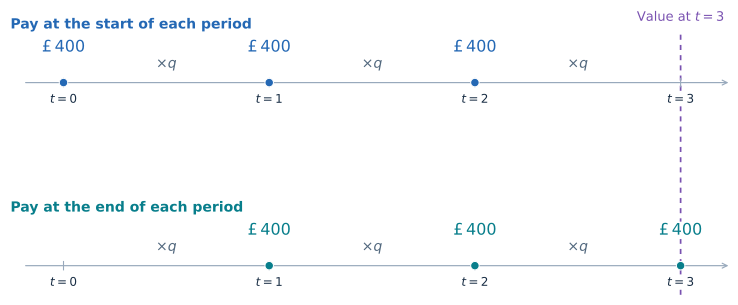
Aligned timelines show the first and last payment dates and the exact number of interest periods earned by each deposit.

Three payments of £400\pounds400 grow by the factor q=1.03q=1.03 each period. Value them just after the third interest credit and the payment due at that time.

TimingValues at third creditTotal
Start of each period400q3,400q2,400q400q^3,400q^2,400q£1273.4508\pounds1273.4508
End of each period400q2,400q,400400q^2,400q,400£1236.36\pounds1236.36

Round only after adding the three values. Start-of-period payments give £1273.45\pounds1273.45 to the nearest penny.

At the same valuation date, three £ 400\text{£}\,400 start payments have ages 3,2,13,2,1; three end payments have ages 2,1,02,1,0. At 3%3\%, their final balances are £ 1 273.45\text{£}\,1\,273.45 and £ 1 236.36\text{£}\,1\,236.36.

Worked example

Three deposits valued on the same date

An empty account receives £ 400\text{£}\,400 once in each of three years. Annual interest is 3%3\%, credited at each year end.

Compare payments at the start of each year with payments at the end of each year immediately after interest. Value both accounts at the end of year three, after its interest credit and any end payment. Round the final balances to the nearest penny.

  1. Start payments earn interest for 3,2,13,2,1 years. End payments earn it for 2,1,02,1,0 years.

  2. Bstart=400(1.033+1.032+1.03)=1 273.4508.B_{\mathrm{start}}=400(1.03^3+1.03^2+1.03)=1\,273.4508.
  3. Bend=400(1.032+1.03+1)=1 236.36.B_{\mathrm{end}}=400(1.03^2+1.03+1)=1\,236.36.
  4. The final balances are £ 1 273.45\text{£}\,1\,273.45 and £ 1 236.36\text{£}\,1\,236.36. Each start payment has earned exactly one more year of interest, so its accumulated payment total is multiplied by 1.031.03.

Your turn

An account starts empty. A payment of £ 300\text{£}\,300 is made once in each of three years. Interest of 4%4\% is credited at each year end.

Find the balance at the end of year three for payments made at each year end, immediately after interest, and for payments made at each year start. In both cases value the account after the last interest credit and any end payment. Give both balances to the nearest penny.

Round as requested in the label, or enter your calculator value. Decimal or fraction input is accepted.

Round as requested in the label, or enter your calculator value. Decimal or fraction input is accepted.

An initial lump sum is present from time zero in both plans and grows for the same nn periods. Only the regular-payment portions differ by one extra factor of qq:

Bstart−Lqn=q(Bend−Lqn).B_{\mathrm{start}}-Lq^n=q\bigl(B_{\mathrm{end}}-Lq^n\bigr).

With no initial lump sum, this reduces to Bstart=qBendB_{\mathrm{start}}=qB_{\mathrm{end}}. With a nonzero lump sum and a nonzero interest rate, multiplying the whole end balance by qq would grow that initial money for an extra period incorrectly.

The total cash paid in is L+nPL+nP. If there are no other transactions, interest earned is the final balance minus this total.

Worked example

An initial lump sum has its own age

An account receives £ 1 000\text{£}\,1\,000 at time zero, then £ 250\text{£}\,250 at each of the next four year ends immediately after interest. Annual interest is 2%2\%.

Find the balance just after the fourth end payment, to the nearest penny.

  1. The initial sum earns four years of interest. The four regular deposits earn 3,2,1,03,2,1,0 years.

  2. B=1 000(1.02)4+250(1.023+1.022+1.02+1).B=1\,000(1.02)^4+250(1.02^3+1.02^2+1.02+1).
  3. B=1 082.43216+1 030.402=2 112.83416.B=1\,082.43216+1\,030.402=2\,112.83416.
  4. The required balance is £ 2 112.83\text{£}\,2\,112.83. The original £ 1 000\text{£}\,1\,000 is included once, separately from the four equal payments.

Your turn

An account receives £ 800\text{£}\,800 at time zero and £ 150\text{£}\,150 at each of the next three year ends, immediately after that year’s interest is credited.

Find its balance just after the third end payment if the annual interest rate is 2.5%2.5\%. Find the balance for the same payments if there is no interest. Give both answers to the nearest penny.

Round as requested in the label, or enter your calculator value. Decimal or fraction input is accepted.

Round as requested in the label, or enter your calculator value. Decimal or fraction input is accepted.

Section 4 of 6 · Core · about 8 min

Which parts of a bouncing path have happened?

Suppose a ball falls from height H>0H>0, and every rebound reaches a fraction rr of the previous height, with 0<r<10<r<1. The rebound peaks are Hr,Hr2,Hr3,…Hr,Hr^2,Hr^3,\ldots. These are heights; total distance must also count the downward journeys.

The symbol ∑\sum means “add the indicated terms”. For a positive integer mm,

∑k=1mHrk=Hr+Hr2+⋯+Hrm.\sum_{k=1}^{m}Hr^k=Hr+Hr^2+\cdots+Hr^m.

Include one term for each integer kk from 11 through mm.

Count the initial landing as ground impact one. At ground impact nn, exactly n−1n-1 rebounds have been completed:

Dimpact n=H+2∑k=1n−1Hrk.D_{\mathrm{impact}\,n}=H+2\sum_{k=1}^{n-1}Hr^k.

The sum is empty at n=1n=1, so the first impact distance is just HH. After mm complete rises and falls, use H+2∑k=1mHrkH+2\sum_{k=1}^{m}Hr^k. At the peak of rebound mm, use:

Dpeak m=H+2∑k=1m−1Hrk+Hrm.D_{\mathrm{peak}\,m}=H+2\sum_{k=1}^{m-1}Hr^k+Hr^m.

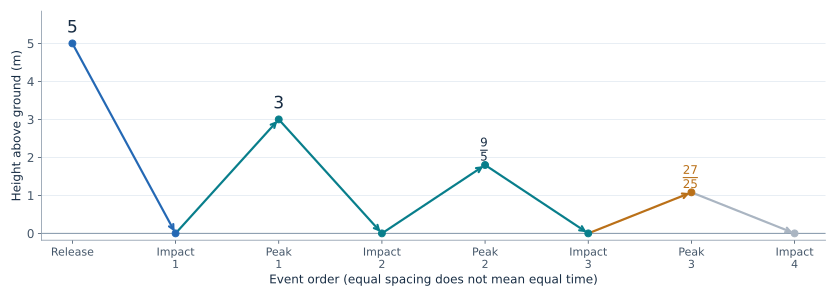
A labelled bounce path distinguishes the initial fall, complete rise-and-fall pairs, ground impacts and the third rebound peak.

  1. For a drop of 5 m5\,\mathrm m followed by rebounds of ratio 35\frac35, count the initial fall once and each complete rebound twice.
  2. At impact 33, the distance is 5+2(3+95)=735 m5+2\left(3+\frac95\right)=\frac{73}{5}\,\mathrm m. Then the upward leg to peak 33 adds 2725 m\frac{27}{25}\,\mathrm m, giving 39225 m\frac{392}{25}\,\mathrm m.
  3. The limiting distance is 5+2(3)1−35=20 m5+\frac{2(3)}{1-\frac35}=20\,\mathrm m.

With H=5 mH=5\text{ m} and r=35r=\frac{3}{5}, impact three occurs after two complete rebounds. The peak of rebound three adds only the upward distance 2725 m\frac{27}{25}\text{ m}. Horizontal spacing shows event order, not elapsed time.

Worked example

Ground impact and rebound peak are different stopping points

A ball is released from 5 m5\text{ m}. Each rebound reaches 35\frac{3}{5} of the previous height. Count the initial landing as ground impact one.

Find the distance travelled by impact three and then at the peak of rebound three.

  1. h1=3,h2=95,h3=2725.h_1=3,\qquad h_2=\frac{9}{5},\qquad h_3=\frac{27}{25}.
  2. At impact three, two rebounds have risen and fallen completely.

  3. Dimpact 3=5+2(3+95)=735 m.D_{\mathrm{impact}\,3}=5+2\left(3+\frac{9}{5}\right)=\frac{73}{5}\text{ m}.
  4. The third rebound peak comes next. Add its upward distance only.

  5. Dpeak 3=735+2725=39225 m.D_{\mathrm{peak}\,3}=\frac{73}{5}+\frac{27}{25}=\frac{392}{25}\text{ m}.

For the idealised infinite model, the rebound heights form a convergent GP. Count the entire vertical path:

Worked example

A limiting distance can determine the rebound ratio

A ball is released from 4 m4\text{ m}. Each rebound reaches a fixed fraction rr of the previous height, where 0<r<10<r<1. Its total vertical distance in the idealised infinite model is 28 m28\text{ m}. Find rr.

  1. 28=4+24r1−r.28=4+2\frac{4r}{1-r}.

    Count the initial fall once and every complete rebound twice.

  2. 24(1−r)=8r⟹r=34.24(1-r)=8r\quad\Longrightarrow\quad r=\frac{3}{4}.
  3. This ratio is positive and less than one. Substituting it into the original distance formula gives 28 m28\text{ m}, so the model is valid.

Your turn

A ball is released from 4 m4\text{ m}. Each rebound reaches half the height of the previous fall. The initial landing is ground impact one.

Find the total vertical distance travelled by ground impact three, at the peak of rebound three, and in the idealised infinite model. Give exact values.

Enter an exact number, for example 3/2 or 2-sqrt(3).

Enter an exact number, for example 3/2 or 2-sqrt(3).

Enter an exact number, for example 3/2 or 2-sqrt(3).

Section 5 of 6 · Core · about 7 min

How do I find an accumulation limit or the first index near it?

Some situations add an increment once at each event. A peg’s depth increases, for example, are added once each. There is no return journey to double. Let the first positive increment be cc, with ratio 0<r<10<r<1.

To find the least integer index satisfying a strict gap bound, write the inequality for RnR_n, then test integer powers using a calculator table or repeated multiplication. Check the first successful index and the one immediately before it. The decreasing-gap property proves that every earlier index also fails.

If observations are separated by several impacts, use their actual index gap. For example, the third increment divided by the first is r2r^2. Algebra may produce both signs; a model of positive depth increases requires a positive ratio.

Worked example

Repeated impacts add depth once, not twice

A peg moves 0.8 cm0.8\text{ cm} farther into a surface on the first impact. Each later depth increase is 34\frac{3}{4} of the previous increase.

Find the limiting depth and the least number of impacts needed for the remaining gap to the limit to be strictly less than 0.2 cm0.2\text{ cm}.

  1. Dn=45(1−(34)n)1−34=165(1−(34)n).D_n=\frac{\frac{4}{5}\left(1-\left(\frac{3}{4}\right)^n\right)}{1-\frac{3}{4}}=\frac{16}{5}\left(1-\left(\frac{3}{4}\right)^n\right).
  2. D∞=165 cm,Rn=165(34)n.D_\infty=\frac{16}{5}\text{ cm},\qquad R_n=\frac{16}{5}\left(\frac{3}{4}\right)^n.
  3. Rn<15⟺(34)n<116.R_n<\frac{1}{5}\quad\Longleftrightarrow\quad\left(\frac{3}{4}\right)^n<\frac{1}{16}.
  4. R9=19 68381 920>15,R10=59 049327 680<15.R_9=\frac{19\,683}{81\,920}>\frac{1}{5},\qquad R_{10}=\frac{59\,049}{327\,680}<\frac{1}{5}.
  5. Each new gap is 34\frac{3}{4} of the previous one. The gaps strictly decrease, so the least number of impacts is 1010.

    A table of integer powers finds the candidate; the neighbouring check and decreasing gap establish that it is the first.

Your turn

Successive impacts drive a peg farther into a surface. The first depth increase is 1.2 cm1.2\text{ cm}, and each later increase is half the previous one. Each increase is counted once.

Find the limiting depth, the depth after four impacts, and the least number of impacts for the remaining gap to the limit to be strictly less than 0.1 cm0.1\text{ cm}. Give exact depth values.

Enter an exact number, for example 3/2 or 2-sqrt(3).

Enter an exact number, for example 3/2 or 2-sqrt(3).

Enter the value on its own or write n = … . Fractions and exact square roots are accepted.

Section 6 of 6 · Further applications · about 9 min

How do I connect different progressions and reject false candidates?

Give each progression its own parameters: an AP may use a,da,d, while a GP uses b,rb,r. Translate each stated equality using the actual term indices or sums. Sharing one term or one total does not make the first terms or change rules equal.

If a selected GP uses vj,vj+m,vj+2m,…v_j,v_{j+m},v_{j+2m},\ldots, its first included value is brj−1br^{j-1} and its ratio is rmr^m. Check convergence of the selected series before using its infinite-sum formula.

Worked example

A finite AP can equal a selected infinite GP sum

An AP has first term 22 and difference 11. A separate GP has first term −21-21 and ratio −12-\frac{1}{2}.

The sum of the first nn AP terms equals the sum of the even-indexed GP terms v2+v4+v6+⋯v_2+v_4+v_6+\cdots. Find the positive integer nn.

  1. SAP,n=n2(4+n−1)=n(n+3)2.S_{\mathrm{AP},n}=\frac{n}{2}(4+n-1)=\frac{n(n+3)}{2}.
  2. v2=212,selected ratio=(−12)2=14.v_2=\frac{21}{2},\qquad\text{selected ratio}=\left(-\frac{1}{2}\right)^2=\frac{1}{4}.
  3. v2+v4+⋯=2121−14=14.v_2+v_4+\cdots=\frac{\frac{21}{2}}{1-\frac{1}{4}}=14.
  4. n(n+3)2=14⟹(n−4)(n+7)=0.\frac{n(n+3)}{2}=14\quad\Longrightarrow\quad(n-4)(n+7)=0.
  5. The index must be a positive integer, so n=4n=4. The AP sum 2+3+4+5=142+3+4+5=14 checks the original equality.

If expressions must form a GP, first use the ordered condition B2=ACB^2=AC, then verify a finite common multiplier in both steps B=rAB=rA, C=rBC=rB. If A≠0A\ne0, use r=BAr=\frac{B}{A}. If A=0A=0, only the all-zero triple works. An AP first term, a changed GP first term and their respective sums remain separate quantities.

Record restrictions before solving: real square roots, nonzero denominators, positive amounts, integer counts and convergence. Factoring can produce several cases; keep each until the original question excludes it.

Worked example

Squaring can introduce a false positive candidate

Let x>0x>0. An AP starts with x−3,1x-3,1. A GP has first term x2\frac{\sqrt{x}}{2} and ratio 12\frac{1}{2}. The first two AP terms have the same sum as the infinite GP. Find every valid xx.

  1. x−2=x21−12=x.x-2=\frac{\frac{\sqrt{x}}{2}}{1-\frac{1}{2}}=\sqrt{x}.
  2. The original right side is nonnegative, so any valid case must also have x−2≥0x-2\ge0.

  3. (x−2)2=x⟹x2−5x+4=0⟹x=1 or x=4.(x-2)^2=x\quad\Longrightarrow\quad x^2-5x+4=0\quad\Longrightarrow\quad x=1\ \text{or}\ x=4.
  4. At x=1x=1, the original sides are −1-1 and 11, so reject it. At x=4x=4, both sides are 22, so it works.

  5. The valid AP begins 1,11,1, and the GP has first term 11, ratio 12\frac{1}{2}, and infinite sum 22. A constant AP is allowed here.

Your turn

Let x>0x>0. An AP begins with x−13,1x-13,1. A GP has first term x2\frac{\sqrt{x}}{2} and ratio 12\frac{1}{2}. The sum of the first two AP terms equals the GP sum to infinity.

Find all roots produced by squaring the resulting equation, then all values that actually satisfy the original condition. Find the common sum in the valid case.

Give the complete set: {1, 4} for separate values, (1, 5] for an interval, U for union or empty for no real solutions. Use sqrt(...) for exact roots.

Give the complete set: {1, 4} for separate values, (1, 5] for an interval, U for union or empty for no real solutions. Use sqrt(...) for exact roots.

Enter an exact number, for example 3/2 or 2-sqrt(3).

Worked examples

Practise the method

Core practice

Question 1 of 4

0 / 4 checked in this collection

Question list

Core practice

Fresh variants

Exam-style

An additive salary model

2 marks

A salary is £24,000 in year 1 and rises by £900 each year. Find the year-6 salary and the total salary over 6 years.

Enter an exact number, for example 3/2 or 2-sqrt(3).

Enter an exact number, for example 3/2 or 2-sqrt(3).

Full answer-format guide

Exact numbers: 3/2, sqrt(5), 2-sqrt(3), pi/6, 3*pi/2. Sets: {1,4}. Intervals: (3,5]; a round bracket excludes the endpoint. Infinity: inf; union: U; no solutions: empty. Separate coordinate pairs or triples with semicolons. Expressions: 2x^2+3x-1; equations: x^2=3x+1 or the polynomial equal to zero. Factors: x-1 ; x+2. Parameter fraction: numerator ; denominator. List integer answers individually.

Review the method

Progress stays in this browser. Create an account to save it or sign in.

Extra practice from this lesson

Sum only the stated run of annual receipts

A grant pays £ 1 200\text{£}\,1\,200 in year one. The annual payment rises by 5%5\% each year.

Find the payment in year six and the total paid from year three through year six inclusive, to the nearest penny. These are receipts; no additional interest is earned on them.

Round as requested in the label, or enter your calculator value. Decimal or fraction input is accepted.

Round as requested in the label, or enter your calculator value. Decimal or fraction input is accepted.

Birthday endpoints both count

A child receives a payment on every birthday from the twelfth through the sixteenth, inclusive. Plan A starts at £ 40\text{£}\,40 and increases each payment by £ 10\text{£}\,10. Plan G starts at £ 40\text{£}\,40 and increases each payment by 25%25\%.

Find the number of payments and the total received under each plan. Give money totals to the nearest penny. The payments are not invested.

Enter an exact number, for example 3/2 or 2-sqrt(3).

Round as requested in the label, or enter your calculator value. Decimal or fraction input is accepted.

Round as requested in the label, or enter your calculator value. Decimal or fraction input is accepted.

Just before the final payment

An account starts empty and is scheduled to receive £ 200\text{£}\,200 at each of four year ends, immediately after that year’s 3%3\% interest credit.

Value the account at the end of year four after interest has been credited but just before the fourth payment is made. How many payments are included, and what is the balance to the nearest penny?

Enter an exact number, for example 3/2 or 2-sqrt(3).

Round as requested in the label, or enter your calculator value. Decimal or fraction input is accepted.

One period with an initial lump sum

An account has an initial £ 500\text{£}\,500 at time zero. One extra payment of £ 100\text{£}\,100 is made either at the start of the year or at the end, immediately after annual interest of 10%10\% is credited.

Find both balances at the end of that year, after interest and any end payment, to the nearest penny. Which part receives one extra growth factor when the payment moves to the start?

Round as requested in the label, or enter your calculator value. Decimal or fraction input is accepted.

Round as requested in the label, or enter your calculator value. Decimal or fraction input is accepted.

Part receiving an extra factor

Four impacts include three complete rebounds

A ball is released from 6 m6\text{ m}, and each rebound reaches 23\frac{2}{3} of the previous height. Count the initial landing as impact one.

Find the exact total distance by impact four and the limiting distance in the idealised infinite model.

Enter an exact number, for example 3/2 or 2-sqrt(3).

Enter an exact number, for example 3/2 or 2-sqrt(3).

Use the gap between observations

Successive positive depth increases follow a GP. The first increase is 0.5 cm0.5\text{ cm} and the third is 0.18 cm0.18\text{ cm}.

Find the physically valid ratio, the total increase after three impacts, and the limiting total increase. Give exact values.

Enter an exact number, for example 3/2 or 2-sqrt(3).

Enter an exact number, for example 3/2 or 2-sqrt(3).

Enter an exact number, for example 3/2 or 2-sqrt(3).

A changed expression creates a different progression

An AP begins x,x+4,x+8x,x+4,x+8. Replacing the third expression by x+12x+12 gives the first three terms of a GP with nonzero terms.

Find xx, the GP ratio, and the sum of the first four terms of each progression.

Enter the value on its own or write x = … . Fractions and exact square roots are accepted.

Enter the value on its own or write r = … . Fractions and exact square roots are accepted.

Enter an exact number, for example 3/2 or 2-sqrt(3).

Enter an exact number, for example 3/2 or 2-sqrt(3).

A finite sum and an alternating infinite sum

An AP has first term 11 and common difference 22. A separate GP has first term 5454 and ratio −12-\frac{1}{2}.

Find the GP sum to infinity and the positive integer nn for which the sum of the first nn AP terms equals it.

Enter an exact number, for example 3/2 or 2-sqrt(3).

Enter the value on its own or write n = … . Fractions and exact square roots are accepted.

Apply it · original exam-style problems

Show your working on paper and compare it with the worked solution and marking guidance.

Start after this lesson

Two separated observations support two growth rules 6 marks

An annual payment is £ 100\text{£}\,100 in year one and £ 144\text{£}\,144 in year three. Model A uses a fixed annual addition. Model G uses a fixed positive percentage increase.

For each model, find the year-two payment and the total of the first five payments, to the nearest penny. A separate record then shows the year-two payment was £ 122\text{£}\,122. Which of the two proposed models agrees with this additional observation?

Hint

The observations are two annual changes apart. For the GP, the required factor is positive.

Worked solution
  1. 100+2d=144⟹d=22,A2=122.100+2d=144\quad\Longrightarrow\quad d=22,\qquad A_2=122.
  2. 100q2=144⟹q=65,G2=120.100q^2=144\quad\Longrightarrow\quad q=\frac{6}{5},\qquad G_2=120.
  3. SA,5=52(100+188)=720.S_{A,5}=\frac{5}{2}(100+188)=720.
  4. SG,5=1001.25−10.2=744.16.S_{G,5}=100\frac{1.2^5-1}{0.2}=744.16.
  5. Both models fit the year-one and year-three observations. Only Model A also predicts the recorded year-two payment of £ 122\text{£}\,122.

Marking guidance
  • 1 mark: use the two-year gap to obtain d=22d=22.
  • 1 mark: obtain the positive multiplier q=65q=\frac{6}{5}.
  • 1 mark: calculate the two year-two predictions, 122122 and 120120.
  • 1 mark: calculate the AP total 720720.
  • 1 mark: calculate the GP total 744.16744.16.
  • 1 mark: select Model A using the additional observation, while recognising that both fit the original observations.
Compare deposit timing without moving the initial money 7 marks

Two accounts each receive an initial £ 900\text{£}\,900 at time zero and four equal regular payments of £ 250\text{£}\,250. Annual interest is 2.5%2.5\%, credited at each year end. No other transactions occur.

In Account S, regular payments are made at the start of each of four years. In Account E, they are made at each year end immediately after interest. Value both accounts at the end of year four, after interest and any final end payment.

Find both balances and the interest earned by Account S, all to the nearest penny.

Hint

Both accounts include 900(1.025)4900(1.025)^4. Only the regular payments change their ages.

Worked solution
  1. Account S payments have ages 4,3,2,14,3,2,1 years; Account E payments have ages 3,2,1,03,2,1,0 years.

  2. BS=900(1.025)4+2501.025(1.0254−1)0.025.B_S=900(1.025)^4+250\frac{1.025(1.025^4-1)}{0.025}.
  3. BS=2 057.51373046875.B_S=2\,057.51373046875.
  4. BE=900(1.025)4+2501.0254−10.025=2 031.5605078125.B_E=900(1.025)^4+250\frac{1.025^4-1}{0.025}=2\,031.5605078125.
  5. Total paid=900+4(250)=1 900.\text{Total paid}=900+4(250)=1\,900.
  6. Interest in S=BS−1 900=157.51373046875.\text{Interest in S}=B_S-1\,900=157.51373046875.
  7. The balances are £ 2 057.51\text{£}\,2\,057.51 and £ 2 031.56\text{£}\,2\,031.56; Account S earns £ 157.51\text{£}\,157.51 interest. The initial money has the same age in both accounts.

Marking guidance
  • 1 mark: assign start-payment exponents 4,3,2,14,3,2,1.
  • 1 mark: assign end-payment exponents 3,2,1,03,2,1,0.
  • 1 mark: include the common initial contribution 900(1.025)4900(1.025)^4 once in each account.
  • 1 mark: form the correct start-payment GP sum.
  • 1 mark: form the correct end-payment GP sum.
  • 1 mark: calculate both balances with rounding only at the final step.
  • 1 mark: subtract the total paid, 1 9001\,900, to obtain the interest £ 157.51\text{£}\,157.51.
Infer the impact ratio and locate the first successful count 7 marks

Each impact drives a peg farther into a surface. Its successive positive depth increases form a GP. The first increase is 0.9 cm0.9\text{ cm} and the third is 0.4 cm0.4\text{ cm}.

Find the valid common ratio and the limiting total depth. Then find the least number of impacts for the remaining gap to the limit to be strictly less than 0.1 cm0.1\text{ cm}. Give the ratio and limiting depth exactly.

Hint

The first and third increases are two multiplication steps apart. After finding the positive ratio, form the gap to the limiting GP sum.

Worked solution
  1. 0.9r2=0.4⟹r2=49⟹r=±23.0.9r^2=0.4\quad\Longrightarrow\quad r^2=\frac{4}{9}\quad\Longrightarrow\quad r=\pm\frac{2}{3}.
  2. Positive increases require r=23r=\frac{2}{3}. This ratio also satisfies convergence.

  3. D∞=9101−23=2710 cm.D_\infty=\frac{\frac{9}{10}}{1-\frac{2}{3}}=\frac{27}{10}\text{ cm}.
  4. Rn=2710(23)n<110⟺(23)n<127.R_n=\frac{27}{10}\left(\frac{2}{3}\right)^n<\frac{1}{10}\quad\Longleftrightarrow\quad\left(\frac{2}{3}\right)^n<\frac{1}{27}.
  5. R8=1281 215>110,R9=2563 645<110.R_8=\frac{128}{1\,215}>\frac{1}{10},\qquad R_9=\frac{256}{3\,645}<\frac{1}{10}.
  6. The gaps strictly decrease, so n=9n=9 is the least successful integer count.

Marking guidance
  • 1 mark: use the index gap to form 0.9r2=0.40.9r^2=0.4.
  • 1 mark: solve the squared ratio and select r=23r=\frac{2}{3} from the positive-increment condition.
  • 1 mark: check convergence and calculate the limit 2710 cm\frac{27}{10}\text{ cm}.
  • 1 mark: form the correct remaining-gap expression.
  • 1 mark: preserve the strict bound and show that the eighth gap fails it.
  • 1 mark: show that the ninth gap satisfies it.
  • 1 mark: use the decreasing gap to justify that 99 is the least count.
A surd ratio and an extraneous positive parameter 8 marks

Let x>0x>0. An AP starts with x−7,1x-7,1. A GP has first term (2−2)x(2-\sqrt{2})\sqrt{x} and common ratio 2−1\sqrt{2}-1. The sum of the first two AP terms equals the GP sum to infinity.

Find all parameter roots produced by squaring the resulting equation, and then all valid values of xx. For the valid case, find the GP first term and the common sum exactly.

Hint

Check the surd ratio’s magnitude, simplify the infinite sum, and compare each squared-equation candidate with the original unsquared equality.

Worked solution
  1. Since 1<2<21<\sqrt{2}<2, the ratio satisfies 0<2−1<10<\sqrt{2}-1<1, so the GP converges.

  2. SGP,∞=(2−2)x1−(2−1)=x.S_{\mathrm{GP},\infty}=\frac{(2-\sqrt{2})\sqrt{x}}{1-(\sqrt{2}-1)}=\sqrt{x}.
  3. x−6=x⟹(x−6)2=x.x-6=\sqrt{x}\quad\Longrightarrow\quad(x-6)^2=x.
  4. x2−13x+36=0⟹(x−4)(x−9)=0.x^2-13x+36=0\quad\Longrightarrow\quad(x-4)(x-9)=0.
  5. At x=4x=4, the original sides are −2-2 and 22, so reject it. At x=9x=9, both sides are 33, so it is valid.

  6. b=3(2−2)=6−32,S=3.b=3(2-\sqrt{2})=6-3\sqrt{2},\qquad S=3.
  7. The valid AP starts 2,12,1, with difference −1-1. Its first-two-term sum checks the common value.

Marking guidance
  • 1 mark: establish 0<2−1<10<\sqrt{2}-1<1.
  • 1 mark: simplify the GP infinite sum to x\sqrt{x}.
  • 1 mark: form the original equation x−6=xx-6=\sqrt{x}.
  • 1 mark: obtain the squared quadratic and both candidates 4,94,9.
  • 1 mark: reject x=4x=4 using the original equation.
  • 1 mark: verify and retain x=9x=9.
  • 1 mark: calculate the GP first term 6−326-3\sqrt{2}.
  • 1 mark: calculate and check the common sum 33.

Come back to what needs practice

Quick revision sheet (A4)

Your review plan starts after your first check.

Question bank and saved work