Maths4U · Learning together
Series models: timing, accumulation and linked progressions
Notes
Objective
Model salaries, regular deposits, repeated motion and linked progressions while checking timing, domains and assumptions.
Before you start
Recall finite AP/GP sums, convergence, percentage multipliers and valid parameter cases.
Key ideas
Choose the model from the rule
A fixed addition gives an AP. A fixed percentage multiplier gives a GP. Agreement at one or two observations does not make two models identical; interpret the stated rule rather than selecting a formula by appearance.
Draw a timeline for regular payments
A payment made at the start of a period earns interest during that period; an end-of-period payment does not. At a fixed valuation date, list the exponents for the first and last payments before summing. Keep exact values until the requested final currency rounding.
Repeated motion counts some distances twice
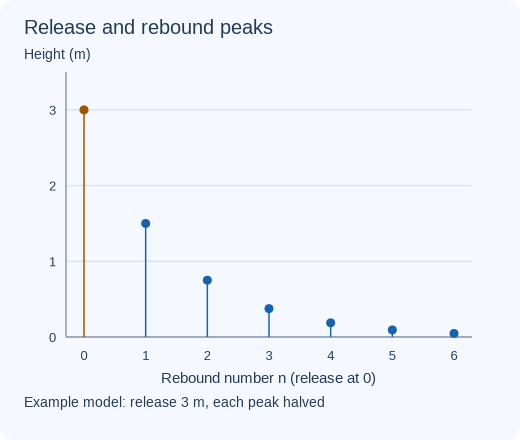
If a ball is released from height H and each rebound reaches a fraction r of the preceding height, with 0<r<1, the rebound peaks are Hr,Hr²,… . The initial fall happens once; each subsequent complete rise and fall happens twice.
Related progressions must satisfy both definitions
Write separate term or sum formulas for each proposed model, then connect only the quantities stated as equal. After solving, reconstruct all relevant terms, signs, indices and convergence conditions. A real algebraic root is not automatically a physically or contextually valid model.
Method
- Define the first term, indexing convention, units and time of valuation.
- Identify addition or multiplication and write the actual first few contributions.
- Use the appropriate finite sum or prove convergence before taking a limit.
- Verify timing, all linked equations and the requested rounding or integer constraint.
Common mistakes
- A year-one amount has exponent zero before its first increase.
- Start and end deposits earn different numbers of periods.
- Count an initial fall once, not twice.
- Do not accept a squared-equation root without checking the original model.
Worked examples
A fixed annual increase is arithmetic
A salary is £24,000 in year 1 and rises by £900 each year. Find the year-6 salary and total salary over six years.
Follow the solutionThe rule is a fixed addition. A percentage increase would require a multiplicative model instead.
Three start-of-year deposits have three different ages
£500 is deposited at the start of each of three years. Interest of 2% is added at each year end. Find the balance at the end of year 3, to the nearest penny.
Follow the solutionThe deposits earn interest for 3, 2 and 1 years respectively:
The final balance is £1560.80. The last deposit earns one period; it must not be counted as an uninvested £500 at this valuation date.
The initial fall is counted once
A ball is released from 3 m and each rebound reaches half the previous height. In the idealised infinite model, find the total vertical distance travelled.
Follow the solutionThe rebound peaks are , whose sum is 3.
The first fall contributes 3 m once; later rebound heights contribute a rise and a fall.
A changed last term creates a different model
Three consecutive AP terms are x,x+3,x+6. Replacing the last by x+9 gives a GP with nonzero terms. Find x and compare the first four-term sums of the two progressions.
Follow the solutionThe AP is 3,6,9,… and the GP is 3,6,12,… . Their first four-term sums are respectively 30 and 45. Restoring the terms checks both the ratio and the difference.