Worked example
Test a shared point
Is on both and ?
Use in the line: . This agrees with .
Use in the curve: . The same ordered pair satisfies both equations.
Use substitution to find matching coordinate pairs, intersections and contact points.
Try the quick check →Section 1 of 6 · Core · about 5 min
One ordered pair solves the system when the same two coordinates satisfy both equations.
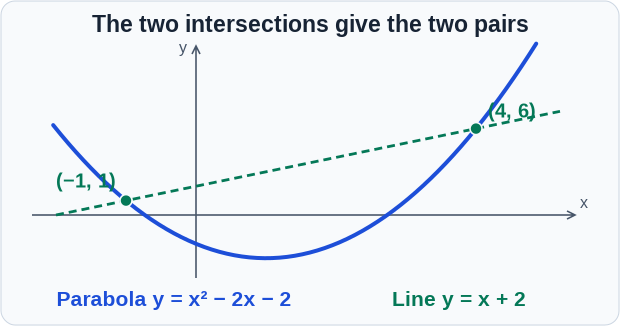
Worked example
Is on both and ?
Use in the line: . This agrees with .
Use in the curve: . The same ordered pair satisfies both equations.
Another common point is . The solutions are the two pairs and , not every possible combination of with . For example, is not on the line.
| Type | Examples | What to notice |
|---|---|---|
| Linear | , | The unknowns occur only to the first power, with constant coefficients. |
| Quadratic relation | , , | The highest total degree in the unknowns is two. In , the powers add to two. |
The quadratic equation does not have to be written as . It may contain , , or more than one of these terms. The same substitution idea still applies.
Section 2 of 6 · Core · about 8 min
Use the linear equation to replace one unknown. Solve the remaining equation and find the partner of each root.
Worked example
Solve and .
The linear equation already gives . At a common point, the two expressions for must agree.
Bring every term to one side. Keep the equation equal to zero before factorising.
Use two numbers with product −4 and sum −3.
Either factor can be zero. These are the first coordinates, so the solution is not finished yet.
| Root | Return to | Matching pair |
|---|---|---|
Check each pair in both original equations. For , the line gives and the curve gives . The check for was shown in the first section. Both pairs work.
Complete answer: .
Why is this valid? If the line says , every common point must use that value of . Putting into the curve tests which points on the line also lie on the curve. Substitution reduces two conditions in two unknowns to one equation in one unknown.
You do not have to make the subject. Look for a coefficient of 1 or −1 in the linear equation, or a rearrangement that avoids unnecessary fractions. Keep the final coordinate order as even if you solve for first.
Worked example
Solve and .
Try it on paper first.
This rearrangement has no denominator. Making the subject would also be valid, but would introduce a fraction.
Replace the whole factor in the product. The remaining equation involves only .
The roots are and .
Use the same linear relation for both roots.
The solutions are and . Both products are 10, and both values of are 9.
Section 3 of 6 · Core · about 7 min
Write the replacement in brackets before you expand a square or multiply terms.
| If | The replacement is | Reason |
|---|---|---|
| Square the whole value of . | ||
| Multiply by the whole replacement. | ||
| Replace both occurrences of . |
Worked example
Solve and .
Use the linear equation, then substitute into the circle equation. You do not need to rearrange the circle into square roots.
Expand as . Its middle term is .
Divide every term by 2 before factorising.
The matching points are and . These are distinct points even though the same two numbers occur.
Both pairs have sum 7 and square-sum 25. The line therefore crosses the circle at two points. A sketch helps interpret the answer; the algebra gives its exact coordinates.
Worked example
Solve and .
Try it on paper first.
Substitute into both and .
Expand before collecting terms. The first two quadratic terms cancel, but another remains.
The two roots are 2 and 3.
Return to . Each pair has sum 5 and satisfies .
Since , the two given equations imply , so . Substituting gives the same quadratic. Different sound algebraic routes must produce the same complete pairs.
If the line gives a constant directly, substitute it directly. For and , you get , so the points are and . Keep both signs. For and , there is just one point, ; this vertical line is not tangent to that parabola.
These examples show why you should inspect the equation that actually remains after substitution instead of assuming that every system has two different roots in .
Section 4 of 6 · Core · about 6 min
Keep each root with the coordinate it produces. Retain fractions and surds until the final answer.
Worked example
Solve and .
At an intersection, both expressions give the same value of for the same input .
Collect every term on one side before factorising.
Set each factor equal to zero. From , divide by 2 to obtain the fractional root.
Use the linear equation separately for each root.
Each coordinate pair is a complete solution. The order of the two solutions does not matter; the order of the coordinates within a pair does.
Check both equations: for , the line gives , while the curve gives . For , the two expressions give and .
Worked example
Solve and , giving exact answers.
Try it on paper first.
Replace the whole of by , keeping brackets around the expression being squared.
Expand the square, collect terms, then divide the equation by 2.
The discriminant is 17, so the quadratic formula gives two irrational roots.
Subtracting the chosen reverses its square-root sign. A plus sign in must go with a minus sign in .
This is the pair obtained from the larger value of .
This is the pair obtained from the smaller value of .
The symbols and describe linked choices: take the top sign in both expressions, or the bottom sign in both. Writing out the two pairs makes this explicit. Choosing both plus signs would give , so that combination is not a solution.
An exact check is possible without decimals. For either correct pair, and . Therefore .
Section 5 of 6 · Core · about 8 min
Use the discriminant of the equation after substitution, provided that equation is genuinely quadratic.
Suppose a valid substitution produces , with , and each resulting x-value determines one permitted y-value. The discriminant then counts the distinct real intersection points.
| Discriminant | Eliminated equation | Simultaneous solutions |
|---|---|---|
| Two distinct real roots | Two distinct coordinate pairs | |
| One repeated real root | One coordinate pair | |
| No real roots | No real coordinate pairs |
For a line and a non-degenerate circle or parabola in this quadratic situation, the repeated-root case represents tangency. Count the repeated root once: writing the same point twice does not create two intersections.
For the curve and the line , substitution gives . The lines for , and show the two-point, tangent and no-intersection cases.
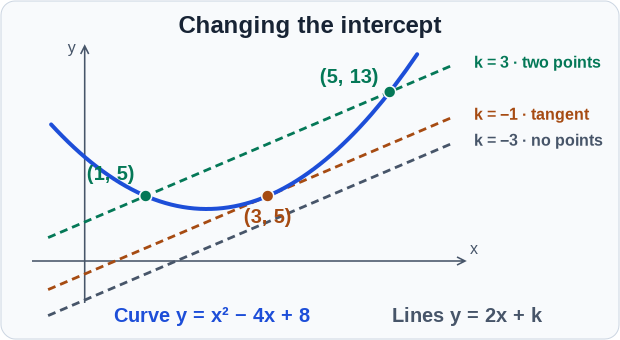
Worked example
The curve is . The line is . Find the values of giving two, one or no real intersections. Find the point of contact in the one-intersection case.
First combine the two equations. It is the discriminant of this new quadratic that counts their intersections.
Keep brackets around the parameter expression when subtracting .
A positive discriminant gives two distinct pairs.
A zero discriminant gives the tangent position of the line.
A negative discriminant means no point satisfies both real equations.
Substitute the parameter back, find the repeated root, then use the line . The point of contact is .
The curve also gives , confirming the contact point. Another way to see the threshold is : a positive right side gives two x-values, zero gives one, and a negative right side gives none.
Check that the eliminated equation is genuinely quadratic before using its discriminant. A vertical line can give a single point directly: and give , although the line is not tangent.
Parameters can also remove the squared term. Consider and .
Substitution gives a quadratic only when .
Handle the exceptional value separately. The horizontal line has one crossing with the hyperbola; this is not a tangent.
Now the discriminant test is valid. The repeated-root case occurs at .
This is the tangent case. Thus exactly one simultaneous solution occurs at or , but only the latter gives tangency.
Worked example
Find the tangent lines to that pass through . A non-vertical line through this point has equation .
Try it on paper first.
Form the intersection equation before imposing the tangent condition.
Both square roots must be considered. There are two tangent slopes, not one.
For the positive slope, the intersection equation is .
For the negative slope, it is . Both lines pass through the required fixed point.
The vertical line through has equation . It crosses the parabola at , where the tangent is horizontal.
The point lies on both and . Find the parameters and the other intersection.
Substitute the known coordinates into each original equation. A point on both graphs must satisfy both conditions.
Now use the determined equations. The known x-coordinate, 1, is one root.
This is the other intersection; do not report the given point as the new one.
A condition on the distance between the x-coordinates can determine a parameter too. In the earlier family , , the roots are . Their separation is . If that separation is 6, then , so ; the points are and .
For a general genuine quadratic, the separation of its two real roots is . This is a horizontal separation; it is not the straight-line distance between the two intersection points.
Section 6 of 6 · Further applications · about 7 min
Set up the original equations and domain before solving. Test each resulting pair against both conditions.
In a word problem, define each variable and its units before forming equations. Identify the linear relationship and the quadratic relationship separately. Write down physical restrictions such as positive lengths or non-negative times; these are part of the problem.
Restrictions can also be mathematical. A point may be required to lie in a stated quadrant or interval. A denominator in an original equation must remain nonzero, even if a later simplification hides it. Apply these conditions to each complete pair, not just to one coordinate.
Worked example
A rectangle has area 60 cm². Its length is 4 cm greater than its width. Find its dimensions.
Let be the width and the length, both in centimetres. Difference gives the linear equation; area gives the product equation.
Replace the length by its expression in terms of the width.
Find every algebraic candidate before applying the physical restriction.
Recover the corresponding length for each width. The negative pair satisfies the equations but cannot describe lengths.
Keep the positive dimensions and include units in the final answer.
Check the original statements: and . Rejecting the negative pair does not mean the quadratic was solved incorrectly. The model has a smaller permitted domain than the algebraic equations alone.
Suppose valid substitution gives a genuine quadratic , with . If its real roots are and , expanding and comparing coefficients gives
There are two distinct positive roots precisely when all three conditions hold:
The discriminant gives distinct real roots. A positive product makes them nonzero and of the same sign; the positive sum selects the positive sign. This criterion does not assume that is positive.
For example, consider and . Their x-coordinates satisfy .
Require two distinct intersections.
Require a positive sum and product as well.
Intersect the three conditions. At the left boundary the points coincide; at the right boundary one x-coordinate is zero.
These conditions concern the x-coordinates only. Recover the matching y-coordinates when requested and check any additional restrictions on them.
Question 1 of 4
0 / 4 checked in this collection
Find every intersection of and .
Progress stays in this browser. Create an account to save it or sign in.
Show your working on paper and compare it with the worked solution and marking guidance.
Your review plan starts after your first check.