Pure Mathematics 1 (9709) · Quadratics · Quick revision
Linear and quadratic simultaneous equations
Rearrange, substitute, solve, pair, check
- Make one variable the subject of the linear equation. Choose the simpler rearrangement.
- Replace every occurrence in the other equation. Square the entire bracket when needed.
- Solve the resulting equation exactly, keeping every candidate.
- Find the other coordinate for each candidate. Write ordered pairs .
- Check both equations and any domain or physical restrictions.
One intersection is one matching pair
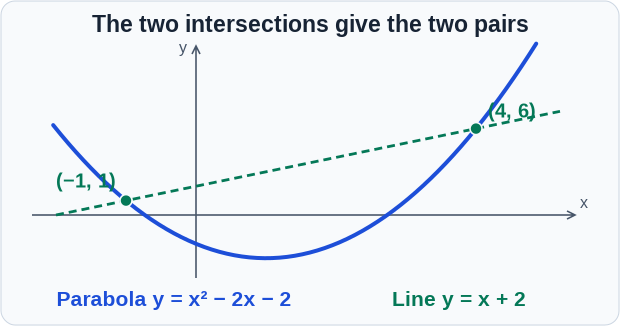
For and , equating the outputs gives . The pairs are and .
How many pairs?
If valid substitution gives a genuine quadratic and each root gives one permitted partner, use its discriminant. Two distinct roots give two pairs, a repeated root gives one pair and a negative discriminant gives none.
For a non-vertical line and parabola, the repeated-root case shows tangency. A single solution can also come from a linear equation or a vertical line. Check the equation after substitution.