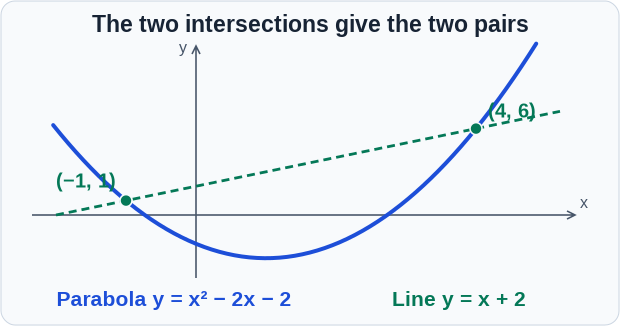
One ordered pair solves the system when the same two coordinates satisfy both equations.
Algebra and graphs describe the same condition.
A point on a graph satisfies its equation. A point where two graphs meet satisfies both equations, so its coordinates solve the system.
Another common point is (4,6). The solutions are the two pairs (−1,1) and (4,6), not every possible combination of x=−1,4 with y=1,6. For example, (−1,6) is not on the line.
Recognise the equations
Type
Examples
What to notice
Linear
2x+y=7, x=3
The unknowns occur only to the first power, with constant coefficients.
Quadratic relation
y=x2+2x, x2+y2=25, xy=6
The highest total degree in the unknowns is two. In xy, the powers add to two.
The quadratic equation does not have to be written as y=f(x). It may contain y2, xy, or more than one of these terms. The same substitution idea still applies.
Before you start
Rearrange a linear equation:x+2y=9⇒x=9−2y.
Expand a whole bracket:(3−y)2=9−6y+y2. The middle term matters.
Solve a quadratic completely: use factorisation, completing the square, or t=2A−B±B2−4AC for At2+Bt+C=0, where A=0.
How do I solve by substitution?
Use the linear equation to replace one unknown. Solve the remaining equation and find the partner of each root.
Rearrange → substitute → solve → pair → check.
Use the linear equation to express one unknown in terms of the other. Replace it everywhere in the second equation, solve the resulting equation, and recover its matching coordinate for every root.
Why is this valid? If the line says y=x+2, every common point must use that value of y. Putting x+2 into the curve tests which points on the line also lie on the curve. Substitution reduces two conditions in two unknowns to one equation in one unknown.
Choose the easier unknown to replace
You do not have to make y the subject. Look for a coefficient of 1 or −1 in the linear equation, or a rearrangement that avoids unnecessary fractions. Keep the final coordinate order as (x,y) even if you solve for y first.
Keep zero roots. From x(x−4)=0, write x=0 or x=4. Dividing by x would discard a possible solution. Factor first, then check every candidate in the original system.
How do I substitute in squares and products?
Write the replacement in brackets before you expand a square or multiply terms.
If y=5−x
The replacement is
Reason
y2
(5−x)2
Square the whole value of y.
xy
x(5−x)
Multiply x by the whole replacement.
x2+xy+y2
x2+x(5−x)+(5−x)2
Replace both occurrences of y.
A square of a sum is different from a sum of squares.(x+y)2=x2+2xy+y2. From x+y=7 you can conclude (x+y)2=49, but you cannot conclude x2+y2=49.
Horizontal and vertical lines
If the line gives a constant directly, substitute it directly. For x=2 and x2+y2=13, you get y2=9, so the points are (2,3) and (2,−3). Keep both signs. For x=2 and y=x2+1, there is just one point, (2,5); this vertical line is not tangent to that parabola.
These examples show why you should inspect the equation that actually remains after substitution instead of assuming that every system has two different roots in x.
How do I keep fractions and surd pairs exact?
Keep each root with the coordinate it produces. Retain fractions and surds until the final answer.
A simultaneous solution is a pair of values that satisfies both original equations. Finding the possible values of one variable is an intermediate step. Substitute each one back to find its own partner, then write the results as ordered pairs.
Keep fractions and square roots exact throughout the working. An early decimal approximation changes the value being substituted and can make a valid pair appear to fail a check. If the question requests a decimal answer, round the final coordinates to the stated accuracy.
Two x-values and two y-values do not give four solutions. Each root determines its partner through the original equation. Never mix the first x-value with whichever y-value is convenient.
When are there two, one or no intersections?
Use the discriminant of the equation after substitution, provided that equation is genuinely quadratic.
Suppose a valid substitution produces Ax2+Bx+C=0, with A=0, and each resulting x-value determines one permitted y-value. The discriminant D=B2−4AC then counts the distinct real intersection points.
Discriminant
Eliminated equation
Simultaneous solutions
D>0
Two distinct real roots
Two distinct coordinate pairs
D=0
One repeated real root
One coordinate pair
D<0
No real roots
No real coordinate pairs
For a line and a non-degenerate circle or parabola in this quadratic situation, the repeated-root case represents tangency. Count the repeated root once: writing the same point twice does not create two intersections.
How the intercept changes the solution pairs
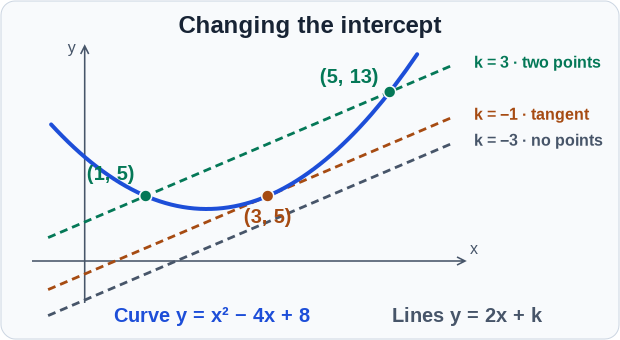
For the curve y=x2−4x+8 and the line y=2x+k, substitution gives (x−3)2=k+1. The lines for k=3, k=−1 and k=−3 show the two-point, tangent and no-intersection cases.
Use the discriminant after substitution. The discriminant of x2−4x+8=0 concerns the curve's intersections with the x-axis. It does not count intersections with an arbitrary line.
Important exception: one intersection need not mean tangency
Check that the eliminated equation is genuinely quadratic before using its discriminant. A vertical line can give a single point directly: x=2 and y=x2 give (2,4), although the line is not tangent.
Parameters can also remove the squared term. Consider xy=4 and y=mx+1.
mx2+x−4=0
Substitution gives a quadratic only when m=0.
m=0:x−4=0⇒(x,y)=(4,1)
Handle the exceptional value separately. The horizontal line has one crossing with the hyperbola; this is not a tangent.
m=0:D=1+16m
Now the discriminant test is valid. The repeated-root case occurs at m=−161.
m=−161⇒(x−8)2=0⇒(x,y)=(8,21)
This is the tangent case. Thus exactly one simultaneous solution occurs at m=0 or m=−161, but only the latter gives tangency.
A known point or separation between intersections
The point (1,6) lies on both y=x2+ax+4 and y=bx+2. Find the parameters and the other intersection.
6=1+a+4⇒a=16=b+2⇒b=4
Substitute the known coordinates into each original equation. A point on both graphs must satisfy both conditions.
x2+x+4=4x+2⇒(x−1)(x−2)=0
Now use the determined equations. The known x-coordinate, 1, is one root.
x=2⇒y=10⇒(2,10)
This is the other intersection; do not report the given point as the new one.
A condition on the distance between the x-coordinates can determine a parameter too. In the earlier family y=x2−4x+8, y=2x+k, the roots are 3±k+1. Their separation is 2k+1. If that separation is 6, then k+1=9, so k=8; the points are (0,8) and (6,20).
For a general genuine quadratic, the separation of its two real roots is ∣A∣D. This is a horizontal separation; it is not the straight-line distance between the two intersection points.
Which pairs are valid in the original problem?
Set up the original equations and domain before solving. Test each resulting pair against both conditions.
In a word problem, define each variable and its units before forming equations. Identify the linear relationship and the quadratic relationship separately. Write down physical restrictions such as positive lengths or non-negative times; these are part of the problem.
Restrictions can also be mathematical. A point may be required to lie in a stated quadrant or interval. A denominator in an original equation must remain nonzero, even if a later simplification hides it. Apply these conditions to each complete pair, not just to one coordinate.
If a question asks for an intersection point, give both coordinates. If it asks for a tangent parameter and the point of contact, provide both results. If there are no real solutions, state that clearly instead of leaving the answer blank.
Both intersection x-coordinates positive
Suppose valid substitution gives a genuine quadratic Ax2+Bx+C=0, with A=0. If its real roots are r and s, expanding A(x−r)(x−s) and comparing coefficients gives
r+s=−AB,rs=AC.
There are two distinct positive roots precisely when all three conditions hold:
D>0,−AB>0,AC>0.
The discriminant gives distinct real roots. A positive product makes them nonzero and of the same sign; the positive sum selects the positive sign. This criterion does not assume that A is positive.
For example, consider y=x+c and x2+y2=8. Their x-coordinates satisfy 2x2+2cx+c2−8=0.
D=64−4c2>0⇒−4<c<4
Require two distinct intersections.
r+s=−c>0,rs=2c2−8>0
Require a positive sum and product as well.
−4<c<−22
Intersect the three conditions. At the left boundary the points coincide; at the right boundary one x-coordinate is zero.
These conditions concern the x-coordinates only. Recover the matching y-coordinates when requested and check any additional restrictions on them.
Before you move on
Set up: identify the two equations and any original restrictions.
Substitute: isolate a convenient variable, replace every occurrence and keep brackets.
Solve: simplify to one equation and find all real candidates, keeping exact values.
Pair: find the matching value of the other variable for each candidate.
Check and report: test both original equations and the domain; give full coordinate pairs or the requested quantities with units.
Worked examples
A line and a parabola
Solve y=x+2 and y=x2−2x−2.
Follow the solution
x+2=x2−2x−2
The linear equation already gives y. At a common point, the two expressions for y must agree.
x2−3x−4=0
Bring every term to one side. Keep the equation equal to zero before factorising.
(x−4)(x+1)=0
Use two numbers with product −4 and sum −3.
x=4orx=−1
Either factor can be zero. These are the first coordinates, so the solution is not finished yet.
Root
Return to y=x+2
Matching pair
x=−1
y=−1+2=1
(−1,1)
x=4
y=4+2=6
(4,6)
Check each pair in both original equations. For (4,6), the line gives 6=4+2 and the curve gives 6=16−8−2. The check for (−1,1) was shown in the first section. Both pairs work.
Complete answer:(x,y)=(−1,1)or(4,6).
Solve for y first
Solve x+2y=9 and xy=10.
Follow the solution
x=9−2y
This rearrangement has no denominator. Making y the subject would also be valid, but would introduce a fraction.
(9−2y)y=10⇒2y2−9y+10=0
Replace the whole factor x in the product. The remaining equation involves only y.
(2y−5)(y−2)=0
The roots are y=25 and y=2.
y=25⇒x=4y=2⇒x=5
Use the same linear relation for both roots.
The solutions are (4,25) and (5,2). Both products are 10, and both values of x+2y are 9.
A line and a circle
Solve x+y=7 and x2+y2=25.
Follow the solution
y=7−xx2+(7−x)2=25
Use the linear equation, then substitute into the circle equation. You do not need to rearrange the circle into square roots.
x2+49−14x+x2=25
Expand (7−x)2 as (7−x)(7−x). Its middle term is −14x.
2x2−14x+24=0⇒(x−3)(x−4)=0
Divide every term by 2 before factorising.
x=3⇒y=4x=4⇒y=3
The matching points are (3,4) and (4,3). These are distinct points even though the same two numbers occur.
Both pairs have sum 7 and square-sum 25. The line therefore crosses the circle at two points. A sketch helps interpret the answer; the algebra gives its exact coordinates.
A mixed quadratic relation
Solve x+y=5 and x2+xy+y2=19.
Follow the solution
x2+x(5−x)+(5−x)2=19
Substitute y=5−x into both xy and y2.
x2+(5x−x2)+(25−10x+x2)=19
Expand before collecting terms. The first two quadratic terms cancel, but another remains.
x2−5x+6=0⇒(x−2)(x−3)=0
The two roots are 2 and 3.
(x,y)=(2,3)or(3,2)
Return to y=5−x. Each pair has sum 5 and satisfies x2+xy+y2=4+6+9=19.
A useful second way to see the structure
Since (x+y)2=x2+2xy+y2, the two given equations imply 25=19+xy, so xy=6. Substituting y=5−x gives the same quadratic. Different sound algebraic routes must produce the same complete pairs.
A fractional coordinate
Solve y=2x+1 and y=2x2+7x−2.
Follow the solution
2x+1=2x2+7x−2
At an intersection, both expressions give the same value of y for the same input x.
2x2+5x−3=0
Collect every term on one side before factorising.
(2x−1)(x+3)=0⇒x=21orx=−3
Set each factor equal to zero. From 2x−1=0, divide by 2 to obtain the fractional root.
x=21⇒y=2x=−3⇒y=−5
Use the linear equation separately for each root.
(x,y)=(21,2)or(−3,−5)
Each coordinate pair is a complete solution. The order of the two solutions does not matter; the order of the coordinates within a pair does.
Check both equations: for (21,2), the line gives 2(21)+1=2, while the curve gives 2(21)2+7(21)−2=2. For (−3,−5), the two expressions give −6+1=−5 and 18−21−2=−5.
The signs in a surd pair are linked
Solve x+y=3 and x2+y2=13, giving exact answers.
Follow the solution
y=3−xx2+(3−x)2=13
Replace the whole of y by 3−x, keeping brackets around the expression being squared.
2x2−6x−4=0⇒x2−3x−2=0
Expand the square, collect terms, then divide the equation by 2.
x=23±17
The discriminant is 17, so the quadratic formula gives two irrational roots.
y=3−23±17=23∓17
Subtracting the chosen x reverses its square-root sign. A plus sign in x must go with a minus sign in y.
(23+17,23−17)
This is the pair obtained from the larger value of x.
(23−17,23+17)
This is the pair obtained from the smaller value of x.
The symbols ± and ∓ describe linked choices: take the top sign in both expressions, or the bottom sign in both. Writing out the two pairs makes this explicit. Choosing both plus signs would give x+y=3+17, so that combination is not a solution.
An exact check is possible without decimals. For either correct pair, x+y=3 and xy=49−17=−2. Therefore x2+y2=(x+y)2−2xy=9+4=13.
Find a parameter for tangency
The curve is y=x2−4x+8. The line is y=2x+k. Find the values of k giving two, one or no real intersections. Find the point of contact in the one-intersection case.
Follow the solution
x2−4x+8=2x+k⇒x2−6x+8−k=0
First combine the two equations. It is the discriminant of this new quadratic that counts their intersections.
D=(−6)2−4(1)(8−k)=4(k+1)
Keep brackets around the parameter expression when subtracting 4AC.
k>−1:two intersections
A positive discriminant gives two distinct pairs.
k=−1:one intersection
A zero discriminant gives the tangent position of the line.
k<−1:no real intersections
A negative discriminant means no point satisfies both real equations.
k=−1⇒(x−3)2=0⇒x=3,y=5
Substitute the parameter back, find the repeated root, then use the line y=2x−1. The point of contact is (3,5).
The curve also gives 32−4(3)+8=5, confirming the contact point. Another way to see the threshold is (x−3)2=k+1: a positive right side gives two x-values, zero gives one, and a negative right side gives none.
Two tangents through one fixed point
Find the tangent lines to y=x2+1 that pass through (0,−3). A non-vertical line through this point has equation y=mx−3.
Follow the solution
x2+1=mx−3⇒x2−mx+4=0
Form the intersection equation before imposing the tangent condition.
D=m2−16=0⇒m=4orm=−4
Both square roots must be considered. There are two tangent slopes, not one.
y=4x−3:(x,y)=(2,5)
For the positive slope, the intersection equation is (x−2)2=0.
y=−4x−3:(x,y)=(−2,5)
For the negative slope, it is (x+2)2=0. Both lines pass through the required fixed point.
The vertical line through (0,−3) has equation x=0. It crosses the parabola at (0,1), where the tangent is horizontal.
Dimensions of a rectangle
A rectangle has area 60 cm². Its length is 4 cm greater than its width. Find its dimensions.
Follow the solution
l=w+4,wl=60w>0,l>0
Let w be the width and l the length, both in centimetres. Difference gives the linear equation; area gives the product equation.
w(w+4)=60⇒w2+4w−60=0
Replace the length by its expression in terms of the width.
(w+10)(w−6)=0⇒w=−10orw=6
Find every algebraic candidate before applying the physical restriction.
(w,l)=(−10,−6)or(6,10)
Recover the corresponding length for each width. The negative pair satisfies the equations but cannot describe lengths.
Width=6 cmLength=10 cm
Keep the positive dimensions and include units in the final answer.
Check the original statements: 10−6=4 and 6×10=60. Rejecting the negative pair does not mean the quadratic was solved incorrectly. The model has a smaller permitted domain than the algebraic equations alone.
Test a shared point
Is (−1,1) on both y=x+2 and y=x2−2x−2?
Follow the solution
Use x=−1 in the line: −1+2=1. This agrees with y=1.
Use x=−1 in the curve: 1+2−2=1. The same ordered pair satisfies both equations.
Practise the method
Quick check
Question 1 of 1
0 / 1 checked in this collection
Question list
Quick check
Core practice
Fresh variants
Exam-style
Mixed practice
Match every coordinate pair
2 marks
Which are all the solution pairs of y=x−3 and y=x2−9? Choose one answer and justify it in one or two lines.
The checker checks final answers only. Compare your explanation, sketch and method with the worked solution; method marks need review.
Show your working on paper and compare it with the worked solution and marking guidance.
Come back to what needs practice
Your review plan starts after your first check.
About these materials and your existing work
Questions come from the independently authored Maths4U Quadratics collection. No Cambridge examination questions or graphics are included in this lesson.