Worked example
Find the signed momentum of one particle
A particle has mass and moves to the left at .
Take rightward as positive.
Give its signed momentum in .
The mass is already in kilograms and the signed velocity is .
Apply . The result is .
Use one positive direction, calculate the momentum of each particle and combine signed contributions on a straight line.
Try the quick check →Section 1 of 6 · Core · about 6 min
Momentum is a vector. Along one line, a sign can record its direction once an axis has been chosen.
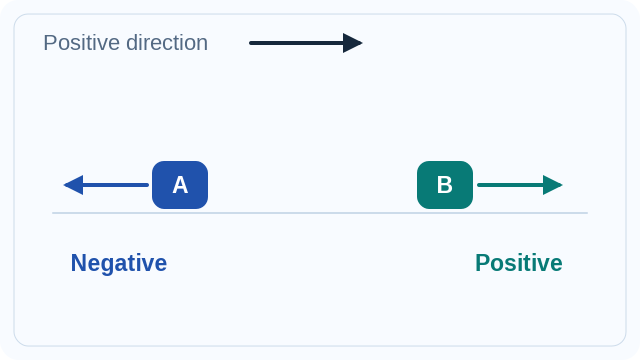
Pick a positive arrow first. Each momentum then has the sign of its velocity.
Worked example
A particle has mass and moves to the left at .
Take rightward as positive.
Give its signed momentum in .
The mass is already in kilograms and the signed velocity is .
Apply . The result is .
Worked example
A particle has mass and is at rest.
Take rightward as positive.
Give its signed momentum in .
Try it on paper first.
The mass is already in kilograms and the signed velocity is .
Apply . The result is .
Section 2 of 6 · Core · about 6 min
Convert grams to kilograms before using an SI velocity. Show the conversion next to the value.
Worked example
A particle has mass and moves to the left at .
Take rightward as positive.
Give its signed momentum in .
Convert to before multiplying.
Apply . The result is .
Section 3 of 6 · Core · about 7 min
Use the known signed momentum with the appropriate rearrangement. If the particle is moving, a mass found from signed quantities must be positive.
Worked example
Take rightward as positive.
A particle moves to the left at and its signed momentum is . Find its mass in kilograms.
Use the signed velocity . Its sign is the same as the given momentum.
, which is positive.
Section 4 of 6 · Core · about 7 min
Find the momentum of each particle independently. Then add the two signed values.
| Quantity | Signed interpretation |
|---|---|
| Positive | Along the positive axis. |
| Zero | No total along the axis. |
| Negative | Opposite to the positive axis. |
Worked example
Particles A and B have masses and . A moves to the right at . B moves to the left at .
Use rightward as positive. Give the total signed momentum in .
With rightward positive, the two momentum components are and .
Add the signed values to get .
Section 5 of 6 · Core · about 7 min
Two signed contributions can cancel, even while both particles are moving. An individual momentum need not be zero.
Worked example
Particles A and B have masses and . A moves to the right at . The two particles have zero total momentum.
Take rightward as positive.
Give the signed velocity of B in .
A contributes . B must contribute the opposite component.
. The particle moves to the left at .
Section 6 of 6 · Extension · about 5 min
The physical direction stays fixed. Reversing the positive axis changes the sign of every component at the same time.
Worked example
Particles A and B have masses and . A moves to the left at . B moves to the right at .
Use leftward as positive. Give the total signed momentum in .
With leftward positive, the two momentum components are and .
Add the signed values to get .
Question 1 of 4
0 / 4 checked in this collection
A particle has mass and moves to the left at .
Take rightward as positive.
Give its signed momentum in .
Progress stays in this browser. Create an account to save it or sign in.
Show your working on paper and compare it with the worked solution and marking guidance.
Your review plan starts after your first check.