Maths4UBETA

Approach, separation and compatible collision data

Read the order of particles, translate speed conditions into signed equations and test whether a collision report respects momentum and separation.

Try the quick check →
Lesson 4 of 5

Section 1 of 6 · Core · about 7 min

How do I know which particles can meet?

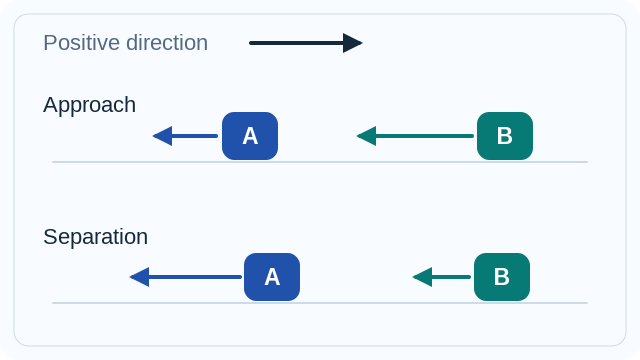
With A to the left of B, the rate at which the positive gap closes is the velocity of A minus that of B.

The first row shows a left and right particle with the left signed velocity greater. The second row shows the order after impact with the right signed velocity greater.

Compare signed velocities in position order. The left particle need not be moving right.

Worked example

Calculate the rate at which the gap closes

At one instant A is 3 m3\,\mathrm m to the left of B. A moves to the right at 2 m s−12\,\mathrm{m\,s^{-1}}. B moves to the right at 1 m s−11\,\mathrm{m\,s^{-1}}.

Take rightward as positive.

Give the signed closing rate, defined as vA−vBv_A-v_B, in m s−1\mathrm{m\,s^{-1}}. Decide what the gap then does if velocities are constant.

  1. Subtract the right-hand velocity from the left-hand velocity: (2)−(1)=1(2)-(1)=1.

  2. The two particles approach.

Worked example

Calculate the rate at which the gap closes

At one instant A is 4 m4\,\mathrm m to the left of B. A moves to the left at 2 m s−12\,\mathrm{m\,s^{-1}}. B moves to the left at 5 m s−15\,\mathrm{m\,s^{-1}}.

Take rightward as positive.

Give the signed closing rate, defined as vA−vBv_A-v_B, in m s−1\mathrm{m\,s^{-1}}. Decide what the gap then does if velocities are constant.

Try it on paper first.

  1. Subtract the right-hand velocity from the left-hand velocity: (−2)−(−5)=3(-2)-(-5)=3.

  2. The two particles approach.

Your turn

At one instant A is 5 m5\,\mathrm m to the left of B. A moves to the left at 4 m s−14\,\mathrm{m\,s^{-1}}. B moves to the left at 7 m s−17\,\mathrm{m\,s^{-1}}.

Take rightward as positive.

Give the signed closing rate, defined as vA−vBv_A-v_B, in m s−1\mathrm{m\,s^{-1}}. Decide what the gap then does if velocities are constant.

Enter an exact number, for example 3/2 or 2-sqrt(3).

What happens to the gap

Section 2 of 6 · Core · about 7 min

Can I turn the closing rate into a contact time?

At constant velocities, each second closes the same amount of gap. If the gap starts positive, a later contact needs a positive closing rate.

Worked example

Test whether the gap closes

A is 14 m14\,\mathrm m to the left of B. A moves to the right at 3 m s−13\,\mathrm{m\,s^{-1}} and B moves to the left at 5 m s−15\,\mathrm{m\,s^{-1}} at constant velocities.

Take rightward as positive.

Decide whether they meet. If they meet, give the time to contact in seconds.

  1. The signed rate at which the gap closes is 8 m s−18\,\mathrm{m\,s^{-1}}. The left particle must have a greater signed velocity to make contact.

  2. Divide the starting gap 14 m14\,\mathrm m by the positive closing rate to obtain 74 s\frac{7}{4}\,\mathrm s.

Your turn

A is 8 m8\,\mathrm m to the left of B. A moves to the right at 7 m s−17\,\mathrm{m\,s^{-1}} and B moves to the right at 4 m s−14\,\mathrm{m\,s^{-1}} at constant velocities.

Take rightward as positive.

Decide whether they meet. If they meet, give the time to contact in seconds.

Do they make contact?

Enter an exact value or round to 3 significant figures.

Section 3 of 6 · Core · about 7 min

What changes after a separating collision?

Immediately after a separating direct collision, the right particle moves away faster along the signed axis than the left particle.

StageTest for A left of B
ApproachuA>uBu_A>u_B
SeparationvA<vBv_A<v_B
Common speedvA=vBv_A=v_B

Worked example

Compare a collision report with two requirements

Two particles move on the same smooth horizontal line. A is to the left of B immediately before impact. Take rightward as positive.

A and B have masses 3 kg3\,\mathrm{kg} and 3 kg3\,\mathrm{kg}. Before impact, A moves to the right at 6 m s−16\,\mathrm{m\,s^{-1}}. B is at rest.

A report describes the immediate state afterwards as follows. A moves to the right at 4 m s−14\,\mathrm{m\,s^{-1}}. B moves to the right at 2 m s−12\,\mathrm{m\,s^{-1}}.

Which tests pass: matching total momentum, and an immediate opening of the gap?

  1. Before and proposed after totals are 18 kg m s−118\,\mathrm{kg\,m\,s^{-1}} and 18 kg m s−118\,\mathrm{kg\,m\,s^{-1}}. They match.

  2. The proposed gap-opening rate is −2 m s−1-2\,\mathrm{m\,s^{-1}}. It is not positive.

  3. Momentum remains the same only.

Your turn

Two particles move on the same smooth horizontal line. A is to the left of B immediately before impact. Take rightward as positive.

A and B have masses 4 kg4\,\mathrm{kg} and 4 kg4\,\mathrm{kg}. Before impact, A moves to the right at 7 m s−17\,\mathrm{m\,s^{-1}}. B moves to the left at 1 m s−11\,\mathrm{m\,s^{-1}}.

A report describes the immediate state afterwards as follows. A moves to the right at 1 m s−11\,\mathrm{m\,s^{-1}}. B moves to the right at 5 m s−15\,\mathrm{m\,s^{-1}}.

Which tests pass: matching total momentum, and an immediate opening of the gap?

Tests passed

Section 4 of 6 · Core · about 6 min

What can be wrong with recorded data?

A pair of proposed velocities can pass one check and fail the other. Compute the momentum totals and the signed gap-opening rate separately.

Worked example

Compare a collision report with two requirements

Two particles move on the same smooth horizontal line. A is to the left of B immediately before impact. Take rightward as positive.

A and B have masses 3 kg3\,\mathrm{kg} and 3 kg3\,\mathrm{kg}. Before impact, A moves to the right at 4 m s−14\,\mathrm{m\,s^{-1}}. B is at rest.

A report describes the immediate state afterwards as follows. A moves to the left at 1 m s−11\,\mathrm{m\,s^{-1}}. B moves to the right at 2 m s−12\,\mathrm{m\,s^{-1}}.

Which tests pass: matching total momentum, and an immediate opening of the gap?

  1. Before and proposed after totals are 12 kg m s−112\,\mathrm{kg\,m\,s^{-1}} and 3 kg m s−13\,\mathrm{kg\,m\,s^{-1}}. They differ.

  2. The proposed gap-opening rate is 3 m s−13\,\mathrm{m\,s^{-1}}. It is positive.

  3. The gap opens only.

Your turn

Two particles move on the same smooth horizontal line. A is to the left of B immediately before impact. Take rightward as positive.

A and B have masses 5 kg5\,\mathrm{kg} and 5 kg5\,\mathrm{kg}. Before impact, A moves to the right at 4 m s−14\,\mathrm{m\,s^{-1}}. B moves to the left at 2 m s−12\,\mathrm{m\,s^{-1}}.

A report describes the immediate state afterwards as follows. A is at rest. B moves to the right at 2 m s−12\,\mathrm{m\,s^{-1}}.

Which tests pass: matching total momentum, and an immediate opening of the gap?

Tests passed

Section 5 of 6 · Core · about 7 min

How do I use a direction-dependent speed condition?

Use the stated directions first. A negative signed velocity represents a positive speed equal to its magnitude.

Worked example

Use a second condition for two velocities

Two particles move on the same smooth horizontal line. A is to the left of B immediately before impact. Take rightward as positive.

A has mass 2 kg2\,\mathrm{kg} and B has mass 5 kg5\,\mathrm{kg}. Before impact, A moves to the right at 5 m s−15\,\mathrm{m\,s^{-1}} and B is at rest. After impact A moves left and B moves right. B's speed is 95\frac{9}{5} times A's speed.

Give both signed velocities immediately after impact in m s−1\mathrm{m\,s^{-1}}.

  1. Momentum alone gives 2vA+5vB=102v_A+5v_B=10.

  2. For vA<0<vBv_A<0<v_B, their ratio of non-negative speeds gives vB=−95vAv_B=-\frac{9}{5}v_A.

  3. Solving the two conditions gives vA=−107v_A=- \frac{10}{7} and vB=187v_B=\frac{18}{7}, in metres per second.

  4. The right-hand particle has the greater signed final velocity. The gap opens.

Your turn

Two particles move on the same smooth horizontal line. A is to the left of B immediately before impact. Take rightward as positive.

A has mass 2 kg2\,\mathrm{kg} and B has mass 3 kg3\,\mathrm{kg}. Before impact, A moves to the right at 4 m s−14\,\mathrm{m\,s^{-1}} and B moves to the left at 2 m s−12\,\mathrm{m\,s^{-1}}. After impact A moves left and B moves right. B's speed is 87\frac{8}{7} times A's speed.

Give both signed velocities immediately after impact in m s−1\mathrm{m\,s^{-1}}.

Enter an exact value or round to 3 significant figures.

Enter an exact value or round to 3 significant figures.

Section 6 of 6 · Extension · about 6 min

What can I deduce with only a separation condition?

With one momentum equation and an ordering inequality, the exact values may still be unknown. State what the two conditions imply.

Worked example

Find the interval allowed by separation

Two particles move on the same smooth horizontal line. A is to the left of B immediately before impact. Take rightward as positive.

A has mass 2 kg2\,\mathrm{kg} and B has mass 4 kg4\,\mathrm{kg}. Before impact, A moves to the right at 6 m s−16\,\mathrm{m\,s^{-1}} and B is at rest.

The post-collision signed velocity of A is vv. Use only momentum conservation and the fact that the gap opens immediately. Give the resulting inequality in vv.

  1. Conservation gives vB=12−(2)v4v_B=\frac{12-(2)v}{4}.

  2. The gap opens when vB>vv_B>v, so 12−(2)v>4v12-(2)v>4v.

  3. This gives v<2v<2. Equality would give no immediate gap increase.

Your turn

Two particles move on the same smooth horizontal line. A is to the left of B immediately before impact. Take rightward as positive.

A has mass 5 kg5\,\mathrm{kg} and B has mass 3 kg3\,\mathrm{kg}. Before impact, A moves to the right at 5 m s−15\,\mathrm{m\,s^{-1}} and B moves to the left at 3 m s−13\,\mathrm{m\,s^{-1}}.

The post-collision signed velocity of A is vv. Use only momentum conservation and the fact that the gap opens immediately. Give the resulting inequality in vv.

Use inequalities in v or interval notation. Join intervals with ‘or’ or ∪. Enter an isolated value on its own.

Worked examples

Practise the method

Core practice

Question 1 of 4

0 / 4 checked in this collection

Question list

Core practice

Fresh variants

Exam-style

Calculate the rate at which the gap closes

2 marks

At one instant A is 7 m7\,\mathrm m to the left of B. A moves to the left at 1 m s−11\,\mathrm{m\,s^{-1}}. B moves to the left at 5 m s−15\,\mathrm{m\,s^{-1}}.

Take rightward as positive.

Give the signed closing rate, defined as vA−vBv_A-v_B, in m s−1\mathrm{m\,s^{-1}}. Decide what the gap then does if velocities are constant.

Enter an exact number, for example 3/2 or 2-sqrt(3).

What happens to the gap

Choose one option. Explain your reasoning on paper.

Full answer-format guide

Exact numbers: 3/2, sqrt(5), 2-sqrt(3), pi/6, 3*pi/2. Sets: {1,4}. Intervals: (3,5]; a round bracket excludes the endpoint. Infinity: inf; union: U; no solutions: empty. Separate coordinate pairs or triples with semicolons. Expressions: 2x^2+3x-1; equations: x^2=3x+1 or the polynomial equal to zero. Factors: x-1 ; x+2. Parameter fraction: numerator ; denominator. List integer answers individually.

Review the method

Progress stays in this browser. Create an account to save it or sign in.

Extra practice from this lesson

Calculate the rate at which the gap closes

At one instant A is 3 m3\,\mathrm m to the left of B. A moves to the left at 3 m s−13\,\mathrm{m\,s^{-1}}. B moves to the left at 6 m s−16\,\mathrm{m\,s^{-1}}.

Take rightward as positive.

Give the signed closing rate, defined as vA−vBv_A-v_B, in m s−1\mathrm{m\,s^{-1}}. Decide what the gap then does if velocities are constant.

Enter an exact number, for example 3/2 or 2-sqrt(3).

What happens to the gap

Test whether the gap closes

A is 9 m9\,\mathrm m to the left of B. A moves to the left at 2 m s−12\,\mathrm{m\,s^{-1}} and B moves to the left at 5 m s−15\,\mathrm{m\,s^{-1}} at constant velocities.

Take rightward as positive.

Decide whether they meet. If they meet, give the time to contact in seconds.

Do they make contact?

Enter an exact number, for example 3/2 or 2-sqrt(3).

Compare a collision report with two requirements

Two particles move on the same smooth horizontal line. A is to the left of B immediately before impact. Take rightward as positive.

A and B have masses 2 kg2\,\mathrm{kg} and 2 kg2\,\mathrm{kg}. Before impact, A moves to the right at 6 m s−16\,\mathrm{m\,s^{-1}}. B is at rest.

A report describes the immediate state afterwards as follows. A moves to the right at 4 m s−14\,\mathrm{m\,s^{-1}}. B moves to the right at 2 m s−12\,\mathrm{m\,s^{-1}}.

Which tests pass: matching total momentum, and an immediate opening of the gap?

Tests passed

Compare a collision report with two requirements

Two particles move on the same smooth horizontal line. A is to the left of B immediately before impact. Take rightward as positive.

A and B have masses 4 kg4\,\mathrm{kg} and 4 kg4\,\mathrm{kg}. Before impact, A moves to the right at 9 m s−19\,\mathrm{m\,s^{-1}}. B moves to the left at 3 m s−13\,\mathrm{m\,s^{-1}}.

A report describes the immediate state afterwards as follows. A is at rest. B moves to the right at 5 m s−15\,\mathrm{m\,s^{-1}}.

Which tests pass: matching total momentum, and an immediate opening of the gap?

Tests passed

Use a second condition for two velocities

Two particles move on the same smooth horizontal line. A is to the left of B immediately before impact. Take rightward as positive.

A has mass 2 kg2\,\mathrm{kg} and B has mass 5 kg5\,\mathrm{kg}. Before impact, A moves to the right at 6 m s−16\,\mathrm{m\,s^{-1}} and B moves to the left at 1 m s−11\,\mathrm{m\,s^{-1}}. After impact A moves left and B moves right. B's speed is 1513\frac{15}{13} times A's speed.

Give both signed velocities immediately after impact in m s−1\mathrm{m\,s^{-1}}.

Enter an exact value or round to 3 significant figures.

Enter an exact value or round to 3 significant figures.

Find the interval allowed by separation

Two particles move on the same smooth horizontal line. A is to the left of B immediately before impact. Take rightward as positive.

A has mass 4 kg4\,\mathrm{kg} and B has mass 6 kg6\,\mathrm{kg}. Before impact, A moves to the right at 7 m s−17\,\mathrm{m\,s^{-1}} and B moves to the left at 3 m s−13\,\mathrm{m\,s^{-1}}.

The post-collision signed velocity of A is vv. Use only momentum conservation and the fact that the gap opens immediately. Give the resulting inequality in vv.

Use inequalities in v or interval notation. Join intervals with ‘or’ or ∪. Enter an isolated value on its own.

Apply it · original exam-style problems

Show your working on paper and compare it with the worked solution and marking guidance.

Come back to what needs practice

Quick revision sheet (A4)

Your review plan starts after your first check.