Maths4UBETA

Coalescence and common velocity

Combine the masses when two particles stick, calculate their shared velocity and work backwards from a stated common motion.

Try the quick check →
Lesson 3 of 5

Section 1 of 6 · Core · about 7 min

What changes when the two particles stick?

Before impact two velocities can differ. If the particles stick, they have one common velocity immediately afterwards.

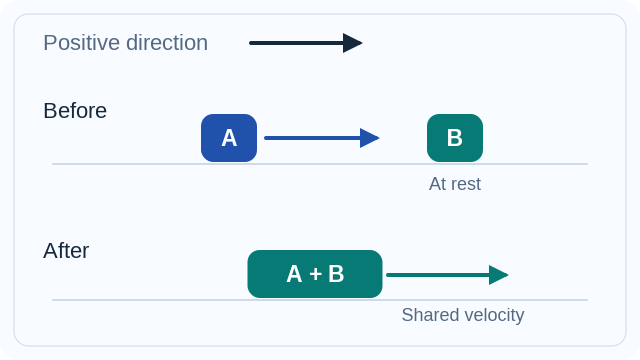
Cart A moves towards stationary cart B. After contact they share a single box and one velocity arrow.

Keep separate before terms. Combine the masses after they join.

Worked example

Find a shared final velocity

Two particles move on the same smooth horizontal line. A is to the left of B immediately before impact. Take rightward as positive. The particles remain joined after impact.

A has mass 3 kg3\,\mathrm{kg} and B has mass 2 kg2\,\mathrm{kg}. Before impact, A moves to the right at 5 m s−15\,\mathrm{m\,s^{-1}} and B is at rest.

Give the signed velocity of the joined pair in m s−1\mathrm{m\,s^{-1}}.

  1. Since the particles stick, their common velocity vv is multiplied by the combined mass 5 kg5\,\mathrm{kg}.

  2. (3)(5)+(2)(0)=15=5v(3)(5)+(2)(0)=15=5v
  3. 3 m s−13\,\mathrm{m\,s^{-1}}. The particle moves to the right at 3 m s−13\,\mathrm{m\,s^{-1}}.

Worked example

Find a shared final velocity

Two particles move on the same smooth horizontal line. A is to the left of B immediately before impact. Take rightward as positive. The particles remain joined after impact.

A has mass 4 kg4\,\mathrm{kg} and B has mass 3 kg3\,\mathrm{kg}. Before impact, A moves to the right at 6 m s−16\,\mathrm{m\,s^{-1}} and B moves to the right at 1 m s−11\,\mathrm{m\,s^{-1}}.

Give the signed velocity of the joined pair in m s−1\mathrm{m\,s^{-1}}.

Try it on paper first.

  1. Since the particles stick, their common velocity vv is multiplied by the combined mass 7 kg7\,\mathrm{kg}.

  2. (4)(6)+(3)(1)=27=7v(4)(6)+(3)(1)=27=7v
  3. 277 m s−1\frac{27}{7}\,\mathrm{m\,s^{-1}}. The particle moves to the right at 277 m s−1\frac{27}{7}\,\mathrm{m\,s^{-1}}.

Your turn

Two particles move on the same smooth horizontal line. A is to the left of B immediately before impact. Take rightward as positive. The particles remain joined after impact.

A has mass 4 kg4\,\mathrm{kg} and B has mass 5 kg5\,\mathrm{kg}. Before impact, A moves to the right at 7 m s−17\,\mathrm{m\,s^{-1}} and B is at rest.

Give the signed velocity of the joined pair in m s−1\mathrm{m\,s^{-1}}.

Enter an exact value or round to 3 significant figures.

Section 2 of 6 · Core · about 7 min

Which way does the joined pair move?

When the initial velocities point in opposite directions, one signed momentum contribution is negative.

Worked example

Find a shared final velocity

Two particles move on the same smooth horizontal line. A is to the left of B immediately before impact. Take rightward as positive. The particles remain joined after impact.

A has mass 4 kg4\,\mathrm{kg} and B has mass 7 kg7\,\mathrm{kg}. Before impact, A moves to the right at 3 m s−13\,\mathrm{m\,s^{-1}} and B moves to the left at 2 m s−12\,\mathrm{m\,s^{-1}}.

Give the signed velocity of the joined pair in m s−1\mathrm{m\,s^{-1}}.

  1. Since the particles stick, their common velocity vv is multiplied by the combined mass 11 kg11\,\mathrm{kg}.

  2. (4)(3)+(7)(−2)=−2=11v(4)(3)+(7)(-2)=-2=11v
  3. −211 m s−1- \frac{2}{11}\,\mathrm{m\,s^{-1}}. The particle moves to the left at 211 m s−1\frac{2}{11}\,\mathrm{m\,s^{-1}}.

Your turn

Two particles move on the same smooth horizontal line. A is to the left of B immediately before impact. Take rightward as positive. The particles remain joined after impact.

A has mass 2 kg2\,\mathrm{kg} and B has mass 6 kg6\,\mathrm{kg}. Before impact, A moves to the right at 5 m s−15\,\mathrm{m\,s^{-1}} and B moves to the left at 4 m s−14\,\mathrm{m\,s^{-1}}.

Give the signed velocity of the joined pair in m s−1\mathrm{m\,s^{-1}}.

Enter an exact value or round to 3 significant figures.

Section 3 of 6 · Core · about 6 min

When can both particles end up at rest?

A stationary joined body has zero final momentum. The individual velocities before impact need not be zero.

Worked example

Determine the mass needed to stop

Two particles move on the same smooth horizontal line. A is to the left of B immediately before impact. Take rightward as positive. The particles remain joined after impact.

A has mass 4 kg4\,\mathrm{kg}. Before impact, A moves to the right at 5 m s−15\,\mathrm{m\,s^{-1}}. B moves to the left at 4 m s−14\,\mathrm{m\,s^{-1}}. Afterwards the joined pair is at rest.

Find the mass of B in kilograms.

  1. Write the final momentum as (4+m)(0)(4+m)(0).

  2. (4)(5)+m(−4)=(4+m)(0)(4)(5)+m(-4)=(4+m)(0)
  3. Collecting gives m(4)=20m(4)=20. Therefore 5 kg5\,\mathrm{kg}.

Your turn

Two particles move on the same smooth horizontal line. A is to the left of B immediately before impact. Take rightward as positive. The particles remain joined after impact.

A has mass 3 kg3\,\mathrm{kg}. Before impact, A moves to the right at 8 m s−18\,\mathrm{m\,s^{-1}}. B moves to the left at 3 m s−13\,\mathrm{m\,s^{-1}}. Afterwards the joined pair is at rest.

Find the mass of B in kilograms.

Enter an exact number, for example 3/2 or 2-sqrt(3).

Section 4 of 6 · Core · about 7 min

How can the common velocity reveal missing data?

Calculate the two-mass total after impact first. Use it as the known total when constructing the equation before impact.

Worked example

Find an initial velocity from coalescence

Two particles move on the same smooth horizontal line. A is to the left of B immediately before impact. Take rightward as positive. The particles remain joined after impact.

A and B have masses 5 kg5\,\mathrm{kg} and 3 kg3\,\mathrm{kg}. Before impact, B moves to the left at 2 m s−12\,\mathrm{m\,s^{-1}}. Afterwards the joined pair moves to the right at 298 m s−1\frac{29}{8}\,\mathrm{m\,s^{-1}}.

Find the signed initial velocity of A in m s−1\mathrm{m\,s^{-1}}.

  1. The total after impact is 29 kg m s−129\,\mathrm{kg\,m\,s^{-1}}.

  2. 5u+(3)(−2)=295u+(3)(-2)=29
  3. Solving gives 7 m s−17\,\mathrm{m\,s^{-1}}.

Your turn

Two particles move on the same smooth horizontal line. A is to the left of B immediately before impact. Take rightward as positive. The particles remain joined after impact.

A and B have masses 3 kg3\,\mathrm{kg} and 5 kg5\,\mathrm{kg}. Before impact, B moves to the left at 1 m s−11\,\mathrm{m\,s^{-1}}. Afterwards the joined pair moves to the right at 114 m s−1\frac{11}{4}\,\mathrm{m\,s^{-1}}.

Find the signed initial velocity of A in m s−1\mathrm{m\,s^{-1}}.

Enter the value on its own or write u = … . Fractions and exact square roots are accepted.

Section 5 of 6 · Core · about 7 min

Does an unknown mass occur on both sides?

An unknown mass is present before impact and in the total mass afterwards. Expand only enough to collect the terms involving it.

Worked example

Find an unknown mass after coalescence

Two particles move on the same smooth horizontal line. A is to the left of B immediately before impact. Take rightward as positive. The particles remain joined after impact.

A has mass 3 kg3\,\mathrm{kg}. Before impact, A moves to the right at 8 m s−18\,\mathrm{m\,s^{-1}}. B moves to the left at 2 m s−12\,\mathrm{m\,s^{-1}}. Afterwards the joined pair moves to the right at 167 m s−1\frac{16}{7}\,\mathrm{m\,s^{-1}}.

Find the mass of B in kilograms.

  1. Write the final momentum as (3+m)(167)(3+m)(\frac{16}{7}).

  2. (3)(8)+m(−2)=(3+m)(167)(3)(8)+m(-2)=(3+m)(\frac{16}{7})
  3. Collecting gives m(307)=1207m(\frac{30}{7})=\frac{120}{7}. Therefore 4 kg4\,\mathrm{kg}.

Your turn

Two particles move on the same smooth horizontal line. A is to the left of B immediately before impact. Take rightward as positive. The particles remain joined after impact.

A has mass 2 kg2\,\mathrm{kg}. Before impact, A moves to the right at 6 m s−16\,\mathrm{m\,s^{-1}}. B moves to the left at 3 m s−13\,\mathrm{m\,s^{-1}}. Afterwards the joined pair moves to the left at 1 m s−11\,\mathrm{m\,s^{-1}}.

Find the mass of B in kilograms.

Enter an exact number, for example 3/2 or 2-sqrt(3).

Section 6 of 6 · Extension · about 5 min

What can I check before trusting the result?

The common velocity is a weighted mean of the two initial velocities. Both masses are positive.

ObservationCheck
Equal weightsOrdinary mean of the two initial velocities.
Opposite totalCommon direction follows the signed sum.
Outlying final valueIncompatible with positive masses.

Worked example

Test a report about the joined pair

Two particles move on the same smooth horizontal line. A is to the left of B immediately before impact. Take rightward as positive.

A has mass 4 kg4\,\mathrm{kg} and B has mass 3 kg3\,\mathrm{kg}. Before impact, A moves to the right at 5 m s−15\,\mathrm{m\,s^{-1}} and B moves to the left at 1 m s−11\,\mathrm{m\,s^{-1}}. They coalesce on impact.

The reported common final signed velocity is 2 m s−12\,\mathrm{m\,s^{-1}}. Is this compatible with the model? Give the actual signed final velocity in m s−1\mathrm{m\,s^{-1}}.

  1. The total initially is 17 kg m s−117\,\mathrm{kg\,m\,s^{-1}}. The total for the reported state would be 14 kg m s−114\,\mathrm{kg\,m\,s^{-1}}.

  2. It lies between the two velocities but gives the wrong total momentum.

  3. Using the combined mass gives 177 m s−1\frac{17}{7}\,\mathrm{m\,s^{-1}}.

Your turn

Two particles move on the same smooth horizontal line. A is to the left of B immediately before impact. Take rightward as positive.

A has mass 3 kg3\,\mathrm{kg} and B has mass 5 kg5\,\mathrm{kg}. Before impact, A moves to the right at 10 m s−110\,\mathrm{m\,s^{-1}} and B moves to the left at 2 m s−12\,\mathrm{m\,s^{-1}}. They coalesce on impact.

The reported common final signed velocity is 52 m s−1\frac{5}{2}\,\mathrm{m\,s^{-1}}. Is this compatible with the model? Give the actual signed final velocity in m s−1\mathrm{m\,s^{-1}}.

Is the report compatible?

Enter an exact value or round to 3 significant figures.

Worked examples

Practise the method

Core practice

Question 1 of 4

0 / 4 checked in this collection

Question list

Core practice

Fresh variants

Exam-style

Find a shared final velocity

1 mark

Two particles move on the same smooth horizontal line. A is to the left of B immediately before impact. Take rightward as positive. The particles remain joined after impact.

A has mass 5 kg5\,\mathrm{kg} and B has mass 3 kg3\,\mathrm{kg}. Before impact, A moves to the right at 7 m s−17\,\mathrm{m\,s^{-1}} and B is at rest.

Give the signed velocity of the joined pair in m s−1\mathrm{m\,s^{-1}}.

Enter an exact value or round to 3 significant figures.

Full answer-format guide

Exact numbers: 3/2, sqrt(5), 2-sqrt(3), pi/6, 3*pi/2. Sets: {1,4}. Intervals: (3,5]; a round bracket excludes the endpoint. Infinity: inf; union: U; no solutions: empty. Separate coordinate pairs or triples with semicolons. Expressions: 2x^2+3x-1; equations: x^2=3x+1 or the polynomial equal to zero. Factors: x-1 ; x+2. Parameter fraction: numerator ; denominator. List integer answers individually.

Review the method

Progress stays in this browser. Create an account to save it or sign in.

Extra practice from this lesson

Find a shared final velocity

Two particles move on the same smooth horizontal line. A is to the left of B immediately before impact. Take rightward as positive. The particles remain joined after impact.

A has mass 7 kg7\,\mathrm{kg} and B has mass 5 kg5\,\mathrm{kg}. Before impact, A moves to the right at 8 m s−18\,\mathrm{m\,s^{-1}} and B is at rest.

Give the signed velocity of the joined pair in m s−1\mathrm{m\,s^{-1}}.

Enter an exact value or round to 3 significant figures.

Find a shared final velocity

Two particles move on the same smooth horizontal line. A is to the left of B immediately before impact. Take rightward as positive. The particles remain joined after impact.

A has mass 5 kg5\,\mathrm{kg} and B has mass 7 kg7\,\mathrm{kg}. Before impact, A moves to the right at 3 m s−13\,\mathrm{m\,s^{-1}} and B moves to the left at 5 m s−15\,\mathrm{m\,s^{-1}}.

Give the signed velocity of the joined pair in m s−1\mathrm{m\,s^{-1}}.

Enter an exact value or round to 3 significant figures.

Determine the mass needed to stop

Two particles move on the same smooth horizontal line. A is to the left of B immediately before impact. Take rightward as positive. The particles remain joined after impact.

A has mass 8 kg8\,\mathrm{kg}. Before impact, A moves to the right at 4 m s−14\,\mathrm{m\,s^{-1}}. B moves to the left at 2 m s−12\,\mathrm{m\,s^{-1}}. Afterwards the joined pair is at rest.

Find the mass of B in kilograms.

Enter an exact number, for example 3/2 or 2-sqrt(3).

Find an initial velocity from coalescence

Two particles move on the same smooth horizontal line. A is to the left of B immediately before impact. Take rightward as positive. The particles remain joined after impact.

A and B have masses 2 kg2\,\mathrm{kg} and 5 kg5\,\mathrm{kg}. Before impact, B moves to the left at 1 m s−11\,\mathrm{m\,s^{-1}}. Afterwards the joined pair moves to the right at 137 m s−1\frac{13}{7}\,\mathrm{m\,s^{-1}}.

Find the signed initial velocity of A in m s−1\mathrm{m\,s^{-1}}.

Enter the value on its own or write u = … . Fractions and exact square roots are accepted.

Find an unknown mass after coalescence

Two particles move on the same smooth horizontal line. A is to the left of B immediately before impact. Take rightward as positive. The particles remain joined after impact.

A has mass 5 kg5\,\mathrm{kg}. Before impact, A moves to the right at 7 m s−17\,\mathrm{m\,s^{-1}}. B moves to the right at 1 m s−11\,\mathrm{m\,s^{-1}}. Afterwards the joined pair moves to the right at 133 m s−1\frac{13}{3}\,\mathrm{m\,s^{-1}}.

Find the mass of B in kilograms.

Enter an exact number, for example 3/2 or 2-sqrt(3).

Test a report about the joined pair

Two particles move on the same smooth horizontal line. A is to the left of B immediately before impact. Take rightward as positive.

A has mass 2 kg2\,\mathrm{kg} and B has mass 6 kg6\,\mathrm{kg}. Before impact, A moves to the right at 8 m s−18\,\mathrm{m\,s^{-1}} and B moves to the left at 3 m s−13\,\mathrm{m\,s^{-1}}. They coalesce on impact.

The reported common final signed velocity is −5 m s−1-5\,\mathrm{m\,s^{-1}}. Is this compatible with the model? Give the actual signed final velocity in m s−1\mathrm{m\,s^{-1}}.

Is the report compatible?

Enter an exact value or round to 3 significant figures.

Apply it · original exam-style problems

Show your working on paper and compare it with the worked solution and marking guidance.

Come back to what needs practice

Quick revision sheet (A4)

Your review plan starts after your first check.