Maths4UBETA

Smooth equilibrium, inclines and tension

Balance smooth contacts and strings in two directions, including an oblique pull and a suspended junction.

Try the quick check →
Lesson 3 of 5

Section 1 of 5 · Core · about 6 min

How do I resolve weight on an incline?

Use one axis up the line of greatest slope and the other normal to the plane. Weight remains vertical in the diagram. The two component magnitudes come from the angle between vertical and the inward normal.

Worked example

Resolve weight on a slope

A particle has weight 45 N45\,\mathrm N. A plane makes angle α\alpha to the horizontal. The acute angle α\alpha satisfies tan⁡α=34\tan \alpha=\frac{3}{4}. Find the two magnitudes of the weight components downhill and into the plane.

  1. The weight points vertically downwards. Its angle to the inward normal is α\alpha.

  2. The weight component along that normal is adjacent to the angle, so it uses cosine.

  3. The downhill component is Wsin⁡α=27W\sin\alpha=27 newtons and the inward component is Wcos⁡α=36W\cos\alpha=36 newtons.

Your turn

A particle has weight 65 N65\,\mathrm N. A plane makes angle α\alpha to the horizontal. The acute angle α\alpha satisfies tan⁡α=512\tan \alpha=\frac{5}{12}. Find the two magnitudes of the weight components downhill and into the plane.

Enter an exact number, for example 3/2 or 2-sqrt(3).

Enter an exact number, for example 3/2 or 2-sqrt(3).

Section 2 of 5 · Core · about 6 min

How does a string along the slope hold a particle?

On a smooth plane the tension can balance the downhill component of weight. If the string is parallel to the plane it has no normal component and only weight presses into the plane.

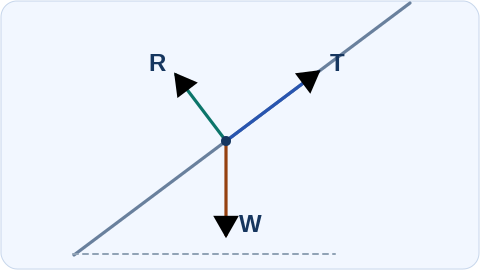
Weight points down, normal reaction points out perpendicular to the slope, and string tension points up the slope.

Use axes along and perpendicular to the incline. Tension has no normal component in this arrangement.

Worked example

Balance a particle on a smooth incline

A particle of weight 85 N85\,\mathrm N rests on a smooth plane inclined at α\alpha to the horizontal. A string pulls up the line of greatest slope, parallel to the incline. The acute angle α\alpha satisfies tan⁡α=34\tan \alpha=\frac{3}{4}. Find the tension and normal reaction.

  1. The weight has a downhill component 51 N51\,\mathrm N and a component 68 N68\,\mathrm N into the plane. Smooth contact gives no friction.

  2. Tension is along the plane, so it has no normal component.

  3. Resolve uphill. T=51T=51 gives T=51T=51.

  4. Resolve outwards. R+(0)T=68R+\left(0\right)T=68 gives R=68R=68.

  5. The tension is 51 N51\,\mathrm N and the normal reaction is 68 N68\,\mathrm N.

Your turn

A particle of weight 52 N52\,\mathrm N rests on a smooth plane inclined at α\alpha to the horizontal. A string pulls up the line of greatest slope, parallel to the incline. The acute angle α\alpha satisfies tan⁡α=512\tan \alpha=\frac{5}{12}. Find the tension and normal reaction.

Enter an exact number, for example 3/2 or 2-sqrt(3).

Enter an exact number, for example 3/2 or 2-sqrt(3).

Worked example

Balance a particle on a smooth incline

A particle of weight 102 N102\,\mathrm N rests on a smooth plane inclined at α\alpha to the horizontal. A string pulls up the line of greatest slope, parallel to the incline. The acute angle α\alpha satisfies tan⁡α=815\tan \alpha=\frac{8}{15}. Find the tension and normal reaction.

Try it on paper first.

  1. The weight has a downhill component 48 N48\,\mathrm N and a component 90 N90\,\mathrm N into the plane. Smooth contact gives no friction.

  2. Tension is along the plane, so it has no normal component.

  3. Resolve uphill. T=48T=48 gives T=48T=48.

  4. Resolve outwards. R+(0)T=90R+\left(0\right)T=90 gives R=90R=90.

  5. The tension is 48 N48\,\mathrm N and the normal reaction is 90 N90\,\mathrm N.

Section 3 of 5 · Core · about 6 min

What changes when the string is horizontal?

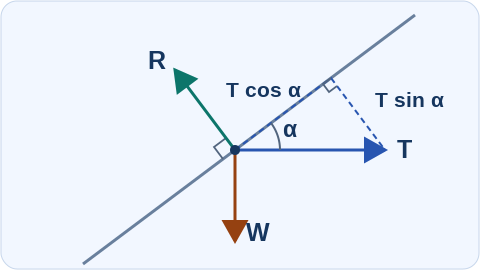
The horizontal tension TT makes angle α\alpha with the slope. The component along the slope points uphill, and the perpendicular component presses the particle into the plane.

A particle is supported by a slope. Weight W points vertically down, reaction R points perpendicular to the slope, and tension T points horizontally right. Angle alpha is between T and the upslope direction. Dashed projections separate the uphill and inward components of T.

The dashed triangle resolves the horizontal tension into Tcos⁡αT\cos\alpha uphill and Tsin⁡αT\sin\alpha into the plane. The inward component adds to the normal load from the weight.

Worked example

Balance a particle on a smooth incline

A particle of weight 48 N48\,\mathrm N rests on a smooth plane inclined at α\alpha to the horizontal. A string pulls horizontally towards the higher side of the plane. The acute angle α\alpha satisfies tan⁡α=43\tan \alpha=\frac{4}{3}. Find the tension and normal reaction.

  1. The weight has a downhill component 1925 N\frac{192}{5}\,\mathrm N and a component 1445 N\frac{144}{5}\,\mathrm N into the plane. Smooth contact gives no friction.

  2. The horizontal tension resolves to Tcos⁡αT\cos\alpha uphill and Tsin⁡αT\sin\alpha into the incline.

  3. Resolve uphill. 35T=1925\frac{3}{5}T=\frac{192}{5} gives T=64T=64.

  4. Resolve outwards. R+(−45)T=1445R+\left(- \frac{4}{5}\right)T=\frac{144}{5} gives R=80R=80.

  5. The tension is 64 N64\,\mathrm N and the normal reaction is 80 N80\,\mathrm N.

Your turn

A particle of weight 80 N80\,\mathrm N rests on a smooth plane inclined at α\alpha to the horizontal. A string pulls horizontally towards the higher side of the plane. The acute angle α\alpha satisfies tan⁡α=34\tan \alpha=\frac{3}{4}. Find the tension and normal reaction.

Enter an exact number, for example 3/2 or 2-sqrt(3).

Enter an exact number, for example 3/2 or 2-sqrt(3).

Worked example

Balance a particle on a smooth incline

A particle of weight 130 N130\,\mathrm N rests on a smooth plane inclined at α\alpha to the horizontal. A string pulls horizontally towards the higher side of the plane. The acute angle α\alpha satisfies tan⁡α=512\tan \alpha=\frac{5}{12}. Find the tension and normal reaction.

Try it on paper first.

  1. The weight has a downhill component 50 N50\,\mathrm N and a component 120 N120\,\mathrm N into the plane. Smooth contact gives no friction.

  2. The horizontal tension resolves to Tcos⁡αT\cos\alpha uphill and Tsin⁡αT\sin\alpha into the incline.

  3. Resolve uphill. 1213T=50\frac{12}{13}T=50 gives T=3256T=\frac{325}{6}.

  4. Resolve outwards. R+(−513)T=120R+\left(- \frac{5}{13}\right)T=120 gives R=8456R=\frac{845}{6}.

  5. The tension is 3256 N\frac{325}{6}\,\mathrm N and the normal reaction is 8456 N\frac{845}{6}\,\mathrm N.

Section 4 of 5 · Core · about 6 min

When can tension reduce the normal reaction?

A string directed above the slope has an outward component. Use the angle between string and slope, which can differ from the angle of the slope itself.

Worked example

Balance a particle on a smooth incline

A particle of weight 50 N50\,\mathrm N rests on a smooth plane inclined at α\alpha to the horizontal. A string pulls uphill at angle β\beta above the line of greatest slope, measured in the vertical cross-section. The acute angle α\alpha satisfies tan⁡α=34\tan \alpha=\frac{3}{4}. The acute angle β\beta satisfies tan⁡β=34\tan \beta=\frac{3}{4}. Find the tension and normal reaction.

  1. The weight has a downhill component 30 N30\,\mathrm N and a component 40 N40\,\mathrm N into the plane. Smooth contact gives no friction.

  2. The tension resolves to Tcos⁡βT\cos\beta uphill and Tsin⁡βT\sin\beta away from the incline.

  3. Resolve uphill. 45T=30\frac{4}{5}T=30 gives T=752T=\frac{75}{2}.

  4. Resolve outwards. R+(35)T=40R+\left(\frac{3}{5}\right)T=40 gives R=352R=\frac{35}{2}.

  5. The tension is 752 N\frac{75}{2}\,\mathrm N and the normal reaction is 352 N\frac{35}{2}\,\mathrm N.

Your turn

A particle of weight 78 N78\,\mathrm N rests on a smooth plane inclined at α\alpha to the horizontal. A string pulls uphill at angle β\beta above the line of greatest slope, measured in the vertical cross-section. The acute angle α\alpha satisfies tan⁡α=512\tan \alpha=\frac{5}{12}. The acute angle β\beta satisfies tan⁡β=34\tan \beta=\frac{3}{4}. Find the tension and normal reaction.

Enter an exact value or round to 3 significant figures.

Enter an exact value or round to 3 significant figures.

Section 5 of 5 · Core · about 6 min

How do two tilted strings balance a hanging load?

Take the junction as the particle. The strings pull up and away from it, and the vertical load pulls down. Angles can differ, so the tensions need not match.

Worked example

Balance two strings at a junction

A light junction carries a vertical load of 140 N140\,\mathrm N. One taut string slopes up to the left at α\alpha above the horizontal, and a second slopes up to the right at β\beta. The acute angle α\alpha satisfies tan⁡α=34\tan \alpha=\frac{3}{4}. The acute angle β\beta satisfies tan⁡β=512\tan \beta=\frac{5}{12}. Find the tension in each string.

  1. The string tensions act away from the junction. The vertical load acts downwards.

  2. Resolve horizontally: 45TL=1213TR\frac{4}{5}T_L=\frac{12}{13}T_R. Resolve vertically: 35TL+513TR=140\frac{3}{5}T_L+\frac{5}{13}T_R=140.

  3. Use the horizontal equation to write TR=1315TLT_R=\frac{13}{15}T_L. Substitute this into the vertical equation.

  4. The left tension is 150 N150\,\mathrm N and the right tension is 130 N130\,\mathrm N.

Your turn

A light junction carries a vertical load of 96 N96\,\mathrm N. One taut string slopes up to the left at α\alpha above the horizontal, and a second slopes up to the right at β\beta. The acute angle α\alpha satisfies tan⁡α=34\tan \alpha=\frac{3}{4}. The acute angle β\beta satisfies tan⁡β=43\tan \beta=\frac{4}{3}. Find the tension in each string.

Enter an exact value or round to 3 significant figures.

Enter an exact value or round to 3 significant figures.

Worked examples

Practise the method

Core practice

Question 1 of 4

0 / 4 checked in this collection

Question list

Core practice

Fresh variants

Exam-style

Resolve weight on a slope

2 marks

A particle has weight 90 N90\,\mathrm N. A plane makes angle α\alpha to the horizontal. The acute angle α\alpha satisfies tan⁡α=34\tan \alpha=\frac{3}{4}. Find the two magnitudes of the weight components downhill and into the plane.

Enter an exact number, for example 3/2 or 2-sqrt(3).

Enter an exact number, for example 3/2 or 2-sqrt(3).

Full answer-format guide

Exact numbers: 3/2, sqrt(5), 2-sqrt(3), pi/6, 3*pi/2. Sets: {1,4}. Intervals: (3,5]; a round bracket excludes the endpoint. Infinity: inf; union: U; no solutions: empty. Separate coordinate pairs or triples with semicolons. Expressions: 2x^2+3x-1; equations: x^2=3x+1 or the polynomial equal to zero. Factors: x-1 ; x+2. Parameter fraction: numerator ; denominator. List integer answers individually.

Review the method

Progress stays in this browser. Create an account to save it or sign in.

Extra practice from this lesson

Resolve weight on a slope

A particle has weight 85 N85\,\mathrm N. A plane makes angle α\alpha to the horizontal. The acute angle α\alpha satisfies tan⁡α=815\tan \alpha=\frac{8}{15}. Find the two magnitudes of the weight components downhill and into the plane.

Enter an exact number, for example 3/2 or 2-sqrt(3).

Enter an exact number, for example 3/2 or 2-sqrt(3).

Balance a particle on a smooth incline

A particle of weight 75 N75\,\mathrm N rests on a smooth plane inclined at α\alpha to the horizontal. A string pulls up the line of greatest slope, parallel to the incline. The acute angle α\alpha satisfies tan⁡α=43\tan \alpha=\frac{4}{3}. Find the tension and normal reaction.

Enter an exact number, for example 3/2 or 2-sqrt(3).

Enter an exact number, for example 3/2 or 2-sqrt(3).

Balance a particle on a smooth incline

A particle of weight 90 N90\,\mathrm N rests on a smooth plane inclined at α\alpha to the horizontal. A string pulls horizontally towards the higher side of the plane. The acute angle α\alpha satisfies tan⁡α=815\tan \alpha=\frac{8}{15}. Find the tension and normal reaction.

Enter an exact number, for example 3/2 or 2-sqrt(3).

Enter an exact number, for example 3/2 or 2-sqrt(3).

Balance a particle on a smooth incline

A particle of weight 104 N104\,\mathrm N rests on a smooth plane inclined at α\alpha to the horizontal. A string pulls uphill at angle β\beta above the line of greatest slope, measured in the vertical cross-section. The acute angle α\alpha satisfies tan⁡α=512\tan \alpha=\frac{5}{12}. The acute angle β\beta satisfies tan⁡β=34\tan \beta=\frac{3}{4}. Find the tension and normal reaction.

Enter an exact number, for example 3/2 or 2-sqrt(3).

Enter an exact number, for example 3/2 or 2-sqrt(3).

Balance two strings at a junction

A light junction carries a vertical load of 120 N120\,\mathrm N. One taut string slopes up to the left at α\alpha above the horizontal, and a second slopes up to the right at β\beta. The acute angle α\alpha satisfies tan⁡α=512\tan \alpha=\frac{5}{12}. The acute angle β\beta satisfies tan⁡β=34\tan \beta=\frac{3}{4}. Find the tension in each string.

Enter an exact value or round to 3 significant figures.

Enter an exact value or round to 3 significant figures.

Apply it · original exam-style problems

Show your working on paper and compare it with the worked solution and marking guidance.

Come back to what needs practice

Quick revision sheet (A4)

Your review plan starts after your first check.