Worked example
Resolve before using the friction limit
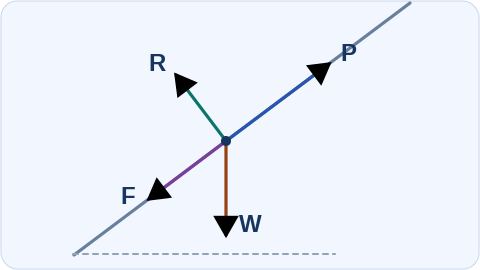
A particle of weight is on a rough horizontal floor. A force of acts to the right, parallel to the floor. The coefficient of friction is . Find the normal reaction, the friction magnitude required for equilibrium and the maximum friction. Decide whether the particle can be in equilibrium.
Take rightwards and upwards as positive. Resolve the applied force: rightwards and upwards.
Vertical equilibrium gives . Then .
The required friction is less than the maximum. The floor supplies the required friction to the left.
The normal reaction is , required friction is , and the maximum is . The floor supplies the required friction to the left.