Maths4UBETA

Resolving forces and finding resultants

Resolve signed components, combine forces and calculate the direction of a resultant or balancing force.

Try the quick check →
Lesson 2 of 5

Section 1 of 5 · Core · about 6 min

Which component uses cosine?

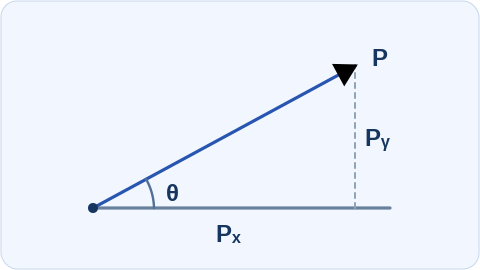
Draw the angle between the force arrow and the reference direction. The adjacent component has magnitude Pcos⁡θP\cos\theta, while the opposite component has magnitude Psin⁡θP\sin\theta. Apply directional signs afterwards.

An angled force P points up and right. A right triangle shows the horizontal projection P x and vertical projection P y.

The labelled angle θ\theta is measured from the horizontal, so the horizontal component is Pcos⁡θP\cos\theta.

Worked example

Resolve an angled force

A force of 25 N25\,\mathrm N acts at angle θ\theta above the horizontal to the right. The acute angle θ\theta satisfies tan⁡θ=34\tan \theta=\frac{3}{4}. Take rightwards and upwards as positive. Find both signed components.

  1. The axis from which the angle is measured gives the adjacent side, so it uses cosine. The other uses sine.

  2. cos⁡θ=45\cos\theta=\frac{4}{5} and sin⁡θ=35\sin\theta=\frac{3}{5}. Apply the signs from the force direction.

  3. The rightwards component is 20 N20\,\mathrm N and the upwards component is 15 N15\,\mathrm N. Their expressions are 25cos⁡θ25\cos\theta and 25sin⁡θ25\sin\theta.

Your turn

A force of 26 N26\,\mathrm N acts at angle θ\theta towards the right of the upward vertical. The acute angle θ\theta satisfies tan⁡θ=512\tan \theta=\frac{5}{12}. Take rightwards and upwards as positive. Find both signed components.

Enter an exact number, for example 3/2 or 2-sqrt(3).

Enter an exact number, for example 3/2 or 2-sqrt(3).

Section 2 of 5 · Core · about 6 min

How do I handle downward or leftward components?

Choose positive directions before resolving. An angle used in a right triangle gives positive side lengths, so those lengths need signs to show direction.

Worked example

Resolve an angled force

A force of 50 N50\,\mathrm N acts at angle θ\theta below the horizontal to the left. The acute angle θ\theta satisfies tan⁡θ=34\tan \theta=\frac{3}{4}. Take rightwards and upwards as positive. Find both signed components.

  1. The axis from which the angle is measured gives the adjacent side, so it uses cosine. The other uses sine.

  2. cos⁡θ=45\cos\theta=\frac{4}{5} and sin⁡θ=35\sin\theta=\frac{3}{5}. Apply the signs from the force direction.

  3. The rightwards component is −40 N-40\,\mathrm N and the upwards component is −30 N-30\,\mathrm N. Their expressions are −50cos⁡θ-50\cos\theta and −50sin⁡θ-50\sin\theta.

Your turn

A force of 39 N39\,\mathrm N acts at angle θ\theta below the horizontal to the right. The acute angle θ\theta satisfies tan⁡θ=125\tan \theta=\frac{12}{5}. Take rightwards and upwards as positive. Find both signed components.

Enter an exact number, for example 3/2 or 2-sqrt(3).

Enter an exact number, for example 3/2 or 2-sqrt(3).

Worked example

Resolve an angled force

A force of 63 N63\,\mathrm N acts at angle θ\theta towards the left of the upward vertical. The acute angle θ\theta satisfies tan⁡θ=125\tan \theta=\frac{12}{5}. Take rightwards and upwards as positive. Find both signed components.

Try it on paper first.

  1. The axis from which the angle is measured gives the adjacent side, so it uses cosine. The other uses sine.

  2. cos⁡θ=513\cos\theta=\frac{5}{13} and sin⁡θ=1213\sin\theta=\frac{12}{13}. Apply the signs from the force direction.

  3. The rightwards component is −75613 N- \frac{756}{13}\,\mathrm N and the upwards component is 31513 N\frac{315}{13}\,\mathrm N. Their expressions are −63sin⁡θ-63\sin\theta and 63cos⁡θ63\cos\theta.

Section 3 of 5 · Core · about 6 min

How do I combine forces pointing in different directions?

Resolve each force along the same pair of perpendicular axes. Add rightwards components to obtain the horizontal total and upwards components to obtain the vertical total.

Worked example

Find a resultant or balancing force

Two forces act on a survey marker modelled as a particle. Their signed components are 14 N14\,\mathrm N rightwards and 5 N5\,\mathrm N upwards for the first, and −8 N-8\,\mathrm N rightwards and 3 N3\,\mathrm N upwards for the second. Find the rightwards and upwards components of the resultant, and its exact magnitude.

  1. Sx=14+(−8)=6S_x=14+\left(-8\right)=6 and Sy=5+(3)=8S_y=5+\left(3\right)=8.

  2. The magnitude follows from Pythagoras using the two resultant components.

  3. The signed components are 6 N6\,\mathrm N rightwards and 8 N8\,\mathrm N upwards. The magnitude is 10 N10\,\mathrm N.

Your turn

Two forces act on a survey marker modelled as a particle. Their signed components are −6 N-6\,\mathrm N rightwards and 13 N13\,\mathrm N upwards for the first, and 10 N10\,\mathrm N rightwards and −9 N-9\,\mathrm N upwards for the second. Find the rightwards and upwards components of the resultant, and its exact magnitude.

Enter an exact number, for example 3/2 or 2-sqrt(3).

Enter an exact number, for example 3/2 or 2-sqrt(3).

Enter an exact number, for example 3/2 or 2-sqrt(3).

Worked example

Find a resultant or balancing force

Two forces act on a survey marker modelled as a particle. Their signed components are 8 N8\,\mathrm N rightwards and 12 N12\,\mathrm N upwards for the first, and −14 N-14\,\mathrm N rightwards and −4 N-4\,\mathrm N upwards for the second. Find the rightwards and upwards components of the resultant, and its exact magnitude.

Try it on paper first.

  1. Sx=8+(−14)=−6S_x=8+\left(-14\right)=-6 and Sy=12+(−4)=8S_y=12+\left(-4\right)=8.

  2. The magnitude follows from Pythagoras using the two resultant components.

  3. The signed components are −6 N-6\,\mathrm N rightwards and 8 N8\,\mathrm N upwards. The magnitude is 10 N10\,\mathrm N.

Section 4 of 5 · Core · about 6 min

How do I state a resultant's direction?

The component signs identify the quadrant. Use the right triangle of component magnitudes to calculate an acute reference angle, then identify which axis and side that angle describes.

Worked example

Find a resultant or balancing force

Two forces act on a survey marker modelled as a particle. Their signed components are 6 N6\,\mathrm N rightwards and 10 N10\,\mathrm N upwards for the first, and 11 N11\,\mathrm N rightwards and 2 N2\,\mathrm N upwards for the second. Give the magnitude of the resultant exactly and its angle above the horizontal to the right, to one decimal place.

  1. Sx=6+(11)=17S_x=6+\left(11\right)=17 and Sy=10+(2)=12S_y=10+\left(2\right)=12.

  2. The magnitude is Sx2+Sy2=433\sqrt{S_x^2+S_y^2}=\sqrt{433}.

  3. Use tan⁡θ=1217\tan\theta=\frac{12}{17}. The resultant has magnitude 433 N\sqrt{433}\,\mathrm N and acts at 35.2∘35.2^\circ above the horizontal to the right.

Your turn

Two forces act on a survey marker modelled as a particle. Their signed components are 14 N14\,\mathrm N rightwards and −5 N-5\,\mathrm N upwards for the first, and −2 N-2\,\mathrm N rightwards and −7 N-7\,\mathrm N upwards for the second. Give the magnitude of the resultant exactly and its angle below the horizontal to the right, to one decimal place.

Enter an exact number, for example 3/2 or 2-sqrt(3).

Round as requested in the label, or enter your calculator value. Decimal or fraction input is accepted.

Section 5 of 5 · Core · about 6 min

What force would cancel the resultant?

An added force produces equilibrium when it cancels the existing resultant on both axes. It has the same magnitude as the resultant and points in the opposite direction.

Worked example

Find a resultant or balancing force

Two forces act on a survey marker modelled as a particle. Their signed components are 15 N15\,\mathrm N rightwards and −8 N-8\,\mathrm N upwards for the first, and −4 N-4\,\mathrm N rightwards and 2 N2\,\mathrm N upwards for the second. Give the two signed components of the additional force that produces equilibrium.

  1. Sx=15+(−4)=11S_x=15+\left(-4\right)=11 and Sy=−8+(2)=−6S_y=-8+\left(2\right)=-6.

  2. An additional force must cancel each component of the resultant separately.

  3. The additional force has rightwards component −11 N-11\,\mathrm N and upwards component 6 N6\,\mathrm N.

Your turn

Two forces act on a survey marker modelled as a particle. Their signed components are −11 N-11\,\mathrm N rightwards and 7 N7\,\mathrm N upwards for the first, and 3 N3\,\mathrm N rightwards and −4 N-4\,\mathrm N upwards for the second. Give the two signed components of the additional force that produces equilibrium.

Enter an exact number, for example 3/2 or 2-sqrt(3).

Enter an exact number, for example 3/2 or 2-sqrt(3).

Worked examples

Practise the method

Core practice

Question 1 of 4

0 / 4 checked in this collection

Question list

Core practice

Fresh variants

Exam-style

Resolve an angled force

2 marks

A force of 40 N40\,\mathrm N acts at angle θ\theta above the horizontal to the right. The acute angle θ\theta satisfies tan⁡θ=34\tan \theta=\frac{3}{4}. Take rightwards and upwards as positive. Find both signed components.

Enter an exact number, for example 3/2 or 2-sqrt(3).

Enter an exact number, for example 3/2 or 2-sqrt(3).

Full answer-format guide

Exact numbers: 3/2, sqrt(5), 2-sqrt(3), pi/6, 3*pi/2. Sets: {1,4}. Intervals: (3,5]; a round bracket excludes the endpoint. Infinity: inf; union: U; no solutions: empty. Separate coordinate pairs or triples with semicolons. Expressions: 2x^2+3x-1; equations: x^2=3x+1 or the polynomial equal to zero. Factors: x-1 ; x+2. Parameter fraction: numerator ; denominator. List integer answers individually.

Review the method

Progress stays in this browser. Create an account to save it or sign in.

Extra practice from this lesson

Resolve an angled force

A force of 35 N35\,\mathrm N acts at angle θ\theta towards the right of the upward vertical. The acute angle θ\theta satisfies tan⁡θ=34\tan \theta=\frac{3}{4}. Take rightwards and upwards as positive. Find both signed components.

Enter an exact number, for example 3/2 or 2-sqrt(3).

Enter an exact number, for example 3/2 or 2-sqrt(3).

Resolve an angled force

A force of 85 N85\,\mathrm N acts at angle θ\theta below the horizontal to the left. The acute angle θ\theta satisfies tan⁡θ=158\tan \theta=\frac{15}{8}. Take rightwards and upwards as positive. Find both signed components.

Enter an exact number, for example 3/2 or 2-sqrt(3).

Enter an exact number, for example 3/2 or 2-sqrt(3).

Find a resultant or balancing force

Two forces act on a survey marker modelled as a particle. Their signed components are 3 N3\,\mathrm N rightwards and 9 N9\,\mathrm N upwards for the first, and −10 N-10\,\mathrm N rightwards and 15 N15\,\mathrm N upwards for the second. Find the rightwards and upwards components of the resultant, and its exact magnitude.

Enter an exact number, for example 3/2 or 2-sqrt(3).

Enter an exact number, for example 3/2 or 2-sqrt(3).

Enter an exact number, for example 3/2 or 2-sqrt(3).

Find a resultant or balancing force

Two forces act on a survey marker modelled as a particle. Their signed components are 8 N8\,\mathrm N rightwards and 18 N18\,\mathrm N upwards for the first, and 11 N11\,\mathrm N rightwards and −4 N-4\,\mathrm N upwards for the second. Give the magnitude of the resultant exactly and its angle above the horizontal to the right, to one decimal place.

Enter an exact number, for example 3/2 or 2-sqrt(3).

Round as requested in the label, or enter your calculator value. Decimal or fraction input is accepted.

Find a resultant or balancing force

Two forces act on a survey marker modelled as a particle. Their signed components are 9 N9\,\mathrm N rightwards and 6 N6\,\mathrm N upwards for the first, and −12 N-12\,\mathrm N rightwards and −11 N-11\,\mathrm N upwards for the second. Give the two signed components of the additional force that produces equilibrium.

Enter an exact number, for example 3/2 or 2-sqrt(3).

Enter an exact number, for example 3/2 or 2-sqrt(3).

Apply it · original exam-style problems

Show your working on paper and compare it with the worked solution and marking guidance.

Come back to what needs practice

Quick revision sheet (A4)

Your review plan starts after your first check.