Maths4UBETA

Time-dependent forces and complete trajectories

Integrate with the initial conditions, then distinguish displacement, distance and a change of model.

Try the quick check →
Lesson 1 of 4

Section 1 of 5 · Core · about 5 min

How do I turn a time-dependent force into velocity?

Along a chosen line, use a signed resultant. Since mass is constant, the signed acceleration is the force divided by mass.

Worked example

Integrate a force-dependent motion model

A particle of mass 33 kilograms has initial velocity 3 m s−13\,\mathrm{m\,s^{-1}}. Its signed resultant force at time tt is F=12−6tF=12 - 6 t newtons. Find its signed acceleration and velocity after 12 s\frac{1}{2}\,\mathrm s.

  1. Divide the net force by mass to obtain a=4−2ta=4 - 2 t. There is a new acceleration at each time.

  2. Integrate and use initial velocity. This gives v=−t2+4t+3v=- t^{2} + 4 t + 3.

  3. At the stated time, signed acceleration is 3 m s−23\,\mathrm{m\,s^{-2}} and velocity is 194 m s−1\frac{19}{4}\,\mathrm{m\,s^{-1}}.

Your turn

A particle of mass 44 kilograms has initial velocity 4 m s−14\,\mathrm{m\,s^{-1}}. Its signed resultant force at time tt is F=20−12tF=20 - 12 t newtons. Find its signed acceleration and velocity after 1 s1\,\mathrm s.

Enter an exact number, for example 3/2 or 2-sqrt(3).

Enter an exact value or round to 3 significant figures.

Section 2 of 5 · Core · about 5 min

Why do I need a second initial condition?

The first integration determines velocity up to a constant. A second integration introduces a new constant for the position origin.

Worked example

Integrate a force-dependent motion model

At t=0t=0, a particle is at x=2x=2 metres with signed velocity 3 m s−13\,\mathrm{m\,s^{-1}}. The acceleration is a=4−2ta=4 - 2 t in SI units. Find its signed coordinate after 12 s\frac{1}{2}\,\mathrm s and its displacement over this time.

  1. First integrate acceleration and fit the initial velocity: v=−t2+4t+3v=- t^{2} + 4 t + 3.

  2. Integrate velocity and fit the initial coordinate: x=−t33+2t2+3t+2x=- \frac{t^{3}}{3} + 2 t^{2} + 3 t + 2.

  3. The displacement is 4724 m\frac{47}{24}\,\mathrm m and the final coordinate is 9524 m\frac{95}{24}\,\mathrm m.

Your turn

At t=0t=0, a particle is at x=3x=3 metres with signed velocity 4 m s−14\,\mathrm{m\,s^{-1}}. The acceleration is a=5−3ta=5 - 3 t in SI units. Find its signed coordinate after 1 s1\,\mathrm s and its displacement over this time.

Enter an exact number, for example 3/2 or 2-sqrt(3).

Enter an exact number, for example 3/2 or 2-sqrt(3).

Section 3 of 5 · Core · about 7 min

Which equation gives the first stop?

A particle can have zero acceleration while still moving. A first stop occurs at the earliest accessible zero of signed velocity.

Worked example

Find the first stop under time-dependent acceleration

A particle has initial velocity 94 m s−1\frac{9}{4}\,\mathrm{m\,s^{-1}}. Its signed acceleration is a=−2ta=- 2 t in SI units. Find the first stopping time and its displacement by then.

  1. Integrating gives v=94−t2v=\frac{9}{4} - t^{2}. The first non-negative zero is 32 s\frac{3}{2}\,\mathrm s.

  2. The motion remains in the positive direction up to that time. The displacement is 94 m\frac{9}{4}\,\mathrm m.

Your turn

A particle has initial velocity 6 m s−16\,\mathrm{m\,s^{-1}}. Its signed acceleration is a=−3ta=- 3 t in SI units. Find the first stopping time and its displacement by then.

Enter an exact number, for example 3/2 or 2-sqrt(3).

Enter an exact number, for example 3/2 or 2-sqrt(3).

Worked example

Find the first stop under time-dependent acceleration

A particle has initial velocity 252 m s−1\frac{25}{2}\,\mathrm{m\,s^{-1}}. Its signed acceleration is a=−4ta=- 4 t in SI units. Find the first stopping time and its displacement by then.

Try it on paper first.

  1. Integrating gives v=252−2t2v=\frac{25}{2} - 2 t^{2}. The first non-negative zero is 52 s\frac{5}{2}\,\mathrm s.

  2. The motion remains in the positive direction up to that time. The displacement is 1256 m\frac{125}{6}\,\mathrm m.

Your turn

A particle has initial velocity 452 m s−1\frac{45}{2}\,\mathrm{m\,s^{-1}}. Its signed acceleration is a=−5ta=- 5 t in SI units. Find the first stopping time and its displacement by then.

Enter an exact number, for example 3/2 or 2-sqrt(3).

Enter an exact number, for example 3/2 or 2-sqrt(3).

Section 4 of 5 · Core · about 5 min

How do I calculate distance when velocity changes sign?

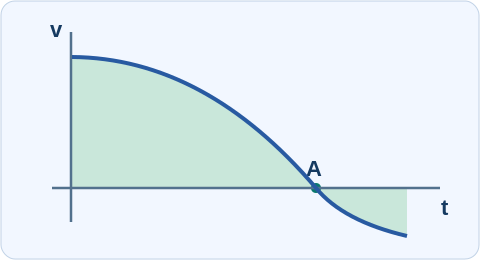
Velocity has signed area on a time graph. For total distance, divide the journey into intervals with constant velocity sign and add the lengths.

A velocity curve crosses the time axis at A. Areas on either side of A have different signs.

Displacement counts the lower region negatively. For distance travelled, count the magnitudes of both regions.

Worked example

Distinguish signed displacement from total distance

A particle has initial velocity 94 m s−1\frac{9}{4}\,\mathrm{m\,s^{-1}}. Its signed acceleration is a=−2ta=- 2 t in SI units. The acceleration law continues until 116 s\frac{11}{6}\,\mathrm s. Find the signed displacement and total distance by that instant.

  1. The velocity is v=94−t2v=\frac{9}{4} - t^{2}. Its sign changes at 32 s\frac{3}{2}\,\mathrm s.

  2. The position relative to the start is 94 m\frac{9}{4}\,\mathrm m at that turn and 671324 m\frac{671}{324}\,\mathrm m at the end.

  3. The signed displacement is 671324 m\frac{671}{324}\,\mathrm m. The distance adds the outward leg and the length travelled back, giving 787324 m\frac{787}{324}\,\mathrm m.

Your turn

A particle has initial velocity 6 m s−16\,\mathrm{m\,s^{-1}}. Its signed acceleration is a=−3ta=- 3 t in SI units. The acceleration law continues until 83 s\frac{8}{3}\,\mathrm s. Find the signed displacement and total distance by that instant.

Enter an exact value or round to 3 significant figures.

Enter an exact value or round to 3 significant figures.

Section 5 of 5 · Core · about 7 min

What changes when the force law switches?

At an ordinary switch in finite force, position and velocity agree at the boundary. A different acceleration law applies on the second interval.

Worked example

Carry velocity and position across a change of law

A particle starts with velocity 13 m s−1\frac{1}{3}\,\mathrm{m\,s^{-1}}. Its acceleration is a=2ta=2 t for 1 s1\,\mathrm s. It then changes to a=4τa=4\tau where τ\tau measures time since that change. Find velocity and displacement relative to the original start after 12 s\frac{1}{2}\,\mathrm s in the second stage.

  1. Integrate the first acceleration from its own initial conditions. At the switch the velocity is 43 m s−1\frac{4}{3}\,\mathrm{m\,s^{-1}} and displacement 23 m\frac{2}{3}\,\mathrm m.

  2. Integrate the second acceleration with new initial velocity 43 m s−1\frac{4}{3}\,\mathrm{m\,s^{-1}}. Integrating this velocity gives the second-stage displacement.

  3. The velocity is 116 m s−1\frac{11}{6}\,\mathrm{m\,s^{-1}} and total displacement is 1712 m\frac{17}{12}\,\mathrm m.

Your turn

A particle starts with velocity 23 m s−1\frac{2}{3}\,\mathrm{m\,s^{-1}}. Its acceleration is a=3ta=3 t for 32 s\frac{3}{2}\,\mathrm s. It then changes to a=5τa=5\tau where τ\tau measures time since that change. Find velocity and displacement relative to the original start after 1 s1\,\mathrm s in the second stage.

Enter an exact value or round to 3 significant figures.

Enter an exact value or round to 3 significant figures.

Worked example

Carry velocity and position across a change of law

A particle starts with velocity 1 m s−11\,\mathrm{m\,s^{-1}}. Its acceleration is a=4ta=4 t for 2 s2\,\mathrm s. It then changes to a=6τa=6\tau where τ\tau measures time since that change. Find velocity and displacement relative to the original start after 32 s\frac{3}{2}\,\mathrm s in the second stage.

Try it on paper first.

  1. Integrate the first acceleration from its own initial conditions. At the switch the velocity is 9 m s−19\,\mathrm{m\,s^{-1}} and displacement 223 m\frac{22}{3}\,\mathrm m.

  2. Integrate the second acceleration with new initial velocity 9 m s−19\,\mathrm{m\,s^{-1}}. Integrating this velocity gives the second-stage displacement.

  3. The velocity is 634 m s−1\frac{63}{4}\,\mathrm{m\,s^{-1}} and total displacement is 58124 m\frac{581}{24}\,\mathrm m.

Your turn

A particle starts with velocity 43 m s−1\frac{4}{3}\,\mathrm{m\,s^{-1}}. Its acceleration is a=5ta=5 t for 52 s\frac{5}{2}\,\mathrm s. It then changes to a=7τa=7\tau where τ\tau measures time since that change. Find velocity and displacement relative to the original start after 2 s2\,\mathrm s in the second stage.

Enter an exact value or round to 3 significant figures.

Enter an exact value or round to 3 significant figures.

Worked examples

Practise the method

Core practice

Question 1 of 4

0 / 4 checked in this collection

Question list

Core practice

Fresh variants

Exam-style

Both full trajectories and a signed force

3 marks

A particle of mass 22 kg has resultant force F=6−4tF=6 - 4 t N, with positive direction fixed. Initially x=0 and v=5 m s⁻¹. Give the full polynomials v(t), x(t), and signed force at t=1 s.

Enter an expression in t; use ^ for powers and / for fractions.

Enter an expression in t; use ^ for powers and / for fractions.

Enter an exact number, for example 3/2 or 2-sqrt(3).

Full answer-format guide

Exact numbers: 3/2, sqrt(5), 2-sqrt(3), pi/6, 3*pi/2. Sets: {1,4}. Intervals: (3,5]; a round bracket excludes the endpoint. Infinity: inf; union: U; no solutions: empty. Separate coordinate pairs or triples with semicolons. Expressions: 2x^2+3x-1; equations: x^2=3x+1 or the polynomial equal to zero. Factors: x-1 ; x+2. Parameter fraction: numerator ; denominator. List integer answers individually.

Review the method

Progress stays in this browser. Create an account to save it or sign in.

Extra practice from this lesson

Integrate a force-dependent motion model

A particle of mass 55 kilograms has initial velocity 5 m s−15\,\mathrm{m\,s^{-1}}. Its signed resultant force at time tt is F=30−20tF=30 - 20 t newtons. Find its signed acceleration and velocity after 32 s\frac{3}{2}\,\mathrm s.

Enter an exact number, for example 3/2 or 2-sqrt(3).

Enter an exact value or round to 3 significant figures.

Integrate a force-dependent motion model

At t=0t=0, a particle is at x=4x=4 metres with signed velocity 5 m s−15\,\mathrm{m\,s^{-1}}. The acceleration is a=6−4ta=6 - 4 t in SI units. Find its signed coordinate after 32 s\frac{3}{2}\,\mathrm s and its displacement over this time.

Enter an exact number, for example 3/2 or 2-sqrt(3).

Enter an exact number, for example 3/2 or 2-sqrt(3).

Find the first stop under time-dependent acceleration

A particle has initial velocity 1474 m s−1\frac{147}{4}\,\mathrm{m\,s^{-1}}. Its signed acceleration is a=−6ta=- 6 t in SI units. Find the first stopping time and its displacement by then.

Enter an exact value or round to 3 significant figures.

Enter an exact value or round to 3 significant figures.

Distinguish signed displacement from total distance

A particle has initial velocity 252 m s−1\frac{25}{2}\,\mathrm{m\,s^{-1}}. Its signed acceleration is a=−4ta=- 4 t in SI units. The acceleration law continues until 72 s\frac{7}{2}\,\mathrm s. Find the signed displacement and total distance by that instant.

Enter an exact value or round to 3 significant figures.

Enter an exact value or round to 3 significant figures.

Carry velocity and position across a change of law

A particle starts with velocity 53 m s−1\frac{5}{3}\,\mathrm{m\,s^{-1}}. Its acceleration is a=6ta=6 t for 3 s3\,\mathrm s. It then changes to a=8τa=8\tau where τ\tau measures time since that change. Find velocity and displacement relative to the original start after 52 s\frac{5}{2}\,\mathrm s in the second stage.

Enter an exact value or round to 3 significant figures.

Enter an exact value or round to 3 significant figures.

Apply it · original exam-style problems

Show your working on paper and compare it with the worked solution and marking guidance.

Come back to what needs practice

Quick revision sheet (A4)

Your review plan starts after your first check.