Maths4UBETA

Position-dependent force and the physical velocity branch

Use the chain rule to find v², then select the direction and test whether a candidate point is reachable.

Try the quick check →
Lesson 2 of 4

Section 1 of 5 · Core · about 5 min

Why is acceleration also v times dv/dx?

Velocity can be described along a monotone part of the path. The chain rule converts a time derivative into a position derivative.

Worked example

Choose the sign after solving for squared speed

At x=0x=0 a particle moves in the positive direction with speed 4 m s−14\,\mathrm{m\,s^{-1}}. Its acceleration is a=x3+1a=\frac{x}{3} + 1 in SI units. Find its signed velocity at x=12x=\frac{1}{2} metres assuming it has not turned.

  1. With position as independent variable, a=vdvdxa=v\frac{\mathrm dv}{\mathrm dx}. Thus 12v2\frac12v^2 is an antiderivative of x3+1\frac{x}{3} + 1.

  2. Apply the initial condition to obtain v2=x23+2x+16v^2=\frac{x^{2}}{3} + 2 x + 16.

  3. Choose the positive square root because the direction is unchanged. The signed velocity is 6156 m s−1\frac{\sqrt{615}}{6}\,\mathrm{m\,s^{-1}}.

Your turn

At x=0x=0 a particle moves in the positive direction with speed 5 m s−15\,\mathrm{m\,s^{-1}}. Its acceleration is a=2x3+32a=\frac{2 x}{3} + \frac{3}{2} in SI units. Find its signed velocity at x=1x=1 metres assuming it has not turned.

Enter an exact value or round to 3 significant figures.

Section 2 of 5 · Core · about 5 min

When do I take the negative square root?

The integrated result frequently gives squared velocity. On a branch without a stop, the velocity retains its starting sign.

Worked example

Choose the sign after solving for squared speed

At x=0x=0 a particle moves in the negative direction with speed 4 m s−14\,\mathrm{m\,s^{-1}}. Its acceleration is a=x3−1a=\frac{x}{3} - 1 in SI units. Find its signed velocity at x=−12x=- \frac{1}{2} metres assuming it has not turned.

  1. With position as independent variable, a=vdvdxa=v\frac{\mathrm dv}{\mathrm dx}. Thus 12v2\frac12v^2 is an antiderivative of x3−1\frac{x}{3} - 1.

  2. Apply the initial condition to obtain v2=x23−2x+16v^2=\frac{x^{2}}{3} - 2 x + 16.

  3. Choose the negative square root because the direction is unchanged. The signed velocity is −6156 m s−1- \frac{\sqrt{615}}{6}\,\mathrm{m\,s^{-1}}.

Your turn

At x=0x=0 a particle moves in the negative direction with speed 5 m s−15\,\mathrm{m\,s^{-1}}. Its acceleration is a=2x3−32a=\frac{2 x}{3} - \frac{3}{2} in SI units. Find its signed velocity at x=−1x=-1 metres assuming it has not turned.

Enter an exact value or round to 3 significant figures.

Section 3 of 5 · Core · about 7 min

Where can a particle stop under a position-dependent force?

Once squared speed is known as a function of position, a zero may mark a turning point. The direction and initial point decide which root can be reached.

Worked example

Locate a first stop from force as a function of x

At x=0x=0 a particle of mass 22 kilograms has rightwards velocity 23 m s−12 \sqrt{3}\,\mathrm{m\,s^{-1}}. The signed resultant force is F=−6xF=- 6 x newtons. Find the coordinate of its first stop.

  1. Set mvdvdx=F(x)mv\frac{\mathrm dv}{\mathrm dx}=F(x) and integrate in x, rather than assuming constant acceleration.

  2. The initial condition gives v2=12−3x2v^2=12 - 3 x^{2}. The positive coordinate where this vanishes is 2 m2\,\mathrm m.

Your turn

At x=0x=0 a particle of mass 33 kilograms has rightwards velocity 5 m s−15\,\mathrm{m\,s^{-1}}. The signed resultant force is F=−12xF=- 12 x newtons. Find the coordinate of its first stop.

Enter an exact value or round to 3 significant figures.

Worked example

Locate a first stop from force as a function of x

At x=0x=0 a particle of mass 44 kilograms has rightwards velocity 35 m s−13 \sqrt{5}\,\mathrm{m\,s^{-1}}. The signed resultant force is F=−20xF=- 20 x newtons. Find the coordinate of its first stop.

Try it on paper first.

  1. Set mvdvdx=F(x)mv\frac{\mathrm dv}{\mathrm dx}=F(x) and integrate in x, rather than assuming constant acceleration.

  2. The initial condition gives v2=45−5x2v^2=45 - 5 x^{2}. The positive coordinate where this vanishes is 3 m3\,\mathrm m.

Your turn

At x=0x=0 a particle of mass 55 kilograms has rightwards velocity 762 m s−1\frac{7 \sqrt{6}}{2}\,\mathrm{m\,s^{-1}}. The signed resultant force is F=−30xF=- 30 x newtons. Find the coordinate of its first stop.

Enter an exact value or round to 3 significant figures.

Section 4 of 5 · Core · about 5 min

How can velocity-squared resistance simplify in space?

On a strictly forward branch, divide the velocity-squared force law by the positive velocity when using the chain rule.

Worked example

Separate with position as the independent variable

A particle has positive velocity 7 m s−17\,\mathrm{m\,s^{-1}} at x=0x=0. Its acceleration while moving forwards is a=−2v23a=- \frac{2 v^{2}}{3}. The speed becomes 72 m s−1\frac{7}{2}\,\mathrm{m\,s^{-1}} at distance Cln⁡2C\ln 2 metres. Find the exact coefficient CC.

  1. Use a=vdvdxa=v\frac{\mathrm dv}{\mathrm dx} and cancel vv on its positive branch.

  2. Integrating gives v=7e−2x3v=7 e^{- \frac{2 x}{3}}. At the target speed, e−23x=12\mathrm e^{-\frac{2}{3}x}=\frac{1}{2}.

  3. Therefore the distance is 3log⁡(2)2 m\frac{3 \log{\left(2 \right)}}{2}\,\mathrm m, with coefficient 32\frac{3}{2}.

Your turn

A particle has positive velocity 8 m s−18\,\mathrm{m\,s^{-1}} at x=0x=0. Its acceleration while moving forwards is a=−v2a=- v^{2}. The speed becomes 83 m s−1\frac{8}{3}\,\mathrm{m\,s^{-1}} at distance Cln⁡3C\ln 3 metres. Find the exact coefficient CC.

Enter an exact number, for example 3/2 or 2-sqrt(3).

Section 5 of 5 · Core · about 7 min

Can zero speed be a purely limiting state?

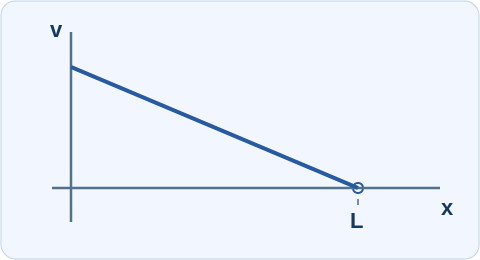
A zero of squared velocity at a spatial coordinate need not occur in finite time.

A forward velocity falls linearly with position towards zero at x = L.

A spatial graph can show a zero speed at a position that is only approached. Solve the time equation before saying that the particle stops there.

Worked example

Keep the physically valid branch up to a boundary

A particle starts from x=0x=0 with velocity 83 m s−1\frac{8}{3}\,\mathrm{m\,s^{-1}}. Its acceleration is a=4x9−169a=\frac{4 x}{9} - \frac{16}{9}. Find the velocity at x=83x=\frac{8}{3} metres and the limiting coordinate.

  1. Integrating with position gives v2=4x29−32x9+649v^2=\frac{4 x^{2}}{9} - \frac{32 x}{9} + \frac{64}{9}. For 0≤x<40\le x<4, choose v=83−2x3v=\frac{8}{3} - \frac{2 x}{3}.

  2. At the requested coordinate the velocity is 89 m s−1\frac{8}{9}\,\mathrm{m\,s^{-1}}. The limiting coordinate is 4 m4\,\mathrm m, approached as speed tends to zero.

Your turn

A particle starts from x=0x=0 with velocity 5 m s−15\,\mathrm{m\,s^{-1}}. Its acceleration is a=x−5a=x - 5. Find the velocity at x=103x=\frac{10}{3} metres and the limiting coordinate.

Enter an exact value or round to 3 significant figures.

Enter an exact number, for example 3/2 or 2-sqrt(3).

Worked example

Keep the physically valid branch up to a boundary

A particle starts from x=0x=0 with velocity 8 m s−18\,\mathrm{m\,s^{-1}}. Its acceleration is a=16x9−323a=\frac{16 x}{9} - \frac{32}{3}. Find the velocity at x=4x=4 metres and the limiting coordinate.

Try it on paper first.

  1. Integrating with position gives v2=16x29−64x3+64v^2=\frac{16 x^{2}}{9} - \frac{64 x}{3} + 64. For 0≤x<60\le x<6, choose v=8−4x3v=8 - \frac{4 x}{3}.

  2. At the requested coordinate the velocity is 83 m s−1\frac{8}{3}\,\mathrm{m\,s^{-1}}. The limiting coordinate is 6 m6\,\mathrm m, approached as speed tends to zero.

Your turn

A particle starts from x=0x=0 with velocity 353 m s−1\frac{35}{3}\,\mathrm{m\,s^{-1}}. Its acceleration is a=25x9−1759a=\frac{25 x}{9} - \frac{175}{9}. Find the velocity at x=143x=\frac{14}{3} metres and the limiting coordinate.

Enter an exact value or round to 3 significant figures.

Enter an exact number, for example 3/2 or 2-sqrt(3).

Worked examples

Practise the method

Core practice

Question 1 of 4

0 / 4 checked in this collection

Question list

Core practice

Fresh variants

Exam-style

The complete squared velocity and first turn

3 marks

A particle starts at x=0 moving forwards with speed squared 3232 m² s⁻². Its acceleration is −6x2-6x^2 m s⁻² for x≥0. Give the full polynomial v²(x), first turning position and signed acceleration there.

Enter an expression in x; use ^ for powers and / for fractions.

Enter an exact number, for example 3/2 or 2-sqrt(3).

Enter an exact number, for example 3/2 or 2-sqrt(3).

Full answer-format guide

Exact numbers: 3/2, sqrt(5), 2-sqrt(3), pi/6, 3*pi/2. Sets: {1,4}. Intervals: (3,5]; a round bracket excludes the endpoint. Infinity: inf; union: U; no solutions: empty. Separate coordinate pairs or triples with semicolons. Expressions: 2x^2+3x-1; equations: x^2=3x+1 or the polynomial equal to zero. Factors: x-1 ; x+2. Parameter fraction: numerator ; denominator. List integer answers individually.

Review the method

Progress stays in this browser. Create an account to save it or sign in.

Extra practice from this lesson

Choose the sign after solving for squared speed

At x=0x=0 a particle moves in the positive direction with speed 6 m s−16\,\mathrm{m\,s^{-1}}. Its acceleration is a=x+2a=x + 2 in SI units. Find its signed velocity at x=32x=\frac{3}{2} metres assuming it has not turned.

Enter an exact value or round to 3 significant figures.

Choose the sign after solving for squared speed

At x=0x=0 a particle moves in the negative direction with speed 6 m s−16\,\mathrm{m\,s^{-1}}. Its acceleration is a=x−2a=x - 2 in SI units. Find its signed velocity at x=−32x=- \frac{3}{2} metres assuming it has not turned.

Enter an exact value or round to 3 significant figures.

Locate a first stop from force as a function of x

At x=0x=0 a particle of mass 66 kilograms has rightwards velocity 47 m s−14 \sqrt{7}\,\mathrm{m\,s^{-1}}. The signed resultant force is F=−42xF=- 42 x newtons. Find the coordinate of its first stop.

Enter an exact number, for example 3/2 or 2-sqrt(3).

Separate with position as the independent variable

A particle has positive velocity 9 m s−19\,\mathrm{m\,s^{-1}} at x=0x=0. Its acceleration while moving forwards is a=−4v23a=- \frac{4 v^{2}}{3}. The speed becomes 94 m s−1\frac{9}{4}\,\mathrm{m\,s^{-1}} at distance Cln⁡4C\ln 4 metres. Find the exact coefficient CC.

Enter an exact number, for example 3/2 or 2-sqrt(3).

Keep the physically valid branch up to a boundary

A particle starts from x=0x=0 with velocity 16 m s−116\,\mathrm{m\,s^{-1}}. Its acceleration is a=4x−32a=4 x - 32. Find the velocity at x=163x=\frac{16}{3} metres and the limiting coordinate.

Enter an exact value or round to 3 significant figures.

Enter an exact number, for example 3/2 or 2-sqrt(3).

Apply it · original exam-style problems

Show your working on paper and compare it with the worked solution and marking guidance.

Come back to what needs practice

Quick revision sheet (A4)

Your review plan starts after your first check.