Maths4UBETA

Limiting speeds, finite travel and constant power

Use the force balance as a candidate limit, then prove reachability from the trajectory.

Try the quick check →
Lesson 4 of 4

Section 1 of 5 · Core · about 5 min

How do I tell whether a boundary is reached in finite time?

An exponential can remain positive for every finite time. Zero speed or a position at a boundary can then be a limit rather than an event.

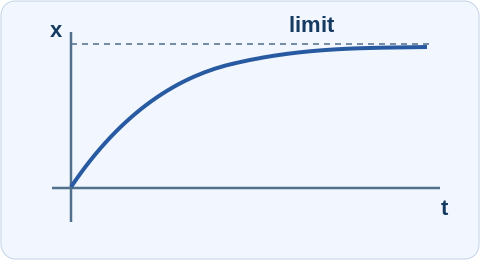
A position curve tends to a horizontal dashed line representing a finite limiting position.

The position can converge even though the particle never comes to rest at a finite time.

Worked example

Distinguish an approached boundary from a finite stop

A particle starts at the origin. In SI units the speed is v=83−2x3v=\frac{8}{3} - \frac{2 x}{3} while its position is below 44. Does it reach x=4x=4 in finite time? Give its limiting coordinate.

  1. Use dxdt=k(L−x)\frac{\mathrm dx}{\mathrm dt}=k(L-x) and separate. The initial condition gives x=4−4e−2t3x=4 - 4 e^{- \frac{2 t}{3}}.

  2. The exponential is positive at every finite time. Thus the limiting coordinate is 4 m4\,\mathrm m but the particle never arrives there at finite time.

Your turn

A particle starts at the origin. In SI units the speed is v=5−xv=5 - x while its position is below 55. Does it reach x=5x=5 in finite time? Give its limiting coordinate.

Reached in finite time

Enter an exact number, for example 3/2 or 2-sqrt(3).

Section 2 of 5 · Core · about 5 min

Can a particle travel a finite total distance without stopping?

Even when speed is positive at all finite times, cumulative displacement can converge.

Worked example

Find a finite limiting distance without a finite stop

A particle with initial velocity 6 m s−16\,\mathrm{m\,s^{-1}} coasts with acceleration a=−2v3a=- \frac{2 v}{3}. Find its limiting distance from its starting position and the distance at time 3log⁡(2)2 s\frac{3 \log{\left(2 \right)}}{2}\,\mathrm s.

  1. Separating gives v=6e−2t3v=6 e^{- \frac{2 t}{3}}. The speed stays positive at all finite times.

  2. Integrating velocity from zero gives x=9−9e−2t3x=9 - 9 e^{- \frac{2 t}{3}}.

  3. The limiting distance is 9 m9\,\mathrm m. At the stated time it has travelled 92 m\frac{9}{2}\,\mathrm m.

Your turn

A particle with initial velocity 7 m s−17\,\mathrm{m\,s^{-1}} coasts with acceleration a=−va=- v. Find its limiting distance from its starting position and the distance at time log⁡(3) s\log{\left(3 \right)}\,\mathrm s.

Enter an exact number, for example 3/2 or 2-sqrt(3).

Enter an exact value or round to 3 significant figures.

Section 3 of 5 · Core · about 7 min

How do I find time under a constant-power drive?

At positive speed, a constant-power engine produces less driving force as speed increases.

Worked example

Use constant power to obtain squared speed in time

A particle of mass 44 kilograms starts with positive speed 3 m s−13\,\mathrm{m\,s^{-1}}. It is driven on a smooth level track by an engine of constant power 90 W90\,\mathrm W. Find the time to reach speed 5 m s−15\,\mathrm{m\,s^{-1}}.

  1. Since P=FvP=Fv, Newton's second law gives mvdvdt=Pmv\frac{\mathrm dv}{\mathrm dt}=P on the positive-speed branch.

  2. Integrating gives v2=45t+9v^2=45 t + 9. The required time is 1645 s\frac{16}{45}\,\mathrm s.

Your turn

A particle of mass 55 kilograms starts with positive speed 4 m s−14\,\mathrm{m\,s^{-1}}. It is driven on a smooth level track by an engine of constant power 135 W135\,\mathrm W. Find the time to reach speed 7 m s−17\,\mathrm{m\,s^{-1}}.

Enter an exact value or round to 3 significant figures.

Worked example

Use constant power to obtain squared speed in time

A particle of mass 66 kilograms starts with positive speed 5 m s−15\,\mathrm{m\,s^{-1}}. It is driven on a smooth level track by an engine of constant power 180 W180\,\mathrm W. Find the time to reach speed 9 m s−19\,\mathrm{m\,s^{-1}}.

Try it on paper first.

  1. Since P=FvP=Fv, Newton's second law gives mvdvdt=Pmv\frac{\mathrm dv}{\mathrm dt}=P on the positive-speed branch.

  2. Integrating gives v2=60t+25v^2=60 t + 25. The required time is 1415 s\frac{14}{15}\,\mathrm s.

Your turn

A particle of mass 77 kilograms starts with positive speed 6 m s−16\,\mathrm{m\,s^{-1}}. It is driven on a smooth level track by an engine of constant power 225 W225\,\mathrm W. Find the time to reach speed 11 m s−111\,\mathrm{m\,s^{-1}}.

Enter an exact value or round to 3 significant figures.

Section 4 of 5 · Core · about 5 min

How do I find distance directly under constant power?

If the question gives two speeds and asks for distance, eliminate time using acceleration as a function of position.

Worked example

Use constant power with position as the variable

A particle of mass 44 kilograms starts with positive speed 3 m s−13\,\mathrm{m\,s^{-1}}. It is driven on a smooth level track by an engine of constant power 90 W90\,\mathrm W. Find the distance to reach speed 5 m s−15\,\mathrm{m\,s^{-1}}.

  1. Use F=PvF=\frac Pv and a=vdvdxa=v\frac{\mathrm dv}{\mathrm dx}. This gives mv2dvdx=Pmv^2\frac{\mathrm dv}{\mathrm dx}=P.

  2. Integrating gives v3=135x2+27v^3=\frac{135 x}{2} + 27. The requested distance is 196135 m\frac{196}{135}\,\mathrm m.

Your turn

A particle of mass 55 kilograms starts with positive speed 4 m s−14\,\mathrm{m\,s^{-1}}. It is driven on a smooth level track by an engine of constant power 135 W135\,\mathrm W. Find the distance to reach speed 7 m s−17\,\mathrm{m\,s^{-1}}.

Enter an exact value or round to 3 significant figures.

Section 5 of 5 · Core · about 7 min

How does constant resistance change the limiting speed?

The forward drive tends to decrease as speed increases. With fixed resistance, the balance speed is approached from a suitable positive-speed initial condition.

Worked example

Compare constant-power drive and resistance

A particle has mass 44 kilograms and constant engine power 90 W90\,\mathrm W. It moves along a horizontal track against constant resistance 907 N\frac{90}{7}\,\mathrm N. Find its positive limiting speed and signed acceleration at speed 5 m s−15\,\mathrm{m\,s^{-1}}.

  1. At positive speed the drive is Pv\frac Pv. Its balance with resistance identifies the limiting speed.

  2. The limiting speed is 7 m s−17\,\mathrm{m\,s^{-1}}. At the stated smaller speed driving force exceeds resistance.

  3. The acceleration from the force difference divided by mass is 97 m s−2\frac{9}{7}\,\mathrm{m\,s^{-2}}.

Your turn

A particle has mass 55 kilograms and constant engine power 135 W135\,\mathrm W. It moves along a horizontal track against constant resistance 15 N15\,\mathrm N. Find its positive limiting speed and signed acceleration at speed 7 m s−17\,\mathrm{m\,s^{-1}}.

Enter an exact number, for example 3/2 or 2-sqrt(3).

Enter an exact value or round to 3 significant figures.

Worked example

Compare constant-power drive and resistance

A particle has mass 66 kilograms and constant engine power 180 W180\,\mathrm W. It moves along a horizontal track against constant resistance 18011 N\frac{180}{11}\,\mathrm N. Find its positive limiting speed and signed acceleration at speed 9 m s−19\,\mathrm{m\,s^{-1}}.

Try it on paper first.

  1. At positive speed the drive is Pv\frac Pv. Its balance with resistance identifies the limiting speed.

  2. The limiting speed is 11 m s−111\,\mathrm{m\,s^{-1}}. At the stated smaller speed driving force exceeds resistance.

  3. The acceleration from the force difference divided by mass is 2033 m s−2\frac{20}{33}\,\mathrm{m\,s^{-2}}.

Your turn

A particle has mass 77 kilograms and constant engine power 225 W225\,\mathrm W. It moves along a horizontal track against constant resistance 22513 N\frac{225}{13}\,\mathrm N. Find its positive limiting speed and signed acceleration at speed 11 m s−111\,\mathrm{m\,s^{-1}}.

Enter an exact number, for example 3/2 or 2-sqrt(3).

Enter an exact value or round to 3 significant figures.

Worked examples

Practise the method

Core practice

Question 1 of 4

0 / 4 checked in this collection

Question list

Core practice

Fresh variants

Exam-style

Both driven trajectories and a finite target time

5 marks

A particle starts from rest at O under dv/dt=12−2vdv/dt=12-2v. Write v=L+Be−ctv=L+B e^{-ct}, x=Lt+D(1−e−ct)x=Lt+D(1-e^{-ct}), and the first half-limit time as T=Kln⁡2T=K\ln2, using the known c from the law. Give L, B, D, K and initial acceleration.

Enter the value on its own or write L = … . Fractions and exact square roots are accepted.

Enter the value on its own or write B = … . Fractions and exact square roots are accepted.

Enter the value on its own or write D = … . Fractions and exact square roots are accepted.

Enter an exact value or round to 3 significant figures.

Enter an exact number, for example 3/2 or 2-sqrt(3).

Full answer-format guide

Exact numbers: 3/2, sqrt(5), 2-sqrt(3), pi/6, 3*pi/2. Sets: {1,4}. Intervals: (3,5]; a round bracket excludes the endpoint. Infinity: inf; union: U; no solutions: empty. Separate coordinate pairs or triples with semicolons. Expressions: 2x^2+3x-1; equations: x^2=3x+1 or the polynomial equal to zero. Factors: x-1 ; x+2. Parameter fraction: numerator ; denominator. List integer answers individually.

Review the method

Progress stays in this browser. Create an account to save it or sign in.

Extra practice from this lesson

Distinguish an approached boundary from a finite stop

A particle starts at the origin. In SI units the speed is v=8−4x3v=8 - \frac{4 x}{3} while its position is below 66. Does it reach x=6x=6 in finite time? Give its limiting coordinate.

Reached in finite time

Enter an exact number, for example 3/2 or 2-sqrt(3).

Find a finite limiting distance without a finite stop

A particle with initial velocity 8 m s−18\,\mathrm{m\,s^{-1}} coasts with acceleration a=−4v3a=- \frac{4 v}{3}. Find its limiting distance from its starting position and the distance at time 3log⁡(4)4 s\frac{3 \log{\left(4 \right)}}{4}\,\mathrm s.

Enter an exact number, for example 3/2 or 2-sqrt(3).

Enter an exact value or round to 3 significant figures.

Use constant power to obtain squared speed in time

A particle of mass 88 kilograms starts with positive speed 7 m s−17\,\mathrm{m\,s^{-1}}. It is driven on a smooth level track by an engine of constant power 270 W270\,\mathrm W. Find the time to reach speed 13 m s−113\,\mathrm{m\,s^{-1}}.

Enter an exact value or round to 3 significant figures.

Use constant power with position as the variable

A particle of mass 66 kilograms starts with positive speed 5 m s−15\,\mathrm{m\,s^{-1}}. It is driven on a smooth level track by an engine of constant power 180 W180\,\mathrm W. Find the distance to reach speed 9 m s−19\,\mathrm{m\,s^{-1}}.

Enter an exact value or round to 3 significant figures.

Compare constant-power drive and resistance

A particle has mass 88 kilograms and constant engine power 270 W270\,\mathrm W. It moves along a horizontal track against constant resistance 18 N18\,\mathrm N. Find its positive limiting speed and signed acceleration at speed 13 m s−113\,\mathrm{m\,s^{-1}}.

Enter an exact number, for example 3/2 or 2-sqrt(3).

Enter an exact value or round to 3 significant figures.

Apply it · original exam-style problems

Show your working on paper and compare it with the worked solution and marking guidance.

Come back to what needs practice

Quick revision sheet (A4)

Your review plan starts after your first check.