Maths4UBETA

Smooth fixed surfaces and rebound geometry

Resolve normal and tangential velocities; connect the rebound to angles, energy and the next flight.

Try the quick check →
Lesson 2 of 4

Section 1 of 5 · Core · about 5 min

Which component can a smooth wall change?

A smooth wall exerts a perpendicular impulse, so the tangential component of the sphere’s momentum cannot change during that collision.

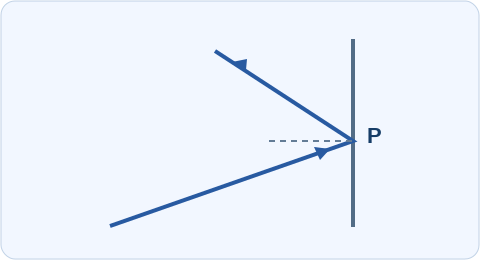
An incident path approaches a vertical wall at P. Its rebounding path leaves the wall while continuing in the same tangential sense.

The smooth wall changes only the normal component. The two path angles are measured relative to the wall itself.

Worked example

Apply restitution normal to a smooth wall

A sphere of mass 11 kilograms strikes a fixed smooth vertical wall. Before impact its signed velocity perpendicular to the wall is −4 m s−1-4\,\mathrm{m\,s^{-1}}, taking away from the wall as positive. Its signed component parallel to the wall is 52 m s−1\frac{5}{2}\,\mathrm{m\,s^{-1}}. The coefficient of restitution is 16\frac{1}{6}. Give both outgoing signed components.

  1. Reverse the normal component and multiply its magnitude by the restitution coefficient.

  2. There is no tangential impulse. The final normal component is 23 m s−1\frac{2}{3}\,\mathrm{m\,s^{-1}} and the parallel component remains 52 m s−1\frac{5}{2}\,\mathrm{m\,s^{-1}}.

Your turn

A sphere of mass 32\frac{3}{2} kilograms strikes a fixed smooth vertical wall. Before impact its signed velocity perpendicular to the wall is −5 m s−1-5\,\mathrm{m\,s^{-1}}, taking away from the wall as positive. Its signed component parallel to the wall is 3 m s−13\,\mathrm{m\,s^{-1}}. The coefficient of restitution is 13\frac{1}{3}. Give both outgoing signed components.

Enter an exact value or round to 3 significant figures.

Enter an exact number, for example 3/2 or 2-sqrt(3).

Section 2 of 5 · Core · about 5 min

How do I state the rebound speed and angle?

Use the two outgoing components to form a right triangle, then measure the angle from the reference requested.

Worked example

Apply restitution normal to a smooth wall

A sphere of mass 11 kilograms strikes a fixed smooth vertical wall. Before impact its signed velocity perpendicular to the wall is −4 m s−1-4\,\mathrm{m\,s^{-1}}, taking away from the wall as positive. Its signed component parallel to the wall is 52 m s−1\frac{5}{2}\,\mathrm{m\,s^{-1}}. The coefficient of restitution is 16\frac{1}{6}. Find its exact speed and the tangent of its acute rebound angle to the wall.

  1. The two outgoing components are 23 m s−1\frac{2}{3}\,\mathrm{m\,s^{-1}} normal and 52 m s−1\frac{5}{2}\,\mathrm{m\,s^{-1}} parallel.

  2. Pythagoras gives exact speed 2416 m s−1\frac{\sqrt{241}}{6}\,\mathrm{m\,s^{-1}}. The angle to the wall has tangent 415\frac{4}{15}.

Your turn

A sphere of mass 32\frac{3}{2} kilograms strikes a fixed smooth vertical wall. Before impact its signed velocity perpendicular to the wall is −5 m s−1-5\,\mathrm{m\,s^{-1}}, taking away from the wall as positive. Its signed component parallel to the wall is 3 m s−13\,\mathrm{m\,s^{-1}}. The coefficient of restitution is 13\frac{1}{3}. Find its exact speed and the tangent of its acute rebound angle to the wall.

Enter an exact number, for example 3/2 or 2-sqrt(3).

Enter an exact value or round to 3 significant figures.

Section 3 of 5 · Core · about 7 min

How can I use a rebound angle to find restitution?

On a smooth wall the tangential speed carried through the collision links the rebound angle to the outgoing normal speed.

Worked example

Apply restitution normal to a smooth wall

A sphere of mass 11 kilograms strikes a fixed smooth vertical wall. Before impact its signed velocity perpendicular to the wall is −4 m s−1-4\,\mathrm{m\,s^{-1}}, taking away from the wall as positive. Its signed component parallel to the wall is 52 m s−1\frac{5}{2}\,\mathrm{m\,s^{-1}}. The tangent of the angle its outgoing velocity makes with the wall is 415\frac{4}{15}. Find the coefficient of restitution and the magnitude of the impulse.

  1. Smooth contact leaves the velocity parallel to the wall unchanged. The outgoing normal component is the tangent of the rebound angle multiplied by that parallel speed.

  2. This gives normal rebound speed 23 m s−1\frac{2}{3}\,\mathrm{m\,s^{-1}}, so e=16e=\frac{1}{6}.

  3. The change of normal momentum gives impulse magnitude 143 N s\frac{14}{3}\,\mathrm{N\,s}.

Your turn

A sphere of mass 32\frac{3}{2} kilograms strikes a fixed smooth vertical wall. Before impact its signed velocity perpendicular to the wall is −5 m s−1-5\,\mathrm{m\,s^{-1}}, taking away from the wall as positive. Its signed component parallel to the wall is 3 m s−13\,\mathrm{m\,s^{-1}}. The tangent of the angle its outgoing velocity makes with the wall is 59\frac{5}{9}. Find the coefficient of restitution and the magnitude of the impulse.

Enter an exact value or round to 3 significant figures.

Enter an exact number, for example 3/2 or 2-sqrt(3).

Worked example

Apply restitution normal to a smooth wall

A sphere of mass 22 kilograms strikes a fixed smooth vertical wall. Before impact its signed velocity perpendicular to the wall is −6 m s−1-6\,\mathrm{m\,s^{-1}}, taking away from the wall as positive. Its signed component parallel to the wall is 72 m s−1\frac{7}{2}\,\mathrm{m\,s^{-1}}. The tangent of the angle its outgoing velocity makes with the wall is 67\frac{6}{7}. Find the coefficient of restitution and the magnitude of the impulse.

Try it on paper first.

  1. Smooth contact leaves the velocity parallel to the wall unchanged. The outgoing normal component is the tangent of the rebound angle multiplied by that parallel speed.

  2. This gives normal rebound speed 3 m s−13\,\mathrm{m\,s^{-1}}, so e=12e=\frac{1}{2}.

  3. The change of normal momentum gives impulse magnitude 18 N s18\,\mathrm{N\,s}.

Your turn

A sphere of mass 52\frac{5}{2} kilograms strikes a fixed smooth vertical wall. Before impact its signed velocity perpendicular to the wall is −7 m s−1-7\,\mathrm{m\,s^{-1}}, taking away from the wall as positive. Its signed component parallel to the wall is 4 m s−14\,\mathrm{m\,s^{-1}}. The tangent of the angle its outgoing velocity makes with the wall is 76\frac{7}{6}. Find the coefficient of restitution and the magnitude of the impulse.

Enter an exact value or round to 3 significant figures.

Enter an exact value or round to 3 significant figures.

Section 4 of 5 · Core · about 5 min

Why does tangential motion cancel in the energy loss?

The wall changes the sphere's normal momentum. Its unchanged tangential speed contributes the same energy before and after.

Worked example

Apply restitution normal to a smooth wall

A sphere of mass 11 kilograms strikes a fixed smooth vertical wall. Before impact its signed velocity perpendicular to the wall is −4 m s−1-4\,\mathrm{m\,s^{-1}}, taking away from the wall as positive. Its signed component parallel to the wall is 52 m s−1\frac{5}{2}\,\mathrm{m\,s^{-1}}. The coefficient of restitution is 16\frac{1}{6}. Find the energy loss and impulse magnitude.

  1. Only the normal velocity changes, from −4 m s−1-4\,\mathrm{m\,s^{-1}} to 23 m s−1\frac{2}{3}\,\mathrm{m\,s^{-1}}.

  2. The tangential KE cancels. The energy loss is 709 J\frac{70}{9}\,\mathrm J and impulse magnitude 143 N s\frac{14}{3}\,\mathrm{N\,s}.

Your turn

A sphere of mass 32\frac{3}{2} kilograms strikes a fixed smooth vertical wall. Before impact its signed velocity perpendicular to the wall is −5 m s−1-5\,\mathrm{m\,s^{-1}}, taking away from the wall as positive. Its signed component parallel to the wall is 3 m s−13\,\mathrm{m\,s^{-1}}. The coefficient of restitution is 13\frac{1}{3}. Find the energy loss and impulse magnitude.

Enter an exact value or round to 3 significant figures.

Enter an exact number, for example 3/2 or 2-sqrt(3).

Section 5 of 5 · Core · about 7 min

What changes if the surface is the floor?

A smooth horizontal floor affects vertical velocity only. Once contact ends, the outgoing components initialise a new projectile stage.

Worked example

Find the maximum height after an oblique floor impact

A ball strikes a fixed smooth level floor with horizontal speed 4 m s−14\,\mathrm{m\,s^{-1}} and downwards speed 5 m s−15\,\mathrm{m\,s^{-1}}. Restitution is 27\frac{2}{7}. Take g=10 m s−2g=10\,\mathrm{m\,s^{-2}}. Find its vertical rise and the horizontal distance to the next impact.

  1. Horizontal speed is unchanged, and restitution gives upwards speed 107 m s−1\frac{10}{7}\,\mathrm{m\,s^{-1}}.

  2. Use vertical constant acceleration after the impact. The height gain is 549 m\frac{5}{49}\,\mathrm m and the non-zero return time is 27 s\frac{2}{7}\,\mathrm s.

  3. The horizontal distance before the next impact is 87 m\frac{8}{7}\,\mathrm m.

Your turn

A ball strikes a fixed smooth level floor with horizontal speed 5 m s−15\,\mathrm{m\,s^{-1}} and downwards speed 6 m s−16\,\mathrm{m\,s^{-1}}. Restitution is 37\frac{3}{7}. Take g=10 m s−2g=10\,\mathrm{m\,s^{-2}}. Find its vertical rise and the horizontal distance to the next impact.

Enter an exact value or round to 3 significant figures.

Enter an exact value or round to 3 significant figures.

Worked example

Find the maximum height after an oblique floor impact

A ball strikes a fixed smooth level floor with horizontal speed 6 m s−16\,\mathrm{m\,s^{-1}} and downwards speed 7 m s−17\,\mathrm{m\,s^{-1}}. Restitution is 47\frac{4}{7}. Take g=10 m s−2g=10\,\mathrm{m\,s^{-2}}. Find its vertical rise and the horizontal distance to the next impact.

Try it on paper first.

  1. Horizontal speed is unchanged, and restitution gives upwards speed 4 m s−14\,\mathrm{m\,s^{-1}}.

  2. Use vertical constant acceleration after the impact. The height gain is 45 m\frac{4}{5}\,\mathrm m and the non-zero return time is 45 s\frac{4}{5}\,\mathrm s.

  3. The horizontal distance before the next impact is 245 m\frac{24}{5}\,\mathrm m.

Your turn

A ball strikes a fixed smooth level floor with horizontal speed 7 m s−17\,\mathrm{m\,s^{-1}} and downwards speed 8 m s−18\,\mathrm{m\,s^{-1}}. Restitution is 57\frac{5}{7}. Take g=10 m s−2g=10\,\mathrm{m\,s^{-2}}. Find its vertical rise and the horizontal distance to the next impact.

Enter an exact value or round to 3 significant figures.

Enter an exact number, for example 3/2 or 2-sqrt(3).

Worked examples

Practise the method

Core practice

Question 1 of 4

0 / 4 checked in this collection

Question list

Core practice

Fresh variants

Exam-style

The complete wall rebound and impulse

5 marks

A particle of mass 33 kg reaches x=0 from x>0 with velocity (−8,6)(-8,6) m s⁻¹. The wall is smooth and e=12e=\frac{1}{2}. Give both outgoing velocity components, both impulse components and the energy lost.

Enter an exact number, for example 3/2 or 2-sqrt(3).

Enter an exact number, for example 3/2 or 2-sqrt(3).

Enter an exact number, for example 3/2 or 2-sqrt(3).

Enter an exact number, for example 3/2 or 2-sqrt(3).

Enter an exact number, for example 3/2 or 2-sqrt(3).

Full answer-format guide

Exact numbers: 3/2, sqrt(5), 2-sqrt(3), pi/6, 3*pi/2. Sets: {1,4}. Intervals: (3,5]; a round bracket excludes the endpoint. Infinity: inf; union: U; no solutions: empty. Separate coordinate pairs or triples with semicolons. Expressions: 2x^2+3x-1; equations: x^2=3x+1 or the polynomial equal to zero. Factors: x-1 ; x+2. Parameter fraction: numerator ; denominator. List integer answers individually.

Review the method

Progress stays in this browser. Create an account to save it or sign in.

Extra practice from this lesson

Apply restitution normal to a smooth wall

A sphere of mass 22 kilograms strikes a fixed smooth vertical wall. Before impact its signed velocity perpendicular to the wall is −6 m s−1-6\,\mathrm{m\,s^{-1}}, taking away from the wall as positive. Its signed component parallel to the wall is 72 m s−1\frac{7}{2}\,\mathrm{m\,s^{-1}}. The coefficient of restitution is 12\frac{1}{2}. Give both outgoing signed components.

Enter an exact number, for example 3/2 or 2-sqrt(3).

Enter an exact value or round to 3 significant figures.

Apply restitution normal to a smooth wall

A sphere of mass 22 kilograms strikes a fixed smooth vertical wall. Before impact its signed velocity perpendicular to the wall is −6 m s−1-6\,\mathrm{m\,s^{-1}}, taking away from the wall as positive. Its signed component parallel to the wall is 72 m s−1\frac{7}{2}\,\mathrm{m\,s^{-1}}. The coefficient of restitution is 12\frac{1}{2}. Find its exact speed and the tangent of its acute rebound angle to the wall.

Enter an exact number, for example 3/2 or 2-sqrt(3).

Enter an exact value or round to 3 significant figures.

Apply restitution normal to a smooth wall

A sphere of mass 33 kilograms strikes a fixed smooth vertical wall. Before impact its signed velocity perpendicular to the wall is −8 m s−1-8\,\mathrm{m\,s^{-1}}, taking away from the wall as positive. Its signed component parallel to the wall is 92 m s−1\frac{9}{2}\,\mathrm{m\,s^{-1}}. The tangent of the angle its outgoing velocity makes with the wall is 4027\frac{40}{27}. Find the coefficient of restitution and the magnitude of the impulse.

Enter an exact value or round to 3 significant figures.

Enter an exact number, for example 3/2 or 2-sqrt(3).

Apply restitution normal to a smooth wall

A sphere of mass 22 kilograms strikes a fixed smooth vertical wall. Before impact its signed velocity perpendicular to the wall is −6 m s−1-6\,\mathrm{m\,s^{-1}}, taking away from the wall as positive. Its signed component parallel to the wall is 72 m s−1\frac{7}{2}\,\mathrm{m\,s^{-1}}. The coefficient of restitution is 12\frac{1}{2}. Find the energy loss and impulse magnitude.

Enter an exact number, for example 3/2 or 2-sqrt(3).

Enter an exact number, for example 3/2 or 2-sqrt(3).

Find the maximum height after an oblique floor impact

A ball strikes a fixed smooth level floor with horizontal speed 8 m s−18\,\mathrm{m\,s^{-1}} and downwards speed 9 m s−19\,\mathrm{m\,s^{-1}}. Restitution is 67\frac{6}{7}. Take g=10 m s−2g=10\,\mathrm{m\,s^{-2}}. Find its vertical rise and the horizontal distance to the next impact.

Enter an exact value or round to 3 significant figures.

Enter an exact value or round to 3 significant figures.

Apply it · original exam-style problems

Show your working on paper and compare it with the worked solution and marking guidance.

Come back to what needs practice

Quick revision sheet (A4)

Your review plan starts after your first check.