Maths4UBETA

Successive impacts and deciding the next event

Carry the current state from one event to the next, and distinguish finite stages from a limiting infinite sequence.

Try the quick check →
Lesson 4 of 4

Section 1 of 5 · Core · about 5 min

How can I decide which of two walls is reached first?

Resolve displacement and velocity towards each contact line. The first event changes variables only after its own time.

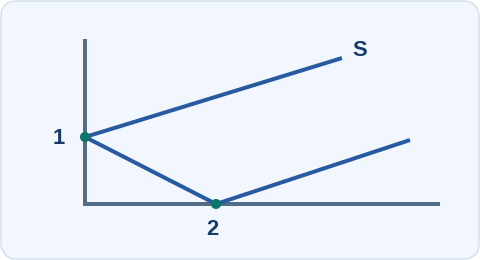
In a right-angle corner, a path from S hits the vertical line first, then the horizontal line.

The first wall changes only its normal component. Compare event times before deciding the sequence.

Worked example

Track one normal change per perpendicular wall

A smooth sphere moves on a smooth level floor near two perpendicular walls. Distances of its centre from the corresponding contact lines are 3 m3\,\mathrm m in x and 163 m\frac{16}{3}\,\mathrm m in y. Its initial signed velocity components are (−3,−4)\left(-3,-4\right) in SI units. Restitution is 12\frac{1}{2} with the x-contact line and 23\frac{2}{3} with the y-contact line. Give which contact occurs first and both times measured from the start.

  1. The candidate times without impact are 1 s1\,\mathrm s for the x-contact line and 43 s\frac{4}{3}\,\mathrm s for the y-contact line.

  2. The first is the x contact. Reset its normal velocity using restitution. The other velocity component is unchanged until its own contact.

  3. The second contact is still at 43 s\frac{4}{3}\,\mathrm s from the original start, because the first impulse does not change the component towards the other wall.

Your turn

A smooth sphere moves on a smooth level floor near two perpendicular walls. Distances of its centre from the corresponding contact lines are 263 m\frac{26}{3}\,\mathrm m in x and 152 m\frac{15}{2}\,\mathrm m in y. Its initial signed velocity components are (−4,−5)\left(-4,-5\right) in SI units. Restitution is 12\frac{1}{2} with the x-contact line and 23\frac{2}{3} with the y-contact line. Give which contact occurs first and both times measured from the start.

First contact

Enter an exact value or round to 3 significant figures.

Enter an exact value or round to 3 significant figures.

Section 2 of 5 · Core · about 5 min

Which velocity do I use after both walls?

Two impacts happen at different times and their normal directions may differ.

Worked example

Track one normal change per perpendicular wall

A smooth sphere moves on a smooth level floor near two perpendicular walls. Distances of its centre from the corresponding contact lines are 3 m3\,\mathrm m in x and 163 m\frac{16}{3}\,\mathrm m in y. Its initial signed velocity components are (−3,−4)\left(-3,-4\right) in SI units. Restitution is 12\frac{1}{2} with the x-contact line and 23\frac{2}{3} with the y-contact line. Find the final signed components immediately after both impacts.

  1. The candidate times without impact are 1 s1\,\mathrm s for the x-contact line and 43 s\frac{4}{3}\,\mathrm s for the y-contact line.

  2. The first is the x contact. Reset its normal velocity using restitution. The other velocity component is unchanged until its own contact.

  3. Apply the other restitution after the second wall. The final signed component pair is (32,83)\left(\frac{3}{2},\frac{8}{3}\right) in SI units.

Your turn

A smooth sphere moves on a smooth level floor near two perpendicular walls. Distances of its centre from the corresponding contact lines are 263 m\frac{26}{3}\,\mathrm m in x and 152 m\frac{15}{2}\,\mathrm m in y. Its initial signed velocity components are (−4,−5)\left(-4,-5\right) in SI units. Restitution is 12\frac{1}{2} with the x-contact line and 23\frac{2}{3} with the y-contact line. Find the final signed components immediately after both impacts.

Enter the value on its own or write x = … . Fractions and exact square roots are accepted.

Enter an exact value or round to 3 significant figures.

Section 3 of 5 · Core · about 7 min

When do two spheres collide again?

After each event compute all relevant velocities and separations. If a new closing speed is positive, divide the current gap by it.

Worked example

Find the delay before two earlier participants meet again

Three identical smooth spheres A, B and C lie in order on a smooth straight track. A hits stationary B at speed 6 m s−16\,\mathrm{m\,s^{-1}}. At that instant the gap between B and stationary C is 32 m\frac{3}{2}\,\mathrm m. The coefficient of restitution at each contact is 27\frac{2}{7}. Find the elapsed time from impact AB to impact BC, then the delay from impact BC to the next impact AB.

  1. Immediately after impact AB, speeds of A and B are 157 m s−1\frac{15}{7}\,\mathrm{m\,s^{-1}} and 277 m s−1\frac{27}{7}\,\mathrm{m\,s^{-1}}. B moves away from A and closes the gap to C in 718 s\frac{7}{18}\,\mathrm s.

  2. After the collision with C, B slows to 13598 m s−1\frac{135}{98}\,\mathrm{m\,s^{-1}}, while C leaves faster than B. At that instant the gap AB has grown to 23 m\frac{2}{3}\,\mathrm m.

  3. The faster A now closes on B. The elapsed time to BC is 718 s\frac{7}{18}\,\mathrm s and the extra delay to the next AB contact is 196225 s\frac{196}{225}\,\mathrm s.

Your turn

Three identical smooth spheres A, B and C lie in order on a smooth straight track. A hits stationary B at speed 7 m s−17\,\mathrm{m\,s^{-1}}. At that instant the gap between B and stationary C is 2 m2\,\mathrm m. The coefficient of restitution at each contact is 37\frac{3}{7}. Find the elapsed time from impact AB to impact BC, then the delay from impact BC to the next impact AB.

Enter an exact value or round to 3 significant figures.

Enter an exact value or round to 3 significant figures.

Worked example

Find the delay before two earlier participants meet again

Three identical smooth spheres A, B and C lie in order on a smooth straight track. A hits stationary B at speed 8 m s−18\,\mathrm{m\,s^{-1}}. At that instant the gap between B and stationary C is 52 m\frac{5}{2}\,\mathrm m. The coefficient of restitution at each contact is 47\frac{4}{7}. Find the elapsed time from impact AB to impact BC, then the delay from impact BC to the next impact AB.

Try it on paper first.

  1. Immediately after impact AB, speeds of A and B are 127 m s−1\frac{12}{7}\,\mathrm{m\,s^{-1}} and 447 m s−1\frac{44}{7}\,\mathrm{m\,s^{-1}}. B moves away from A and closes the gap to C in 3588 s\frac{35}{88}\,\mathrm s.

  2. After the collision with C, B slows to 6649 m s−1\frac{66}{49}\,\mathrm{m\,s^{-1}}, while C leaves faster than B. At that instant the gap AB has grown to 2011 m\frac{20}{11}\,\mathrm m.

  3. The faster A now closes on B. The elapsed time to BC is 3588 s\frac{35}{88}\,\mathrm s and the extra delay to the next AB contact is 49099 s\frac{490}{99}\,\mathrm s.

Your turn

Three identical smooth spheres A, B and C lie in order on a smooth straight track. A hits stationary B at speed 9 m s−19\,\mathrm{m\,s^{-1}}. At that instant the gap between B and stationary C is 3 m3\,\mathrm m. The coefficient of restitution at each contact is 57\frac{5}{7}. Find the elapsed time from impact AB to impact BC, then the delay from impact BC to the next impact AB.

Enter an exact value or round to 3 significant figures.

Enter an exact value or round to 3 significant figures.

Section 4 of 5 · Core · about 5 min

Which momentum law belongs at which event?

A wall collision gives momentum to an external support. A later collision between spheres can use their combined momentum if there is no external impulse along their line.

Worked example

Allow for a wall impulse before the next sphere collision

Sphere A of mass 33 kilograms moves right at 7 m s−17\,\mathrm{m\,s^{-1}} on a smooth track. Its centre must travel 2 m2\,\mathrm m before hitting a wall. After rebounding, it must travel 6 m6\,\mathrm m left to meet stationary sphere B, of mass 44 kilograms. The restitution with the wall is 12\frac{1}{2} and with B is 27\frac{2}{7}. Find time from the initial state to meeting B and B's speed immediately afterwards.

  1. The wall is reached in 27 s\frac{2}{7}\,\mathrm s. The wall changes A’s speed to 72 m s−1\frac{7}{2}\,\mathrm{m\,s^{-1}} leftwards, so the extra time before B is 127 s\frac{12}{7}\,\mathrm s.

  2. At impact with B, choose left as positive. Conserve momentum for the two spheres and use restitution. B leaves at speed 2714 m s−1\frac{27}{14}\,\mathrm{m\,s^{-1}}.

  3. The total time is 2 s2\,\mathrm s.

Your turn

Sphere A of mass 44 kilograms moves right at 8 m s−18\,\mathrm{m\,s^{-1}} on a smooth track. Its centre must travel 3 m3\,\mathrm m before hitting a wall. After rebounding, it must travel 7 m7\,\mathrm m left to meet stationary sphere B, of mass 55 kilograms. The restitution with the wall is 12\frac{1}{2} and with B is 37\frac{3}{7}. Find time from the initial state to meeting B and B's speed immediately afterwards.

Enter an exact value or round to 3 significant figures.

Enter an exact value or round to 3 significant figures.

Section 5 of 5 · Core · about 7 min

Why do successive flights take less time?

The normal approach speed is carried from each flight into the next impact. The horizontal velocity is unchanged at every smooth-floor collision.

Worked example

Carry the changing normal speed through repeated bounces

Immediately after a bounce from a smooth level floor, a ball has upwards speed 5 m s−15\,\mathrm{m\,s^{-1}} and horizontal speed 7 m s−17\,\mathrm{m\,s^{-1}}. The coefficient of restitution for further bounces is 27\frac{2}{7}. Take g=10 m s−2g=10\,\mathrm{m\,s^{-2}}. Find the duration of the second of the next two flights and the total horizontal distance across both flights.

  1. The first flight lasts 1 s1\,\mathrm s, and the ball returns with downward speed equal to the preceding upward speed.

  2. On its next rebound, the vertical component is multiplied by restitution. The second flight lasts 27 s\frac{2}{7}\,\mathrm s.

  3. The same horizontal component applies in each flight. The total horizontal distance is 9 m9\,\mathrm m.

Your turn

Immediately after a bounce from a smooth level floor, a ball has upwards speed 6 m s−16\,\mathrm{m\,s^{-1}} and horizontal speed 8 m s−18\,\mathrm{m\,s^{-1}}. The coefficient of restitution for further bounces is 37\frac{3}{7}. Take g=10 m s−2g=10\,\mathrm{m\,s^{-2}}. Find the duration of the second of the next two flights and the total horizontal distance across both flights.

Enter an exact value or round to 3 significant figures.

Enter an exact value or round to 3 significant figures.

Worked example

Carry the changing normal speed through repeated bounces

Immediately after a bounce from a smooth level floor, a ball has upwards speed 7 m s−17\,\mathrm{m\,s^{-1}} and horizontal speed 9 m s−19\,\mathrm{m\,s^{-1}}. The coefficient of restitution for further bounces is 47\frac{4}{7}. Take g=10 m s−2g=10\,\mathrm{m\,s^{-2}}. Find the duration of the second of the next two flights and the total horizontal distance across both flights.

Try it on paper first.

  1. The first flight lasts 75 s\frac{7}{5}\,\mathrm s, and the ball returns with downward speed equal to the preceding upward speed.

  2. On its next rebound, the vertical component is multiplied by restitution. The second flight lasts 45 s\frac{4}{5}\,\mathrm s.

  3. The same horizontal component applies in each flight. The total horizontal distance is 995 m\frac{99}{5}\,\mathrm m.

Your turn

Immediately after a bounce from a smooth level floor, a ball has upwards speed 8 m s−18\,\mathrm{m\,s^{-1}} and horizontal speed 10 m s−110\,\mathrm{m\,s^{-1}}. The coefficient of restitution for further bounces is 57\frac{5}{7}. Take g=10 m s−2g=10\,\mathrm{m\,s^{-2}}. Find the duration of the second of the next two flights and the total horizontal distance across both flights.

Enter an exact value or round to 3 significant figures.

Enter an exact value or round to 3 significant figures.

Worked examples

Practise the method

Core practice

Question 1 of 4

0 / 4 checked in this collection

Question list

Core practice

Fresh variants

Exam-style

The complete state after two successive pair impacts

6 marks

Three equal particles A, B and C move on a smooth line. At t=0, A strikes stationary B at x=0 with velocity +66 m s⁻¹. C is at rest at x=44 m. Let eAB=13e_{AB}=\frac{1}{3}, eBC=0e_{BC}=0. Give the time and position of the B–C contact, all three velocities just after it, and the A–B gap then.

Enter an exact number, for example 3/2 or 2-sqrt(3).

Enter an exact number, for example 3/2 or 2-sqrt(3).

Enter an exact number, for example 3/2 or 2-sqrt(3).

Enter an exact number, for example 3/2 or 2-sqrt(3).

Enter an exact number, for example 3/2 or 2-sqrt(3).

Enter an exact number, for example 3/2 or 2-sqrt(3).

Full answer-format guide

Exact numbers: 3/2, sqrt(5), 2-sqrt(3), pi/6, 3*pi/2. Sets: {1,4}. Intervals: (3,5]; a round bracket excludes the endpoint. Infinity: inf; union: U; no solutions: empty. Separate coordinate pairs or triples with semicolons. Expressions: 2x^2+3x-1; equations: x^2=3x+1 or the polynomial equal to zero. Factors: x-1 ; x+2. Parameter fraction: numerator ; denominator. List integer answers individually.

Review the method

Progress stays in this browser. Create an account to save it or sign in.

Extra practice from this lesson

Track one normal change per perpendicular wall

A smooth sphere moves on a smooth level floor near two perpendicular walls. Distances of its centre from the corresponding contact lines are 10 m10\,\mathrm m in x and 18 m18\,\mathrm m in y. Its initial signed velocity components are (−5,−6)\left(-5,-6\right) in SI units. Restitution is 12\frac{1}{2} with the x-contact line and 23\frac{2}{3} with the y-contact line. Give which contact occurs first and both times measured from the start.

First contact

Enter an exact number, for example 3/2 or 2-sqrt(3).

Enter an exact number, for example 3/2 or 2-sqrt(3).

Track one normal change per perpendicular wall

A smooth sphere moves on a smooth level floor near two perpendicular walls. Distances of its centre from the corresponding contact lines are 10 m10\,\mathrm m in x and 18 m18\,\mathrm m in y. Its initial signed velocity components are (−5,−6)\left(-5,-6\right) in SI units. Restitution is 12\frac{1}{2} with the x-contact line and 23\frac{2}{3} with the y-contact line. Find the final signed components immediately after both impacts.

Enter an exact value or round to 3 significant figures.

Enter the value on its own or write y = … . Fractions and exact square roots are accepted.

Find the delay before two earlier participants meet again

Three identical smooth spheres A, B and C lie in order on a smooth straight track. A hits stationary B at speed 10 m s−110\,\mathrm{m\,s^{-1}}. At that instant the gap between B and stationary C is 72 m\frac{7}{2}\,\mathrm m. The coefficient of restitution at each contact is 67\frac{6}{7}. Find the elapsed time from impact AB to impact BC, then the delay from impact BC to the next impact AB.

Enter an exact value or round to 3 significant figures.

Enter an exact value or round to 3 significant figures.

Allow for a wall impulse before the next sphere collision

Sphere A of mass 55 kilograms moves right at 9 m s−19\,\mathrm{m\,s^{-1}} on a smooth track. Its centre must travel 4 m4\,\mathrm m before hitting a wall. After rebounding, it must travel 8 m8\,\mathrm m left to meet stationary sphere B, of mass 66 kilograms. The restitution with the wall is 12\frac{1}{2} and with B is 47\frac{4}{7}. Find time from the initial state to meeting B and B's speed immediately afterwards.

Enter an exact value or round to 3 significant figures.

Enter an exact value or round to 3 significant figures.

Carry the changing normal speed through repeated bounces

Immediately after a bounce from a smooth level floor, a ball has upwards speed 9 m s−19\,\mathrm{m\,s^{-1}} and horizontal speed 11 m s−111\,\mathrm{m\,s^{-1}}. The coefficient of restitution for further bounces is 67\frac{6}{7}. Take g=10 m s−2g=10\,\mathrm{m\,s^{-2}}. Find the duration of the second of the next two flights and the total horizontal distance across both flights.

Enter an exact value or round to 3 significant figures.

Enter an exact value or round to 3 significant figures.

Apply it · original exam-style problems

Show your working on paper and compare it with the worked solution and marking guidance.

Come back to what needs practice

Quick revision sheet (A4)

Your review plan starts after your first check.