Maths4UBETA

Signed impulse, direct impact and energy

Use a signed momentum balance, identify the system and separate restitution from energy conservation.

Try the quick check →
Lesson 1 of 4

Section 1 of 5 · Core · about 5 min

Why can impulse have a negative sign?

The impulse along a chosen axis equals the change in signed momentum along that axis.

Worked example

Use a signed velocity change for impulse

A sphere of mass 33 kilograms initially moves rightwards at 5 m s−15\,\mathrm{m\,s^{-1}}. A short impulse makes it move leftwards at 2 m s−12\,\mathrm{m\,s^{-1}}. Taking right as positive, find the signed impulse.

  1. Write the initial and final velocities using the same sign convention: 5 m s−15\,\mathrm{m\,s^{-1}} and −2 m s−1-2\,\mathrm{m\,s^{-1}}.

  2. The impulse is final momentum minus initial momentum, giving −21 N s-21\,\mathrm{N\,s}.

Your turn

A sphere of mass 44 kilograms initially moves rightwards at 6 m s−16\,\mathrm{m\,s^{-1}}. A short impulse makes it move leftwards at 3 m s−13\,\mathrm{m\,s^{-1}}. Taking right as positive, find the signed impulse.

Enter an exact number, for example 3/2 or 2-sqrt(3).

Section 2 of 5 · Core · about 5 min

Which two equations determine the outgoing velocities?

If the external impulse along the line of centres is negligible, conserve total momentum in that direction.

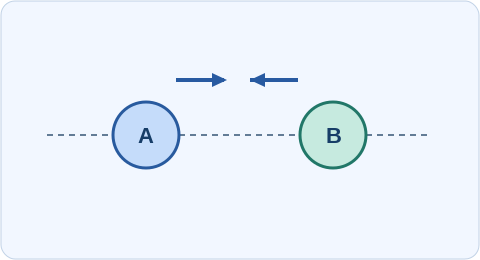
Spheres A and B lie on a common line. Their two incoming velocity arrows point towards each other.

Choose one positive direction for both spheres. With right positive, the arrows shown give a positive velocity for A and a negative velocity for B.

Worked example

Resolve a direct impact with signed momentum

Spheres A and B of masses 22 and 44 kilograms collide directly on a smooth horizontal track. Positive is from A towards B at contact. Their incoming signed velocities are 6 m s−16\,\mathrm{m\,s^{-1}} and −12 m s−1- \frac{1}{2}\,\mathrm{m\,s^{-1}}, respectively. The coefficient of restitution is 27\frac{2}{7}. Find both outgoing signed velocities.

  1. Momentum along the line is conserved. With outgoing velocities vAv_A and vBv_B, use 2vA+4vB=102v_A+4v_B=10.

  2. Apply restitution to the separation speed, vB−vA=137v_B-v_A=\frac{13}{7}. Solving gives 37 m s−1\frac{3}{7}\,\mathrm{m\,s^{-1}} for A and 167 m s−1\frac{16}{7}\,\mathrm{m\,s^{-1}} for B.

Your turn

Spheres A and B of masses 33 and 55 kilograms collide directly on a smooth horizontal track. Positive is from A towards B at contact. Their incoming signed velocities are 7 m s−17\,\mathrm{m\,s^{-1}} and −1 m s−1-1\,\mathrm{m\,s^{-1}}, respectively. The coefficient of restitution is 37\frac{3}{7}. Find both outgoing signed velocities.

Enter an exact value or round to 3 significant figures.

Enter an exact value or round to 3 significant figures.

Section 3 of 5 · Core · about 7 min

What do measured outgoing velocities tell me about restitution?

Once the incoming velocities and one outgoing velocity are known, momentum gives the other. Restitution follows from the ratio of relative speeds.

Worked example

Resolve a direct impact with signed momentum

Spheres A and B of masses 22 and 44 kilograms collide directly on a smooth horizontal track. Positive is from A towards B at contact. Their incoming signed velocities are 6 m s−16\,\mathrm{m\,s^{-1}} and −12 m s−1- \frac{1}{2}\,\mathrm{m\,s^{-1}}, respectively. The outgoing velocity of B is 167 m s−1\frac{16}{7}\,\mathrm{m\,s^{-1}}. Find the signed outgoing velocity of A and coefficient of restitution.

  1. Use the momentum equation with the known outgoing velocity of B. A leaves with signed velocity 37 m s−1\frac{3}{7}\,\mathrm{m\,s^{-1}}.

  2. The separation speed is 137 m s−1\frac{13}{7}\,\mathrm{m\,s^{-1}} and approach speed 132 m s−1\frac{13}{2}\,\mathrm{m\,s^{-1}}. Their ratio gives e=27e=\frac{2}{7}.

Your turn

Spheres A and B of masses 33 and 55 kilograms collide directly on a smooth horizontal track. Positive is from A towards B at contact. Their incoming signed velocities are 7 m s−17\,\mathrm{m\,s^{-1}} and −1 m s−1-1\,\mathrm{m\,s^{-1}}, respectively. The outgoing velocity of B is 237 m s−1\frac{23}{7}\,\mathrm{m\,s^{-1}}. Find the signed outgoing velocity of A and coefficient of restitution.

Enter an exact value or round to 3 significant figures.

Enter an exact value or round to 3 significant figures.

Worked example

Resolve a direct impact with signed momentum

Spheres A and B of masses 44 and 66 kilograms collide directly on a smooth horizontal track. Positive is from A towards B at contact. Their incoming signed velocities are 8 m s−18\,\mathrm{m\,s^{-1}} and −32 m s−1- \frac{3}{2}\,\mathrm{m\,s^{-1}}, respectively. The outgoing velocity of B is 31370 m s−1\frac{313}{70}\,\mathrm{m\,s^{-1}}. Find the signed outgoing velocity of A and coefficient of restitution.

Try it on paper first.

  1. Use the momentum equation with the known outgoing velocity of B. A leaves with signed velocity −6770 m s−1- \frac{67}{70}\,\mathrm{m\,s^{-1}}.

  2. The separation speed is 387 m s−1\frac{38}{7}\,\mathrm{m\,s^{-1}} and approach speed 192 m s−1\frac{19}{2}\,\mathrm{m\,s^{-1}}. Their ratio gives e=47e=\frac{4}{7}.

Your turn

Spheres A and B of masses 55 and 77 kilograms collide directly on a smooth horizontal track. Positive is from A towards B at contact. Their incoming signed velocities are 9 m s−19\,\mathrm{m\,s^{-1}} and −2 m s−1-2\,\mathrm{m\,s^{-1}}, respectively. The outgoing velocity of B is 417 m s−1\frac{41}{7}\,\mathrm{m\,s^{-1}}. Find the signed outgoing velocity of A and coefficient of restitution.

Enter an exact number, for example 3/2 or 2-sqrt(3).

Enter an exact value or round to 3 significant figures.

Section 4 of 5 · Core · about 5 min

Does momentum conservation imply no energy loss?

With non-unit restitution, the speeds can change so that total kinetic energy falls while total momentum remains unchanged.

Worked example

Resolve a direct impact with signed momentum

Spheres A and B of masses 22 and 44 kilograms collide directly on a smooth horizontal track. Positive is from A towards B at contact. Their incoming signed velocities are 6 m s−16\,\mathrm{m\,s^{-1}} and −12 m s−1- \frac{1}{2}\,\mathrm{m\,s^{-1}}, respectively. The coefficient of restitution is 27\frac{2}{7}. Find the total kinetic energy lost and the signed impulse on A.

  1. Momentum along the line is conserved. With outgoing velocities vAv_A and vBv_B, use 2vA+4vB=102v_A+4v_B=10.

  2. Apply restitution to the separation speed, vB−vA=137v_B-v_A=\frac{13}{7}. Solving gives 37 m s−1\frac{3}{7}\,\mathrm{m\,s^{-1}} for A and 167 m s−1\frac{16}{7}\,\mathrm{m\,s^{-1}} for B.

  3. Subtract the final system KE from the initial system KE. The energy lost is 253598 J\frac{2535}{98}\,\mathrm J.

  4. The signed impulse on A is −787 N s- \frac{78}{7}\,\mathrm{N\,s}. The impulse on B is equal and opposite.

Your turn

Spheres A and B of masses 33 and 55 kilograms collide directly on a smooth horizontal track. Positive is from A towards B at contact. Their incoming signed velocities are 7 m s−17\,\mathrm{m\,s^{-1}} and −1 m s−1-1\,\mathrm{m\,s^{-1}}, respectively. The coefficient of restitution is 37\frac{3}{7}. Find the total kinetic energy lost and the signed impulse on A.

Enter an exact value or round to 3 significant figures.

Enter an exact value or round to 3 significant figures.

Section 5 of 5 · Core · about 7 min

Can measured post-impact readings be inconsistent?

Conservation of momentum alone is not enough to validate a proposed collision. It must also keep separation consistent with the assumed model.

Worked example

Validate a proposed post-impact record

Two spheres of masses 33 and 22 kilograms approach along their line of centres with signed velocities 3 m s−13\,\mathrm{m\,s^{-1}} and 0 m s−10\,\mathrm{m\,s^{-1}}. A proposed pair of outgoing readings is 95 m s−1\frac{9}{5}\,\mathrm{m\,s^{-1}} for A and 95 m s−1\frac{9}{5}\,\mathrm{m\,s^{-1}} for B. Find the inferred restitution coefficient and classify the record.

  1. The incoming relative approach speed is 3 m s−13\,\mathrm{m\,s^{-1}}. The proposed separation velocity of B relative to A is 0 m s−10\,\mathrm{m\,s^{-1}}.

  2. Their quotient gives e=0e=0. Zero restitution gives equal normal speeds immediately afterwards.

Your turn

Two spheres of masses 44 and 33 kilograms approach along their line of centres with signed velocities 4 m s−14\,\mathrm{m\,s^{-1}} and 0 m s−10\,\mathrm{m\,s^{-1}}. A proposed pair of outgoing readings is 47 m s−1\frac{4}{7}\,\mathrm{m\,s^{-1}} for A and 327 m s−1\frac{32}{7}\,\mathrm{m\,s^{-1}} for B. Find the inferred restitution coefficient and classify the record.

Enter the value on its own or write e = … . Fractions and exact square roots are accepted.

Classification

Worked example

Validate a proposed post-impact record

Two spheres of masses 55 and 44 kilograms approach along their line of centres with signed velocities 5 m s−15\,\mathrm{m\,s^{-1}} and 0 m s−10\,\mathrm{m\,s^{-1}}. A proposed pair of outgoing readings is 1 m s−11\,\mathrm{m\,s^{-1}} for A and 5 m s−15\,\mathrm{m\,s^{-1}} for B. Find the inferred restitution coefficient and classify the record.

Try it on paper first.

  1. The incoming relative approach speed is 5 m s−15\,\mathrm{m\,s^{-1}}. The proposed separation velocity of B relative to A is 4 m s−14\,\mathrm{m\,s^{-1}}.

  2. Their quotient gives e=45e=\frac{4}{5}. The coefficient is between zero and one, as for a partially elastic impact.

Your turn

Two spheres of masses 66 and 55 kilograms approach along their line of centres with signed velocities 6 m s−16\,\mathrm{m\,s^{-1}} and 0 m s−10\,\mathrm{m\,s^{-1}}. A proposed pair of outgoing readings is −322 m s−1- \frac{3}{22}\,\mathrm{m\,s^{-1}} for A and 8111 m s−1\frac{81}{11}\,\mathrm{m\,s^{-1}} for B. Find the inferred restitution coefficient and classify the record.

Enter an exact value or round to 3 significant figures.

Classification

Worked examples

Practise the method

Core practice

Question 1 of 4

0 / 4 checked in this collection

Question list

Core practice

Fresh variants

Exam-style

Both outgoing velocities, impulse and energy

4 marks

At an approaching direct contact A is to the left of B. Rightwards is positive. Let mA=2, mB=1m_A=2,\ m_B=1 kg, uA=6, uB=−3u_A=6,\ u_B=-3 m s⁻¹ and e=13e=\frac{1}{3}. Give both signed outgoing velocities, the signed impulse on A and the total energy loss.

Enter an exact number, for example 3/2 or 2-sqrt(3).

Enter an exact number, for example 3/2 or 2-sqrt(3).

Enter an exact number, for example 3/2 or 2-sqrt(3).

Enter an exact number, for example 3/2 or 2-sqrt(3).

Full answer-format guide

Exact numbers: 3/2, sqrt(5), 2-sqrt(3), pi/6, 3*pi/2. Sets: {1,4}. Intervals: (3,5]; a round bracket excludes the endpoint. Infinity: inf; union: U; no solutions: empty. Separate coordinate pairs or triples with semicolons. Expressions: 2x^2+3x-1; equations: x^2=3x+1 or the polynomial equal to zero. Factors: x-1 ; x+2. Parameter fraction: numerator ; denominator. List integer answers individually.

Review the method

Progress stays in this browser. Create an account to save it or sign in.

Extra practice from this lesson

Use a signed velocity change for impulse

A sphere of mass 55 kilograms initially moves rightwards at 7 m s−17\,\mathrm{m\,s^{-1}}. A short impulse makes it move leftwards at 4 m s−14\,\mathrm{m\,s^{-1}}. Taking right as positive, find the signed impulse.

Enter an exact number, for example 3/2 or 2-sqrt(3).

Resolve a direct impact with signed momentum

Spheres A and B of masses 44 and 66 kilograms collide directly on a smooth horizontal track. Positive is from A towards B at contact. Their incoming signed velocities are 8 m s−18\,\mathrm{m\,s^{-1}} and −32 m s−1- \frac{3}{2}\,\mathrm{m\,s^{-1}}, respectively. The coefficient of restitution is 47\frac{4}{7}. Find both outgoing signed velocities.

Enter an exact value or round to 3 significant figures.

Enter an exact value or round to 3 significant figures.

Resolve a direct impact with signed momentum

Spheres A and B of masses 66 and 88 kilograms collide directly on a smooth horizontal track. Positive is from A towards B at contact. Their incoming signed velocities are 10 m s−110\,\mathrm{m\,s^{-1}} and −52 m s−1- \frac{5}{2}\,\mathrm{m\,s^{-1}}, respectively. The outgoing velocity of B is 36549 m s−1\frac{365}{49}\,\mathrm{m\,s^{-1}}. Find the signed outgoing velocity of A and coefficient of restitution.

Enter an exact value or round to 3 significant figures.

Enter an exact value or round to 3 significant figures.

Resolve a direct impact with signed momentum

Spheres A and B of masses 44 and 66 kilograms collide directly on a smooth horizontal track. Positive is from A towards B at contact. Their incoming signed velocities are 8 m s−18\,\mathrm{m\,s^{-1}} and −32 m s−1- \frac{3}{2}\,\mathrm{m\,s^{-1}}, respectively. The coefficient of restitution is 47\frac{4}{7}. Find the total kinetic energy lost and the signed impulse on A.

Enter an exact value or round to 3 significant figures.

Enter an exact value or round to 3 significant figures.

Validate a proposed post-impact record

Two spheres of masses 77 and 66 kilograms approach along their line of centres with signed velocities 7 m s−17\,\mathrm{m\,s^{-1}} and 0 m s−10\,\mathrm{m\,s^{-1}}. A proposed pair of outgoing readings is 6313 m s−1\frac{63}{13}\,\mathrm{m\,s^{-1}} for A and 9839 m s−1\frac{98}{39}\,\mathrm{m\,s^{-1}} for B. Find the inferred restitution coefficient and classify the record.

Enter an exact value or round to 3 significant figures.

Classification

Apply it · original exam-style problems

Show your working on paper and compare it with the worked solution and marking guidance.

Come back to what needs practice

Quick revision sheet (A4)

Your review plan starts after your first check.