Maths4UBETA

Small and large units, prisms and cylinders

Choose suitable units and derive volumes by stacking equal cross-sections.

Try the quick check →
Lesson 2 of 4

Section 1 of 3 · Core · about 8 min

Choose a practical unit

A dust grain, water sample and loaded delivery lorry need different units.

Worked example

Change units before comparing

A log records 5.2 km.

  1. Write the quantity in m.

    [2]
  2. Explain why the numerical size changes.

    [1]
  1. (a) One km contains 1000 m.

  2. Multiply by 1000.

  3. 52005200

  4. (b) Table headings or measurement labels tell you which unit is being counted.

  5. A bigger unit needs a smaller count for the same quantity.
Your turn

A log records 5.4 µm.

Write the quantity in mm.

Enter an exact value or round to 3 significant figures.

Worked example

Change units before comparing

A log records 5.9 km.

  1. Write the quantity in m.

    [2]
  2. Explain why the numerical size changes.

    [1]

Try it on paper first.

  1. (a) One km contains 1000 m.

  2. Multiply by 1000.

  3. 59005900

  4. (b) Table headings or measurement labels tell you which unit is being counted.

  5. A bigger unit needs a smaller count for the same quantity.

Your turn

A log records 6.1 µm.

Write the quantity in mm.

Enter an exact value or round to 3 significant figures.

Section 2 of 3 · Core · about 8 min

Stack equal slices

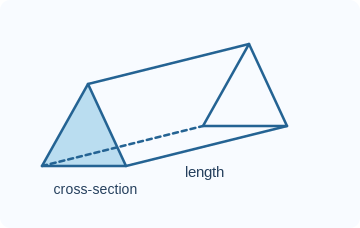
Imagine looking into the cut end of a prism.

A triangular prism with its near triangular face shaded

The same triangular cross-section continues from one end of the prism to the other.

Worked example

Stack triangular cross-sections

A prism has a right-triangle cross-section with legs 9 cm and 3 cm. Its length is 3 cm.

  1. Find the volume in cubic centimetres.

    [2]
  2. Explain why the formula works.

    [1]
  1. (a) The triangular cross-section has area 272\frac{27}{2} square centimetres.

  2. Multiply by 3 cm.

  3. 812\frac{81}{2}

  4. (b) A layer one centimetre thick contains as many cubic centimetres as the cross-section has square centimetres.

  5. The same cross-section fills every slice along the length.

Your turn

A prism has a right-triangle cross-section with legs 9 cm and 6 cm. Its length is 3 cm.

Find the volume in cubic centimetres.

Enter one number. Fractions and decimals are accepted.

Worked example

Stack triangular cross-sections

A prism has a right-triangle cross-section with legs 10 cm and 3 cm. Its length is 3 cm.

  1. Find the volume in cubic centimetres.

    [2]
  2. Explain why the formula works.

    [1]

Try it on paper first.

  1. (a) The triangular cross-section has area 1515 square centimetres.

  2. Multiply by 3 cm.

  3. 4545

  4. (b) A layer one centimetre thick contains as many cubic centimetres as the cross-section has square centimetres.

  5. The same cross-section fills every slice along the length.

Your turn

A prism has a right-triangle cross-section with legs 10 cm and 6 cm. Its length is 3 cm.

Find the volume in cubic centimetres.

Enter one number. Fractions and decimals are accepted.

Section 3 of 3 · Core · about 8 min

Use a circular cross-section

A cylinder stacks identical circles.

Worked example

Fill a cylinder

A cylinder has radius 12 cm and height 5 cm.

  1. The volume is kπ cubic centimetres. Find k.

    [2]
  2. Explain what happens when the height is tripled and the radius stays the same.

    [1]
  1. (a) A=π(12)2=144πA=\pi(12)^2=144\pi.

  2. Multiply the area of the base by the height, 5 cm.

  3. 720720

  4. (b) The base area is unchanged, but there are three times as many slices.

  5. The volume triples.

Your turn

A cylinder has radius 12 cm and height 7 cm.

The volume is kπ cubic centimetres. Find k.

Enter one number. Fractions and decimals are accepted.

Worked example

Fill a cylinder

A cylinder has radius 3 cm and height 5 cm.

  1. The volume is kπ cubic centimetres. Find k.

    [2]
  2. Explain what happens when the height is tripled and the radius stays the same.

    [1]

Try it on paper first.

  1. (a) A=π(3)2=9πA=\pi(3)^2=9\pi.

  2. Multiply the area of the base by the height, 5 cm.

  3. 4545

  4. (b) The base area is unchanged, but there are three times as many slices.

  5. The volume triples.

Your turn

A cylinder has radius 3 cm and height 7 cm.

The volume is kπ cubic centimetres. Find k.

Enter one number. Fractions and decimals are accepted.

Worked examples

Practise the method

Core practice

Question 1 of 12

0 / 12 checked in this collection

Question list

Core practice

Fresh variants

Exam-style

Change units before comparing

1 mark

A log records 3.1 km.

Write the quantity in m.

Enter one number. Fractions and decimals are accepted.

Full answer-format guide

Exact numbers: 3/2, sqrt(5), 2-sqrt(3), pi/6, 3*pi/2. Sets: {1,4}. Intervals: (3,5]; a round bracket excludes the endpoint. Infinity: inf; union: U; no solutions: empty. Separate coordinate pairs or triples with semicolons. Expressions: 2x^2+3x-1; equations: x^2=3x+1 or the polynomial equal to zero. Factors: x-1 ; x+2. Parameter fraction: numerator ; denominator. List integer answers individually.

Review the method

Progress stays in this browser. Create an account to save it or sign in.

Extra practice from this lesson

A log records 5.6 t.

Write the quantity in kg.

Enter one number. Fractions and decimals are accepted.

A log records 6.3 t.

Write the quantity in kg.

Enter one number. Fractions and decimals are accepted.

A prism has a right-triangle cross-section with legs 9 cm and 8 cm. Its length is 3 cm.

Find the volume in cubic centimetres.

Enter one number. Fractions and decimals are accepted.

A prism has a right-triangle cross-section with legs 10 cm and 8 cm. Its length is 3 cm.

Find the volume in cubic centimetres.

Enter one number. Fractions and decimals are accepted.

A cylinder has radius 12 cm and height 9 cm.

The volume is kπ cubic centimetres. Find k.

Enter one number. Fractions and decimals are accepted.

A cylinder has radius 3 cm and height 9 cm.

The volume is kπ cubic centimetres. Find k.

Enter one number. Fractions and decimals are accepted.

Apply it · original exam-style problems

Show your working on paper and compare it with the worked solution and marking guidance.

Come back to what needs practice

Quick revision sheet (A4)

Your review plan starts after your first check.