Worked example
Find the hypotenuse before substituting
Use the right-angle mark to choose the longest side.
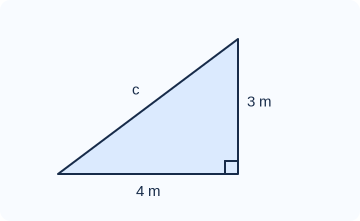
The two legs meet at the right angle, so .
The length is positive, so .
Find missing sides and check if a triangle is right-angled.
Try the quick check →Section 1 of 3 · Core · about 8 min
Identify the right angle first. Look directly across from it.
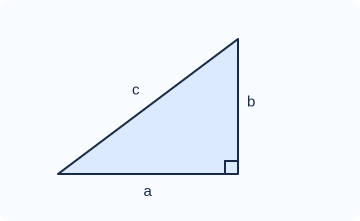
Right-angled triangle. Legs a and b; hypotenuse c lies across from the right angle.
Worked example
Use the right-angle mark to choose the longest side.
The two legs meet at the right angle, so .
The length is positive, so .
Worked example
On a flat grid, Lia walks 12 m east and 16 m north.
Give the direct distance from her start in metres.
[2]Explain why the two walks make a right angle.
[1](a) .
Take the positive square root to get 20 m.
(b) The right angle tells us where we can use the theorem.
East and north are perpendicular directions.
Worked example
On a flat grid, Lia walks 15 m east and 20 m north.
Give the direct distance from her start in metres.
[2]Explain why the two walks make a right angle.
[1]Try it on paper first.
(a) .
Take the positive square root to get 25 m.
(b) The right angle tells us where we can use the theorem.
East and north are perpendicular directions.
Section 2 of 3 · Core · about 8 min
Decide which squared length is the total and which is one part of it.
Worked example
A right triangle has hypotenuse 52 cm and one leg 20 cm.
Find the other leg in centimetres.
[2]Check your value using the original lengths.
[1](a) .
Take the square root.
(b) The known and calculated legs square to the hypotenuse squared.
Worked example
A right triangle has hypotenuse 65 cm and one leg 25 cm.
Find the other leg in centimetres.
[2]Check your value using the original lengths.
[1]Try it on paper first.
(a) .
Take the square root.
(b) The known and calculated legs square to the hypotenuse squared.
Section 3 of 3 · Core · about 8 min
Test a triangle with three known sides by putting the longest side on its own.
Worked example
A triangular frame has side lengths 12, 16 and 20 cm.
Find the sum of the squares of the two shorter lengths.
[2]Is it a right triangle? Explain.
[2](a) .
(b) The square of the longest side is 400. It equals the sum for the shorter sides.
Yes.
Worked example
A triangular frame has side lengths 15, 20 and 26 cm.
Find the sum of the squares of the two shorter lengths.
[2]Is it a right triangle? Explain.
[2]Try it on paper first.
(a) .
(b) The square of the longest side is 676. It does not equal the sum for the shorter sides.
No.
Question 1 of 12
0 / 12 checked in this collection
On a flat grid, Lia walks 35 m east and 84 m north.
Give the direct distance from her start in metres.
Progress stays in this browser. Create an account to save it or sign in.
Show your working on paper and compare it with the worked solution and marking guidance.
Your review plan starts after your first check.