Maths4UBETA

Surface area and symmetry of solids

Read surfaces as flat shapes and identify planes that split solids into mirror halves.

Try the quick check →
Lesson 3 of 4

Section 1 of 4 · Core · about 8 min

Pair the opposite faces

A cube is a cuboid with all three lengths equal. Compare where its face pairs sit.

Worked example

Count opposing faces

A closed cuboid measures 5 cm by 3 cm by 4 cm.

  1. Find the surface area in square centimetres.

    [2]
  2. Explain why the answer is measured in square centimetres.

    [1]
  1. (a) There are two of each of the three face areas 15, 12 and 20.

  2. 9494

  3. (b) The surface comprises six two-dimensional faces.

  4. Each face area is a length multiplied by a length.
Your turn

A closed cuboid measures 13 cm by 5 cm by 4 cm.

Find the surface area in square centimetres.

Enter one number. Fractions and decimals are accepted.

Worked example

Count opposing faces

A closed cuboid measures 6 cm by 3 cm by 4 cm.

  1. Find the surface area in square centimetres.

    [2]
  2. Explain why the answer is measured in square centimetres.

    [1]

Try it on paper first.

  1. (a) There are two of each of the three face areas 18, 12 and 24.

  2. 108108

  3. (b) The surface comprises six two-dimensional faces.

  4. Each face area is a length multiplied by a length.

Your turn

A closed cuboid measures 2 cm by 5 cm by 4 cm.

Find the surface area in square centimetres.

Enter one number. Fractions and decimals are accepted.

Section 2 of 4 · Core · about 8 min

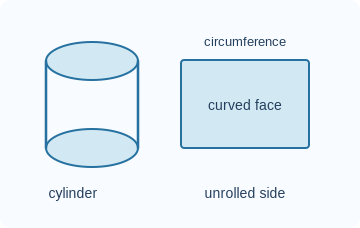
Unroll a circular side

Trace the long edge of a cylinder's wrapping around a base.

A cylinder and the rectangular piece that fits around the curved face

The long edge of the unrolled rectangle fits around a circular end.

Worked example

Unroll the cylinder

A closed cylinder has radius 6 cm and height 4 cm.

  1. Write its surface area as kπ square centimetres. Find k.

    [2]
  2. Give the two dimensions of the unrolled curved surface.

    [1]
  1. (a) The two circular ends give 72π72\pi.

  2. The rectangle wrapped around them gives 48π48\pi.

  3. 120120

  4. (b) The long edge wraps around the circle and the other matches the cylinder height.

  5. 12π cm12\pi\text{ cm} by 44 cm.

Your turn

A closed cylinder has radius 2 cm and height 7 cm.

Write its surface area as kπ square centimetres. Find k.

Enter one number. Fractions and decimals are accepted.

Worked example

Unroll the cylinder

A closed cylinder has radius 7 cm and height 4 cm.

  1. Write its surface area as kπ square centimetres. Find k.

    [2]
  2. Give the two dimensions of the unrolled curved surface.

    [1]

Try it on paper first.

  1. (a) The two circular ends give 98π98\pi.

  2. The rectangle wrapped around them gives 56π56\pi.

  3. 154154

  4. (b) The long edge wraps around the circle and the other matches the cylinder height.

  5. 14π cm14\pi\text{ cm} by 44 cm.

Your turn

A closed cylinder has radius 3 cm and height 7 cm.

Write its surface area as kπ square centimetres. Find k.

Enter one number. Fractions and decimals are accepted.

Section 3 of 4 · Core · about 8 min

Fold faces and locate mirror halves

Compare square-based pyramids and triangular prisms.

Worked example

Cover a square-based pyramid

A square-based pyramid has a 7 cm square base. The perpendicular height inside each triangular face is 13 cm.

  1. Find its total surface area in square centimetres.

    [2]
  2. Name a plane of symmetry.

    [1]
  1. (a) The base contributes 49.

  2. Each triangular face contributes 912\frac{91}{2}; count four faces.

  3. 231231

  4. (b) The plane cuts the pyramid into mirror halves.

  5. A plane through the apex and a diagonal of the square base.

Your turn

A square-based pyramid has a 3 cm square base. The perpendicular height inside each triangular face is 11 cm.

Find its total surface area in square centimetres.

Enter one number. Fractions and decimals are accepted.

Worked example

Cover a square-based pyramid

A square-based pyramid has an 8 cm square base. The perpendicular height inside each triangular face is 14 cm.

  1. Find its total surface area in square centimetres.

    [2]
  2. Name a plane of symmetry.

    [1]

Try it on paper first.

  1. (a) The base contributes 64.

  2. Each triangular face contributes 5656; count four faces.

  3. 288288

  4. (b) The plane cuts the pyramid into mirror halves.

  5. A plane through the apex and a diagonal of the square base.

Your turn

A square-based pyramid has a 4 cm square base. The perpendicular height inside each triangular face is 12 cm.

Find its total surface area in square centimetres.

Enter one number. Fractions and decimals are accepted.

Section 4 of 4 · Core · about 8 min

Use two ends and three rectangles

Trace the edges of the triangular cross-section to find the widths of the three rectangles.

Worked example

Trace a triangular prism net

A right-triangle cross-section has sides 24, 32 and 40 cm. The prism is 7 cm long.

  1. Find the total surface area in square centimetres.

    [2]
  2. Explain the position of a plane of symmetry.

    [1]
  1. (a) Two triangular ends contribute 768768.

  2. The three rectangles have respective widths 24, 32 and 40 cm, all with length 7 cm.

  3. 14401440

  4. (b) It swaps the two ends and each side face with its mirror half.

  5. A plane halfway along the length and parallel to the triangular ends.

Your turn

A right-triangle cross-section has sides 12, 16 and 20 cm. The prism is 9 cm long.

Find the total surface area in square centimetres.

Enter one number. Fractions and decimals are accepted.

Worked example

Trace a triangular prism net

A right-triangle cross-section has sides 27, 36 and 45 cm. The prism is 7 cm long.

  1. Find the total surface area in square centimetres.

    [2]
  2. Explain the position of a plane of symmetry.

    [1]

Try it on paper first.

  1. (a) Two triangular ends contribute 972972.

  2. The three rectangles have respective widths 27, 36 and 45 cm, all with length 7 cm.

  3. 17281728

  4. (b) It swaps the two ends and each side face with its mirror half.

  5. A plane halfway along the length and parallel to the triangular ends.

Your turn

A right-triangle cross-section has sides 15, 20 and 25 cm. The prism is 10 cm long.

Find the total surface area in square centimetres.

Enter one number. Fractions and decimals are accepted.

Worked examples

Practise the method

Core practice

Question 1 of 12

0 / 12 checked in this collection

Question list

Core practice

Fresh variants

Exam-style

Count opposing faces

1 mark

A closed cuboid measures 10 cm by 3 cm by 10 cm.

Find the surface area in square centimetres.

Enter one number. Fractions and decimals are accepted.

Full answer-format guide

Exact numbers: 3/2, sqrt(5), 2-sqrt(3), pi/6, 3*pi/2. Sets: {1,4}. Intervals: (3,5]; a round bracket excludes the endpoint. Infinity: inf; union: U; no solutions: empty. Separate coordinate pairs or triples with semicolons. Expressions: 2x^2+3x-1; equations: x^2=3x+1 or the polynomial equal to zero. Factors: x-1 ; x+2. Parameter fraction: numerator ; denominator. List integer answers individually.

Review the method

Progress stays in this browser. Create an account to save it or sign in.

Extra practice from this lesson

A closed cuboid measures 9 cm by 7 cm by 4 cm.

Find the surface area in square centimetres.

Enter one number. Fractions and decimals are accepted.

A closed cuboid measures 10 cm by 7 cm by 4 cm.

Find the surface area in square centimetres.

Enter one number. Fractions and decimals are accepted.

A closed cylinder has radius 10 cm and height 9 cm.

Write its surface area as kπ square centimetres. Find k.

Enter one number. Fractions and decimals are accepted.

A closed cylinder has radius 11 cm and height 9 cm.

Write its surface area as kπ square centimetres. Find k.

Enter one number. Fractions and decimals are accepted.

A square-based pyramid has an 11 cm square base. The perpendicular height inside each triangular face is 21 cm.

Find its total surface area in square centimetres.

Enter one number. Fractions and decimals are accepted.

A square-based pyramid has a 12 cm square base. The perpendicular height inside each triangular face is 22 cm.

Find its total surface area in square centimetres.

Enter one number. Fractions and decimals are accepted.

A right-triangle cross-section has sides 36, 48 and 60 cm. The prism is 12 cm long.

Find the total surface area in square centimetres.

Enter one number. Fractions and decimals are accepted.

A right-triangle cross-section has sides 39, 52 and 65 cm. The prism is 12 cm long.

Find the total surface area in square centimetres.

Enter one number. Fractions and decimals are accepted.

Apply it · original exam-style problems

Show your working on paper and compare it with the worked solution and marking guidance.

Come back to what needs practice

Quick revision sheet (A4)

Your review plan starts after your first check.