Maths4UBETA

Coordinates and rigid transformations

Find points on segments and apply and describe reflections, translations and rotations.

Try the quick check →
Lesson 1 of 2

Section 1 of 4 · Core · about 8 min

Use a fraction of the movement

Find the change in x and in y from the first endpoint to the second.

Worked example

Divide a line segment

Points A and B are (5,3) and (11,-3). P lies one third of the way from A to B.

  1. Give P as an ordered pair.

    [2]
  2. Give the ratio AP : PB.

    [1]
  1. (a) From A to B, the changes are 6 in x and -6 in y.

  2. Use one third of each change. Add the resulting vector (2, -2) to A.

  3. (7,1)(7,1)

  4. (b) The first part is one third, leaving two thirds.

  5. 1 : 2.

Your turn

Points A and B are (12,5) and (18,-1). P lies one third of the way from A to B.

Give P as an ordered pair.

Enter each pair in the order shown. Separate complete pairs with commas or semicolons.

Worked example

Divide a line segment

Points A and B are (6,3) and (12,-3). P lies one third of the way from A to B.

  1. Give P as an ordered pair.

    [2]
  2. Give the ratio AP : PB.

    [1]

Try it on paper first.

  1. (a) From A to B, the changes are 6 in x and -6 in y.

  2. Use one third of each change. Add the resulting vector (2, -2) to A.

  3. (8,1)(8,1)

  4. (b) The first part is one third, leaving two thirds.

  5. 1 : 2.

Your turn

Points A and B are (13,5) and (19,-1). P lies one third of the way from A to B.

Give P as an ordered pair.

Enter each pair in the order shown. Separate complete pairs with commas or semicolons.

Section 2 of 4 · Core · about 8 min

Follow a pair of instructions in order

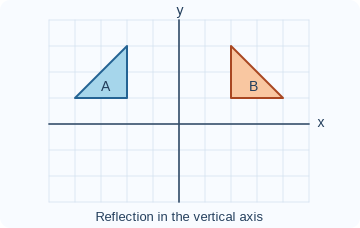
Mark one intermediate image so it is clear which transformation happened first.

Two same-sized right triangles on opposite sides of a vertical coordinate axis

Each image point is the same perpendicular distance from the mirror line as its original point.

Worked example

Reflect, then translate

Point P starts at (5,4). Reflect it in the y-axis. Then move it 2 units right and 2 units down.

  1. Give the final ordered pair.

    [2]
  2. Would swapping the order give the same point? Explain.

    [2]
  1. (a) The reflection gives (-5,4).

  2. Add 2 to x and subtract 2 from y.

  3. (−3,2)(-3,2)

  4. (b) Translation and reflection need not commute.

  5. No. Reflecting after translating changes the sign of the rightward movement.

Your turn

Point P starts at (12,7). Reflect it in the y-axis. Then move it 2 units right and 2 units down.

Give the final ordered pair.

Enter each pair in the order shown. Separate complete pairs with commas or semicolons.

Worked example

Reflect, then translate

Point P starts at (6,4). Reflect it in the y-axis. Then move it 2 units right and 2 units down.

  1. Give the final ordered pair.

    [2]
  2. Would swapping the order give the same point? Explain.

    [2]

Try it on paper first.

  1. (a) The reflection gives (-6,4).

  2. Add 2 to x and subtract 2 from y.

  3. (−4,2)(-4,2)

  4. (b) Translation and reflection need not commute.

  5. No. Reflecting after translating changes the sign of the rightward movement.

Your turn

Point P starts at (13,7). Reflect it in the y-axis. Then move it 2 units right and 2 units down.

Give the final ordered pair.

Enter each pair in the order shown. Separate complete pairs with commas or semicolons.

Section 3 of 4 · Core · about 8 min

Use a centre for a quarter turn

Mark the centre. Read each point as a horizontal and vertical displacement from it.

Worked example

Rotate about a marked centre

Rotate point P (7,8) 90° clockwise about centre C (5,6).

  1. Give the coordinates of the image.

    [2]
  2. Explain whether rotating a whole triangle this way would change its side lengths.

    [2]
  1. (a) Read the movement from C to P as (2, 2).

  2. A clockwise quarter turn sends it to (2, -2).

  3. Add the new movement back to C.

  4. (7,4)(7,4)

  5. (b) A rigid rotation moves each vertex without stretching its distances to the other vertices.

  6. No. The rotation keeps lengths and angles. The two triangles are congruent.

Your turn

Rotate point P (14,10) 90° clockwise about centre C (12,8).

Give the coordinates of the image.

Enter each pair in the order shown. Separate complete pairs with commas or semicolons.

Worked example

Rotate about a marked centre

Rotate point P (8,8) 90° clockwise about centre C (6,6).

  1. Give the coordinates of the image.

    [2]
  2. Explain whether rotating a whole triangle this way would change its side lengths.

    [2]

Try it on paper first.

  1. (a) Read the movement from C to P as (2, 2).

  2. A clockwise quarter turn sends it to (2, -2).

  3. Add the new movement back to C.

  4. (8,4)(8,4)

  5. (b) A rigid rotation moves each vertex without stretching its distances to the other vertices.

  6. No. The rotation keeps lengths and angles. The two triangles are congruent.

Your turn

Rotate point P (15,10) 90° clockwise about centre C (13,8).

Give the coordinates of the image.

Enter each pair in the order shown. Separate complete pairs with commas or semicolons.

Section 4 of 4 · Core · about 8 min

Compare an object with its image

Match the vertices before comparing their movements.

Worked example

Describe a change from an object to an image

A triangle has vertices (5,7), (7,7) and (5,8). Its corresponding image vertices are (3,5), (5,5) and (3,6).

  1. Give the translation movement as an ordered pair (horizontal change, vertical change).

    [2]
  2. Describe the transformation fully and compare the two areas.

    [2]
  1. (a) Subtract the original coordinates from the image coordinates. Each vertex moves (-2, -2).

  2. (−2,−2)(-2,-2)

  3. (b) Translations preserve both side lengths and angles.

  4. A translation 2 units left and 2 units down. The areas are equal.

Your turn

A triangle has vertices (12,9), (14,9) and (12,10). Its corresponding image vertices are (10,7), (12,7) and (10,8).

Give the translation movement as an ordered pair (horizontal change, vertical change).

Enter each pair in the order shown. Separate complete pairs with commas or semicolons.

Worked example

Describe a change from an object to an image

A triangle has vertices (6,7), (8,7) and (6,8). Its corresponding image vertices are (4,5), (6,5) and (4,6).

  1. Give the translation movement as an ordered pair (horizontal change, vertical change).

    [2]
  2. Describe the transformation fully and compare the two areas.

    [2]

Try it on paper first.

  1. (a) Subtract the original coordinates from the image coordinates. Each vertex moves (-2, -2).

  2. (−2,−2)(-2,-2)

  3. (b) Translations preserve both side lengths and angles.

  4. A translation 2 units left and 2 units down. The areas are equal.

Your turn

A triangle has vertices (13,10), (15,10) and (13,11). Its corresponding image vertices are (11,8), (13,8) and (11,9).

Give the translation movement as an ordered pair (horizontal change, vertical change).

Enter each pair in the order shown. Separate complete pairs with commas or semicolons.

Worked examples

Practise the method

Core practice

Question 1 of 12

0 / 12 checked in this collection

Question list

Core practice

Fresh variants

Exam-style

Divide a line segment

1 mark

Points A and B are (8,6) and (32,0). P lies one third of the way from A to B.

Give P as an ordered pair.

Enter each pair in the order shown. Separate complete pairs with commas or semicolons.

Full answer-format guide

Exact numbers: 3/2, sqrt(5), 2-sqrt(3), pi/6, 3*pi/2. Sets: {1,4}. Intervals: (3,5]; a round bracket excludes the endpoint. Infinity: inf; union: U; no solutions: empty. Separate coordinate pairs or triples with semicolons. Expressions: 2x^2+3x-1; equations: x^2=3x+1 or the polynomial equal to zero. Factors: x-1 ; x+2. Parameter fraction: numerator ; denominator. List integer answers individually.

Review the method

Progress stays in this browser. Create an account to save it or sign in.

Extra practice from this lesson

Points A and B are (6,7) and (12,1). P lies one third of the way from A to B.

Give P as an ordered pair.

Enter each pair in the order shown. Separate complete pairs with commas or semicolons.

Points A and B are (7,7) and (13,1). P lies one third of the way from A to B.

Give P as an ordered pair.

Enter each pair in the order shown. Separate complete pairs with commas or semicolons.

Point P starts at (6,9). Reflect it in the y-axis. Then move it 2 units right and 2 units down.

Give the final ordered pair.

Enter each pair in the order shown. Separate complete pairs with commas or semicolons.

Point P starts at (7,9). Reflect it in the y-axis. Then move it 2 units right and 2 units down.

Give the final ordered pair.

Enter each pair in the order shown. Separate complete pairs with commas or semicolons.

Rotate point P (8,12) 90° clockwise about centre C (6,10).

Give the coordinates of the image.

Enter each pair in the order shown. Separate complete pairs with commas or semicolons.

Rotate point P (9,12) 90° clockwise about centre C (7,10).

Give the coordinates of the image.

Enter each pair in the order shown. Separate complete pairs with commas or semicolons.

A triangle has vertices (6,12), (8,12) and (6,13). Its corresponding image vertices are (3,10), (5,10) and (3,11).

Give the translation movement as an ordered pair (horizontal change, vertical change).

Enter each pair in the order shown. Separate complete pairs with commas or semicolons.

A triangle has vertices (7,12), (9,12) and (7,13). Its corresponding image vertices are (4,10), (6,10) and (4,11).

Give the translation movement as an ordered pair (horizontal change, vertical change).

Enter each pair in the order shown. Separate complete pairs with commas or semicolons.

Apply it · original exam-style problems

Show your working on paper and compare it with the worked solution and marking guidance.

Come back to what needs practice

Quick revision sheet (A4)

Your review plan starts after your first check.